

75% of participants, 185 women, reported at least one bra-fit issue in a study of female British military recruits, with underwire digging among the frequently reported problems. That measured discomfort, not wires breaking through fabric, but it reframes the worry: a painful bra deserves a fit check, not more tolerance.
If you've been adjusting the same sharp spot for weeks, you haven't failed at wearing a bra. An underwire poking out of a bra is a reason to inspect the fit, the wire and the fabric holding it, especially when pregnancy or breastfeeding keeps changing what fits.
Why Underwire Pokes Out and What Each Sign Means
A bra can feel familiar without fitting well. In a 2025 University of Lancashire study, 40% of self-selected bras had an incorrectly shaped underwire, and participants' own fit judgments agreed with objective assessments in only 51% of cases.
That doesn't mean you should distrust your comfort. It means a size label and a familiar feel don't tell you whether the wire follows your breast shape. A wire can be the wrong curve even when the band fastens and the cups look reasonably smooth.
The wire channel, the narrow fabric casing around the metal, also matters. When the wire presses repeatedly against a weak seam or shifts inside worn fabric, the tip can work toward an opening. A poke isn't automatically proof of a poor-quality bra, and it isn't automatically ordinary wear either.
If the wire is exposed or sharp right now, stop wearing the bra and use the safety triage below before investigating the cause.
Match the symptom before changing size
These signs give you a starting point, not a diagnosis. Check the bra off your body first, and only assess it while wearing it if the wire remains safely enclosed.
Underwire signs, likely causes and quick checks
| What You Notice | Likely Cause | Quick Check |
|---|---|---|
| Wire slides out at the underarm or side | Cup too small or band too loose | Check cup fullness and band snugness while seated |
| Wire digs into the fold below the breast | Wire too rigid or too shallow for your shape | Compare the wire curve with your underbust fold |
| Wire presses or pokes at the centre front | Front band not touching the breastbone | Confirm the centre panel lies flat against the sternum |
| Fabric thins or frays where the wire ends | Channel wear from friction and washing | Feel both wire ends for thinning and broken stitching |
| Wire pokes out after washing or drying | Possible heat damage to the channel | Review your washing and drying routine |
| Wire starts poking after pregnancy or weaning | Breast volume has changed | Refit the bra before wearing it again |
Timing is a clue, not proof. Discovering the wire after laundry doesn't establish that washing caused it, just as discomfort after weaning doesn't rule out worn stitching.
Practical rule: Match the symptom to a row, then inspect the bra before deciding that a larger cup, tighter band or sewing repair will solve it.
Find Where the Wire Is Failing
Take the bra off and inspect it somewhere bright. You'll need clean hands, a flat surface and enough light to see the stitching rather than just feel for the metal.
Check the casing, curve and movement
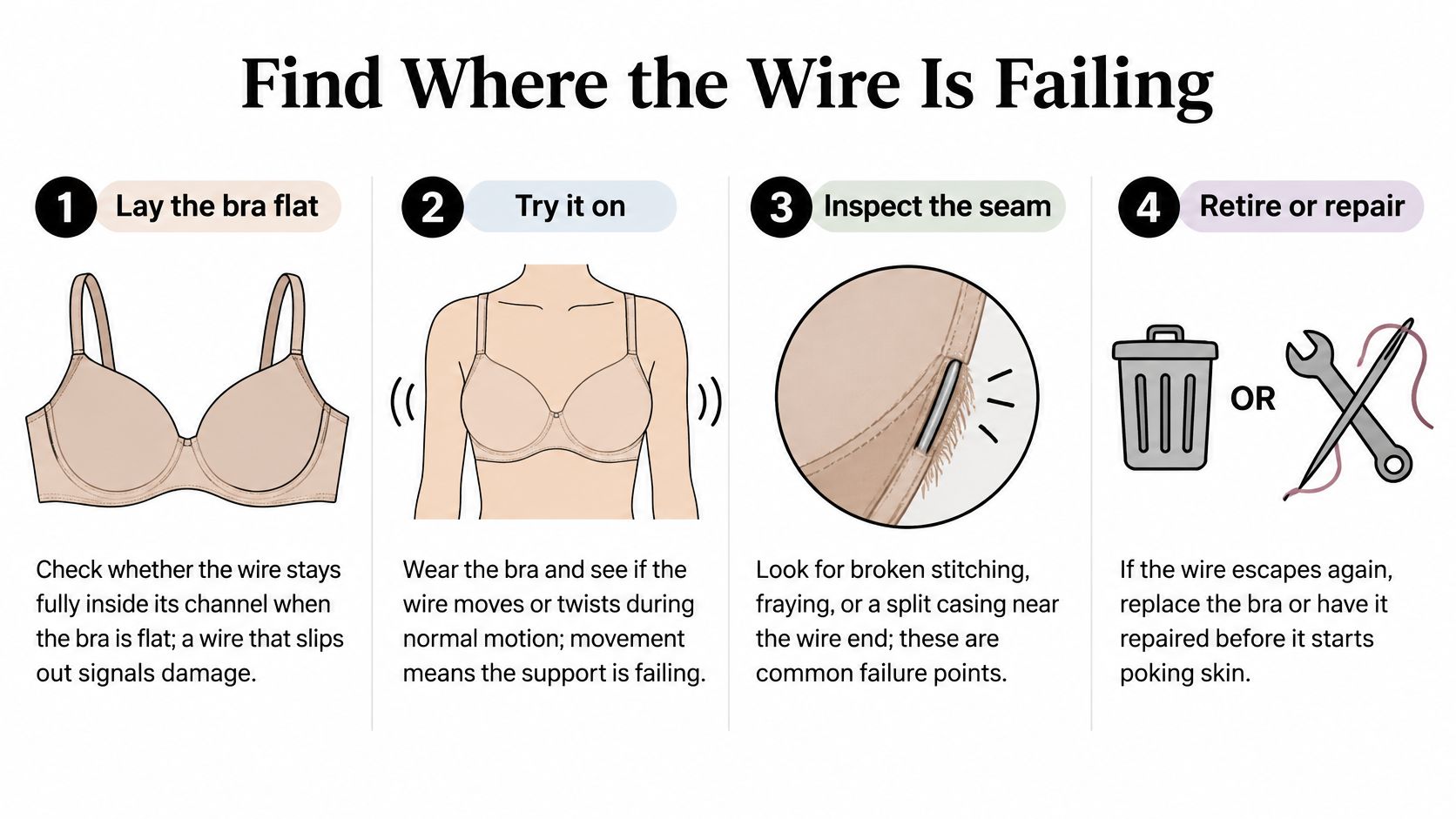
- Inspect whether the wire stays enclosed. Lay the bra flat without twisting the cups, then look along the entire channel. If the wire is fully enclosed and nothing feels sharp, check whether it shifts during wear; movement can indicate a fit problem, although it doesn't rule out weakened fabric.
- Examine both wire ends. Look for thinning, frayed threads and broken bartacks, the dense reinforcement stitches that close the channel ends. Compare the affected side with the other cup, because a difference in fabric thickness can reveal wear before a large hole appears.
- Compare the curve with your underbust fold. With the bra unfastened and the wire safely covered, position the cup against the natural crease beneath your breast without forcing it into place. Notice whether the wire follows the crease or cuts across breast tissue; changing band tension won't necessarily correct the wrong wire shape.
- Test normal posture and movement. Only if the bra passes the safety inspection, fasten it, sit down, stand and reach forward. A fit that works only when you're standing still isn't a comfortable everyday fit.
Use this visual as a reminder of the inspection process.
Record what actually failed
Write a short note such as outer seam frayed, wire crosses the fold or band moves when seated. That's more useful during a fitting than saying the bra hurts.
A technical bra-fit assessment involving 309 women found significant variation in underwire, front-band and strap fit, with cup and band problems among the most prevalent overall. The practical implication is that adjusting one component may leave another unresolved.
Match your finding to the symptom table, but let the condition of the wire and casing determine whether the bra can be worn again. Don't put it back on just to reproduce a painful poke.
Safe Temporary Fixes and When to Stop Wearing It
If the wire is exposed, stop wearing the bra now. Pushing it back while the bra is still on doesn't repair the opening or tell you whether the metal is damaged.
Inspect the wire first for bends, sharp edges or rust. Then examine the channel, its closing stitches and the surrounding fabric. Finally, establish whether this is a small first-time opening or a repeat failure.
The distinction between a temporary patch and structural damage matters. Bra Calculator's underwire repair guidance describes pushing an intact wire back into its channel and stitching the opening, while warning that exposed metal can scratch skin and create an infection risk.
Make the repair-or-replace decision
Repair or replace by damage found
| Damage Found | Verdict | Next Step |
|---|---|---|
| Wire intact, channel slightly loose | Repair | Patch the exit point and stop hot washing |
| Wire bent, sharp or rusting | Replace | Stop wearing it now |
| Channel torn or wire pokes out again after a repair | Replace | Retire the bra and refit before buying |
| Skin scratched, red, bleeding or painful | Stop wearing | Rest the skin and seek medical advice if it worsens or looks infected |
| Poke caused by a shifting band or small cup | Refit, then decide | Test a better size before repairing anything |
What a temporary repair requires
For a repairable opening, take the bra off and gently guide the straight, undamaged wire fully back inside. Don't force it against resistance. Use a needle, strong sewing thread and a tightly woven fabric patch that extends onto sound fabric around the opening.
Fold under any rough patch edges, then sew around the patch with small, rounded stitches. Keep knots and raised stitching away from the skin-facing surface, and avoid sewing through the wire itself. Run your fingertips over the finished area before considering a try-on.
A patch is only as dependable as the fabric it's attached to. Sewing into thinning cloth won't restore a strong channel.
Don't trim the wire, rely on adhesive alone or keep wearing the bra over damaged skin. A patch also won't correct a shifting band, a restrictive cup or repeated heat exposure.
Can you keep wearing it while waiting for a replacement? Only if the wire is intact, the channel is sound or securely repaired, the fit is comfortable and your skin is uninjured. If any of those conditions fails, choose another bra rather than accepting another poke.
Prevent Poking With Measurement, Fit and Washing Habits
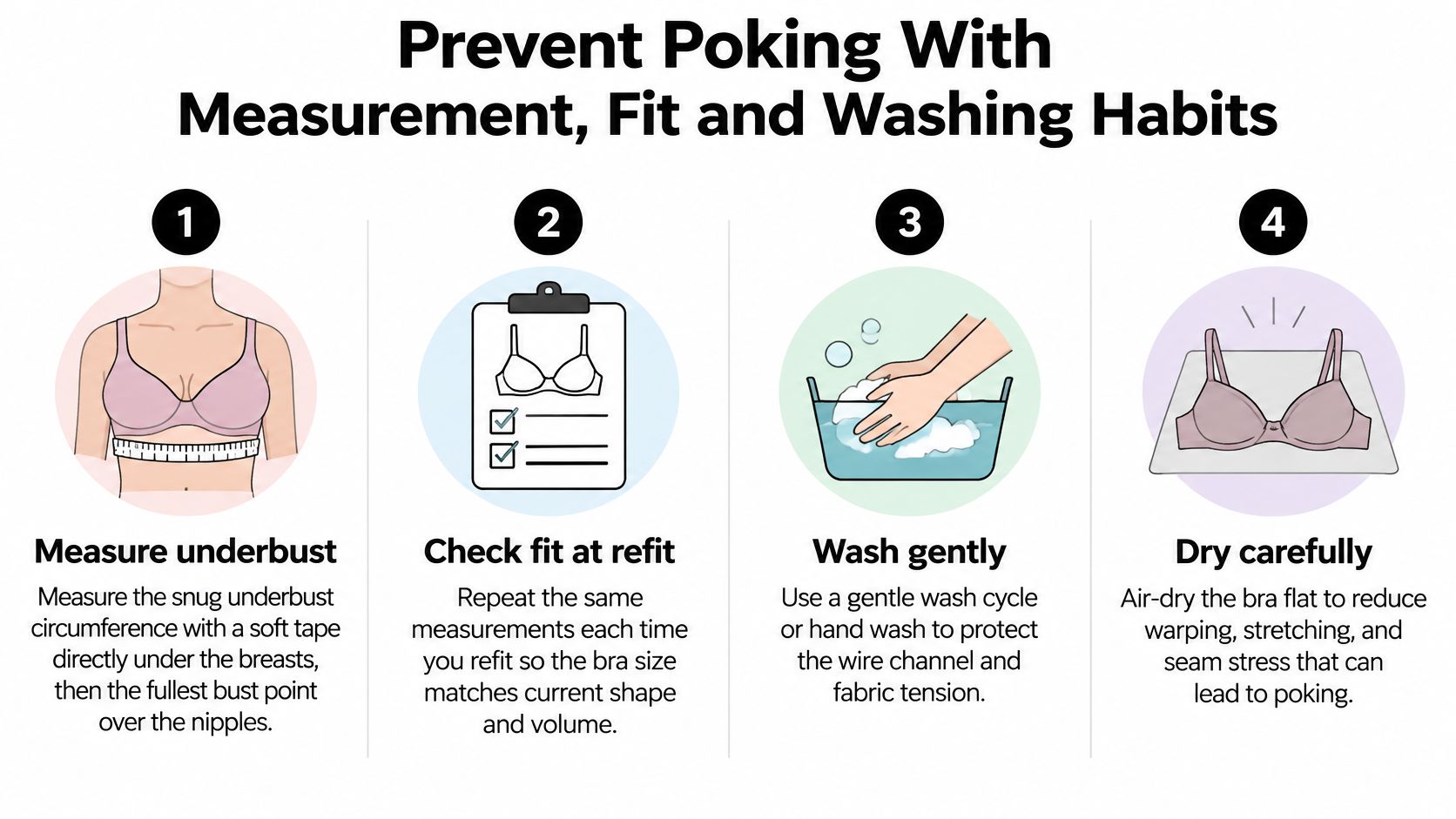
Start each refit with a soft measuring tape, not your previous size label. Measure snugly around your torso directly beneath your breasts, keeping the tape level, then measure around the fullest bust point over the nipples without compressing the tissue.
Record both measurements and their difference. Use them with the relevant brand's size chart as a starting point, rather than assuming a cup letter means the same thing in every bra. Measurements help you select candidates; trying them on establishes whether the shape works.
Fit the bra in the right order
- Set the band first. For a new bra, start on the loosest hooks and check that the band stays level and secure without restricting your breathing.
- Settle the breasts into the cups. Lean forward slightly and gently bring tissue into each cup so it isn't trapped beneath the wire or spilling at the edges.
- Remove strap slack. Adjust until the straps stay in place without hauling the back band upward.
- Check the wire's position. It should surround the breast tissue and rest against the ribcage, not sit on the breast.
This order prevents you from tightening the straps to disguise a poor band or cup fit. Our bra-fitting guide can help you work through those checks without relying on the label alone.
The care-and-measurement routine is simple enough to repeat whenever the fit changes.
Reduce pressure and protect the channel
A bra-pressure paper reports a recommended comfortable pressure range below approximately 2.7 kPa and describes a separate soft-mannequin experiment in which removing the wire reduced mid-underbust pressure by 39%–79%, depending on strap and band tension. Those are laboratory benchmarks, not personal injury thresholds or something you need to measure at home.
Your practical test is comfort during normal movement. Don't accept a concentrated sharp spot because the bra looks correct.
- Wash gently. Hand wash, or use a gentle machine cycle in a mesh lingerie bag when the care label permits, to limit agitation against the casing.
- Avoid heated drying. High-temperature drying can damage the channel and accelerate failure.
- Air dry carefully. Lay the bra flat without twisting the cups or wringing the wired section.
- Inspect after washing. Check both channel ends before putting the bra back into rotation.
Store the bra without folding one wired cup inside the other. Protecting its shape is easier than trying to bend a distorted wire back into service.
Postpartum and Nursing Changes That Shift the Wire
Say your bra fitted comfortably during pregnancy, but now the same wire feels sharp by the afternoon. You may be dealing with a different breast volume or shape, not a sudden inability to tolerate structured support.
An academic review of pregnancy and postpartum breast changes reports that self-reported bra size increased by approximately one underband and two cup sizes across the period before, during and after pregnancy. That describes the reviewed participants, not a size prescription for your body.
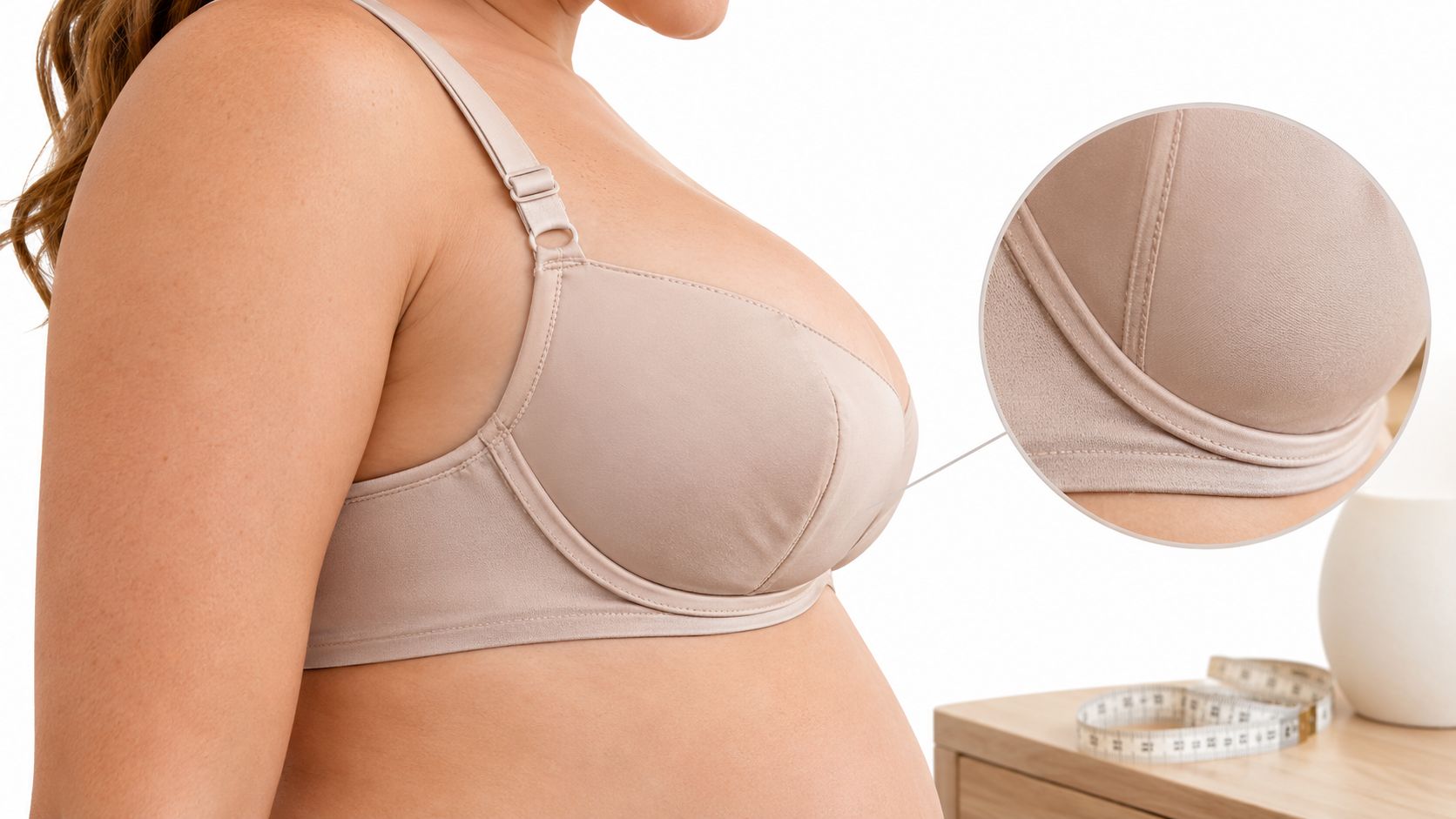
During a postpartum refit, pay attention to the seams and cup edges as well as the overall silhouette.
Fit the stage you're in
In the early weeks, tenderness and changing fullness can make a previously comfortable wire feel unforgiving. A soft or wire-free bra gives you an alternative while you recover, without requiring you to predict your eventual size.
When milk volume is high, check the fit when your breasts are comfortably full, not only immediately after feeding. Later, as feeding patterns change or weaning progresses, reassess rather than assuming the same cups and band still work.
Postpartum stages and what to do with the wire
| Stage | What Changes | Fit Action |
|---|---|---|
| Early weeks | Tenderness and fullness can change daily | Choose soft or wire-free; refit if the wire feels sharp |
| Peak milk production | Breasts may be at their fullest, changing where the wire sits | Repeat the underbust and bust measurements or see a professional fitter |
| Later months or weaning | Shape may settle as routines return | Test a refitted size if you want structured underwire again |
These are recognisable patterns, not deadlines. Our guide to choosing a nursing bra size helps you assess current fullness rather than buying for an earlier stage.
Keep your own fit checks in mind when watching the accompanying video.
Let comfort determine the return to structure
Try a refitted bra during ordinary activities, including feeding, sitting and reaching. If you're returning to exercise, assess your activity bra separately rather than assuming an everyday nursing bra will meet that need.
Choosing wire-free support during tender weeks isn't a failure, and returning to underwire isn't a milestone you have to reach.
Expect to reassess more than once. A changing body needs a flexible fitting plan, not pressure to make an old purchase work.
Decide Whether to Replace Your Underwire Bra
Use the repair-or-replace table as your verdict rule, not the bra's price or how much you liked it when it was new. If it qualifies for repair, resolve the fit problem first, then check the repaired bra before returning it to regular wear.
If replacement is the verdict, buy for your current shape. Ordering the same size and style without checking either can leave you with the same pressure point in fresh fabric.
Take a movement-based checklist shopping
- Wire curve: It follows the underbust fold without cutting across breast tissue.
- Band and straps: The band stays level and secure, and the adjustable straps don't need to be overtightened.
- Cup capacity: Your breasts sit inside the cups without spilling, pinching or being pushed beneath the wire.
- Nursing access: If you're breastfeeding, test whether you can open and close the access comfortably with one hand.
Try sitting, reaching and moving your arms before deciding. A replacement should work for the way you spend your day, not just for a still moment in front of the mirror.
Choose structure without ignoring sensitivity
Our underwire versus wire-free comparison can help you weigh structured shaping against a softer feel. Neither choice excuses pressure, and adjustable features can't make every wire curve suit every body.
For later postpartum support, we offer the GAIA Lace Nursing Bra with Gentle Underwire, which is unpadded, and the Petra Lace Nursing Bra, which has an adjustable fit. GAIA doesn't include padding for leaks, so nursing pads can be added if needed; check the fit with those pads in place.
Refit this week, check the replacement criteria and decide within a week whether your current bra is worth repairing. You don't need to keep negotiating with a bra that hurts.
At Milk&Lace, we offer structured nursing lingerie for later postpartum routines, with lace designs and practical nursing access. Visit us when you're ready to explore a refitted bra that supports breastfeeding and feels like your style, without asking you to tolerate a poking wire.