

You're standing in front of an open drawer, holding three nursing bras in three different sizes, and somehow none of them feels right. One rides up at the back, another leaves space at the top of the cups, and the softest one feels supportive until you bend over to pick up your baby.
That confusion is normal. Nursing bra sizing changes because your breasts change, sometimes from pregnancy to early lactation and again as feeding becomes more established. The right approach isn't to guess from your pre-pregnancy size or automatically buy a larger band. It's to measure carefully, choose the right moment to measure, and understand how cup volume can shift while the band remains relatively stable.
Why Nursing Bra Sizing Feels So Different
Regular bra shopping usually assumes that your measurements are reasonably consistent from one fitting room visit to the next. Nursing bra shopping takes place during a period when breast size, fullness, and firmness can move through several stages. Pregnancy can change the breast and ribcage, early lactation can bring temporary fullness, and later postpartum changes may create a different shape from the one you had before birth.
The result is that a bra can fit beautifully in the morning and feel crowded before a feeding, or feel comfortable after feeding but leave you unsupported later. That doesn't mean your body is doing anything wrong. It means one fixed size may not describe every moment of your day.
Three changes affect the fit
The band may shift. Your ribcage can feel different during pregnancy and after birth, so the measurement underneath the breasts deserves its own check. A loose band can ride up and leave the straps doing too much work. A tight band can feel restrictive and make nursing access unpleasant.
Cup volume can swing. Breast tissue may feel fuller before feeding and softer afterward. The cup therefore needs enough room for your usual changes without becoming so loose that it stops supporting you.
Firmness changes shape. Two breasts with the same measurement can fit differently when one is fuller and firmer and the other is softer. This is why the tape measure gives you a starting point, while a mirror fit check confirms whether the bra works on your body.
The practical goal: Find a band that provides most of the support, cups that contain the breast without pressure, and nursing access you can manage with one hand.
A poor fit affects more than appearance. It can make feeding awkward, create uncomfortable pressure, reduce support under clothing, and leave you tugging at your bra throughout the day. A well-fitting nursing bra gives you a stable foundation while your body continues to change.
Measuring Your Underbust and Bust at Home
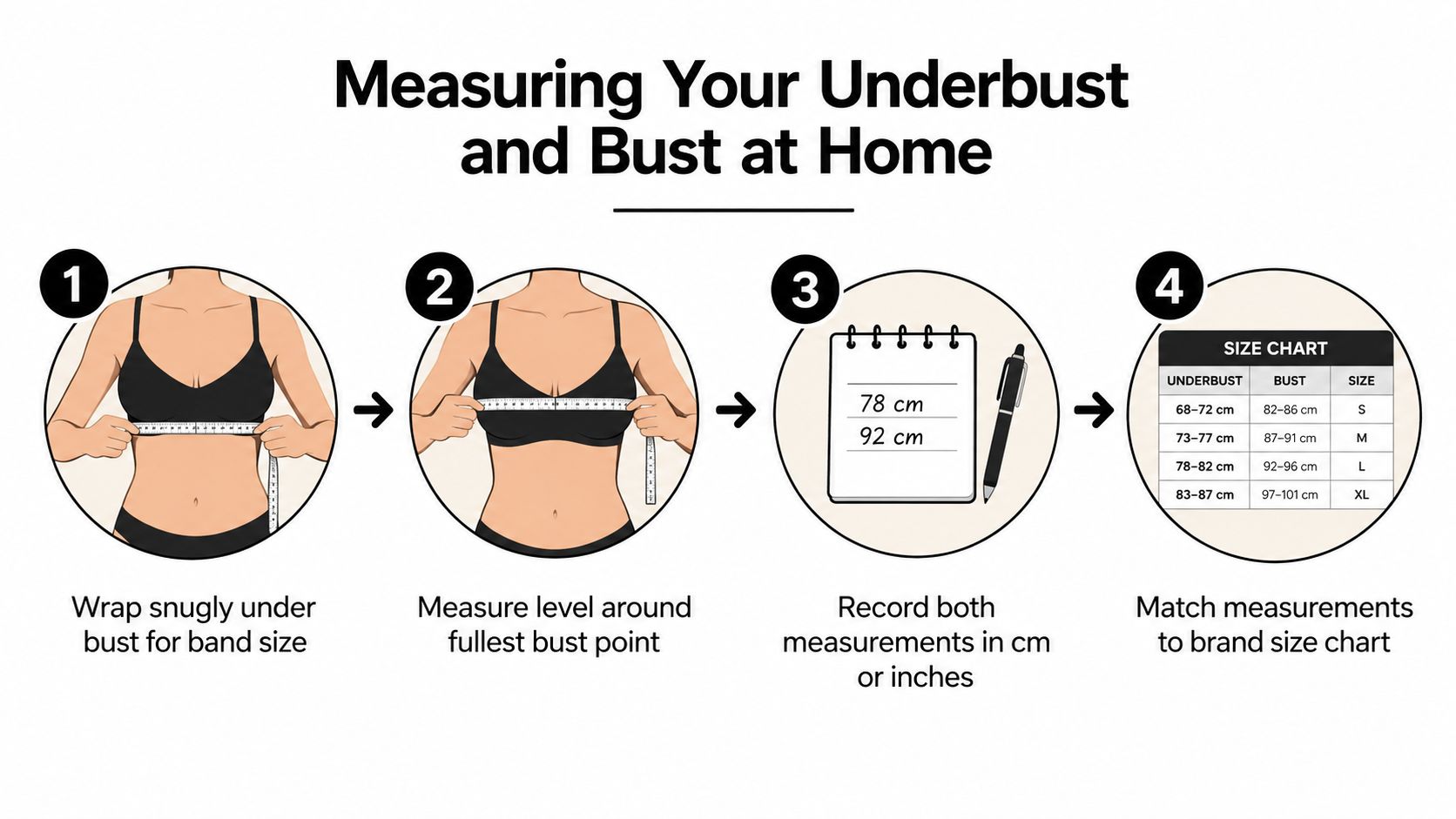
You can measure at home with a soft tape measure, a mirror, and a few quiet minutes. If possible, wear a thin, non-padded bra or measure without a bra so padding doesn't add volume to the bust measurement.
Start with the underbust
- Wrap the tape around your ribcage directly underneath your breasts.
- Keep it snug, level, and parallel to the floor.
- Breathe normally, then note the measurement without pulling the tape painfully tight.
This is the measurement used to establish the band. If the tape slopes upward at the back, the number won't represent your true ribcage measurement. If it hangs loosely, you may choose a band that can't provide dependable support.
Next, measure around the fullest part of your bust. Keep the tape level and let it rest gently against your body. Don't compress the breast tissue. For a more useful reading, take this measurement before a feeding session or after a full exhale, rather than immediately after feeding when temporary volume changes may affect the result.
You can find a detailed visual walkthrough in Milk&Lace's guide to measuring for a nursing bra.
Compare the two numbers
Subtract the underbust measurement from the fullest-bust measurement. Each inch of difference represents roughly one cup increment, although the final letter can vary between brands and sizing systems. Always compare your measurements with the specific brand's chart rather than treating a general formula as a guaranteed answer.
One widely used band method says to add 4 inches to an even underbust number or 5 inches to an odd one when converting to a band size. Treat that as a starting point, not a verdict. Modern bra designs and international charts don't all use the same conversion.
| Measurement | How to Take It | Your Number |
|---|---|---|
| Underbust | Wrap snugly and level under the breasts | |
| Fullest bust | Measure gently around the fullest part, tape parallel to the floor | |
| Difference | Subtract underbust from fullest bust | |
| Starting size | Match the measurements to the brand chart |
If you're shopping for a flexible option, GAIA is described as a soft nursing bra with stretch lace, flexible support, and effortless breastfeeding access. Its adaptability may be useful during a stage when your measurements aren't perfectly constant, but the correct size still depends on your measurements and the brand chart.
When to Measure and When to Buy
The most useful answer to when to measure a nursing bra size is not “once.” Your pre-pregnancy size can provide context, but it shouldn't be the only measurement used for a nursing bra purchase. Breast size and firmness may change during pregnancy, around milk coming in, and again as feeding settles.
A study of self-reported UK bra sizes found that size increased on average by about one underband and two cup sizes from before pregnancy to during or after pregnancy, as reported in the Nottingham Trent University research record. That finding explains why reaching for your old pre-pregnancy bra can be so misleading. It also shows why band and cup changes shouldn't be treated as one combined increase.
Match the bra to the stage
Before pregnancy: Use your old size only as a reference. It can help you notice the direction of change, but it can't predict the size you'll need later.
Late pregnancy: This is a sensible time to buy an initial nursing bra, particularly if your current bras feel uncomfortable. Choose a style with some flexibility and avoid buying a large collection before you know how your body will settle.
The first postpartum weeks: Expect your breast volume to be less predictable. A bra that accommodates change can be more useful than a highly structured style fitted to one temporary snapshot. Don't use a visibly full or engorged moment as the permanent size unless the bra is specifically intended to accommodate that state.
Later postpartum: Re-measure around 6 weeks postpartum, then reassess again as supply stabilizes, as recommended in recent nursing-bra fit guidance from Babylist. This later measurement is often more relevant for a structured, premium bra because it reflects the size and shape you'll wear more consistently.
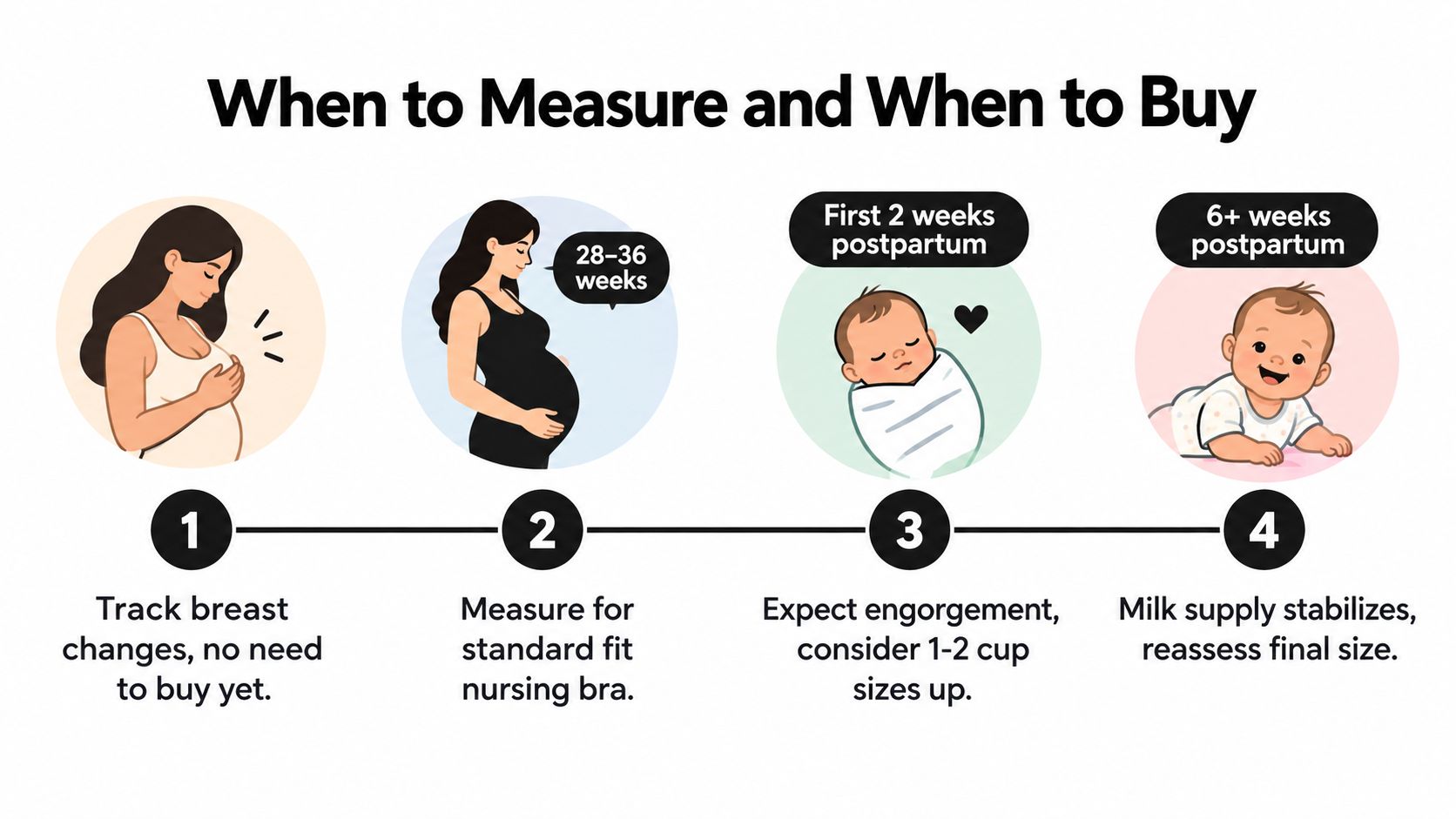
A flexible early bra and a later structured bra serve different purposes. The first needs to tolerate variation. The second can be chosen after you have a clearer sense of your stable band and cup relationship.
Choosing Between Stretch Lace and Structured Underwire
Once you have a measurement, construction becomes the next decision. A nursing bra isn't only a size label. Fabric stretch, cup shape, band strength, underwire, and nursing access all affect how that size behaves during the day.
Flexible stretch lace
Stretch lace moves with changes in fullness. That can make it a practical choice for early pregnancy, the first postpartum weeks, or days when your breasts feel noticeably different before and after feeding. Flexible support can also reduce the pressure to find a single cup shape that fits perfectly at every point in the feeding cycle.
The trade-off is definition. A very flexible bra may provide less shaping under fitted clothing, and it may not feel sufficient if you want a more lifted, contained silhouette. Check that the band still lies level and that the cups don't allow breast tissue to escape when you move.
Structured underwire
A structured nursing bra creates a clearer frame around the breast. Gentle underwire can offer a more defined shape and a steadier feel, provided the wire sits around the breast rather than on it and the size is correct. This approach often makes more sense later postpartum, when your measurements and daily fullness have become easier to predict.
PETRA is described as featuring ultra-soft stretch lace, gentle underwire, and one-hand nursing access. Those features illustrate how a bra can combine structure with flexibility, but they don't remove the need for a careful fit check.

Use this decision guide:
- Choose flexible stretch lace if your breast volume changes noticeably through the day or you're shopping before your size has settled.
- Choose structured support if your band and cup measurements feel more consistent and you want more shaping beneath clothing.
- Check nursing access if you expect to feed while holding your baby. A clip that opens with one hand matters as much as the size.
- Treat underwire as a fit issue rather than an automatic yes or no. It shouldn't press into breast tissue or create a painful, restrictive fit.
For more detail on construction and fit, see this guide to nursing bras with underwire. The right choice depends on your current stage, your support needs, and how much daily variation you want the fabric to accommodate.
Fit Checks Every Nursing Bra Must Pass
The size on the label is only the beginning. Put the bra on with the cups positioned correctly, fasten it on the loosest comfortable hook, and move your arms, sit down, and lean forward. Your body should feel supported without needing constant adjustment.
Use the mirror test
Start with the band. It should sit horizontally around your body, not climb toward your shoulder blades. You should be able to pull it approximately 5 cm away from your body, according to the fit guidance used by Breast Cancer Now and the National Childbirth Trust. If it pulls much farther, the band may be too loose. If you can't create that small amount of space comfortably, it may be too tight.
Next, look at the center front. It should lie flat against your chest. The cups should fully enclose the breasts, with no bulging over the top or sides and no large empty spaces.
A cup problem isn't always a band problem. If the cup is too small but the band feels secure, try a larger cup in the same band before changing the band itself.
The straps should support the fit, not carry the weight of the breasts. If they dig into your shoulders, loosen them briefly and reassess the band. The band should do most of the support work, as outlined in the well-fitting bra guidance from Breast Cancer Now.
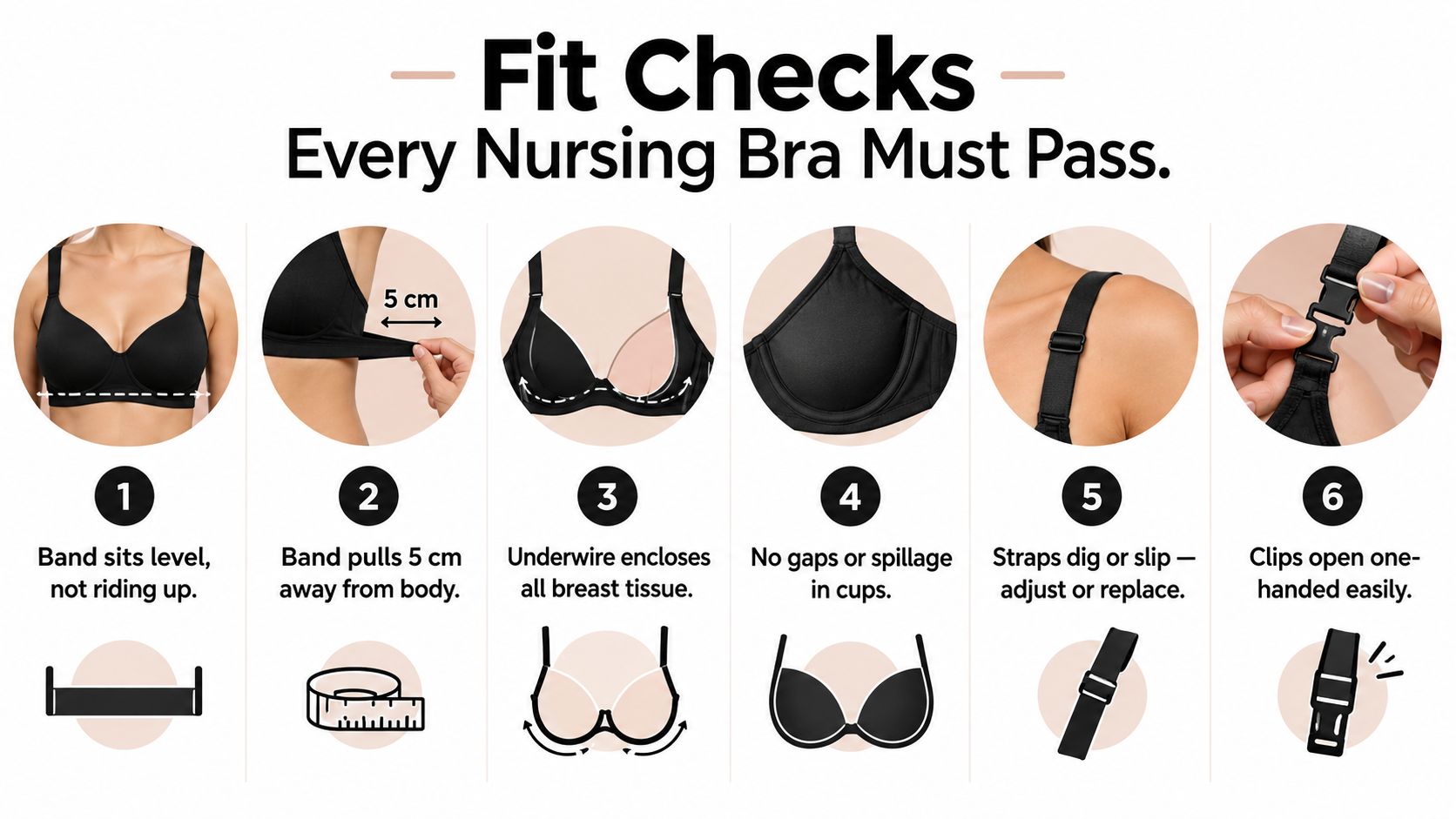
Use this quick diagnosis:
- Band rides up: The band may be too loose, or the straps may be tightened too much.
- Band feels restrictive: Check whether the band is too small before adjusting the cups.
- Breast tissue spills out: Try a larger cup, particularly if the band feels level and secure.
- Cups gape: The cup shape or volume may be too large for that moment, or the bra may need repositioning.
- Center front floats away: The cups may not be containing the breast correctly, especially in a structured style.
- Clip is difficult to open: The bra fails a practical nursing test, even if the static fit looks good.
Sister Sizing, Exchanges, and Building Confidence
A nursing bra may fit well in one place and poorly in another. Sister sizing adjusts the band and cup together so the overall cup volume stays broadly comparable. If the cup fits but the band feels loose, choose a smaller band with the corresponding larger cup. If the band fits but the cup is crowded, keep the band and move up in the cup. See the complete sister sizes for bras guide for a conversion table.
Sister sizing is different from choosing a larger band. Cup volume can shift through a feeding and pumping cycle, while the ribcage measurement usually stays more stable. A larger band may therefore reduce support without solving the actual fit issue. A different cup, a more flexible style, or a new measurement at another stage may work better.
Which moment should you fit?
Choose a structured bra for the fullest point you regularly experience. Avoid fitting for the most extreme temporary fullness or for the emptiest point immediately after feeding. The cups should contain your usual daily changes without cutting into the breast or collapsing away from it.
Flexible bras can allow more room for variation. Structured styles need closer attention to the later postpartum measurement, when supply and shape may be more predictable. If you sit between sizes, assess the band first. Then adjust cup volume or try a sister size instead of changing both measurements at random.
An exchange policy can support this process. Milk&Lace offers a flexible size-exchange policy, so you can correct an imperfect first choice as your measurements become clearer. Review the current terms before ordering, and keep the tags and packaging intact if the policy requires them.
Your size may change as feeding patterns and breast volume change. Measure at the stage that matches your purchase, check the band before blaming the cup, and treat a later size change as useful information rather than a mistake.
Milk&Lace offers nursing lingerie designed around breastfeeding access, soft lace, and support for the later postpartum stage, with a flexible size-exchange policy as your fit evolves. Visit Milk&Lace to explore the collection and choose a nursing bra that supports comfort and confidence.