

The most repeated advice for nursing parents is blunt: skip underwire until you wean. It sounds protective. It also treats every breast, every week, and every bra as the same, and that shortcut misses how fit works.
Underwire vs no underwire is not a character test. A wire that rests on the ribcage, follows the breast root, and leaves tissue free can feel steady through a long day. That same wire, a size too small during engorgement, can press, mark, and leave a breast feeling unfinished after a feed. A wireless bra can be the kinder choice at 3 a.m. and still leave a larger bust aching by midafternoon.
You're allowed to want softness and a shape you recognize in the mirror. The useful question is which construction fits this week, this task, and this body.
Underwire and No Underwire Side by Side
Underwire gives firmer containment and less breast movement. A no underwire bra gives softer pressure and more tolerance for swelling. Stage and task decide which of those wins, not the mere presence of a wire.
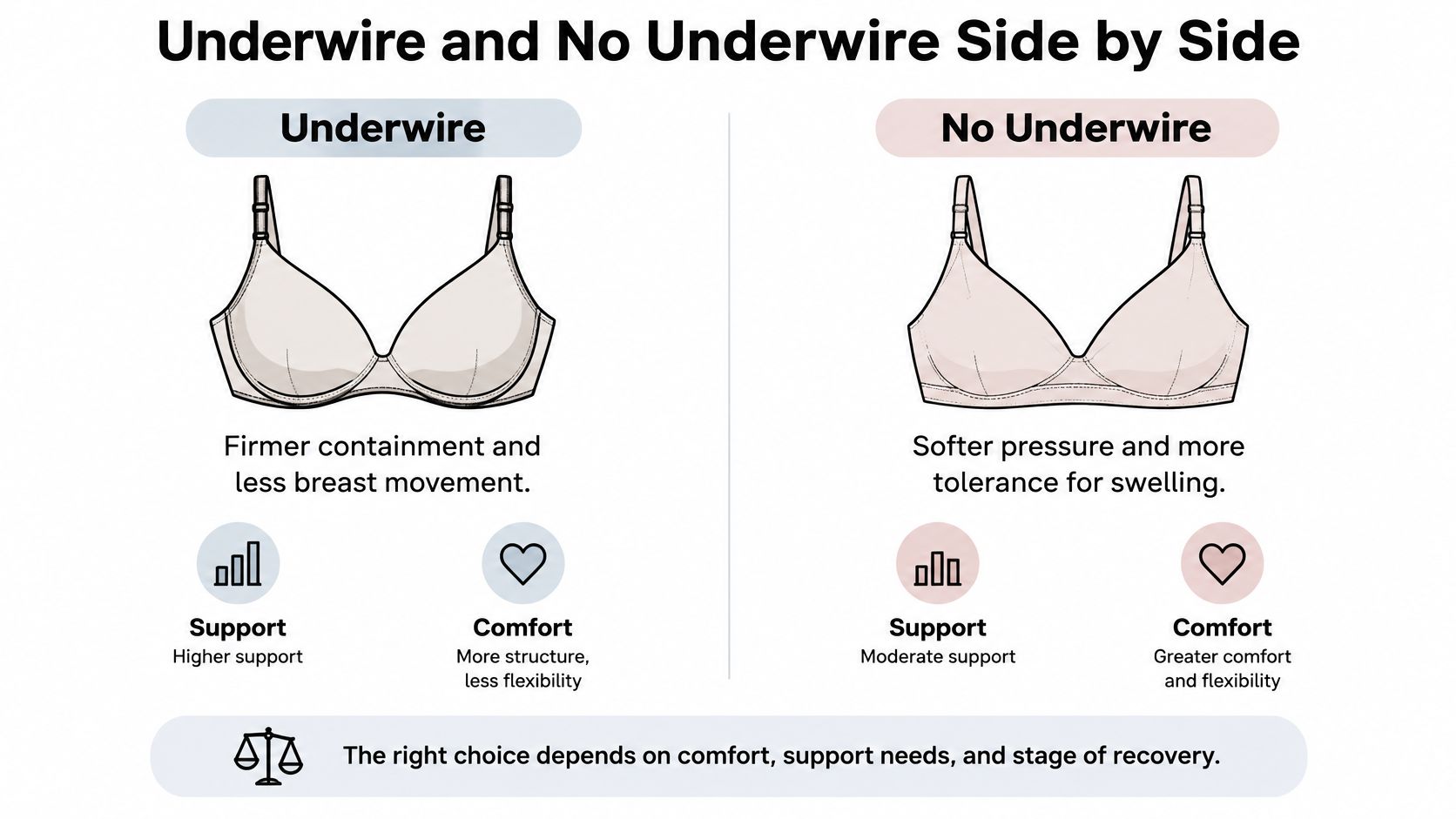
| Criterion | Underwire | No Underwire |
|---|---|---|
| Lift and containment | Firmer structure holds shape through the day | Relies on fabric, band, and straps for lift |
| Motion control | Significantly less vertical movement in treadmill testing | Less control during fast movement and exercise |
| Pressure pattern | Concentrates load along the under-breast curve | Spreads pressure across a wider textile area |
| Engorgement tolerance | Can feel rigid when breasts are full or tender | Usually more forgiving during swelling |
| Nursing access | Depends on cup design and flap placement | Often simpler for pull-down or pull-aside access |
| Shape and silhouette | Defined, lifted shape under clothing | Softer, more natural shape |
| Best-fit wearer | Larger busts, long daytime wear, active days | Early postpartum, sleep, fluctuating volume |
Two construction facts carry that table. In treadmill testing with nine C-cup wearers, an underwired bra reduced vertical breast movement compared with a wireless bra, which is why motion control is a real difference, not a slogan. Nursing access is separate. A drop cup, a stretch panel, or a well-placed flap decides whether you can latch with one hand. The wire doesn't open the cup.
The rows describe typical construction, not every product. A wire sitting on breast tissue can feel worse than a firm wireless bra with a strong band. A soft bra with a loose band can slide until the straps do all the lifting.
What the table can't show is your fit this week. Volume can shift between morning and night, and between week two and month four. Wikipedia's account of the underwire bra places metal support much earlier than maternity fashion: Marie Tucek's 1893 U.S. patent used a metal plate, Helene Pons patented an open-ended wire loop in 1931, and underwire bras became broadly popular only in the 1950s. Age doesn't make a wire right for you. Fit and the week you're in do.
How Underwire Supports and Where It Presses
A wire is a curved stiffener sewn into a channel under the cup. When the curve matches your breast root, it traces the fold and lets the band carry weight, so the cup can hold shape without the straps hauling everything upward. When the curve is too short, too narrow, or too stiff, you feel a hard line instead of lift.
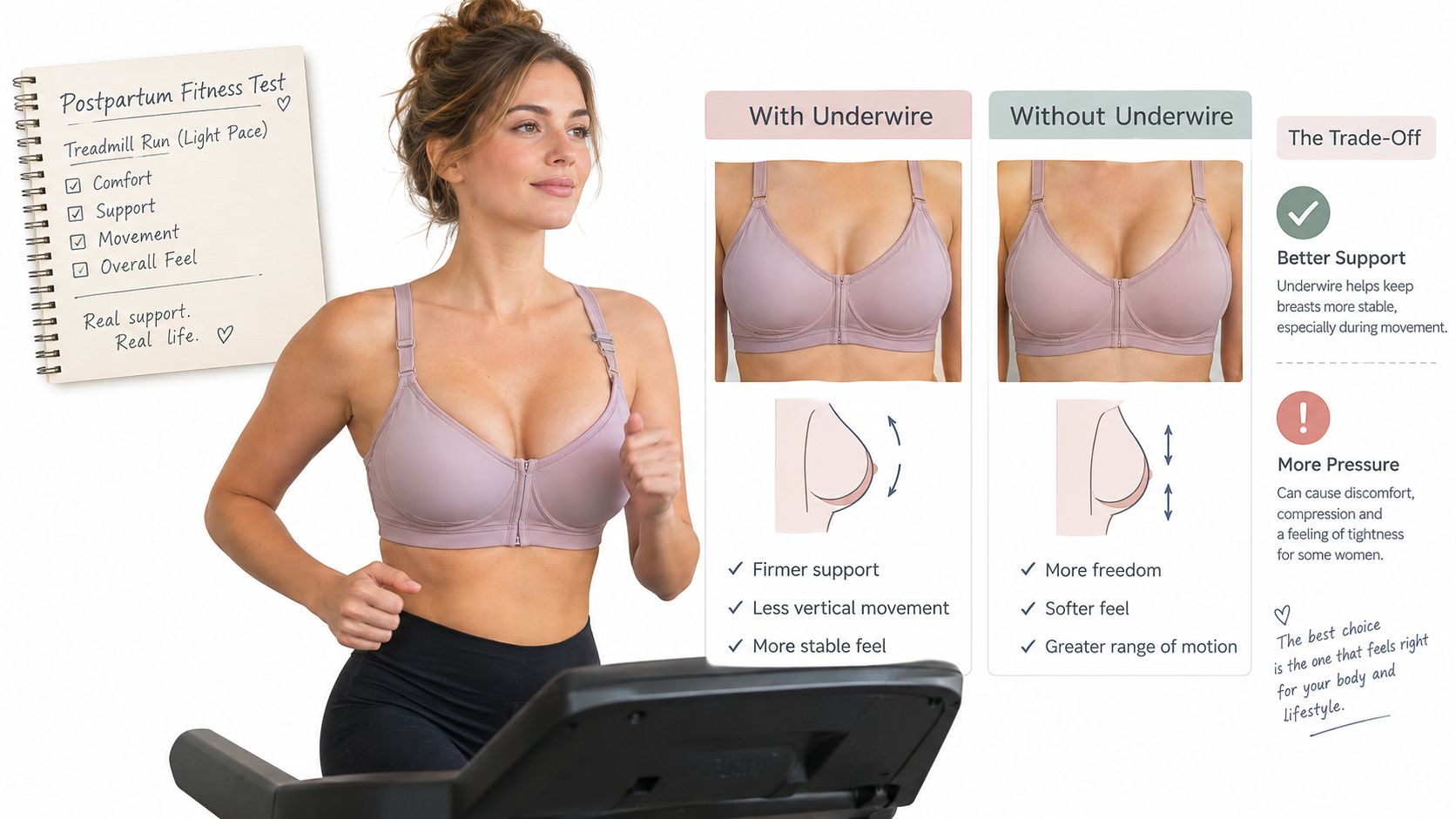
Say you're walking fast with a baby carrier. Breasts that aren't contained bounce, and that bounce can ache even when the fabric feels soft. In a treadmill study of 9 women with C-cup breasts, the underwired condition significantly reduced vertical breast displacement (p < 0.05), perceived breast movement (p = 0.007), and discomfort (p = 0.025) compared with an underwire-free bra, in the biomechanics comparison indexed by OUCI. A 2025 pressure-distribution study in that same line of engineering work found a customized 3D-printed underwire cut localized pressure versus conventional stainless steel by 36.36% at the base, 38.10% near the sternum, and 35.00% near the underarm when standing still, and by 24.00%, 21.74%, and 22.22% during movement. Shape and flexibility of the wire change the feel, not only whether a wire exists.
Where the load collects
Containment has a cost, and it shows up as pressure. Testing on a breast-prosthesis manikin found that taking the underwire out reduced pressure at the middle of the under-breast curve by approximately 39% to 79%, depending on strap and underband tension, in the PolyU soft manikin paper. In the tightest setup, the wire midpoint reached 10.6 kPa, against 6.3 kPa with no wire. Band and strap pressures in that work sat between 5.8 and 7.8 kPa. You feel that as a focused line under the breast rather than a broad hug of fabric.
Fit decides the feel: wire length, curvature, channel padding, band tension, and strap adjustment decide whether a wire supports you or presses on you.
Postpartum tissue keeps changing, so a curve that was fine last month can land on breast tissue this month. Padding in the channel softens the edge. A band that is already snug on the loosest hook shouldn't be cranked tighter to "fix" a poking wire. If the straps are doing the lifting, the wire is often the wrong length or the band is too loose, and tightening the straps only moves the pain to your shoulders.
Breastfeeding Safety and Fit Warning Signs
"Underwire is unsafe" and "underwire is always fine" are both too tidy. The Australian Breastfeeding Association's maternity-bra guidance cautions that rigid wires can press on a changing, milk-filled breast and may contribute to inflammation or mastitis risk, while the Academy of Breastfeeding Medicine recommends an appropriately fitting supportive bra. Direct evidence tying the wire itself to lactation problems is limited. The clearer problem is prolonged, localized pressure from a poor fit.
A wire is a tool that can sit well or sit badly. Early fullness, a band that won't expand, or a cup that cuts across the lower breast turns that tool into a clamp. A wireless bra can clamp too, if the elastic is narrow and the band is tiny. Style doesn't excuse pressure.
Knowing how nursing bras open during a feed helps you tell a cup problem from a wire problem. If the flap won't clear the nipple, or the cup folds back onto the breast while the baby feeds, access is the issue. If the breast feels pinched before you even unclip, the support is the issue.
Signs worth acting on
| Symptom | Likely Cause | Action |
|---|---|---|
| Indentation or red line under the wire | Wire sits on breast tissue or the band is too tight | Switch to a soft-cup bra and check band size |
| Tender or hard spot near the wire | Pressure on milk-filled tissue | Stop the wire until tenderness settles and seek lactation support |
| Breast doesn't feel emptied after feeds | Restrictive support over full tissue | Move to a wireless bra and review feeding position with a consultant |
| Skin marks that don't fade, or broken skin | Prolonged friction or pressure | Stop wearing that bra and seek care promptly |
| Redness with fever or flu-like symptoms | Possible mastitis | Contact a clinician the same day |
A fading pink line after a long day is common with any snug garment. A groove that is still there at the next feed, a hot spot, or a breast that stays full on the side nearest the channel is a stop sign. Don't wait for the end of the week to "see if you get used to it." Tissue that's being compressed doesn't adapt its way out of a bad curve.
Any bra that causes pain, pressure, or skin damage should come off, wired or not. Comfort here isn't a mood. It's the absence of a mark, a tender ridge, or a feed that won't finish.
Matching Each Style to Your Postpartum Stage
Early engorgement and fast volume shifts favor stretch and adjustability. Later months can make a correctly fitted structured bra reasonable, once the wire clears breast tissue and the band stays level for hours.
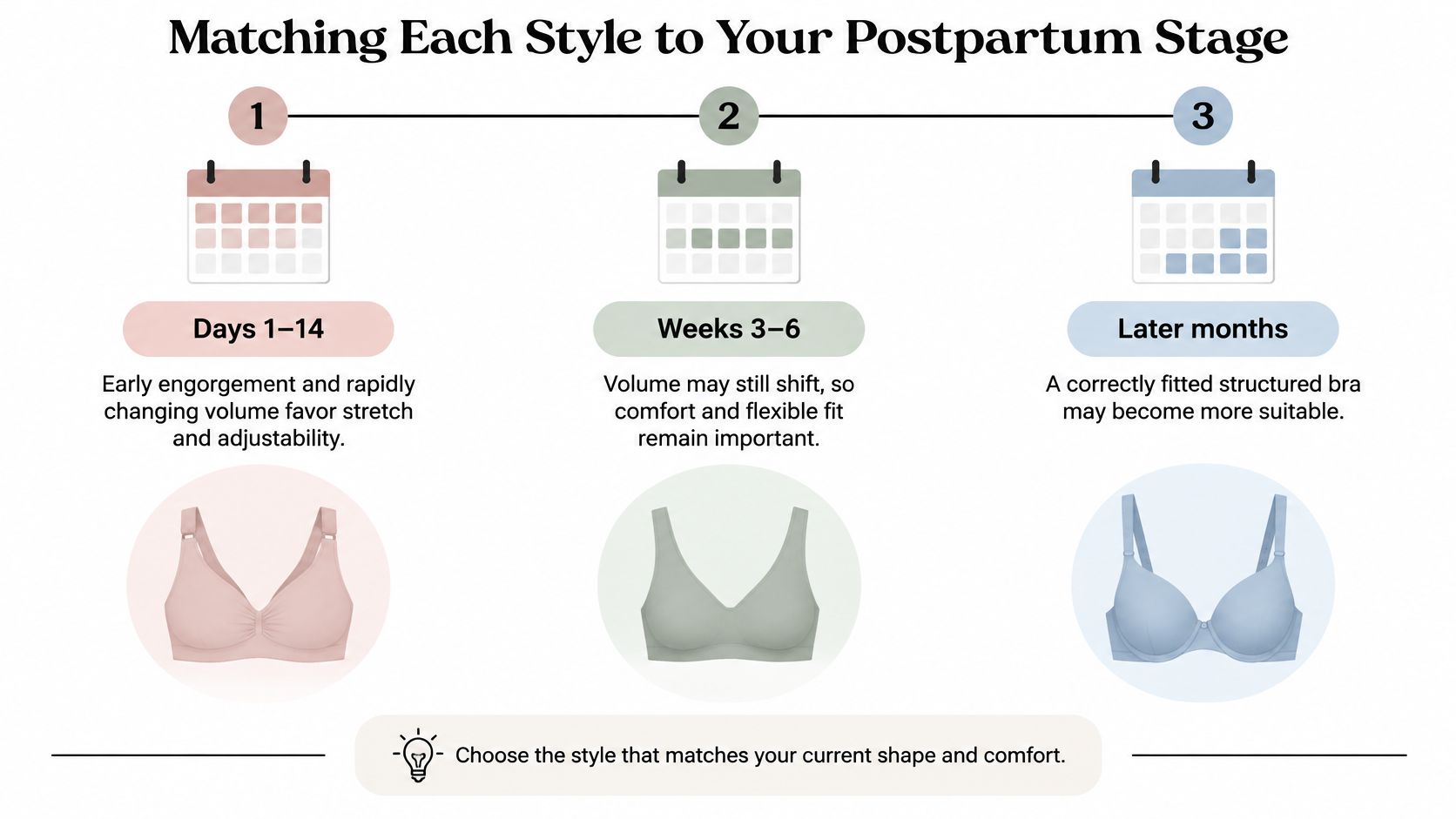
| Stage | Typical Breast Changes | Best-Fit Style | Check Before Switching |
|---|---|---|---|
| Days 1 to 14 | Engorgement and rapid volume shifts | Wireless or soft-cup with room to expand | Band stretches and nothing sits on breast tissue |
| Weeks 3 to 8 | Supply settling, volume still changing | Mostly wireless, structured for short outings | No pressure marks after several hours of wear |
| Months 3 to 6 | Steadier volume, routines returning | Either, structured for long or active days | Band still fits after weight and volume change |
| Month 6 onward or weaning | Stable or shrinking volume | Structured or wireless by activity | Band size reassessed, not only cup size |
In 2025, Dataintelo estimated that wireless bras held 42.3% of the global maternity-and-nursing-bras market, compared with 18.6% for underwire bras, in its maternity and nursing bra market estimate. That split fits a staged wardrobe more than a permanent rule. Many parents start in soft cups and add structure only for certain days.
What each architecture trades
The Academy of Breastfeeding Medicine's 2022 mastitis-spectrum protocol links appropriate support with reducing dependent lymphedema and progressive back and neck pain. Taking all structure away isn't automatically the kinder health choice. That doesn't mean a wire improves health. It means support that fits can matter for how your chest and shoulders feel by evening.
- Underwire: adds stability and a defined shape, and it can feel rigid when you're engorged. It presses at the fold if the curve is short, and it fails fast when the band or the wire length is wrong.
- Wireless: feels softer and adapts when volume jumps between feeds. It usually gives less lift to a larger bust and less shaping under a fitted shirt.
- Rotation: wireless for sleep and for days when size swings, structured for long daytime wear, work, a larger bust, or an occasion where shape matters. Switching by task is a sound plan, not indecision.
A soft nursing bra with stretch lace and flexible support, such as GAIA, sits in that middle ground once early swelling has eased and you still want simple breastfeeding access. It isn't a substitute for the softest early bras, and it still has to pass the mark test.
Reassess the band at every stage change, not only the cup. Cups can look full while a too-big band rides up and dumps weight onto the wire or the straps. If a style hurts or leaves pressure, stop wearing it. Timing your next size check is easier once you know when to buy nursing bras as your routine changes.
A short fitting walk-through can make the stage checks easier to picture before you try them at home.
How to Test Fit Before You Commit
The fitting room shows a snapshot. Most problems show up after a feed, a walk, or a few hours at a desk. Run the checks in order, and don't skip the wear test because the mirror looked fine.
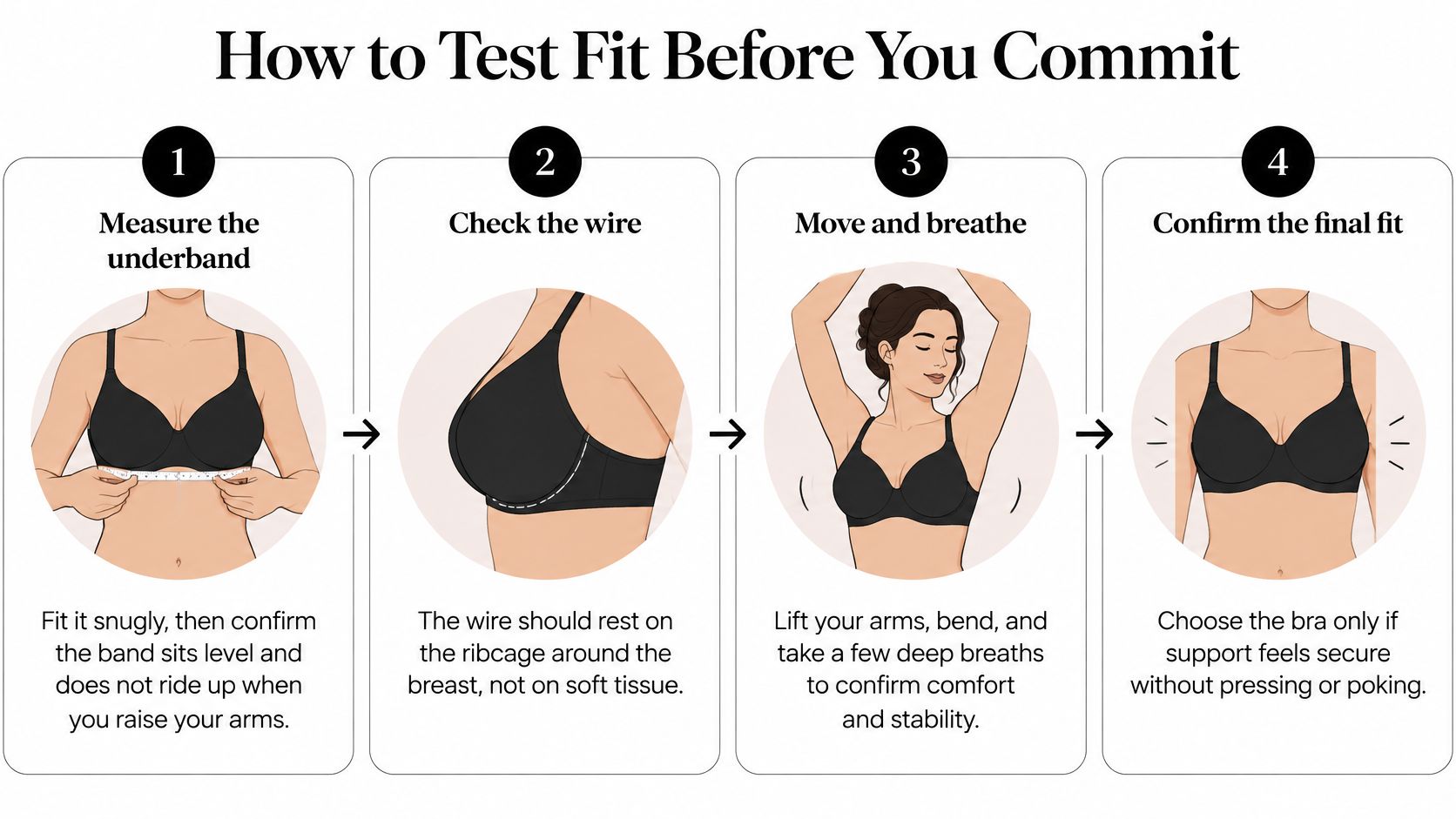
- Measure the underband snugly. Then confirm it sits level and doesn't ride up when you raise your arms. A band that climbs is too loose, and the cups will follow it.
- Check the wire path. It should rest on the ribcage around the breast, not on breast tissue, and the center gore should lie flat. If you can pinch breast tissue under the channel, the cup or the wire length is off. On a wireless bra, feel for a narrow elastic doing the same job as a misplaced wire.
- Lean forward and scoop. Breast tissue shouldn't spill at the sides or the top once you stand back up. Side spill often means the wire is too narrow, or the wing is too shallow.
- Fasten on the loosest hook. The band should still support you there. Tighten a hook only if the straps are carrying most of the weight. You want spare hooks for later, when elastic relaxes.
- Set the straps for lift without digging. Two fingers should slide under a strap. If loosening them collapses the cup, the band isn't doing its share.
- Wear it for two to three hours, including a feed. Look for marks, tenderness, or a breast that feels unemptied. A quick try-on can't show a ridge that appears after nursing.
- Open the nursing flap with one hand while you imagine holding the baby. The flap should clear fully and stay out of the latch. If you need two hands and a mirror, daily feeds will frustrate you.
More detail on band, cup, and gore lives in this guide to nursing bra fit. Use it beside these seven checks, then trust the hours of wear over the first glance.
If it only feels right while you're standing still in a shop, it isn't ready for a Tuesday.
Choose Your Style and Confirm Your Next Step
Choose a wireless or soft-cup style if you're in the first weeks, your volume swings between feeds, you need sleep comfort, or pressure makes you wince. Consider a correctly fitted structured style if you're past that early swell, you want longer daytime support, you have a larger bust, or you want a defined shape for work or an occasion.
The wire isn't the problem. The fit and the stage are.
Rotating styles by task is a sound choice. Sleep and volatile days can stay soft. Workdays and events can use structure, as long as the channel stays on the ribcage. Any bra that causes pain, pressure, or skin damage comes off, no matter which column it sat in.
Three moves make the choice concrete. Run the seven-point fit test before you keep a bra. Reassess the band each time your stage changes, not only the cup. If you want structured nursing support in the later postpartum months, compare a softer lace option with PETRA, which uses gentle underwire, stretch lace, and one-hand nursing access, and read the retailer's return or exchange terms before you buy.
Milk&Lace designs nursing lingerie for the months when you want support, a softer shape under clothes, and discreet access in the same piece. If you're weighing underwire vs no underwire for life after the earliest weeks, their structured nursing bras are built for that stage rather than as a replacement for your softest early bras. Visit Milk&Lace to compare styles, check the fit details, and use the size-exchange policy while your band and cups are still settling.