

You've got an invitation, a changing body, and a wardrobe full of safe neutrals. A red dress catches your eye, then the practical questions arrive: Will it fit by the event? Can you sit comfortably? Will you wear it after your baby arrives?
A maternity red dress should feel like a choice you made for yourself, not a costume you have to tolerate. Choose it for the occasion, your preferred shade, and the way you need it to work through pregnancy and postpartum. The right dress leaves room for you to move, feed your baby if needed, and enjoy being dressed up.
Why Red Still Turns Heads in Maternity Style
If you've been living in black leggings and oatmeal knits, red can feel surprisingly public. That's a good reason to try it, not a reason to force yourself into the brightest shade on the rail.
Red maternity dressing has a longer visual history than celebrity photographs suggest. The Courier's account of maternity style highlights Catherine's red Jenny Packham charity-event dress and traces an older connection through Marcus Gheeraerts II's 1620 Portrait of a Woman in Red, from the period when pregnancy portraits became recognizable in British portraiture.
Those examples offer useful permission: pregnancy can be part of the outfit's character rather than something to disguise. A visible bump and a polished look aren't opposing ideas.
Practical rule: Wear red because you want to be present in the room, not because anyone promises it will make you look a particular way.
There's no reliable global sales figure here proving red maternity dresses are everyone's favorite. Nor does a striking color automatically suit every wearer.
Your best choice comes from ordinary decisions: where you're going, which red you enjoy in the actual lighting, and how the dress accommodates your body. Decide the occasion first, then the shade, then the cut.
Match Red and Silhouette to Each Occasion
Red maternity dress by occasion
| Occasion | Red to choose | Silhouette | Key check |
|---|---|---|---|
| Baby shower | Bright cherry or true red | Empire waist or A-line | Lightweight lining and easy sitting comfort |
| Maternity photos | Deep ruby or brick red | Wrap or column that follows the bump | Matte fabric to avoid glare in daylight |
| Wedding guest or formal dinner | Wine or ruby | Structured bodice with flowing skirt | Opacity at the bust and when seated |
| Daytime brunch or family event | Tomato or berry red | Relaxed shift or wrap | Breathable fabric for warm rooms |
| Holiday party | Deep berry or ruby | Ruched or empire waist with a longer hem | Lining checked under bright indoor light |
| Early postpartum outing | Brick or muted red | Wrap or drape with nursing access | Quick one-hand opening and a neckline that stays in place |
Treat these combinations as styling starting points, not a dress code. Your venue, preferences, and comfort matter more than matching a particular red to a particular invitation.
For a baby shower, prioritize the experience of sitting, opening gifts, and leaning forward. An empire seam should sit comfortably beneath the bust, not cut across breast tissue. An A-line skirt is useful if you prefer fabric that falls away from your abdomen.
For maternity photographs, choose how clearly you want to show the bump. A column dress follows its outline; a wrap gives you more control over definition. Check the hem from the side, because a length you like standing straight may feel awkward in a seated photograph.
Dress for the hours you'll actually spend there
A wedding or formal dinner calls for a different test: can you stay in the dress through the meal? Choose structure where you enjoy support, with enough movement through the skirt for sitting and walking. Follow the invitation's dress code and any cultural expectations around color.
For brunch, family gatherings, and early postpartum outings, don't buy a dress that requires constant adjustment. A relaxed shape you can settle into is more useful than a dramatic neckline you keep checking.
Keep these finishing decisions practical:
- Check the photographed hem: Ask someone to take a full-length picture from the front and side.
- Choose usable adjustment: Look for a tie or wrap you can reposition without distorting the neckline.
- Lighten daytime outfits: Skip dense formal fabric if you'll spend the afternoon in a warm room.
A common styling mistake is buying a deep, formal red for a bright daytime celebration because it feels safer. Try cherry or tomato before deciding. For ideas on balancing the rest of the outfit, use our guide to stylish maternity outfits.
Finish with a simple trial: hang the dress in daylight, put it on, sit down, and hug yourself. If the color still feels like you and the garment doesn't resist your movement, it's a strong candidate.
Choose Your Red by Undertone and Lighting
Treat undertone matching as a starting point. Clothing-color findings published in Fashion and Textiles show that responses to red differ with the shade and the wearer's coloring. Comparing swatches beats accepting a promise that red is universally flattering.
Start beside a window with your face free of strongly tinted makeup. Hold different reds near your face rather than judging them against your hand. Look for the shade that lets you notice your face first, without needing extra makeup to balance it. This is the daylight check to return to when you compare fabrics and make your final decision.
Use the comparison below to narrow similar reds before you shop.

Red families by undertone and lighting
| Red family | Undertone it tends to suit | Daylight | Evening or warm light |
|---|---|---|---|
| Tomato red | Warm | Bright and energetic | Can look orange under warm bulbs |
| Brick red | Warm | Earthy and grounded | Keeps depth under lamps |
| Berry red | Cool | Soft and romantic | Can read purple |
| Ruby red | Cool | Clear and striking | Stays rich under lamps |
| Wine red | Neutral to cool | Muted and refined | Can read almost black in low light |
Use your coloring as a clue
Green-looking wrist veins and a preference for gold jewelry can suggest a warm undertone. Blue-looking veins and a preference for silver can suggest a cool one. These clues stay rough: veins can be hard to read, and both metals may suit you.
Compare tomato with ruby, then brick with berry. If the warmer options appeal to you, begin there. If neither group wins, choose according to the setting and the effect you enjoy.
A favorite dress deserves a second chance even when a chart disagrees. A neckline that leaves space around your face, or a jacket in a familiar neutral, can make an unfamiliar shade easier to wear. Keep two red families in rotation rather than committing to one, since a shade that flatters you mid-pregnancy may read differently in the postpartum months.
Check the light and the finish
Shop lighting can make reds look sharper than they do at home. Warm bulbs can pull a red toward orange, while wine can lose its red character in a dim restaurant. Check your finalist in daylight and under lighting similar to the event's.
Sheen changes the impression, too. Satin catches bright highlights; matte crepe gives a quieter finish. If you want expressive color without feeling conspicuous, try a matte surface before choosing a darker shade.
You don't have to make red quieter by hiding yourself. You can choose a softer finish, a different neckline, or a shade you feel at home in.
Ruching, neckline depth, and hem placement also shape how the outfit's proportions read. Look at the whole silhouette instead of inspecting your abdomen in isolation.
Ask yourself: which red family do I enjoy against my skin? How does this cut look in my lighting? Does the color feel expressive without making me feel exposed?
Silhouettes That Carry You From Bump to Postpartum
Buy for a body stage, not just a size label. A dress that fits your bump beautifully may have nowhere useful to adjust after birth, while an oversized conventional dress may still pull across your bust.
Longitudinal postpartum work indexed by OUCI followed 32 women through 128 interviews, documenting how clothing fit and body perception keep shifting during the first postpartum year. Plan for two sets of adjustments: one for late pregnancy and one for the first few weeks postpartum.
Use these construction features as your shortlist.
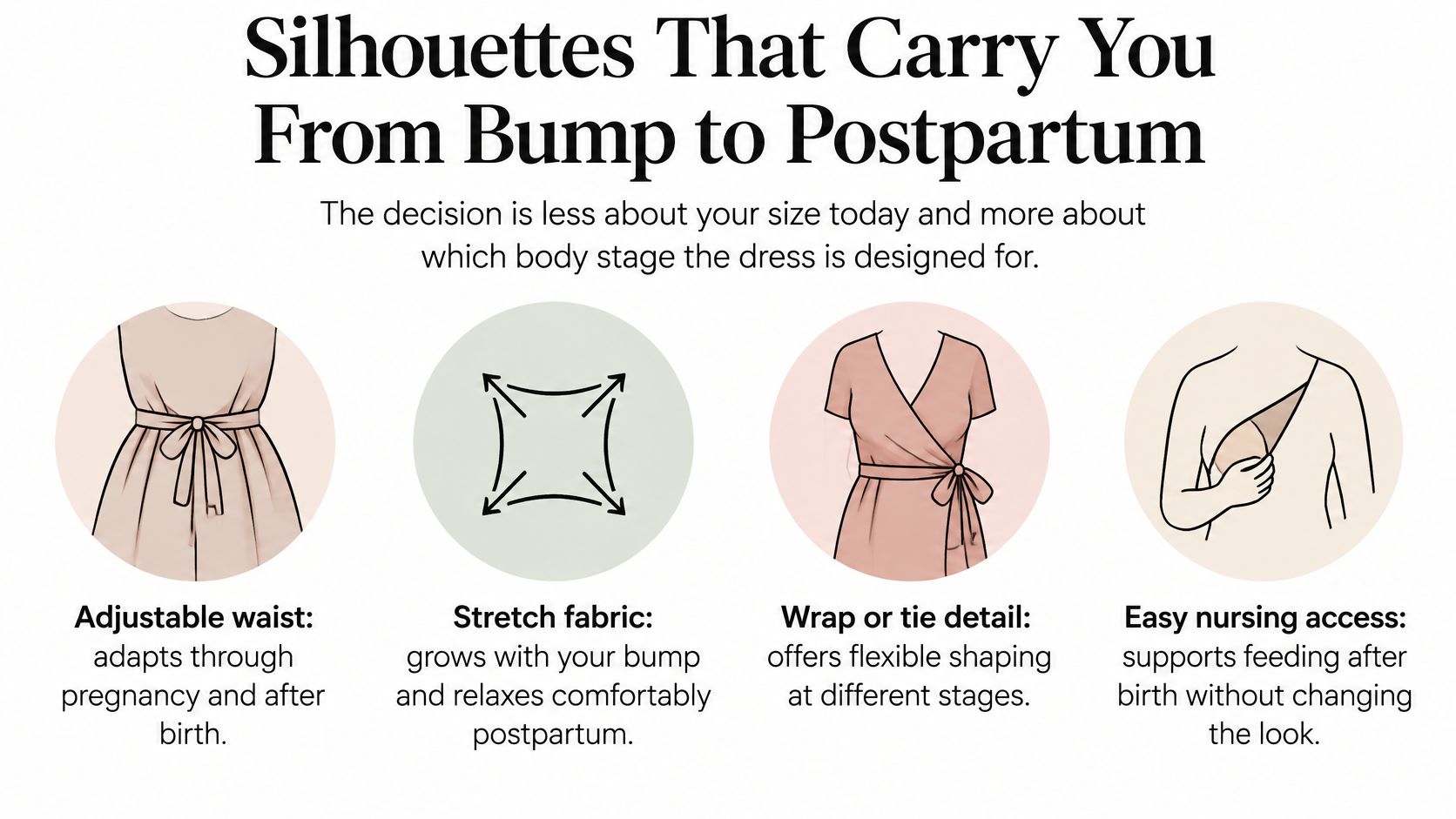
- Adjustable construction: Wrap ties, elasticized side panels, and movable waist details let you redistribute fabric instead of wearing it looser.
- Discreet feeding openings: If you plan to breastfeed, choose access that works without lifting the entire dress.
- A gentle inner surface: Check seam allowances, labels, and lining against skin that feels sensitive.
- Useful coverage: Choose lining that stays in place behind the skirt when you move.
- Appropriate hems and sleeves: Match coverage to your climate, venue, and personal or cultural preferences.
Choose structure without accepting pressure
A fitted bodice can feel reassuring after birth. It can also feel intolerable when your preferred fit shifts during the day. Choose a silhouette that fits the stage you are in now.
Take a full breath, sit, and lift your arms. Reject a bodice you can only tolerate while standing still. Controlled ease beats both extremes: tight stretch that fights your ribs, and an oversized cut that swamps your frame.
If every dress opening feels awkward, compare our guide to nursing-friendly dresses and consider separates for daily feeding. One well-chosen wrap or button-front often outperforms a closet of compromises.
Color shapes how observers read an outfit and how you feel wearing it, a distinction examined in Fashion and Textiles' clothing-color study. Treat your own experience as the deciding vote.
A movable waist detail and a neckline that returns to shape are the features to judge in motion. The fitting video below shows why those checks matter.
Buy for the stage you're in and the one immediately ahead. A red dress earns its place in your wardrobe by adjusting with you, and the right silhouette will still feel like yours months after the bump is gone.
Fabric, Opacity and Nursing Access Checks
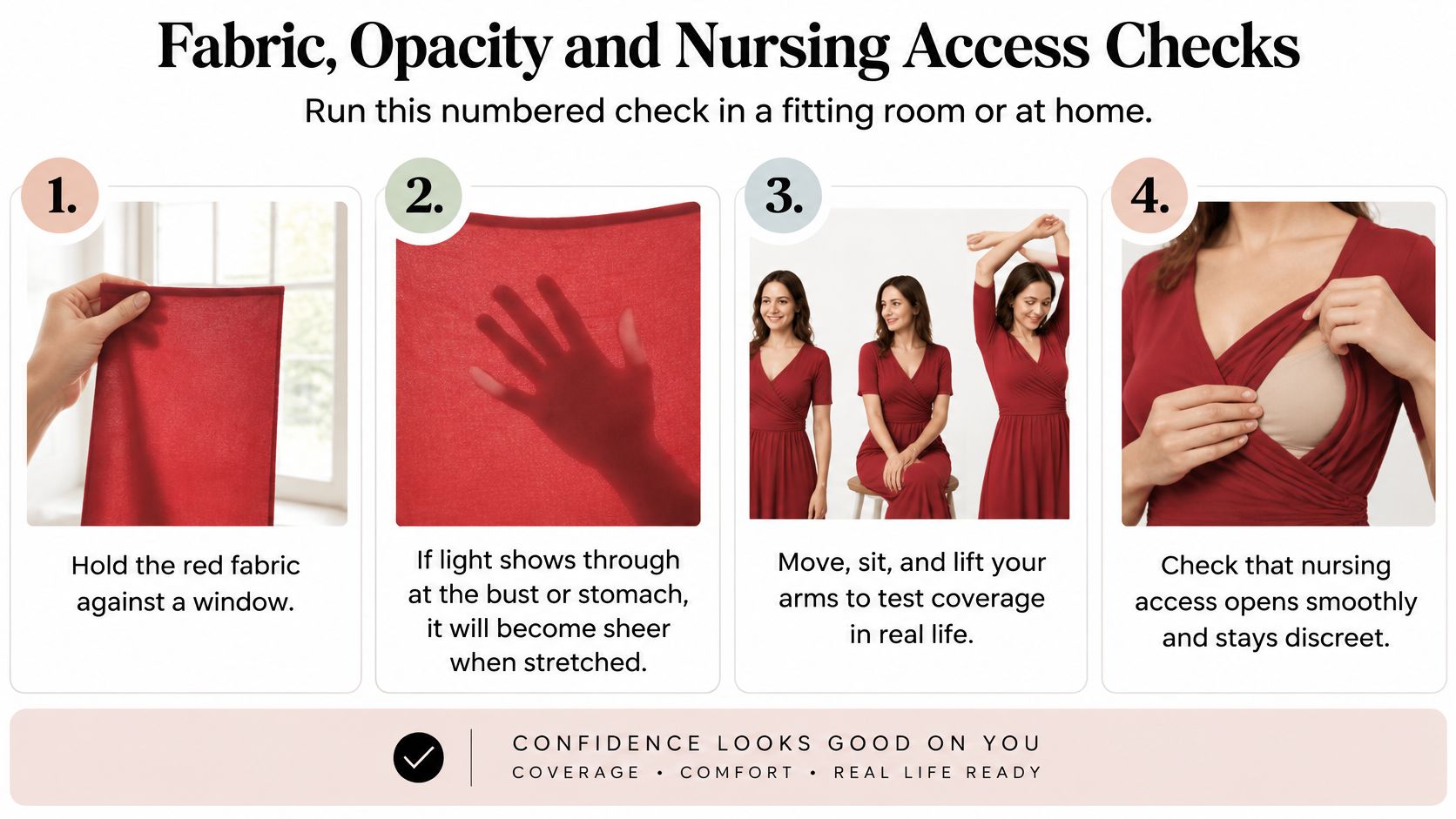
- Start at a window. Hold the fabric toward daylight, then inspect it while wearing the dress. Visible light through loose fabric is a warning to test coverage carefully, not proof that the garment will be sheer on your body.
- Check the stretched areas. Look across the bust and abdomen for thinning, shine, visible underwear, or a lighter patch of red. Test the lining as well as the outer fabric.
- Sit and move. Settle into a chair, lean forward, reach, and walk. Notice pressure from the waist seam, armholes, neckline, and any closure.
- Rehearse feeding access. Open and close the dress with one hand, using a cushion to occupy your other arm. Check that the opening closes securely and the neckline returns to shape.
- Read the care label. Follow its washing instructions, including temperature and whether the garment needs separate laundering. Turn it inside out if the label permits, and don't assume every red fabric tolerates the same treatment.
Keep this visual checklist beside you during the try-on.
Choose fabric for the room, not just the mirror
Maternity-wear design work published through PubMed Central identifies adaptability, comfort, ventilation, and humidity management as important requirements. A fabric that feels soft between your fingers can still feel hot or restrictive once it's lined and fitted.
Compare a stretch jersey, a woven fabric with elastane, and a breathable natural-fiber blend if you have the choice. Scrunch each gently, release it, and see whether it recovers. Run your fingertips along the inside seams, especially where they cross the abdomen.
For occasion fabrics, our guide to maternity silk dresses offers another starting point. Judge the finished garment, though: a breathable outer fabric won't cancel out a dense lining.
Fitting-room priority: A dress must pass the seated test. A beautiful standing reflection isn't enough.
Make the dress and nursing support work together
A built-in shelf bra can provide light support and reduce layers. Check whether it opens for feeding and whether its elastic presses against you. Don't assume a shelf replaces the support you personally prefer.
A separate nursing bra lets you choose support independently of the dress. Our GAIA nursing bra, for example, combines stretch lace, flexible support, and breastfeeding access. Whatever you wear underneath, make sure the dress opening and bra opening are reachable together.
A wrap dress can offer straightforward access, but only if the overlap moves far enough without dragging the opposite side across your chest. Test it with the bra you'll wear, rather than assuming a V-neck means nursing-friendly.
Choose soft cups when you prefer flexibility and fewer rigid components. If you prefer underwire, check that it surrounds rather than rests on breast tissue, and that the fitted bodice doesn't push it inward. Pain, digging, or pressure means the combination isn't right.
For a shower or formal dinner, prioritize secure coverage while seated. For an early postpartum outing, favor the setup you can operate without a mirror. The best nursing arrangement is the one you can use comfortably away from your bedroom.
Choose Your Red Dress This Week
Make the decision with a short, practical plan rather than another evening of scrolling.
- Name the occasion. Save the shade and silhouette you want to try, along with the invitation's dress code.
- Decide the support plan first. Choose the bra or built-in support that will go underneath before you commit, so the dress is judged alongside the opening you will use.
- Compare two finalists, then stop. Photograph each option on your phone, look at the pictures side by side, and give yourself a firm order date that leaves room for an exchange if your fit shifts.
Finish the outfit without overworking it
- Keep lingerie discreet: Try skin-tone or tonal underwear and inspect it beneath the actual fabric. Look at both color contrast and seam lines.
- Choose a focal accessory: Let earrings or a clutch provide the finishing detail rather than adding several competing pieces.
- Wear dependable shoes: Choose a pair you already know you can stand and walk in comfortably. An event isn't the place to discover an unstable heel.
A red dress earns its place when it lets you express something you enjoy about yourself. That might be bold color with flat sandals, a covered neckline with beautiful earrings, or a simple wrap you'll wear again.
At Milk&Lace, we were founded to celebrate motherhood, breastfeeding, and the women moving through this season. Our philosophy is reflected in the card included with the bra: “Because motherhood doesn't replace us, it adds and enhances us.” Getting dressed can honor who you are now without treating your previous wardrobe, or your previous body, as a deadline.
Before you buy, answer this: which occasion is this dress for?
We offer maternity and nursing lingerie to complement the clothes you want to wear through this changing stage. Visit Milk&Lace to explore nursing support, then try your chosen bra beneath your red dress so the complete outfit works for you.