

You're standing in front of a wardrobe full of clothes that used to make getting dressed easy. Now the waistband digs in, the blouse pulls across your bust, and the dress that looked effortless a few months ago suddenly feels like a costume. In early postpartum, the problem shifts again. Your bump has changed, your bust is unpredictable, and you want something comfortable without disappearing inside oversized layers.
The answer isn't more clothes. It's a better system. The most successful stylish maternity outfits use adaptable silhouettes, breathable fabrics, repeatable proportions, and supportive lingerie underneath. Build around those elements and your wardrobe can move with you from pregnancy through nursing and later postpartum, without asking you to dress like a different person.
Why Dressing Well During Pregnancy Feels Harder Than It Should
Getting dressed in the third trimester often becomes a negotiation. You pull on a knit dress because it still fits, reject it because you've worn it twice this week, then reach for leggings and a loose shirt because they're predictable. The clothes aren't necessarily wrong. They were designed for a body that stays relatively stable.
Maternity fashion has been solving this design problem for a long time, although the priorities have changed. During the Victorian era, structured maternity corsets were intended to disguise or minimize the visible bump. Lane Bryant, founded in 1904, introduced adjustable shirtwaists and wrap-front dresses, bringing practical adaptability into early ready-to-wear maternity clothing. The U.S. Patent and Trademark Office identifies Page Boy, founded in Dallas in 1937, as the first high-end maternity-wear firm, and in 1988 Gela Taylor and Pamela Skaist-Levy created Travis Jeans, a maternity-denim line designed in response to the shortage of contemporary options. These milestones are documented in the history of maternity clothing.
Stop treating your body like a styling problem
The old instinct is to hide the bump or compensate for it with volume. Neither approach is necessary. A wrap dress can define the smallest part of your upper torso while giving your abdomen room. A wide-leg trouser can balance a fitted knit top. A jacket that closes below the bust can add authority without compressing the belly.
The key is choosing garments that anticipate movement. Your bust, abdomen, waist, hips, and torso won't change at the same pace, so a fixed waistband or rigid bodice creates pressure exactly where you need flexibility. A stylish wardrobe should accommodate those changes while keeping the silhouette intentional.
The guiding principle: Don't shop for clothes that disguise your body. Shop for clothes that understand it.
That means replacing random maternity purchases with formulas you can repeat. A knit dress and structured jacket can become a work outfit, a school-run look, or a dinner ensemble depending on shoes and accessories. A wrap top can work over trousers now and under a cardigan later. Once you see clothing as a set of adaptable components, getting dressed stops feeling like a daily failure.
The Fabric and Fit Rules That Make Maternity Outfits Work
Start with the fabric, not the trend. A beautiful garment that traps heat, scratches sensitive skin, or restricts your stride won't become wearable because the color is perfect. A narrative review identifies adaptability, comfort, and stylishness as central requirements for healthy maternity wear, while a wear trial found that thermal comfort depended heavily on fiber content and breathability. A soft, well-fitting cotton/elastane garment performed best overall in that trial, as reported in this review of maternity-support garment design.
Your purchase checklist
Look for cotton/elastane blends, breathable knits, soft linings, and seams that don't sit directly across the most sensitive parts of your abdomen. Stretch should help the garment recover after movement, not just make a poor fit feel temporarily possible.
Adjustability matters just as much. Elasticized panels, wrap construction, multi-position fasteners, and strategic gathers allow one garment to respond to changing measurements. A gathered side seam can expand without adding shapeless volume. A wrap front can adapt to the bust and abdomen while creating a clean diagonal line. A multi-position fastening can keep a bra or trouser comfortable as your ribcage changes.
| What to Check | Why It Matters | Passes If... |
|---|---|---|
| Fiber and breathability | Heat and moisture build quickly in restrictive fabrics | The fabric feels light, soft, and comfortable against bare skin |
| Adjustable construction | Your body changes across the bust, abdomen, waist, hips, and torso | Panels, ties, gathers, or fasteners adapt without digging in |
| Seam placement | Poor seams create pressure and irritation | You can sit and move without rubbing or red marks |
| Stretch recovery | Stretch that stays stretched loses its polished shape | The garment returns to form after walking and sitting |
| Movement comfort | Standing still tells you very little | You can bend, reach, walk, and sit naturally |
| Postpartum usefulness | A pregnancy-only garment may have a short life | The silhouette, access, or layering still works after birth |
Test clothes in motion
Try every important piece seated, walking, bending, and reaching. A dress that looks elegant in front of a mirror may ride up when you sit. A blouse may feel fine standing but pull across the bust when you reach for something. A trouser panel may support the abdomen yet become irritating during a long car ride.
Avoid rigid waist shaping and garments tested on only one fit model. Those choices can create pressure points, overheating, visible marks, or a piece that looks polished but fails during nursing and daily movement. Fit is functional when you're pregnant. It's also what makes an outfit look expensive, because fabric falls cleanly instead of fighting your body.
Take current measurements before ordering: bust, underbust, waist, hip, and torso length. Add posture notes if your shoulders or lower back have changed. Compare those measurements with the brand's actual garment dimensions, not just a generic small, medium, or large label.
Everyday and Work Outfit Formulas You Can Repeat All Week
A real wardrobe needs to survive ordinary days. Monday may involve school drop-off and a full calendar. Tuesday may require a polished office outfit. Friday may call for dinner without the energy to reinvent your look.
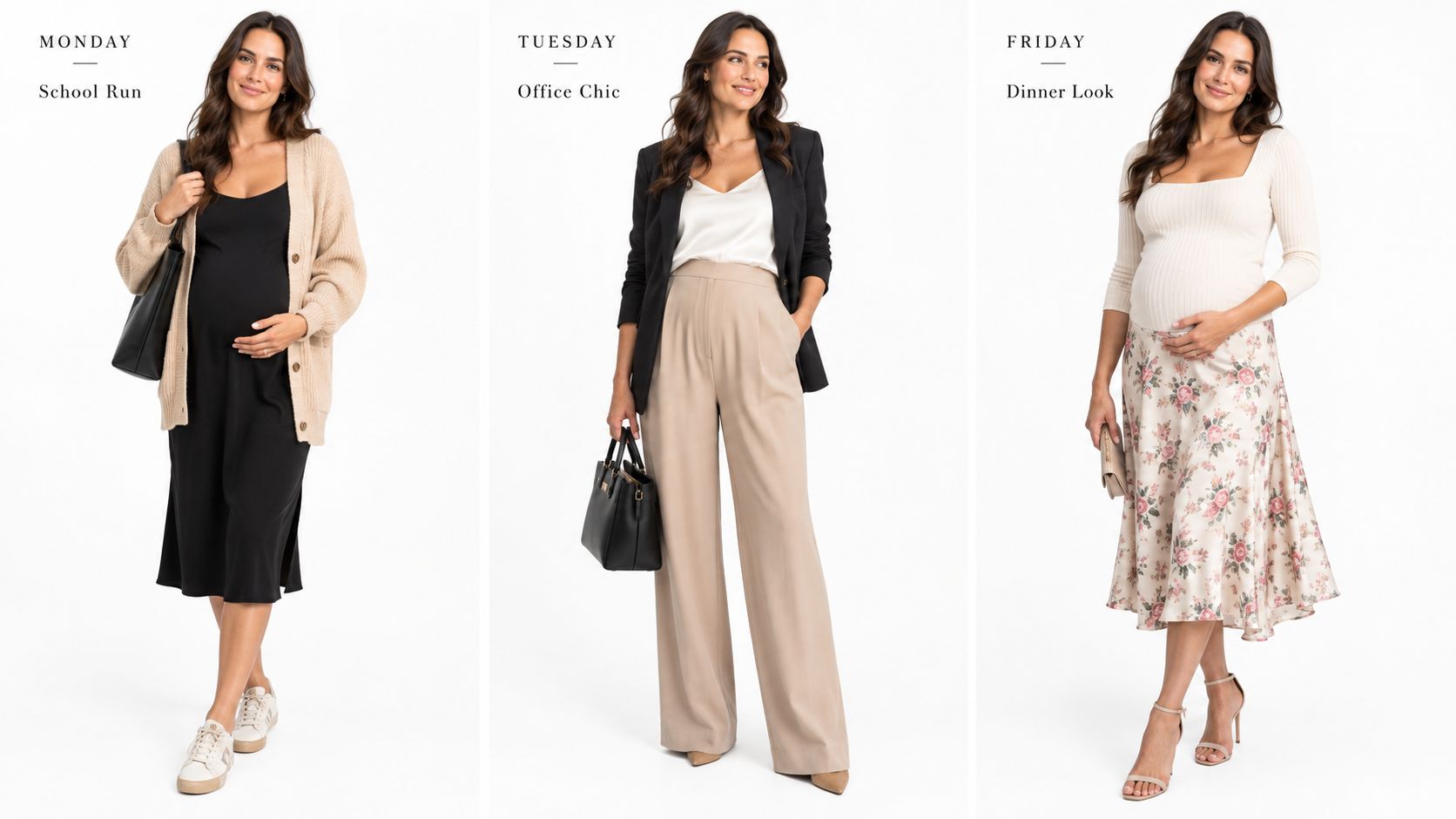
Monday school run
Choose a stretch knit dress, cropped or softly structured jacket, and flat loafers or supportive sneakers. The dress follows the bump without requiring a waist seam, while the jacket adds shape at the shoulders. Keep the lower half simple if the jacket is relaxed, or pair a closer-fitting jacket with a fuller knit dress.
Formula: Let one piece follow your body and let another create structure.
For a more casual version, wear wide-leg maternity trousers with a fitted wrap top and a cardigan. The trousers provide ease through the abdomen and hips, while the wrap top defines the upper body. Keep the cardigan open so the outfit retains a vertical line instead of becoming a single block of fabric.
Tuesday office day
A shirt dress with a belt placed above the bump is one of the easiest ways to look deliberate without squeezing your waist. Wear the belt under the bust or at the narrowest comfortable point, then add a blazer that closes below the bust or stays open over the dress. Choose loafers, low block heels, or polished flats.
For trousers, use a wide-leg pair with a wrap blouse or softly tucked knit. The volume belongs on the bottom, so keep the top close enough to show your shoulders and neckline. You'll find more practical guidance on choosing work pants for pregnant women when a standard waistband no longer works.
Friday coffee meeting or dinner
Use the same knit dress from Monday, but switch the jacket for a longline cardigan, add earrings, and choose a sleek flat or low heel. Or wear the wrap top with dark stretch jeans and a fitted jacket. Dark denim gives the outfit visual weight, while the wrap line prevents it from feeling like a basic weekend uniform.
The trick is not owning a separate outfit for every occasion. It's changing the proportion, shoe, and finishing layer. Keep the base comfortable and let one polished detail carry the look.
After you've worn these formulas in front of the mirror, test them through movement and a full day. A quick styling video can help you visualize how a small wardrobe shifts from casual to polished:
Dressing for Special Occasions and Travel Without Overpacking
Events and travel seem like different wardrobe problems, but they need the same solution: a small number of versatile basics transformed by accessories. Don't buy a dress that only works for one wedding if a wrap midi can handle a baby shower, dinner, a flight, and postpartum nursing.
A midi wrap dress is the strongest starting point. For a wedding, add low heels, earrings, a compact bag, and a fine cardigan for the evening. For travel, wear the same dress with clean sneakers, a soft cardigan, and a crossbody bag. The wrap construction accommodates body changes, while the accessories decide whether the outfit reads festive or practical.
For more refined occasion ideas, use maternity silk dresses as inspiration for choosing fluid fabrics and simple shapes that don't depend on a fixed waist. Look for fabrics that resist wrinkling, especially if you'll be sitting in a car or on a plane. A dress that recovers after being folded is more useful than one that looks exceptional only on a hanger.
Build around five core pieces
Pack a week of travel around a few pieces that can share shoes and layers:
- A midi wrap dress: Wear it with sneakers for transit and jewelry for dinner.
- Wide-leg trousers: Pair them with a fitted tee, wrap top, or button-down.
- A stretch knit dress: Add tights and boots in cool weather, or wear it alone.
- A button-down shirt: Leave it open over dresses or tie it above the bump.
- A cardigan or relaxed jacket: Use it for temperature changes and instant polish.
Comfortable footwear is essential. Pregnancy and postpartum feet can feel different from day to day, so choose shoes with a stable sole, a forgiving upper, and enough room for swelling. A low heel can look elegant, but no occasion requires shoes that make walking miserable.
Postpartum guests need another consideration: access. A fitted-looking dress with discreet nursing access can remain useful at a christening or dinner after birth, provided the bust fits securely and the opening is easy to operate. A soft, elegant nursing bra such as GAIA combines stretch lace, flexible support, and breastfeeding access, making the foundation more adaptable beneath occasion clothing.
Building a Maternity Capsule Wardrobe That Lasts Beyond the Bump
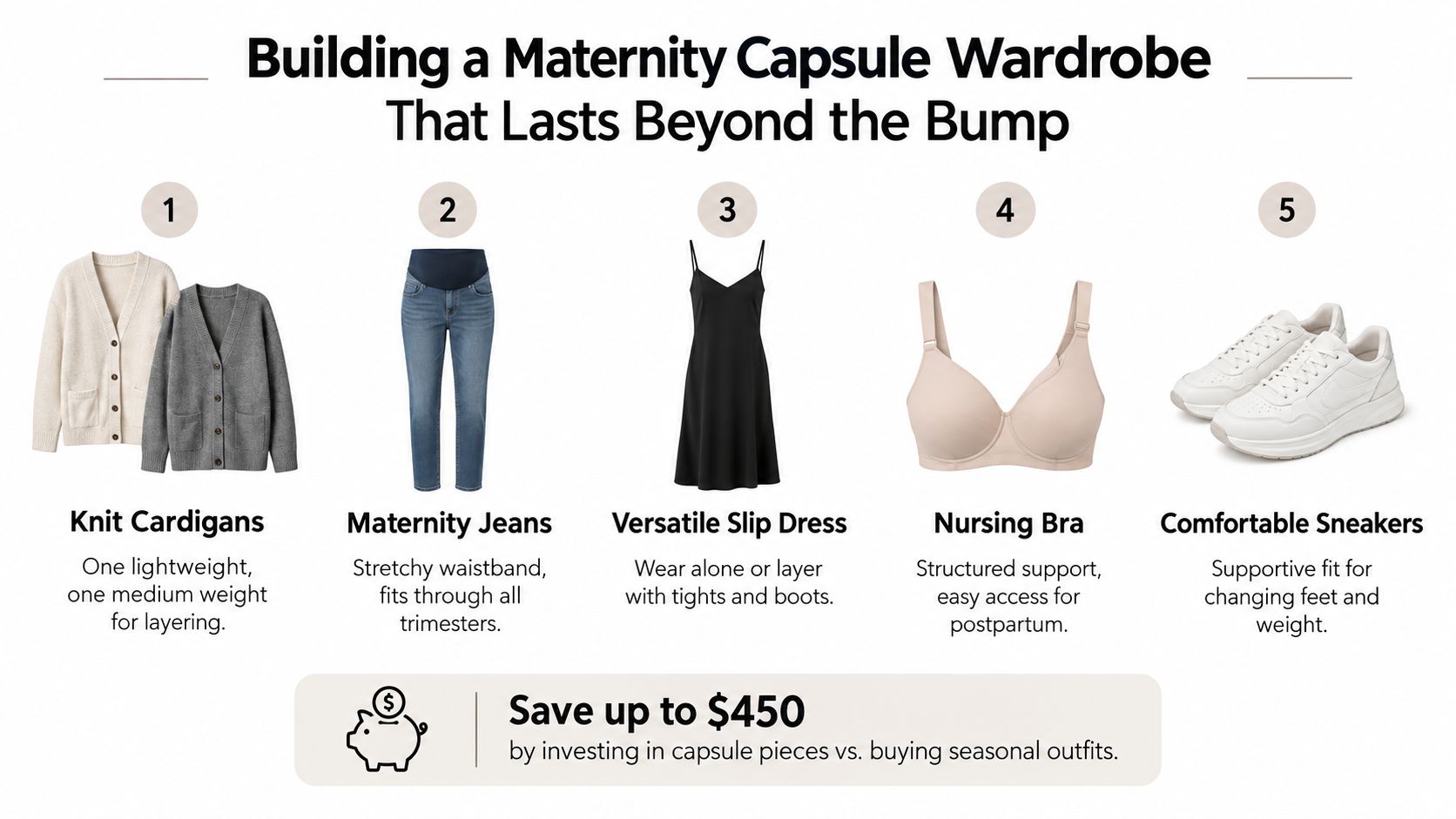
You get more wear from a maternity capsule when each piece adjusts with your body instead of serving one short phase. Build around silhouettes that can shift in proportion, layer easily, and still make sense once the bump is gone and your shape keeps changing through postpartum and nursing.
A practical core looks like this:
- Two knit dresses, one fitted and one relaxed.
- Wide-leg trousers with an adaptable waist.
- Dark stretch jeans with a supportive maternity panel.
- A wrap top that works during pregnancy and nursing.
- A button-down shirt for layering and office dressing.
- A cardigan for temperature changes.
- A structured jacket that closes below the bust or works open.
Design for two postpartum phases
Early postpartum dressing needs softness, easy access, and room where your body still asks for it. The abdomen may stay tender and fuller for a while, and the bust can change quickly during feeding. Relaxed dresses, wrap tops, open shirts, and elasticated trousers usually keep working here. Rigid tailoring usually does not.
Later postpartum, many people want sharper lines again. That is when a fitted knit dress, polished trouser, or structured jacket earns its place, especially if the foundation underneath supports the bust properly. Do not save every fitted piece for some future version of your body. Buy for your current measurements and let the cut do the work now.
Analysts in commercial maternity-wear market reporting note that roughly 58% of consumers seek garments usable during both pregnancy and postpartum, while around 56% look for pieces that work through pregnancy and nursing. That lines up with what actually makes a wardrobe useful. Rewearable pieces matter more than a larger pile of single-purpose maternity buys.
Spend on categories you will reach for repeatedly, not on duplicates that solve the same outfit problem. One good wrap top that works with jeans, trousers, and skirts is more valuable than several novelty tops that only fit for a few weeks.
A lasting capsule expands and contracts with you. It doesn't get boxed up the moment the baby arrives.
Styling With Elegant Nursing Lingerie as Your Foundation
The outfit starts underneath. A blouse can be beautifully cut and still hang badly if the bra band shifts, the cups compress the bust, or the straps create visible tension. A knit dress can feel exposed if the foundation doesn't provide stable support. Nursing lingerie isn't a separate technical layer. It influences the line, balance, and confidence of everything above it.
That matters most in later postpartum, when comfort remains essential but you also want to feel recognizable again. A supportive nursing bra with a smooth second-skin feel can make fitted dresses, jackets, and fine knits feel wearable. Discreet nursing access keeps the practical detail hidden, so the finished outfit still looks intentional.
Milk&Lace offers the PETRA nursing bra, described as featuring ultra-soft stretch lace, gentle underwire, and one-hand nursing access. Those details are useful when you're dressing for the later postpartum stage and want support without abandoning elegant lingerie.
Measure before you judge the silhouette
Don't use your pre-pregnancy bra size as a shortcut. Take current measurements across the bust and underbust, then note your waist, hip, and torso length when choosing clothing to wear over the bra. A garment may need more room at the bust while still benefiting from a close fit through the shoulder.
Research on functional apparel found that pre-pregnancy size is a poor predictor of postpartum garment size. In a 3D-body-scan study of 677 women, an SVM model using key anthropometric measurements predicted clothing size with 89.66% accuracy, while traditional sizing systems failed to represent diverse body shapes adequately, as reported in this functional apparel sizing study.
Use a try-on checklist rather than relying on the label:
- Band stability: It stays level without digging in.
- Cup containment: The bust sits securely without spilling or compression.
- Strap pressure: Straps support without leaving painful marks.
- Nursing-access reach: You can open and close the cup with one hand.
- Seam comfort: Lace, elastic, and underwire don't irritate sensitive areas.
- Extended wear: The bra remains comfortable after sitting and moving.
A flexible exchange policy matters because your body may continue changing. The right size is the one that supports you now, not the size you hope to wear later.
When Sizing Fails and What to Do Instead of Sizing Up
“Just size up” is lazy advice. It ignores simultaneous changes in the ribcage, bust, waist, hips, and torso, and it often replaces a fit problem with excess fabric. Oversized clothing can obscure your proportions, create friction while you're carrying a baby, and make an otherwise thoughtful outfit look unfinished.
Market reporting suggests that about 56% of consumers struggle to find accurate sizing across brands, while approximately 49% seek personalized sizing and adjustable garments, according to maternity clothing market reporting. Use those figures as context, not as a reason to buy blindly.
What should you measure?
Take your current bust, underbust, waist, hip, and torso measurements. Compare them with the garment's finished dimensions, and check whether the item is designed to stretch, wrap, gather, or adjust.
What should fit now?
A relaxed dress can accommodate future change, but a structured jacket, bra, or fitted bodice needs precision today. Buy ease where the garment needs movement, not everywhere.
When is an exchange better than a larger size?
Choose an exchange when the shoulders, cups, band, or armholes fit incorrectly. Going larger may fix the abdomen while making the upper body collapse. Flexible panels and adjustable fasteners are better solutions than adding volume indiscriminately.
What's the difference between ease and excess?
Ease lets you move while preserving the garment's intended shape. Excess volume hides the shape entirely and can make layering awkward. Keep one part of the outfit relaxed and another part defined, so the look still has a point of view.
You don't need to return to a pre-pregnancy body to deserve beautiful clothes. Dress the body you have now with intention, support, and pleasure.
Milk&Lace offers elegant nursing bras with structured support, soft stretch lace, and discreet breastfeeding access for the later postpartum stage. If you're ready to make polished maternity outfits feel wearable from the foundation up, visit Milk&Lace and explore pieces designed to support comfort, confidence, and personal style.