

You've got a baby on your hip, a full day ahead, and a closet that suddenly seems designed for someone else. The dress you loved before pregnancy may pull across your chest, ride up when you sit, or leave you wrestling with layers every time your baby needs to feed. Meanwhile, the oversized alternative makes you feel hidden rather than dressed.
The best nursing friendly dresses solve both problems. They give you fast, discreet access without turning your outfit into obvious nursingwear, and they work with a supportive nursing bra to create a silhouette that feels intentional. A wrap dress, shirt dress, or concealed-zip style can take you from errands to the office to dinner, but only if its construction matches your routine.
The Search for Postpartum Style That Actually Works
A few weeks after giving birth, you stand in front of the mirror with a dress in one hand and a nursing baby in the other. The dress looks beautiful on the hanger. On your body, the bust feels crowded, the waist lands in the wrong place, and the neckline seems impossible to open with one hand. You put it back and reach for the same soft top you've worn all week.
That choice makes sense in the moment, but repeating it can leave you feeling disconnected from your personal style. You shouldn't have to choose between a practical feeding outfit and clothing that makes you feel polished. The right dress should accommodate your changing body while still looking like something you'd have chosen before motherhood.
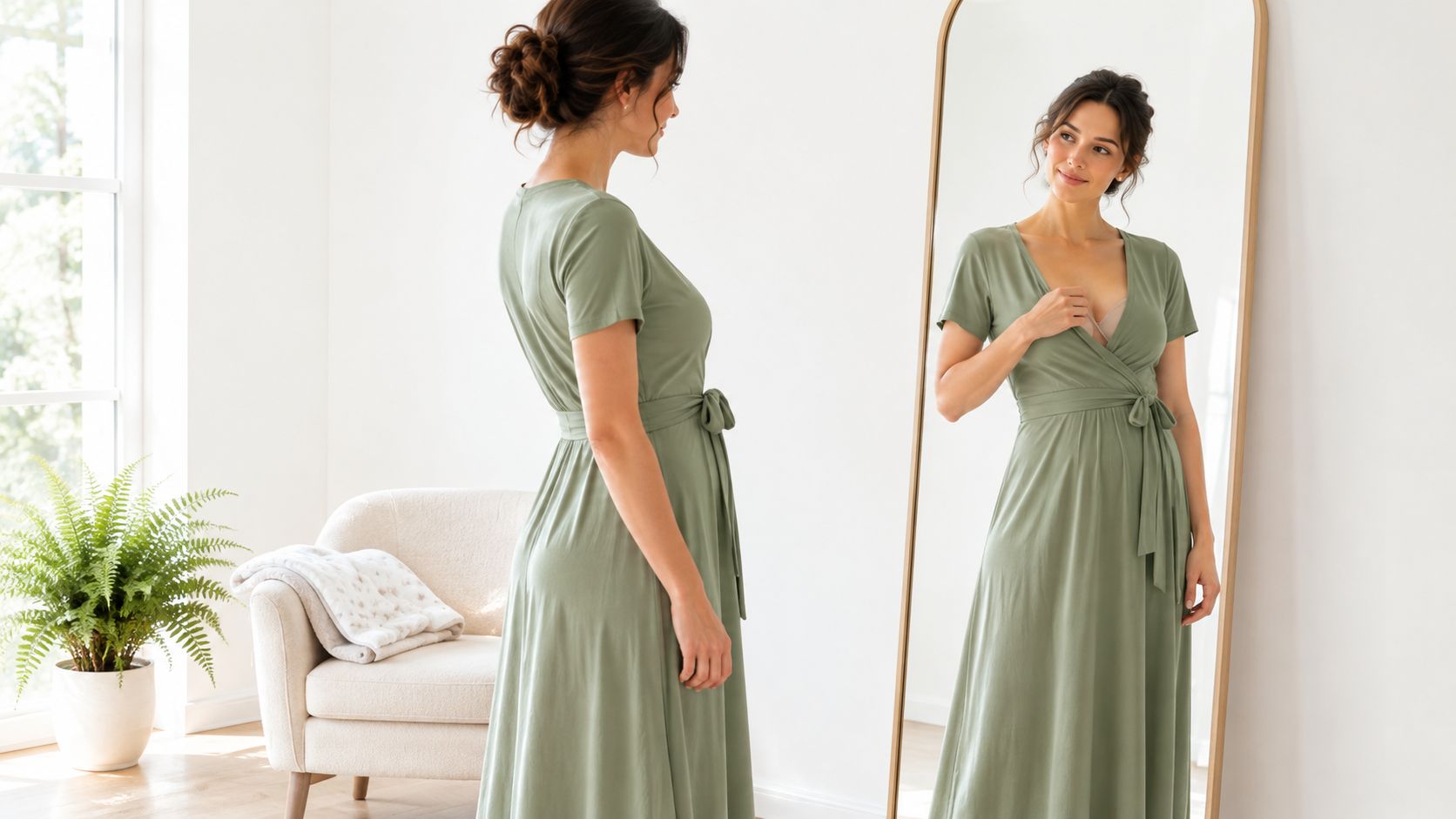
Breastfeeding remains part of everyday life for many families well beyond the earliest postpartum weeks. In the United States, 86.1% of infants born in 2023 were ever breastfed, while 62.8% were still breastfed at 6 months and 40.8% at 12 months, according to the CDC breastfeeding data survey. That makes a nursing dress more than a temporary maternity purchase. It can become dependable wardrobe infrastructure for commuting, travel, social events, and ordinary days out with your baby.
Style should support your actual day
A dress that only works when you're standing in front of a mirror isn't nursing-friendly enough. You need to test it while seated, holding your baby, wearing the bra you'll use, and reaching for the opening with one hand. If the garment shifts, exposes more than you want, or requires a complete outfit change, it belongs in the “pretty but impractical” category.
Look for pieces that can stay in your wardrobe after breastfeeding, too. A wrap silhouette, a useful button placket, or a concealed opening can remain valuable long after nursing ends. The stylish nursing wear guide from Milk&Lace reflects that broader approach, pairing function with a more considered view of postpartum identity.
What Truly Makes a Dress Nursing Friendly
A nursing-friendly label doesn't guarantee a workable dress. The true test is whether you can feed comfortably, discreetly, and without using both hands to dismantle the garment.
The strongest design criterion is one-handed breast access. Qualitative research with breastfeeding mothers identifies ease of use, modesty, comfort, fit, and operation during body changes as central requirements. Mothers also emphasized one-handed use because feeding often happens while holding or positioning an infant, as documented in research on ergonomic nursing-dress design.
Examine the opening before the silhouette
Concealed zippers, overlapping wrap panels, and under-bust openings usually outperform a standard pull-down neckline. A neckline that stretches too far may expose the entire upper chest, while a narrow opening can make latching awkward. The best access point exposes what you need and keeps the rest of the outfit stable.
Use this practical test before buying:
- One hand: Open and close the mechanism while holding a weighted object in your other arm.
- Seated posture: Test the opening in a chair, not only while standing.
- Bra compatibility: Wear a nursing bra underneath and check that the dress doesn't catch on the cup or strap.
- Coverage: Bend forward and lift your arms to see whether the fabric still feels secure.
- Re-closure: Make sure the opening returns neatly to its original position after feeding.
The garment also needs controlled flexibility. Postpartum bodies change in the bust, abdomen, and waist, so rigid fabric can create pressure or ride up when you sit and bend. Research on postpartum apparel comfort and nursing-dress design supports soft stretch materials, movement-friendly construction, thermal comfort, and fabrics that remain stable across changing body proportions.
Don't confuse looseness with adaptability
A shapeless dress may hide fluctuations, but it can also twist around the bust, drag at the hem, and make access harder. Better designs provide ease where you need it, then use wrap geometry, panel placement, elastic, or adjustable ties to retain shape.
A bra matters here because it controls the foundation beneath the opening. GAIA is a soft nursing bra with stretch lace, flexible support, and breastfeeding access. Whatever bra you choose, check that the dress accommodates its cup edge, straps, and nursing clasp without pulling the outer fabric out of alignment.
Practical rule: If you can't operate the dress one-handed while seated, it isn't ready for real-life feeding.
Comparing Styles for Different Lifestyles
Your best choice depends on where and how you'll wear it. A wrap dress may be perfect for flexible fit and quick access, while a concealed-zip dress can look sharper for work or formal events. A button-front style offers familiar control, but decorative buttons don't help if they don't open.
| Style | Access Type | Best For | Pros |
|---|---|---|---|
| Wrap dress | Overlapping front panels | Changing body shapes, everyday wear, travel | Adjustable fit, recognizable silhouette, easy access |
| Concealed-zip dress | Hidden vertical or under-bust zipper | Office days, commuting, discreet public feeding | Clean appearance, controlled exposure, quick operation |
| Button-front dress | Functional buttons through the bodice | Casual days, layered outfits, pumping breaks | Familiar opening, adjustable coverage, easy styling |
| Lift-up panel dress | Fabric panel lifts from the bust | Errands, relaxed routines, warm weather | Fast access, minimal hardware, comfortable movement |
| Stretch pull-down style | Flexible neckline or upper bodice | Home wear and informal outings | Simple construction, easy to layer, often soft |
The right answer may change during the day. A button-front shirt dress can work for a childcare pickup and a café stop, while a structured concealed-zip dress can make more sense for meetings. For a closer look at how wrap construction affects access and styling, read this guide to wrap dresses for breastfeeding.
Match access to privacy
A quick opening isn't automatically the most useful one. If you're pumping at work, you may value a stable bodice, room for a nursing bra, and fast re-closure more than a dramatic wrap. If you're caring for a baby at home, softer fabric and flexible movement may matter most.
Think beyond direct feeding. Workplace routines may involve pumping, limited private space, and the need to return to a professional setting quickly. Research involving breastfeeding nurses and support staff identified clothing discomfort, limited public breastfeeding spaces, cultural pressure, and job-security concerns as barriers, while a global-health review connected returning to work with inadequate facilities and insufficient support. Clothing can make access easier, but it can't solve structural workplace problems.
Choosing the Right Dress for Your Body and Occasion
Start with the occasion, then choose the silhouette. A dress for a work meeting needs a different balance of structure and softness than one for a long day of errands. The most flattering option is usually the one that gives your body room to change without looking oversized.
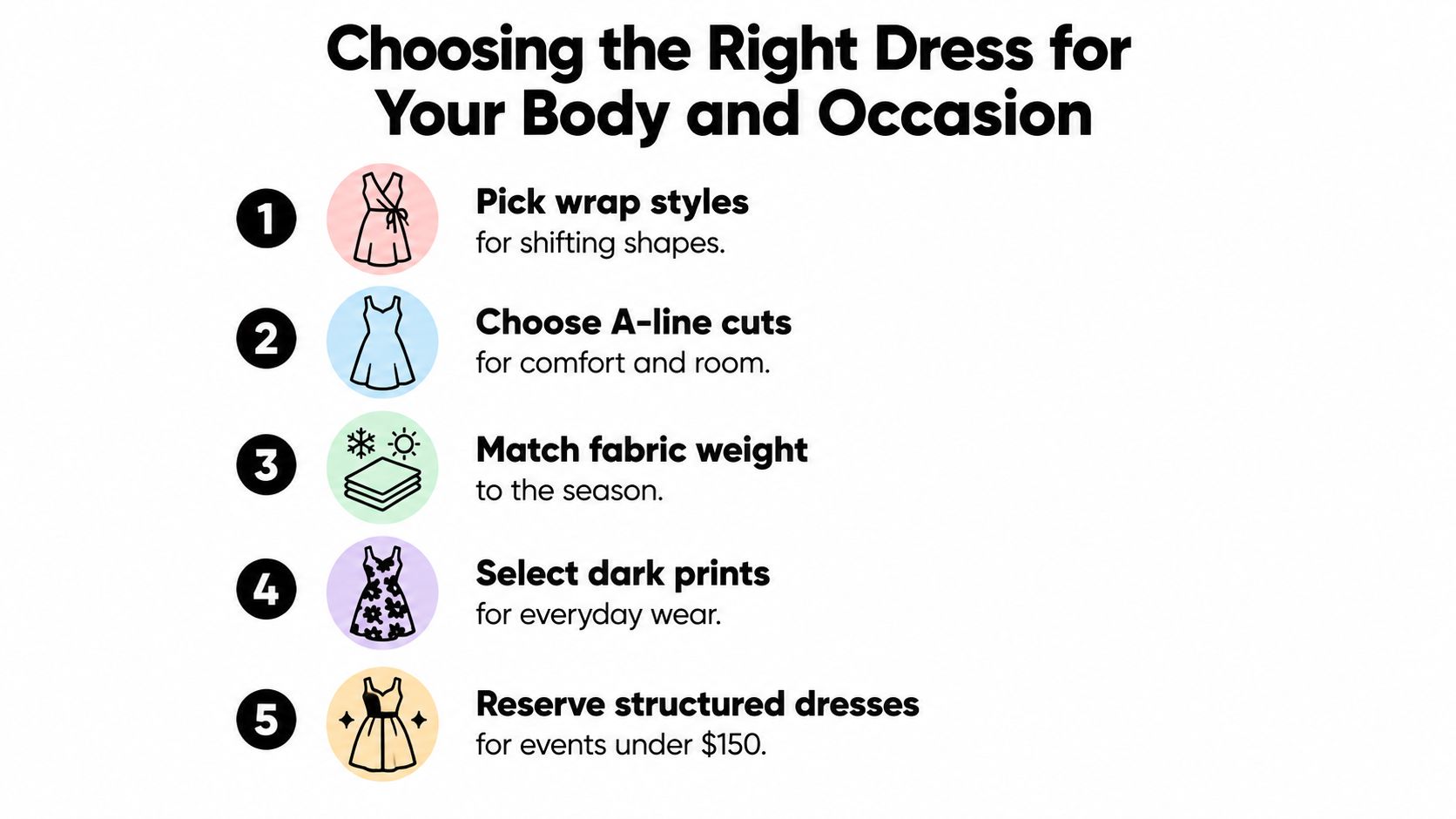
Begin with your current proportions
Measure your bust at its fullest practical point, wearing the bra you expect to wear with the dress. Don't size from your pre-pregnancy measurements alone. Breast volume can fluctuate, and a dress that fits perfectly across the shoulders may still feel restrictive at the bust or abdomen.
Wrap styles are especially useful when your proportions are shifting. You can adjust the waist without forcing the bodice to sit at one fixed point, but inspect the overlap carefully. If it opens when you bend, the apparent flexibility becomes a coverage problem.
A-line cuts suit anyone who wants more room through the waist and hips without losing shape. They're also useful when sitting, carrying a baby, or moving through a busy day because the skirt doesn't cling around the abdomen.
Choose by setting
- For work: Pick a midi length, stable fabric, and concealed access. Add a fitted cardigan or blazer if the neckline needs extra coverage.
- For everyday errands: Choose a soft wrap, button-front, or lift-up style that won't punish you for bending, walking, or sitting on the floor.
- For warm weather: Favor breathable, moisture-managing fabric and check opacity across the bust and hips.
- For events: Look for a defined waist, reliable lining, and access that doesn't require removing jewelry or outer layers.
- For travel: Prioritize wrinkle resistance, quick access, and a silhouette that can work with flat shoes and layers.
Fabric weight should follow the season and your schedule. Lightweight fabric can feel pleasant in warm weather but may need a lining for coverage. Heavier fabric can create a more polished line, but it needs enough flexibility for nursing and sitting.
Dark prints and mid-tone colors are practical for frequent wear because they make everyday marks less conspicuous. That doesn't mean your wardrobe should become cautious. A vivid wrap dress or a soft floral shirt dress can still be functional if its opening and fit pass the movement test.
The Secret to a Polished Look, Pairing with the Right Bra
The dress is only half the outfit. A nursing dress can have excellent access and still look unfinished if the bra underneath creates bulges, collapses the bust, or leaves straps fighting with the neckline.
A supportive nursing bra gives the dress a stable foundation. It helps the bust sit where the designer intended, keeps wrap panels from drifting, and prevents the fabric from stretching across sensitive areas. This matters even more with fitted bodices, smooth jersey, satin, and lightweight knits, where every underlying line becomes visible.
Build the outfit from the inside out
Start by checking the band. It should feel secure without digging into the ribs, and the cups should contain the breast tissue without spilling at the top or sides. A nursing clasp should open smoothly with one hand and close without forcing you to twist the dress.
Next, examine the neckline. A plunge wrap dress may need a lower-profile bra, while a square-neck style may work better with wider straps. If the dress has a racerback or narrow shoulder, test the bra underneath before deciding that the problem is the dress.
A beautiful dress can't compensate for a bra that changes its shape.
Milk&Lace positions its nursing lingerie around the point when comfort still matters but you also want a more refined look. Its collection includes lace nursing bras designed with breastfeeding access, flexible support, and a softer lingerie aesthetic. That kind of foundation can work particularly well under a dress that relies on a defined bust line rather than excess fabric.
Use the bra to solve, not hide, fit problems
Don't buy a dress several sizes too large to accommodate your chest. Excess fabric can obscure your waist, pull the nursing opening away from the breast, and create accidental exposure when you lean forward. A better approach is a dress with bust ease and a bra that offers the support your current shape needs.
The right pairing also improves confidence. You're less likely to tug at the neckline, adjust the straps, or avoid lifting your arms when the bra and dress move together. For help comparing support, coverage, and silhouette, use the Milk&Lace nursing bra style guide.
Try the complete outfit before wearing it outside. Sit, lift your arms, pick up a bag, open the nursing clasp, and check your reflection from the side. If the bra keeps the bodice smooth and the access point remains easy to reach, you've created a coordinated outfit rather than merely combined two functional items.
Fit, Sizing, and Care for Long-Lasting Style
The best nursing friendly dresses should work with your body as it changes, not demand that your body stay at one exact measurement. Buy for your current bust and use the garment's construction to accommodate the rest. A flexible waist can handle gradual change, but a tight chest usually becomes uncomfortable quickly.
Fit with the bra you'll actually wear
Measure at the fullest part of your bust and compare that measurement with the garment's size chart. Try the dress over a supportive nursing bra, not a thin camisole. Check whether the armholes pinch, whether the waist stays in place when you sit, and whether the nursing opening still aligns with the bra cup.
A good fit should pass these checks:
- Bust: The fabric lies smoothly without pulling across the nursing access.
- Underarm: Seams don't press into sensitive breast or underarm areas.
- Waist: The dress gives shape without compressing the abdomen.
- Skirt: The hem remains comfortable when seated and doesn't ride sharply upward.
- Opacity: The fabric stays opaque when stretched across the bust.
Plan for exchanges when your body is still changing. Read the retailer's size and return guidance before removing tags, and keep packaging until you've tested the dress through normal movement. A flexible return process can save you from keeping a garment that only works for a brief window.
Protect stretch, closures, and coverage
Follow the care label, wash delicate fabrics gently, and avoid treating stretch lace or elastic as indestructible. Heat and rough handling can affect recovery, which may leave the nursing opening loose or cause the fabric to lose its shape. Close zippers and fasteners before washing, and store wrap dresses without crushing the tie or panel.
Let the dress dry in a way that preserves its shape. If the fabric remains damp, don't put it away tightly folded. Check the lining, seams, and nursing mechanism periodically, especially if the dress is part of your weekly rotation.
For a visual guide to coordinating fit, care, and nursing access, use the video below after you've considered the written checks.
A reliable postpartum wardrobe doesn't need dozens of dresses. It needs a few pieces that open easily, fit over the right bra, survive repeated washing, and suit the places you go. Choose the dress as part of a complete outfit, and you'll spend less time adjusting fabric and more time feeling like yourself.
Milk&Lace offers elegant nursing bras designed to combine breastfeeding access with flexible support and a more refined lingerie feel. Visit Milk&Lace to find a nursing bra that gives your favorite nursing-friendly dresses a smoother, more confident foundation.