

The invitation lands, it's black tie, and your body is not the body you dressed six months ago. Maybe you're newly pregnant and not yet showing but feeling fuller at the bust. Maybe the event falls two weeks after your due date and you're trying to imagine feeding a baby in a floor-length gown. Either way, sizing up a regular dress rarely solves it, because the waistline is still in the wrong place.
Treat maternity black tie as one system instead. Choose the silhouette for your stage on the night, pick a fabric that moves with you, fit it by measurement, and plan the bra underneath before you fall for a neckline. That's how you get an outfit you can sit, eat, dance and, if needed, nurse in.
Black Tie Silhouettes That Work Through Pregnancy
| Silhouette | Early pregnancy | Late pregnancy | Postpartum nursing |
|---|---|---|---|
| Empire-waist gown | Works well | Works well, skims the bump | Good, easy to layer |
| A-line with stretch panel | Works well | Works well | Good with side access |
| Draped wrap gown | Works well | Works well, adjustable | Fair, check the neckline |
| Column gown with side zip | Fits well | Tight over the bump | Fair, zip can strain |
| Two-piece bodice and skirt | Works well | Works well, skirt adjusts | Excellent, bodice can open |
| Mermaid with boned bodice | Fits well | Restrictive | Poor, avoid |
Why the Ratings Land That Way
An empire waist sits under the bust and lets the skirt fall freely, so nothing presses on the bump. It's the safest late-pregnancy choice and it still looks intentional in photographs. An A-line works when the bodice fits and the flare clears the hip. A column depends entirely on fabric and seams, since a rigid column has nowhere to put a growing abdomen.
A wrap bodice earns its place because you can retie it as your bust changes. A two-piece set is more flexible than it looks, because the skirt stays anchored while the bodice can open, lift or be swapped. That's why it outscores one-piece gowns after birth.
Formal pregnancy dressing has a long, practical history. A study of more than 300 garments across 51 museum collections documented maternity adaptations from 1750 to 1900, including evening gowns where women let out darts, lengthened skirt fronts or altered bodices, then converted garments back later. Support, fit flexibility and refinement have coexisted in formal maternity dress for centuries.
What to Avoid
- Boned mermaid bodices: They compress the abdomen and fight deep breathing through a long dinner.
- Fitted columns with strained zips: If the zip pulls at the bump while standing, it will fail you seated.
- Necklines built for a bra you don't own: Don't buy a backless or plunge gown and hope support appears later.
Choose for the stage you'll be in on the event date, not the stage you're in this week. A gown that's perfect now can be wrong in eight weeks.
Fabrics and Construction That Forgive Changing Shape
Start with a floor-length gown in an evening fabric. The formal black tie guide from Fashion Informed lists silk, velvet, chiffon, lace, brocade and taffeta as evening fabrics, and pattern research cited there gives approximate added ease of 7-10 inches at the waist, 2-4 inches at the bust, 3-4 inches at the hip and 1-2 inches at the bicep as development benchmarks. Use those numbers as a check, not a promise. Too much bust ease gapes, while too little hip ease pulls and lifts the hem when you sit.
Before you judge color or sparkle, look at how the cloth behaves against your hand and over your belly.
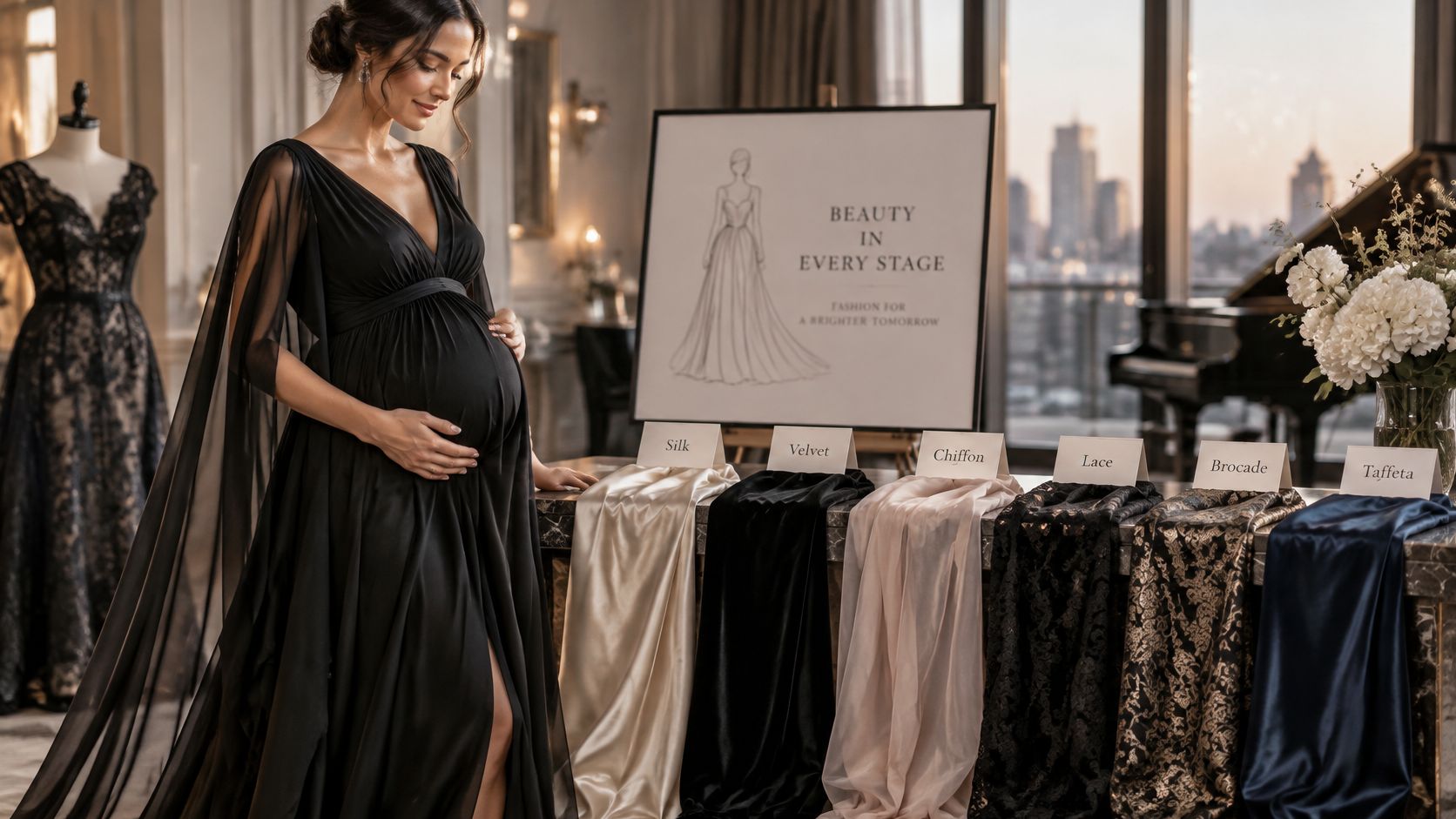
Silk and fine crepe drape cleanly without clinging, which is why they photograph so well over a bump. If you're weighing silk in particular, our guide to maternity silk dresses covers how it behaves across pregnancy. Chiffon and lace layer beautifully over a light lining and soften the silhouette. Velvet reads instantly formal but holds heat, so save it for cooler venues and winter dates.
Construction Details Worth Paying For
- Pleats and gathers at the waist: They release fabric exactly where the abdomen needs it.
- Stretch panels in the side seams: They give without changing the front view of the gown.
- A draped overskirt or wrap front: It hides adjustment room inside a deliberate design line.
- A lining that moves separately: The outer layer can skim while the lining keeps you comfortable.
- Engineered openings: Hidden zips or panels placed for access, not added as an afterthought.
Prefer single-layer or lightly lined builds for long events. They breathe better, carry less bulk and don't stick to your legs through dinner. Check straps and sleeves with the same care. Straps should have a little give so they don't dig into swollen shoulders, and sleeves need enough bicep room to lift a glass, shake hands and reach across a table.
If a fabric wrinkles badly after five minutes in a fitting room, it will look worse after six hours of dinner.
Measure, Fit and Confirm the Gown Before the Event
At your final fitting, the gown, bra and shoes must work together. Start with fresh measurements, then judge the fit in the full outfit rather than trusting your usual dress size.
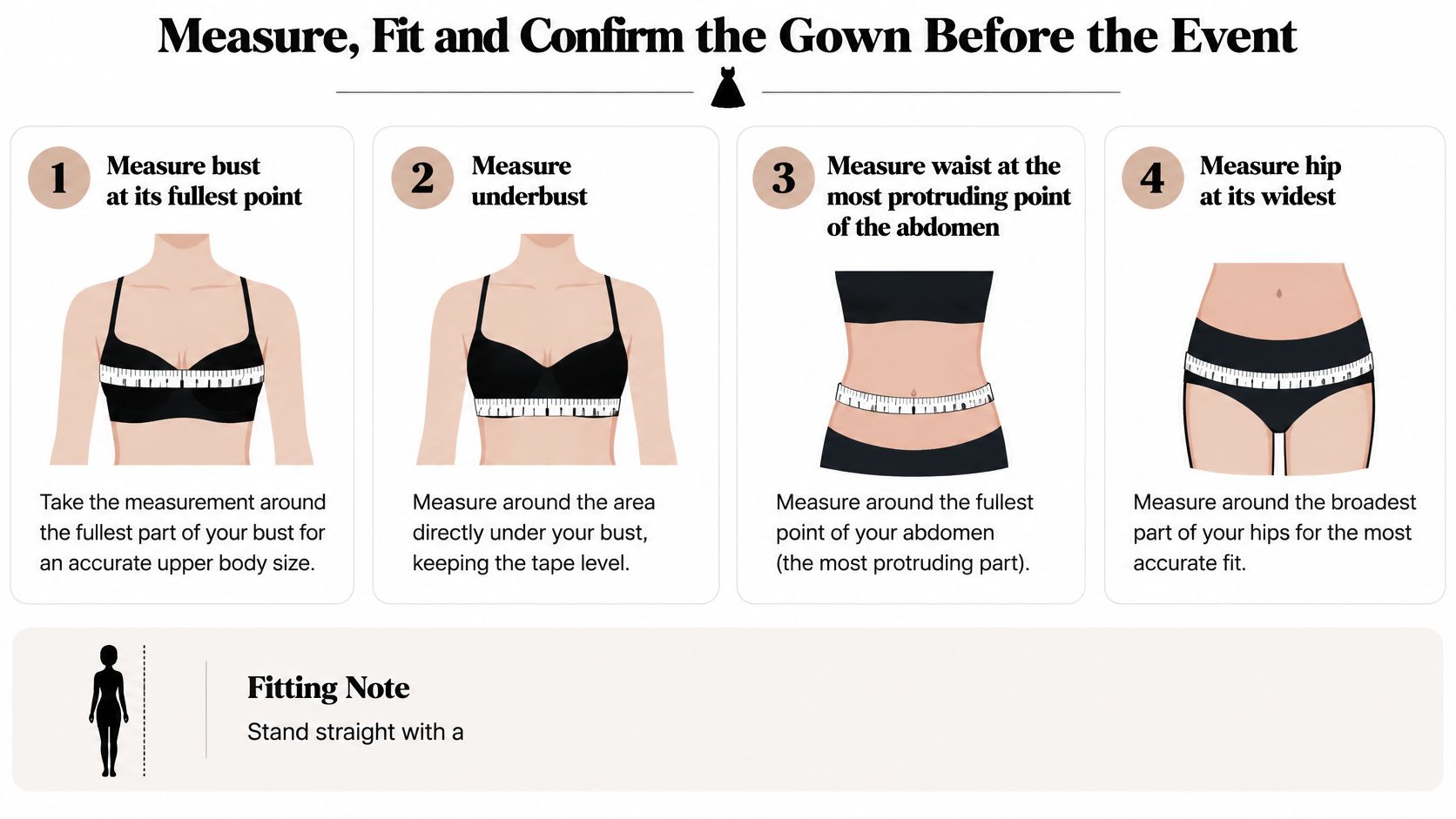
The Fitting Routine
- Measure four points. Stand straight and record your bust at its fullest point, underbust, waist at the most protruding point of your abdomen, and hip at its widest. Keep the tape level and snug, never tight.
- Repeat within two weeks of the event. Pregnancy changes can make an earlier measurement unreliable.
- Compare with the brand's size chart. A 3D anthropometric study of 20 women found that actual waist and hip changes differed significantly from ASTM D7197-13 estimates, while bust changes aligned with the standard. Treat the chart as a starting point, then confirm the fit on your body.
- Check the gown in motion. Wear the bra and shoes planned for the event. Sit, walk, breathe normally and lift one arm to shoulder height. Check that the hem stays level and the bodice remains comfortable.
| Fitting checkpoint | What to check |
|---|---|
| Bust and neckline | The bodice supports without gaping; the neckline stays in place when you reach |
| Underbust and abdomen | No pinching or compression while standing or seated |
| Hips and hem | The skirt hangs evenly and does not pull or rise when you sit |
| Shoulders and arms | Straps stay put; sleeves allow you to move freely |
Your fitting rule is simple: the gown must let you sit, walk and breathe without pressure, and its seams and closures must lie flat in every position.
Mistakes That Ruin a Good Gown
Fitting only while standing misses the posture you'll hold through dinner. Sit in the gown and check for pulling at the waist, hips and closures. A waist that feels merely snug in a fitting room can become uncomfortable over a long evening.
Bust and abdomen measurements can change at different rates. If the waist fits but the bust gapes, ask a tailor to take in the bodice rather than letting out the waist. Before you pay, read the written return and exchange terms for the garment. Milk&Lace returns and exchanges are governed solely by its Refund Policy.
Buying rule: Choose the gown that passes every fitting check, and wear the same bra and shapewear you tested with it on the night.
Nursing Access and Gown Construction After Birth
Most guides treat maternity and nursing as the same problem. They aren't. Maternity construction accommodates a growing abdomen, while nursing construction needs discreet, fast access, and guidance collected by The Bump on maternity fashion collections notes garments designed around pregnancy may fit poorly postpartum when the bump changes and the bust can remain fuller or fluctuate during feeds. A gown that flattered your bump can become restrictive, hard to layer over a nursing bra or useless when you need to pump between courses.
| Construction | One-handed access | Seated comfort | Best stage |
|---|---|---|---|
| Wrap front | Good | Good | Pregnancy and early postpartum |
| Lift-up panel | Excellent | Good | Late postpartum feeds |
| Side zip | Poor | Fair | Pregnancy only, then fit with a shawl |
| Two-piece bodice and skirt | Excellent | Excellent | Long events, feeding or pumping |
Test It Like the Night Will Happen
Sit down in the gown. Hold a bag or a baby-weight cushion in one arm and open the access with the other hand, wearing the bra you plan to use. If you need two hands, a mirror and patience, reject it. For more constructions that work this way, see our picks for nursing-friendly dresses.
Your standard is clips that open easily one-handed while seated. One of our customers, Maggie, put it plainly about her bra. "The fabric has a nice stretch, and the nursing clips are easy to use with one hand." That's the bar for the whole outfit, not just the bra.
Under a low-cut or unsupported bodice, choose a structured nursing bra with gentle underwire for reliable support, then bend forward and check neckline clearance. One option built for that job is GAIA, a soft nursing bra with stretch lace, flexible support and effortless breastfeeding access. Leave space for absorbent breast pads under a fitted bodice, because silk and pale crepe show leaks fast. If you'll pump during a long event, favor wrap, lift-up or two-piece bodices over a back zip you can't reach alone.
Plan feeding logistics before you arrive. Ask the host about a quiet room, or choose a chair near the exit so you can slip out without climbing past a table of guests.
Outfit Recipes That Still Feel Like You
Comfort isn't the whole brief. A survey of 1,000 mothers reported in Good Housekeeping found reported personal-style confidence fell from 70% before having a baby to 40% afterward, and 40% said they still did not feel like themselves when dressing two or more years later. So dress for the person you recognize, not to disappear.
Use this first look as your starting reference, then adapt it to your stage.
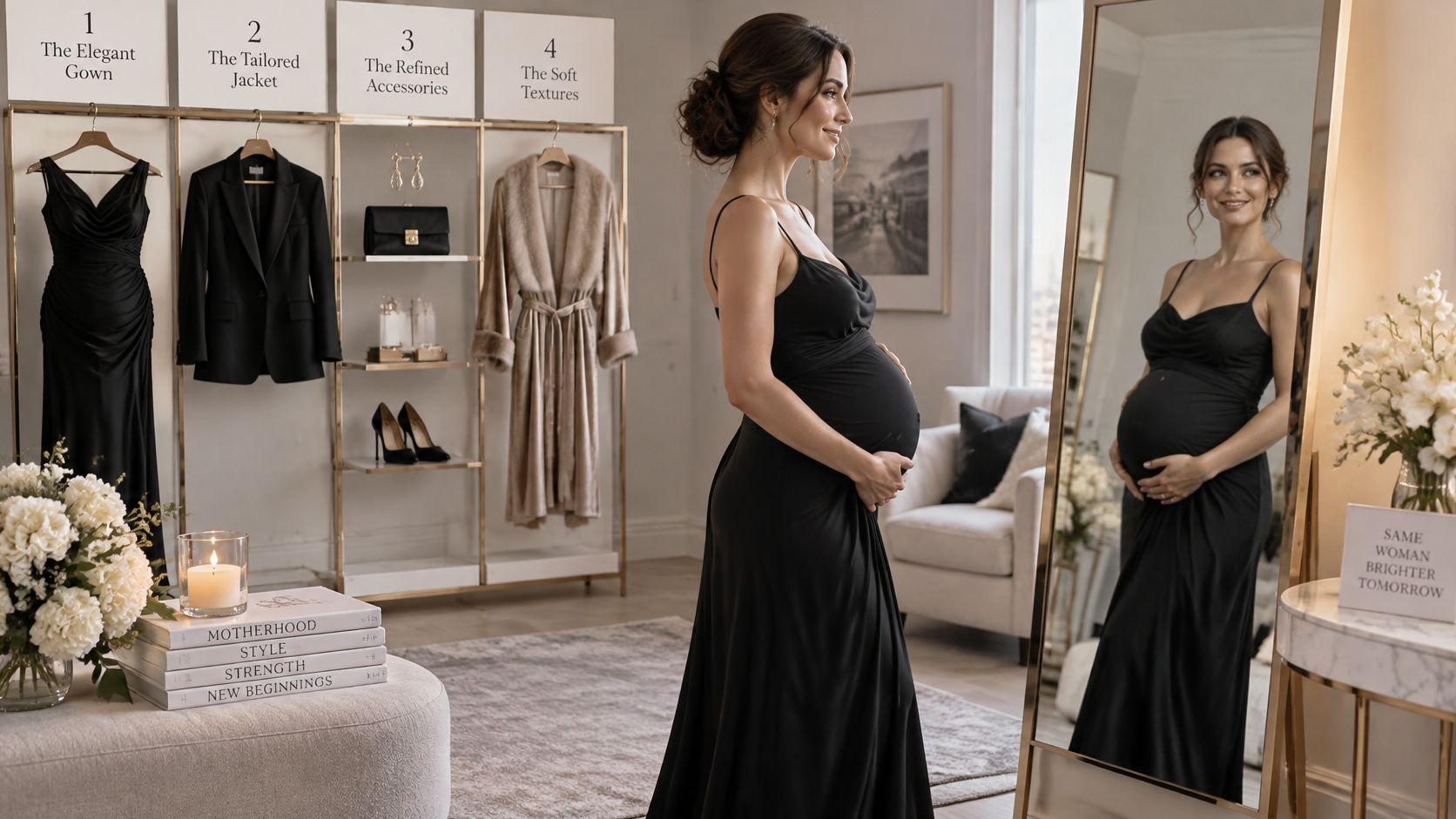
| Stage | Gown base | Statement piece | Undergarment |
|---|---|---|---|
| Pregnant guest, first trimester | Column gown in silk | Long pendant earrings | Smooth-cup maternity bra |
| Pregnant guest, late pregnancy | A-line gown with stretch panel | Lace bolero | Supportive maternity bra and belly band |
| Early postpartum guest | Two-piece bodice and skirt | Metallic clutch | Nursing bra with easy clips |
| Later nursing guest | Wrap gown | Lace-trimmed cape | Structured nursing bra with gentle underwire |
Build each recipe with deliberate styling tools. Let visible lace be a choice at a neckline or sleeve rather than something you hide. Use earrings or a pendant to draw the eye up toward your face. Stay inside a color palette you already love, and pick a neckline for your bust now, not the bust you had last year. For more combinations, browse these stylish maternity outfit ideas and steal the proportions, not the whole look.
Watch how a finished outfit moves as one system, from foundation to hem, before you finalize yours.
Shop for your current body. A wrap, tie or adjustable strap beats a brave guess about a future size every time. Our philosophy is that motherhood doesn't replace women but adds to and enhances them, and the card included with our bra reads, "Because motherhood doesn't replace us, it adds and enhances us."
Keep one signature that's entirely yours on the night, whether that's your usual scent, a bold lip or the hairstyle you wear every day. The outfit should support you, not replace you.
Build your black-tie look from the foundation up with maternity and nursing lingerie designed to support your bust, open one-handed for feeds and still feel like your own style under silk, lace or a wrap bodice. Visit Milk&Lace to find the nursing bra that lets your gown, not your undergarment, set the rules for the night.