

You're standing in front of the mirror, tape measure in one hand and your favorite pre-pregnancy bra in the other, wondering how both can belong to the same body. The band won't close on the loosest hook, or it closes and the cups sit wrong in a way you can't quite name. That's not a mistake you made. It's the normal starting point for learning how to choose maternity bra size as a process, not a single number, and you can work through it one calm fit check at a time.
Why Your Pre-Pregnancy Size Stops Working
One morning the bra you wore for years feels tight across the back. By evening the cups dig in. A week later the same bra gaps at the top, which makes no sense until you remember your body isn't holding still right now.
That's the first thing to accept, gently. Your old size isn't a promise. It's a snapshot from a different stage, and pregnancy rewrites the terms.
What Actually Changes
Your rib cage expands as pregnancy progresses, so the band that once sat level may ride up or squeeze. Your breasts grow, soften, and change shape as tissue prepares for milk production. After birth, whether you breastfeed and how feeding settles will keep shifting what feels right from week to week.
None of these changes follow a tidy schedule. Two women at the same stage can need completely different sizes, and the same woman can need a different fit in the morning than she did the week before.
A 2025 study of 323 women tracked from before pregnancy through postpartum included 97 pregnant participants, 192 who had given birth within the previous 12 months, and 34 breastfeeding participants. Self-reported UK bra size rose by an average of one underband size and two cup sizes, with the modal size shifting from 32B before pregnancy to 34D during pregnancy and 36C postpartum.
Read those figures as a map of a crowd, not directions for your own body. They're group averages, useful for showing that change is real and common, but they don't tell you what to buy. Your rib cage, your tissue, and your feeding plans will write your version.
A reassuring starting point: needing a different size doesn't mean you measured wrong last time. It means you're measuring a body that's doing new work.
The Principle That Replaces the Old Label
Start from a fresh measurement taken at the stage when you'll wear the bra. A size that worked in the second trimester may not serve you in the first postpartum weeks, and that's expected.
Prioritize adjustability over loyalty to a familiar label. Look for:
- Multiple hook positions: Room to loosen or tighten the band as your rib cage changes.
- A firm but nonrestrictive band: Support without compression that leaves you counting the hours until you can take it off.
- Cup room with some give: Space for growth without forcing you into a size that's too large everywhere else.
One more finding from that same research deserves attention. Professional fitting dropped sharply during pregnancy and postpartum, even though that's exactly when bodies change most. You don't need a professional fitting to get this right, but you do need to measure again rather than reordering your old size on autopilot.
Treat your pre-pregnancy size as history, not a starting point. From here, current measurements and fit signals lead, and the label follows.
How to Measure Your Band and Cup Accurately
You need a soft measuring tape, a mirror, and about two quiet minutes. Wear a thin, unpadded bra or no bra, stand naturally, and breathe normally. The method below gives you a starting size you can then test on your body.
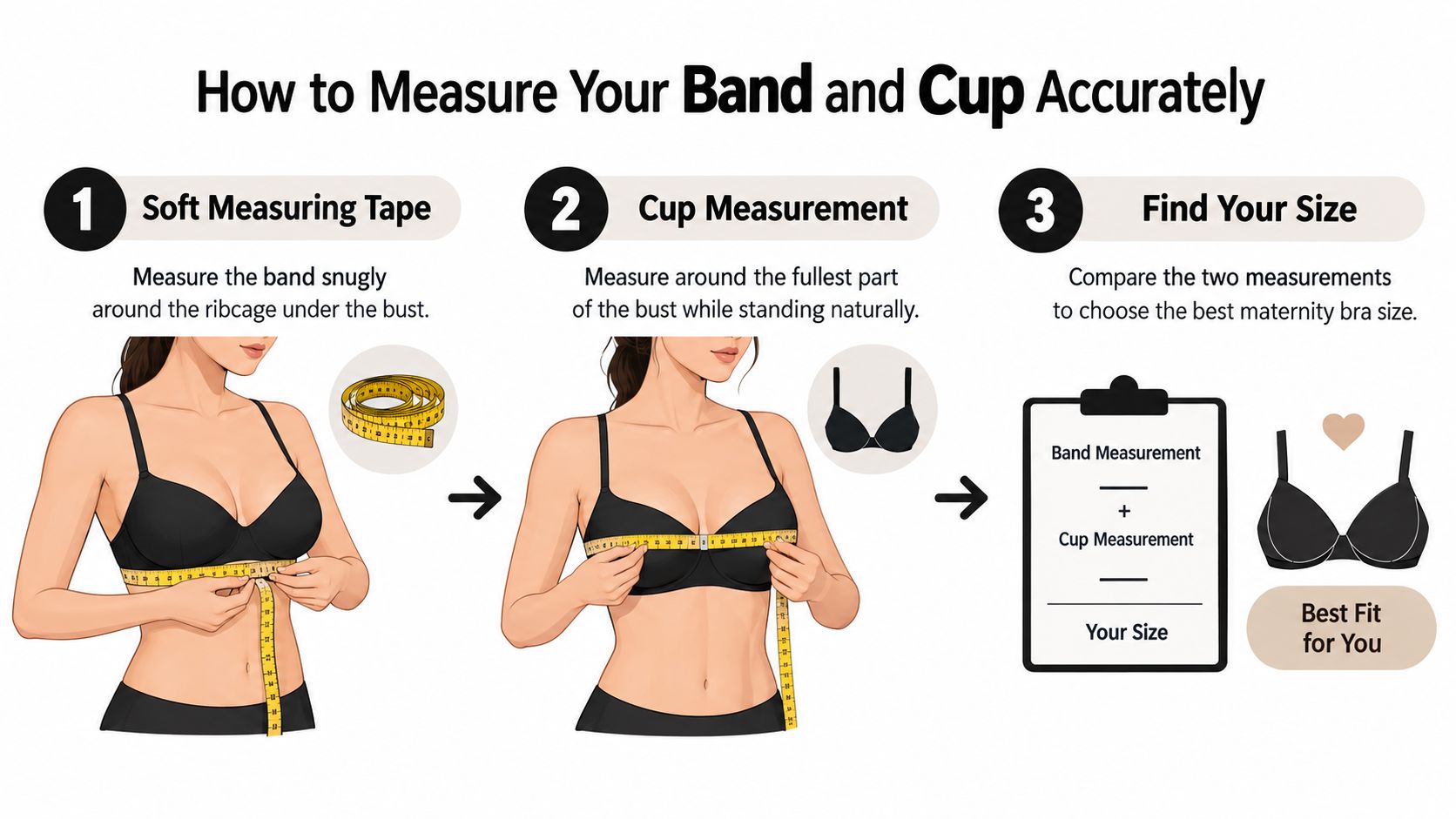
Step One for the Band
Wrap the tape around your rib cage directly beneath your breasts, where a bra band sits. Keep it level all the way around and comfortably snug, not tight enough to indent. This underbust number is your foundation, because the band does most of the supporting work in a well-fitted bra.
If the brand you're shopping uses even band numbers, round to the nearest even number as its system requires. Write the raw measurement down too, since you'll want it when you compare charts across brands.
Step Two for the Bust
Move the tape to the fullest part of your bust, usually across the nipples. Keep it level across your back and let it rest on the tissue without compressing it. Pulling the tape tight here is the most common home-measuring error, and it shrinks your cup estimate before you've even tried anything on.
Stand the way you stand. Don't hold your breath, push your chest out, or pull your shoulders back into a posture you can't maintain through a normal day.
Turning Two Numbers Into a Starting Size
The two-stage method uses subtraction and the manufacturer's own chart: take your bust measurement minus your band measurement, then map that difference to the cup letter on the chart for the specific brand you're buying.
That last part matters more than most guides admit. Cup letters are not standardized internationally, and they aren't consistent between brands either. A difference that earns one letter from one maker can earn another letter elsewhere, so never carry a cup letter from one brand's chart into another brand's sizing without checking.
Write both raw numbers in a phone note with the date. When your fit changes in a few weeks, you'll see exactly which measurement moved, and remeasuring takes a minute instead of becoming a research project.
A Real Morning Measurement Problem
Say you measure first thing in the morning and your bust number looks larger than you expected. You feel fuller than usual, maybe tender. Don't order based on that single reading, and don't discard it either.
Measure again later in the day when you feel more typical, and compare. If the two readings differ, use the in-between one as your starting point and lean toward a style with some stretch in the cup. A measurement taken at your fullest moment sizes you for a peak your body doesn't hold all day.
Here's a simple way to record it:
- Underbust: The snug rib-cage number, plus the rounded band if the brand requires one.
- Bust: The fullest-part number, noted with the time of day.
- Difference and chart result: The cup letter from that brand's chart only, with the brand name beside it.
That note becomes your reference every time something feels off. The tape gives you a starting size, never a verdict. What you do next, trying the bra on and auditing the fit, is where sizing happens.
Allowing for Postpartum Swelling and Daily Changes
Pregnancy growth is gradual enough that you can measure, buy, and adjust over weeks. The first postpartum days don't offer that courtesy. Your size can shift within a single day, and a rigid cup sized to one morning's measurement can feel punishing by the next.
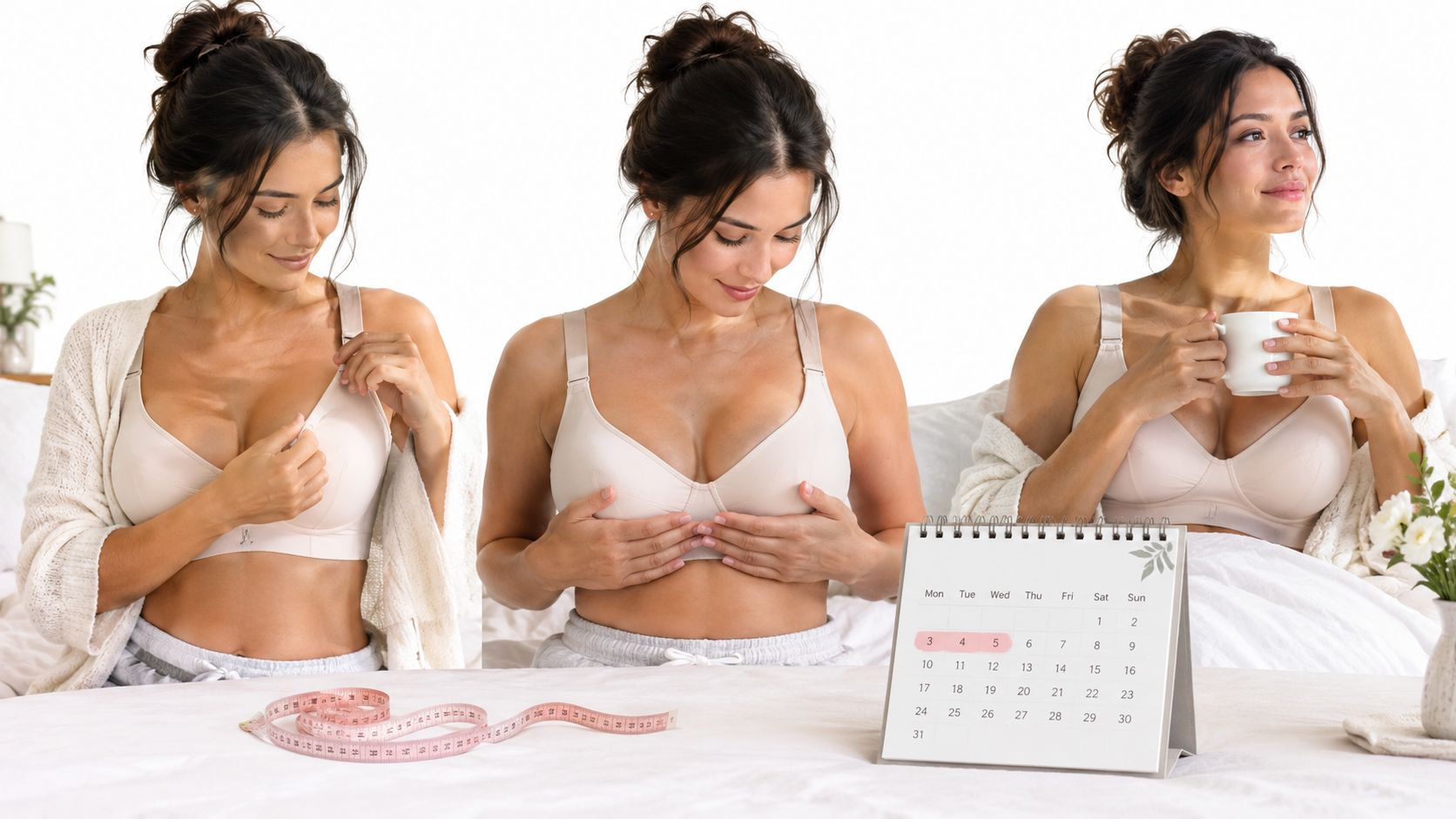
The Engorgement Window
Physiologic engorgement most commonly arrives around postpartum days 3 to 5, when milk comes in and blood flow and fluid increase along with it. More than two-thirds of women may experience breast tenderness by day 5, and one survey found 36.6% of women experienced overly full breasts during the first two postpartum weeks.
The scale of the change surprises most first-time mothers. During engorgement, breasts commonly increase by approximately 1.5 to 2.0 times their prenatal size. That's a temporary state, not your new permanent size, and treating it as permanent is how women end up in bras that offer no support a month later.
When to Measure and What to Choose
Measure when your breasts are neither maximally full nor immediately after a feed. Either extreme distorts the number. A mid-state measurement gives you a size that works across more of the day.
Then plan for roughly one to two additional cup sizes of capacity during engorgement, delivered through stretch fabric or extra cup room rather than a bigger rigid cup. Controlled stretch expands with you at your fullest and recovers after a feed. A rigid cup sized to your largest moment gaps the rest of the day, and a rigid cup sized to your average moment compresses you when you're full.
Band flexibility helps here too. If your cup fit is right but your rib cage needs temporary breathing room, a maternity bra extender for the in-between weeks can bridge the gap without forcing you into a whole new size you'll outgrow in reverse.
Signs It's Time to Recheck
Reassess your fit after your milk supply stabilizes, and sooner if you notice:
- Band riding up: The back of the band climbs, which usually means it isn't anchoring properly.
- Cups overflowing: Tissue spills over the top or sides, especially at your fullest time of day.
- Wires pressing on tissue: Any wire sitting on breast tissue rather than around it needs immediate attention.
A bra that's too tight during this stage can worsen discomfort, so don't push through compression hoping your body will adjust to the bra. The bra adjusts to you, or it's the wrong bra for now.
One boundary matters here. Persistent focal pain, redness, fever, or severe swelling isn't a sizing problem to solve with a different cup. Those signs need clinical assessment, promptly. Sizing choices support comfort. They don't treat symptoms.
Think of the early postpartum weeks as a season your wardrobe passes through. Flexible, forgiving styles carry you through it, and your more structured options will still be there when your days settle into a rhythm.
When to Size Up, Size Down, or Try a Sister Size
Sooner or later you'll hold a bra that almost fits and ask the practical question. Do I need a bigger cup, a different band, or something else entirely? The answer depends on which fit signal you're seeing, and guessing wrong in either direction costs you support.
Why the Fixed Formula Fails
Popular advice often tells pregnant women to add one cup and one band size, while other sources suggest breasts may change by one to four cup sizes. If those rules worked, they wouldn't contradict each other so widely.
A 2025 peer-reviewed study reporting bra size before pregnancy versus postpartum found no significant difference in average bra size between those stages. Set that beside the study in the first section showing average increases, and the lesson becomes clear. Population averages point in different directions because individual bodies do too.
First-time mothers who size up by habit often buy a bra that's larger than they need, then wonder why they feel unsupported. A cup with too much empty room and a band that's too loose can't hold anything in place, no matter how comfortable it felt in the first five minutes.
Fit checkpoints beat formulas: a level band, a cup that contains without spilling or gaping, and wires that sit around tissue will tell you more than any sizing rule you've read online.
How Sister Sizes Work
A sister size keeps roughly the same cup volume while changing the band. If your cup fits well but the band feels loose, go down a band size and up a cup letter. If the band feels too tight but the cup volume is right, reverse it, up a band and down a cup letter.
This is the adjustment most women miss. They assume discomfort means a bigger bra overall, when often only one dimension is wrong. The sister sizes guide for finding your equivalent fit walks through the equivalents if you want to see your options laid out before ordering.
Fit Signals and Their Likely Adjustments
| Fit Signal | Likely Cause | Suggested Adjustment |
|---|---|---|
| Spillage over the cup | Cup volume too small for current tissue | Try the next cup size up in the same band |
| Gaping or wrinkling cup | Cup volume too large, or temporary fullness has passed | Try a smaller cup, or a stretch cup that adapts |
| Band riding up at the back | Band too loose to anchor support | Go down a band, up a cup letter as a sister size |
| Band digging in | Band too tight for your current rib cage | Go up a band, down a cup letter as a sister size |
| Wire sitting on tissue | Cup too small or wrong shape for your breast root | Increase cup size and recheck wire placement |
Telling True Growth From Temporary Swelling
Before you size up for good, check the fit at a different time of day. Overflow that appears only at your fullest and disappears after a feed points to temporary swelling, which stretch fabric handles better than a permanently larger cup.
Overflow that's there every time you put the bra on, at every hour, is a larger cup asking to be bought. The distinction saves you from owning three bras sized for a version of your body that only exists at 7 a.m.
Work one variable at a time. Change the cup or the band, recheck every signal, then decide. Changing both at once leaves you unsure which adjustment helped, and you'll need that knowledge again at your next stage.
Trying On Bras and Checking Fit in Motion
A tape measure can't tell you how a bra behaves when you bend to lift your baby, reach a top shelf, or walk around the block. That's why the fitting room, or your living room, is where sizing gets confirmed. If you're learning how to choose maternity bra size with confidence, this audit is the skill that carries you through every stage.
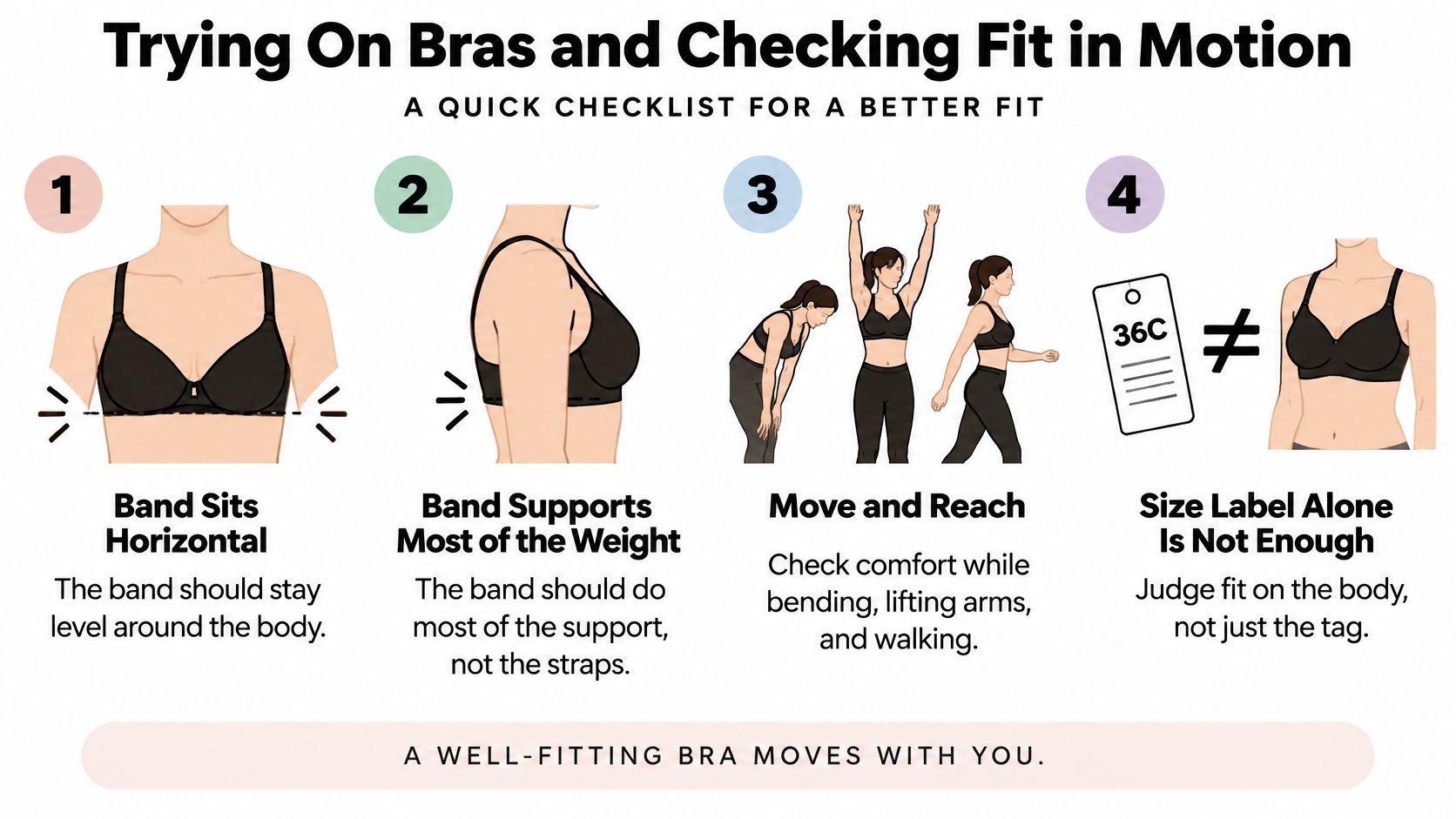
The Four-Point Fit Audit
Fasten the bra on the loosest hook if it's new. That leaves you room to tighten as the band relaxes with wear and as your rib cage changes. A new bra that only feels right on the tightest hook has nowhere to go.
Then check each point in order:
- Band level and firm: It should sit horizontal around your torso and provide most of the support, staying put without the straps doing the heavy lifting.
- Cups containing everything: All breast tissue sits inside the cup with no bulging over the edges and no wrinkling or empty space.
- Underwire placement: If there's a wire, it should lie flat around your breast tissue, never pressing into it.
- Center front position: The middle of the bra should rest against your sternum rather than floating away from your chest.
NHS guidance notes there's no evidence requiring women to stop wearing underwired bras when the bra fits properly and the wire doesn't dig in. Fit and tissue clearance matter more than the mere presence of a wire, which is why flexible styles suit the fluctuating early weeks and structured styles can earn their place later.
Move Like You Actually Live
Don't judge the bra standing still. Bend forward, lift your arms overhead, twist gently, and walk around for a minute. Tissue that escapes when you bend, straps that slide when you reach, and a band that migrates when you walk are all fit failures a mirror pose won't reveal.
Getting the fit wrong is remarkably common. In a peer-reviewed study assessing 104 women against professional fitting criteria, 85% were wearing ill-fitting bras. Those women weren't careless. They'd never been shown what to check, and now you have.
Matching Style to Stage
Different stages ask different things of a bra. During fluctuating weeks, stretch and flexibility do the work. The GAIA nursing bra, a soft style with stretch lace and flexible support plus easy breastfeeding access, suits days when your fullness changes between feeds and you want the cup to adapt with you.
Later, when your supply and shape have settled and you want more structure under regular clothes, the PETRA offers ultra-soft stretch lace with a gentle underwire and one-hand nursing access. The fit audit stays the same. Only the level of structure changes to match where you are.
Whichever style you're testing, run the same four checks in motion before you commit. A beautiful bra that fails the bend test isn't a treat. It's a return waiting to happen, and there's no harm in knowing that before the tags come off.
Returns, Exchanges, and Your Next Step
Here's a reframe worth keeping. Exchanging a maternity bra for a different size isn't a shopping failure. It's the process working exactly as it should for a body that's still changing.
Buy With Flexibility Already in Mind
Your measurements can shift within weeks during pregnancy and the postpartum months. A bra that passes the fit audit today might overflow during engorgement or gape once your supply settles, through no error of yours.
So treat the exchange policy as part of the product. Before you order, read the terms rather than assuming them, and keep tags on while you run your movement checks at home. Milk&Lace offers a flexible size-exchange policy with clear return, refund, and shipping guidelines, and the size and returns policy details are worth reviewing on the site before you buy so there are no surprises later.
A few habits make exchanges painless if you need one:
- Test at your typical fullness: Try the bra at a representative time of day, not at your fullest or emptiest.
- Keep packaging until you're sure: A few days of real wear around the house tells you more than a first impression.
- Note what failed: Write down whether the cup, band, or wire placement was wrong, so your exchange targets the right sister size.
Where This Brand Fits in Your Journey
It's worth being clear about what a bra like this is for. Milk&Lace isn't trying to replace the soft, essential early nursing bras that carry you through the engorgement window and the round-the-clock feeding weeks. Those bras have a job, and they do it well.
The point comes later, when comfort alone starts to feel like not quite enough. You're returning to routines, getting dressed with intention again, and wanting your lingerie to feel like yours. That's the stage these structured, lace styles are made for, when you're ready to reconnect with your confidence and your own sense of style alongside everything motherhood asks of you.
Motherhood expands who you are. It doesn't replace you, and getting dressed can be one small, daily way of remembering that.
Your Next Step This Week
You don't need to overhaul your drawer today. You need one measurement, one note, and one honest try-on.
- Take a fresh two-stage measurement this week, underbust and fullest bust, at a typical time of day.
- Record both numbers with the date, plus the cup result from the specific brand chart you're shopping.
- Run the fit audit in motion on whatever you try, checking band level, cup containment, wire placement, and center front while you bend, reach, and walk.
- Choose for your current stage, flexible stretch while your size is still moving, more structure when it settles, and remeasure whenever the signals say so.
Your body has done something extraordinary, and it's still changing in ways that deserve patience rather than frustration. The right size isn't a number you achieve once and keep. It's a fit you check, adjust, and check again, and each time you do, you get a little closer to feeling like yourself in your own skin. That feeling is worth measuring for.
When you're ready for a nursing bra that pairs structured support with elegant lace and discreet nursing access, explore the GAIA and PETRA styles at Milk&Lace and use your fresh measurements and fit audit to choose your size with confidence. With a flexible size-exchange policy behind your order, you can find the fit that helps you feel like yourself again.