

You put on the bra that fit last month. The cups seem close enough, but the band feels like it's arguing with your ribs. Or the band finally feels comfortable, and now the cups wrinkle in a way they didn't before. That can feel maddening when you're postpartum and your body seems to change from week to week, or even morning to evening.
None of that means your body is “hard to fit.” It usually means the sizing label isn't telling the whole story.
A lot of women reach for a totally different size when what they need is a smaller adjustment. That's where sister sizes for bras can help. They give you a practical way to keep the cup volume about the same while changing band tension, which is often exactly what's needed during postpartum shifts.
Why Your Bra Size Feels So Confusing Right Now
You fasten a bra on the loosest hook, stand in front of the mirror, and think, “Why is this suddenly wrong?” The cups hold you fairly well. The straps aren't the main problem. But the band digs, or it rides up, or everything feels slightly off in a way that's hard to name.
That moment is common after pregnancy and birth. Your ribcage may still be changing. Breast fullness can shift through the day. A bra that worked beautifully two weeks ago can feel strangely uncooperative now.

What confuses many people is that bra fit isn't just about one number and one letter. The letter only makes sense in relation to the band. If you've ever felt lost switching between brands or trying to compare US and UK bra sizes, you've already met part of the problem.
The fit issue is often more specific than it feels
Sometimes the bra is not entirely wrong. Sometimes one part fits and one part doesn't.
That distinction matters. If the cups fit but the band doesn't, you may not need a full size overhaul. You may just need a smarter neighboring size.
Practical rule: When the cups feel right and the band is the only clear issue, sister sizing is often the first thing worth trying.
Postpartum changes can make normal fit rules feel unreliable
In early motherhood, fit can be less stable than it used to be. Nursing, swelling, weaning, sleep position, and simple body recovery can all change how a bra feels. That's why random trial and error gets exhausting fast.
A simple volume-based adjustment can bring back some calm. You don't have to memorize the whole sizing system. You just need to know how to spot when a sister size can help, and when it's time to remeasure or change bra shape instead.
What Sister Sizes Really Mean for Your Fit
A lot of postpartum fit confusion starts here. You try one bra and think, “The cups seem close, so why does the whole thing still feel off?” Sister sizing explains that mismatch.
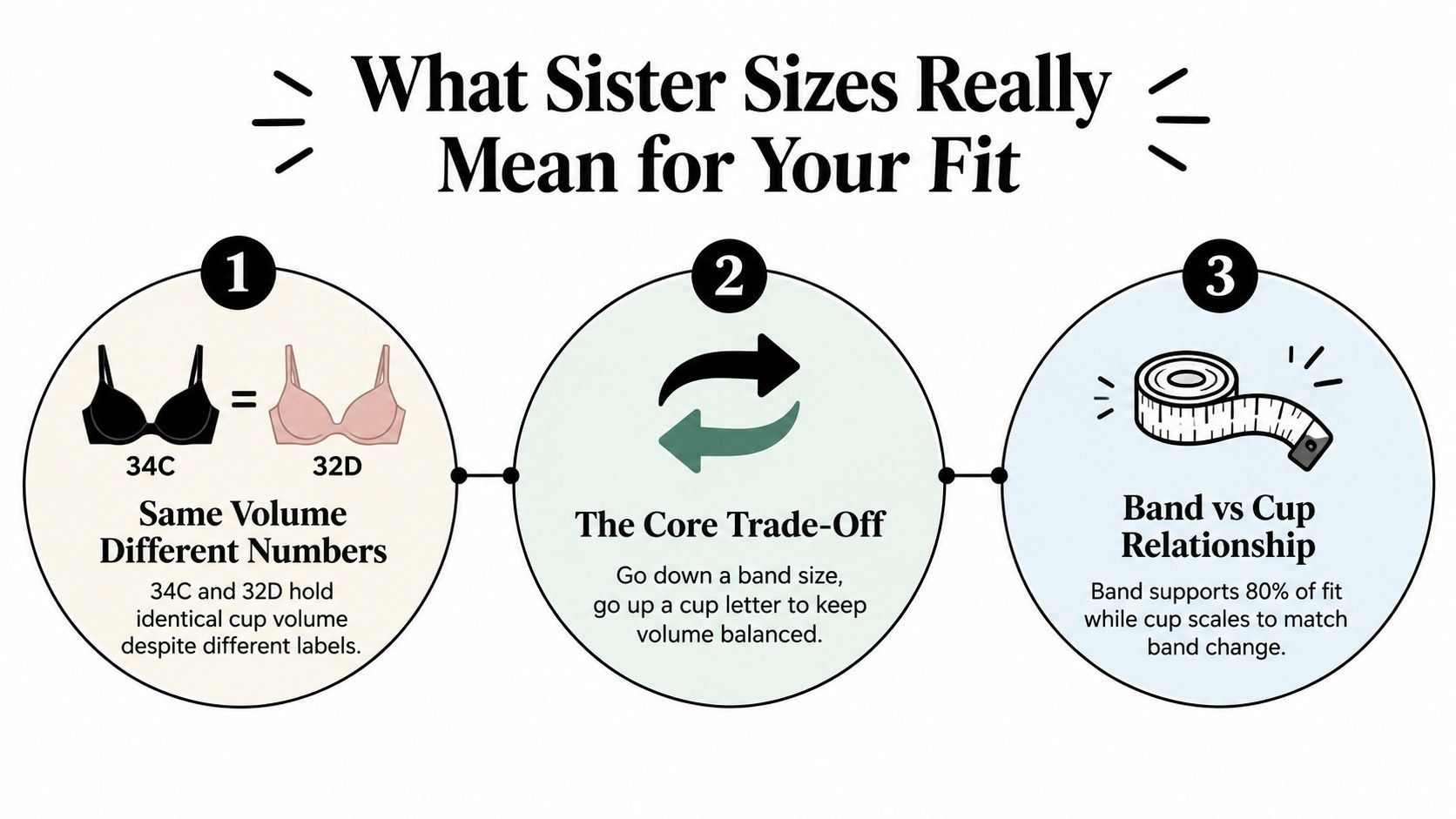
Sister sizes are size neighbors that keep about the same cup volume while changing the band length and tension. A common chain is 36C, 34D, and 32DD/E. As the band goes down, the cup letter goes up to keep the cup volume close, as explained in this history and overview of bra sizing.
The cup letter only means something with the band
This is the part that trips up many bra shoppers.
A D cup on a 34 band is not the same cup size as a D cup on a 38 band. The letter is attached to the band, almost like shoe width attached to shoe length. You need both parts to know what the bra is trying to fit.
Here's the rule that makes sister sizing work:
- Go down one band size, and go up one cup letter
- Go up one band size, and go down one cup letter
That shift keeps the cup volume in the same general range while changing how snug the band feels around your ribcage.
Sister sizing changes tension, not your body
This matters a lot after pregnancy and during nursing, when your body can change from week to week or even morning to evening.
If your cups fit well enough but the band feels too loose, a sister size can tighten the support without asking you to squeeze into smaller cups. If your cups fit but the band feels too firm, a sister size can give you breathing room without jumping to a completely different fit.
That is why sister sizing works best as a temporary fit tool. It helps when the core issue is band tension. It does not fix every bra problem.
Sister sizing keeps the part that is working, usually cup volume, and adjusts the part that is not, usually band feel.
Volume can stay similar while shape still changes
Many postpartum fittings get confusing. Two sister sizes can hold a similar amount of breast tissue, but they do not always feel identical on the body.
A smaller band with a higher cup letter often brings the wires a bit narrower and the band a bit firmer. A larger band with a lower cup letter may feel more relaxed through the torso. So sister sizes are close relatives, not clones.
That distinction helps in real try-ons. If a bra feels better in a sister size, great. If the cups start sitting too wide, cutting in at the top, or collapsing near the apex, the issue may be bra shape or cut, not size math.
Why fitters use sister sizes carefully
A sister size is a useful adjustment, not a permanent rule to force every bra to work.
If your body is in a fluctuating postpartum phase, sister sizing can buy you comfort for now. If your breasts have changed shape, fullness, or sensitivity, you may need a fresh measurement or a different style altogether. A soft nursing bra, a fuller-coverage cup, or a different wire shape can solve problems that sister sizing cannot.
If you're trying a style like PETRA, which features ultra-soft stretch lace, gentle underwire, and one-hand nursing access, this size relationship still matters. The fabric and design affect comfort, but the sister-size logic stays the same.
How to Find Your Sister Size Without Guesswork
The easiest way to use sister sizes for bras is to start with the size that feels close, not with a blank chart. You're looking for the bra that almost works, then adjusting one part of the fit at a time.
Use the one-step rule
Start here:
- Put on the bra and fasten it on the loosest hook.
- Check whether the cups fit. Are they containing breast tissue smoothly enough for this style?
- Decide whether the band is the problem.
- Move only one step.
If the band feels too tight but the cups fit, go up one band size and down one cup letter.
If the band feels too loose but the cups fit, go down one band size and up one cup letter.
For a practical measuring refresher before you size-swap, this guide on how to measure for your bra size can help.
Real examples make the pattern easier
Take 36C.
- If the band feels tight, try 38B
- If the band feels loose, try 34D
Take 34D.
- If the band feels tight, try 36C
- If the band feels loose, try 32DD/E
Take 32DD.
- If the band feels tight, try 34D
- If the band feels loose, try 30E if your brand uses that notation
The key is that you are preserving cup volume as closely as possible while adjusting band tension.
Sister Size Quick Reference Grid
| Your Current Size | If Band Feels Tight | If Band Feels Loose |
|---|---|---|
| 32C | 34B | 30D |
| 34C | 36B | 32D |
| 34D | 36C | 32DD/E |
| 36C | 38B | 34D |
| 36D | 38C | 34DD/E |
| 38C | 40B | 36D |
Avoid the most common mistake
The usual error is simple. Someone tries a bra, feels band discomfort, and changes only the band.
That is not sister sizing.
If you go from 34D to 36D, you have changed both the band fit and the cup volume. You are no longer testing the same volume relationship. That can make the cups feel too large, too shallow, or just oddly proportioned.
If you change the band, change the cup in the opposite direction. Otherwise you're testing a different fit, not a sister size.
A quick self-check
Ask yourself these questions:
- Do the cups already feel right? If not, stop here and remeasure.
- Is the band the only obvious issue? Then a sister size is worth trying.
- Am I jumping more than one step? If yes, the bra's proportions may change too much to stay comfortable.
That last point matters more than many people realize.
When Sister Sizing Helps and When to Remeasure Instead
You put on a bra that felt fine last week. Today the cups still seem right, but the band feels sharper by lunchtime. That is a common postpartum fit moment, and it is usually the point where sister sizing can help.
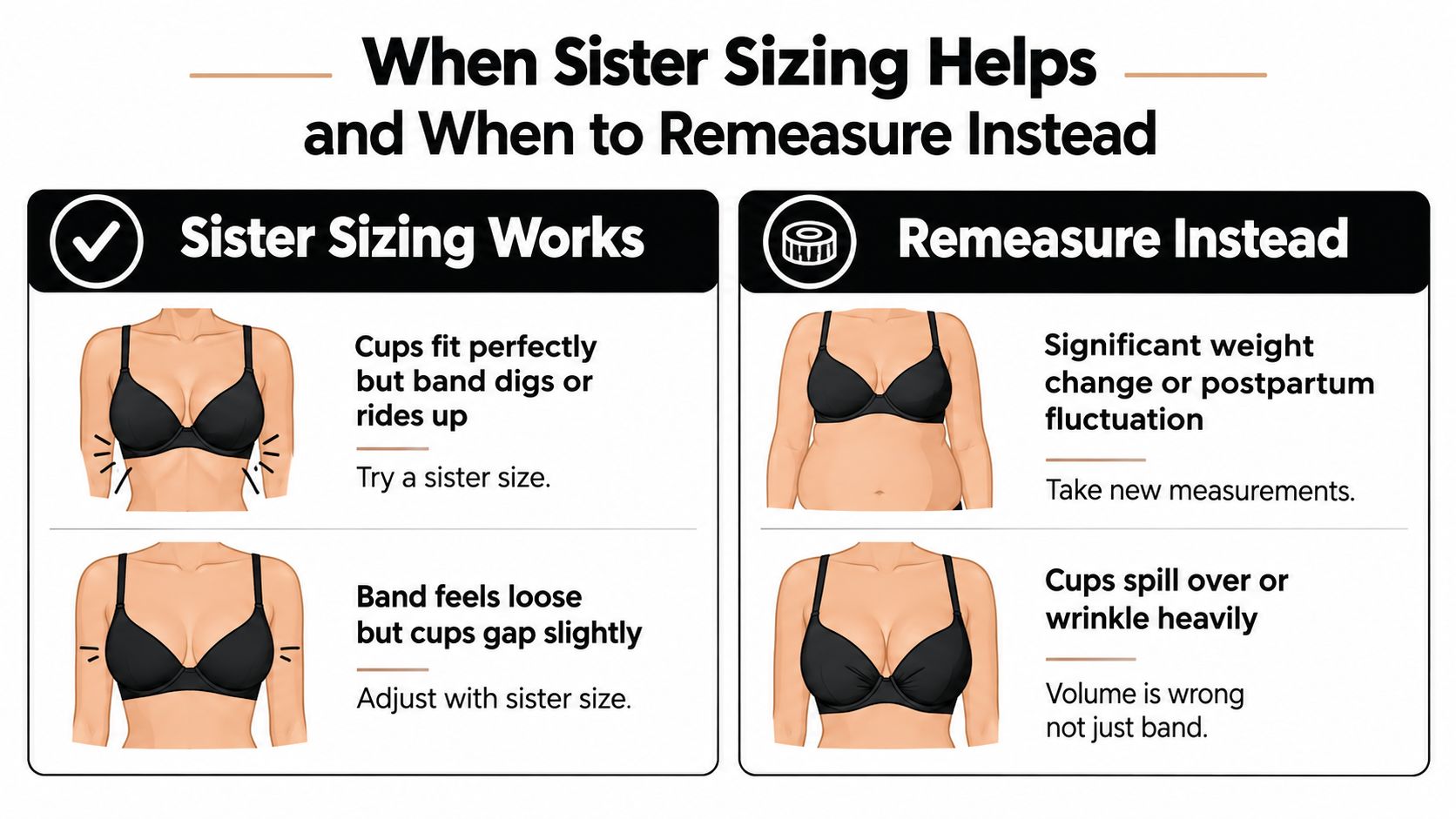
Sister sizing works best as a short-term adjustment tool. It helps when one part of the fit changed, but the rest of the bra still makes sense on your body. A good fitting rule is simple. If the cups fit and the band is the only clear problem, try one sister-size step. Guidance from this Iowa State fit guidance document also notes that going beyond one step often changes wire width, cup shape, and strap placement enough to change how the bra wears.
When a sister size usually helps
A sister size is often worth trying when the bra feels close, just slightly off:
- The cups fit, but the band feels too tight on fuller days
- The cups fit, but the band rides up
- The same size feels different across brands because one band runs firmer or looser
- Your body is still fluctuating week to week, and you need a temporary adjustment rather than a full size reset
A sister size works like loosening or tightening one notch on a backpack strap while keeping the bag itself the same. You are making a controlled adjustment, not starting over.
When remeasuring is the kinder option
Sometimes the bra is not close. It is sending several mismatch signals at once.
| What you notice | Better next step |
|---|---|
| Band hurts and cups also cut in | Remeasure |
| Band rides up and cups gap heavily | Remeasure |
| Wire sits on breast tissue | Remeasure or change cut |
| Bra only feels wearable after two size jumps | Remeasure |
| Straps, gore, and cups all feel off | Try a new cut and remeasure |
Here is the easiest way to sort it out. Ask, "Is only one thing wrong, or is the whole bra arguing with my body?" If it is just the band, sister sizing may solve it. If the band, cups, wires, and straps all feel wrong, a new measurement or a different bra shape will save you time.
Why this matters more postpartum
Postpartum bodies rarely change in one neat direction. Ribcage tension, breast fullness, swelling, milk production, and plain old sleep deprivation can all affect how a bra feels from morning to evening. That is why sister sizing is useful, but only as a temporary tool.
Researchers publishing in 2025 found that sister bra size group had a stronger association with breast weight than cup size or band size alone, with Spearman correlation ρ = 0.76, compared with ρ = 0.67 for cup size, ρ = 0.61 for BMI, and ρ = 0.48 for band size, in this peer-reviewed study on bra size grouping and breast weight. The same paper also referenced a standard U.S. grid with 10 band sizes and 12 cup sizes, or 120 labeled sizes.
That helps explain why sister sizing can be useful without being the full answer. Band and cup work together. But if your breast shape has changed, your upper fullness is different, or the wires now sit in the wrong place, the issue may be the bra cut or your current measurements, not the next label over.
Sister Size Tips for Nursing and Postpartum Bodies
Postpartum fit is its own category. Your body may be healing, your breast fullness may shift during feeds, and your tolerance for pressure may change week to week. That's why sister sizes for bras can be useful, but they work best as a temporary fit tool, not as the only plan.

Recent maternity and postpartum sizing guidance increasingly emphasizes measurement-based recalculation and flexibility rather than relying only on sister-size swaps, and bra-size tools and guides published in 2026 increasingly frame sister sizing as a backup when the ideal size isn't available, according to this maternity bra size calculator guidance. That aligns with real-life postpartum fitting. When your body is actively changing, rechecking size matters.
Use a sister size for temporary relief
A sister size can be a good move when:
- Your usual cups still fit, but your band feels tight on fuller days
- You need a nearby option because your preferred size isn't available
- You're between stages, and your body hasn't settled into a stable fit yet
It's less helpful when your breasts have changed in volume enough that the cups themselves no longer make sense.
Remeasure more often when your body is still shifting
If your fit changes keep repeating, don't keep forcing the same label to work. Use a measuring guide, like this one on how to measure for a nursing bra, and recalculate instead of endlessly chasing comfort through sister sizes alone.
That small reset can save a lot of frustration.
Change the cut if the size keeps fighting you
Sometimes the size isn't the main problem. The bra shape is.
A postpartum body may need more stretch at the neckline, a different wire shape, softer edge finishes, or a different level of structure depending on where you are in recovery and feeding. That's why a sister size can feel only partly better if the cut itself isn't right.
A bra like GAIA is one example of a nursing bra designed with stretch lace, flexible support, and breastfeeding access. Details like those can matter when your body wants gentleness in one season and more structure in another.
If a visual walkthrough helps, this can make the fitting process easier to picture:
Your Confident Fit Checklist for Every Try On
You clasp the bra, stand up straight, and for one second it seems promising. Then the band shifts when you lift the baby, the cup cuts in on one side, and suddenly you are back to wondering whether you need a new size, a sister size, or a completely different bra.
A calm check helps more than guessing. Sister sizing is a useful short-term tool for postpartum changes, but only if you can tell what the bra is doing on your body.
Start with what the bra is telling you
Use this quick check each time you try one on:
- Band first: It should stay level around your ribcage and feel firm enough to anchor the bra. If the cups feel right and the band alone feels too tight or too loose, a sister size may help.
- Cup fit: Breast tissue should sit inside the cups without cutting in, folding down, or leaving obvious empty space. If the cup looks wrong in several ways, do not assume a sister size will fix it.
- Wire or cup edge placement: The edge should sit around your breast tissue, not on top of it. In a wireless bra, the lower cup and side support should still contain tissue comfortably.
- Straps: They should rest in place and give light support. If tightening the straps is doing most of the work, the fit problem usually starts elsewhere.
- Real-life movement: Reach forward, sit down, pick up weight, and take a full breath. A bra for postpartum life has to work while you move, not only while you stand still in front of a mirror.
Keep the next adjustment small
If one thing feels off, change one thing.
That is where sister sizing works best. The cups may feel close, but the band tension is off because your ribcage is still changing, you are swollen by evening, or your body feels different from week to week.
If several parts are fighting you at once, use that as a signal. As noted earlier, the label alone will not solve a bra that is wrong in both size and shape.
Your body is not the problem. The bra is giving you clues.
Use the checklist to decide what to do next
A sister size is worth trying when the fit is almost there.
Remeasuring makes more sense when the whole bra feels confusing two or three try-ons in a row. And if the size seems close but the neckline gapes, the cup cuts across fuller tissue, or the shape feels awkward all day, the cut may be the issue rather than the number and letter on the tag.
That distinction matters after pregnancy and during nursing. Postpartum bodies can change fast. A sister size can buy you comfort for this stage without pretending it has to be your forever size.
Confidence counts here too
Postpartum dressing gets practical very quickly. You still deserve a bra that feels like it belongs to your current life and your current body.
A good nursing bra supports feeding, comfort, and your sense of self. Sister sizing can widen your options for a shifting season. Then, when your fit keeps changing or the bra shape keeps missing the mark, you can remeasure and choose something better suited to the body you have today.
Milk&Lace offers nursing lingerie designed for the stage when you want both function and a sense of yourself again, with elegant details, nursing access, and a flexible size-exchange approach that fits naturally with the territory of changing postpartum sizing. If you're working out whether a sister size, a remeasure, or a different bra shape makes the most sense right now, visit Milk&Lace to explore options created for that in-between season.