

A maternity bra extender is a hook-and-eye insert that lengthens only the bra band, not the cups, and can add approximately 3 inches, or about 7.6 cm, to create breathing room during pregnancy and postpartum. It's a bridge between sizes, not a universal fix for every bra-fit problem.
You may notice the need on an ordinary morning. You reach for the nursing bra that felt comfortable recently, fasten it, and feel the band press into your ribs before you've even picked up your baby. Your body is still changing, your breasts may feel fuller, and the difference between “supportive” and “too tight” can seem frustratingly small.
That frustration is normal. Pregnancy and early postpartum life can bring sizing whiplash, with a bra feeling right for a while and then suddenly becoming restrictive. A small accessory can sometimes make those in-between weeks easier, but only when the rest of the bra still fits correctly.
When Your Bra Band Stops Cooperating
The first clue is often the band, not the cups. You fasten your bra and notice pressure around your rib cage, or you find yourself adjusting the closure throughout the day. The garment may still support your breasts well, yet the back feels uncomfortably tight after your body has expanded.
A maternity bra extender attaches to the bra's existing hook-and-eye closure and adds length across the band. Retail guidance describes extenders as adding approximately 3 inches, or about 7.6 cm, while broader bra-fitting guidance describes up to 3 inches or 8 cm, depending on the hook arrangement and elastic construction. You can compare that practical function with bra extender guidance from MommyGear, which also places the accessory in maternity use over many years.
A maternity bra extender buys time, not a new cup fit.
That distinction matters after delivery, when your body may change faster than your lingerie drawer. An extender can help you continue wearing a bra whose cups, center front, and overall shape still feel right. It can be a modest, affordable way to avoid replacing a wearable bra just because the band needs more room.
This isn't about forcing your body into an old size. It's about giving yourself comfort while your measurements settle. The right fit can make feeding, carrying, resting, and moving through the day feel less demanding.
You'll need to identify the problem accurately, match the extender to your closure, attach it flat, and watch for signs that the bra itself no longer provides the support you need. That boundary is where an extender becomes useful instead of misleading.
What a Maternity Bra Extender Actually Does
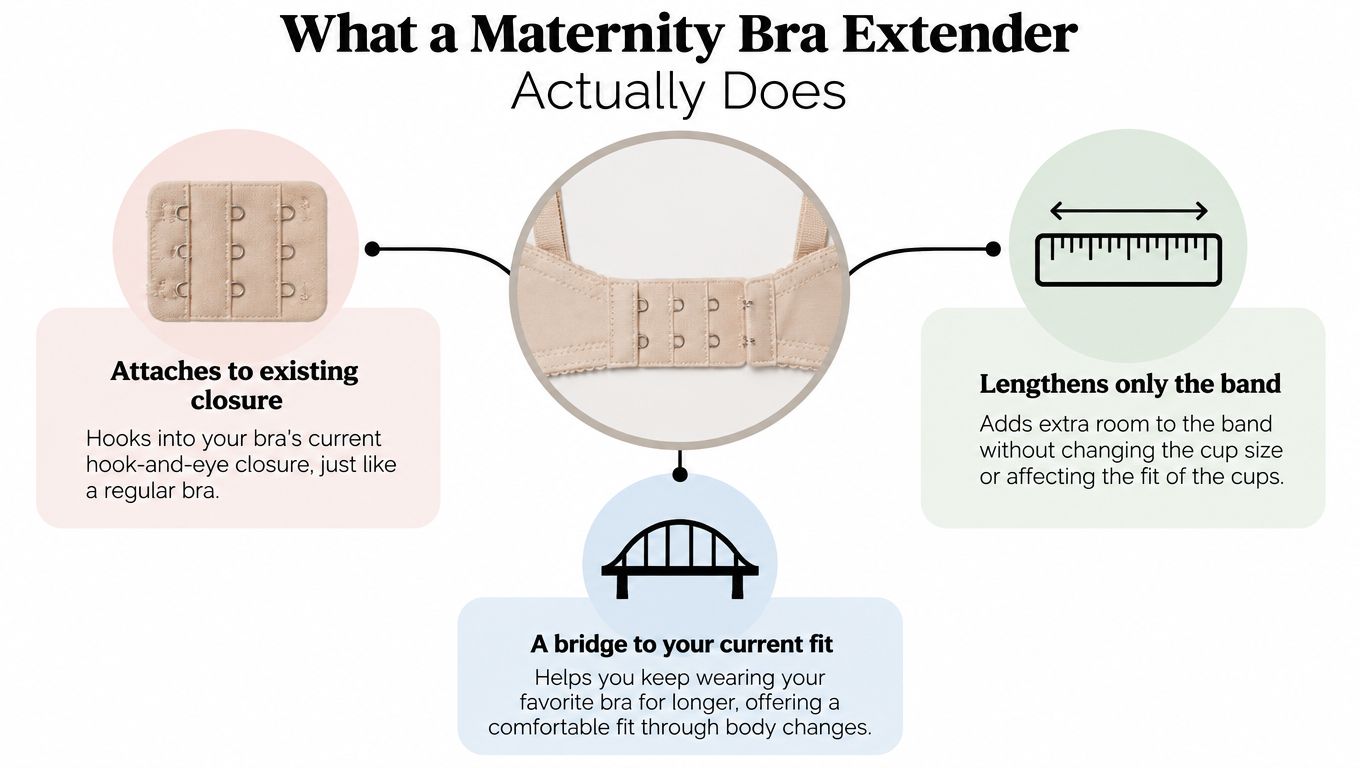
Think of an extender as a short bridge between the bra and its fastening point. One side connects to the bra's existing hooks, and the other side provides eyes for the bra's hooks to enter. The bridge lengthens the band circumference only.
That makes it useful when your rib cage has expanded and the band feels tight, while the cups still contain your breasts comfortably. Maternity fit guidance describes this exact use, while also warning that an extender won't solve cup overflow or problems with the depth beneath the breast. The maternity bra sizing guidance from Mom Loves Best explains why the band, cups, and center front must be assessed together.
The thirty-second fit check
Stand in front of a mirror and ask three questions:
- Are your breasts fully contained? If tissue spills over the top, sides, or center, the cup is too small. An extender can't add cup volume.
- Does the center front sit correctly? If the center section gapes or presses in a way the design shouldn't, adding band length may not correct the problem.
- Does the band remain level? After adding the extender, the band should sit evenly around your body rather than riding up in back.
The band provides the bra's main support structure. Loosening it can reduce pressure and improve comfort, but only if the cups and center front remain properly positioned. If the band loses nearly all tension, the extender has gone beyond a helpful bridge and is weakening the support architecture.
A useful example is a soft nursing style such as GAIA, which combines stretch lace, flexible support, and breastfeeding access. An extender may help preserve the band fit when the cup and nursing design still work for you, but it can't change the bra's cup shape.
Types and Materials Explained Simply
Start with the closure, not the color, brand, or packaging. Extenders commonly come in 2-hook and 3-hook configurations, and the hook-center spacing must align with the bra. Many 2-hook designs use spacing around 13 mm, while 3-hook designs often use about 19 mm. Some narrower styles use spacing around 10 mm. These specifications are described in bra extender product details from Brah.
A mismatch can make the hooks sit at an angle, pull unevenly, or detach under movement. Count the rows on your bra and compare the spacing rather than assuming that any extender will fit.
Choosing the construction
Soft cotton-backed elastic can feel gentler against sensitive skin, especially when the extender sits under clothing for long periods. A smoother backing also helps reduce the rough sensation that may become noticeable during nursing or frequent holding.
Firmer woven elastic offers a more stable feel when you want added room without making the closure feel flimsy. It may suit a structured bra better, provided the hardware matches and the added length remains modest.
Multi-position extenders include several rows of eyes, allowing you to make a smaller or larger adjustment. That flexibility can be useful as your comfort changes, but it doesn't turn the extender into a permanent resizing device.
Choose the geometry first, the material second, and the amount of added length last.
Product specifications commonly describe about 5 cm per piece in a single step, or up to roughly 3 inches, or 8 cm, depending on construction. Those figures support a practical rule: an extender is designed to bridge a temporary or moderate band change. If you need substantially more room, the bra may no longer be the right size or shape.
Checking Compatibility With Your Nursing or Maternity Bra
Compatibility takes less than a minute when you inspect the closure carefully. Put the bra flat on a bed or hold it behind your back, then count the hooks from top to bottom. Next, estimate the distance between the hook centers and look for an extender with the same arrangement.
Use the bra's actual closure as your reference. A 2-hook extender usually belongs with a 2-hook bra, and a 3-hook extender with a 3-hook bra. Narrower closures need narrower hardware, even if the extender appears visually similar.
For a deeper measuring explanation, use this guide to measuring for a maternity bra, then compare the result with the bra you already own.
Matching Your Bra Closure to the Right Extender
| Bra closure type | Recommended extender | Approximate added length |
|---|---|---|
| 2-hook closure with standard spacing | 2-hook extender with matching spacing | About 5 cm per piece |
| 3-hook closure with wider spacing | 3-hook extender with matching spacing | About 5 cm per piece |
| Narrow 2-hook closure | Narrow 2-hook extender | Varies by construction |
| Closure with several adjustment rows | Matching multi-position extender | Up to roughly 3 inches, or 8 cm, depending on construction |
| Front closure without compatible hook-and-eye hardware | No standard back extender | Not applicable |
Nursing bras can use extenders when they have a compatible back hook-and-eye closure. Wireless construction doesn't prevent extender use, and structured underwire construction doesn't guarantee compatibility either. The hardware determines the answer.
Front-closure bras, pull-on bralettes, and designs without exposed hook-and-eye rows generally won't accept a standard back extender. Don't force one onto a closure that wasn't built for it. A secure fit starts with matching the mechanism, not improvising around it.
How to Use a Bra Extender for the Best Fit
Lay the bra and extender flat before you attach them. Hook the extender onto the bra's existing eyes, then fasten the bra to the extender so the insert sits smoothly between the closure and your back. The hardware should lie flat, without twisting, folding, or pulling one side higher than the other.
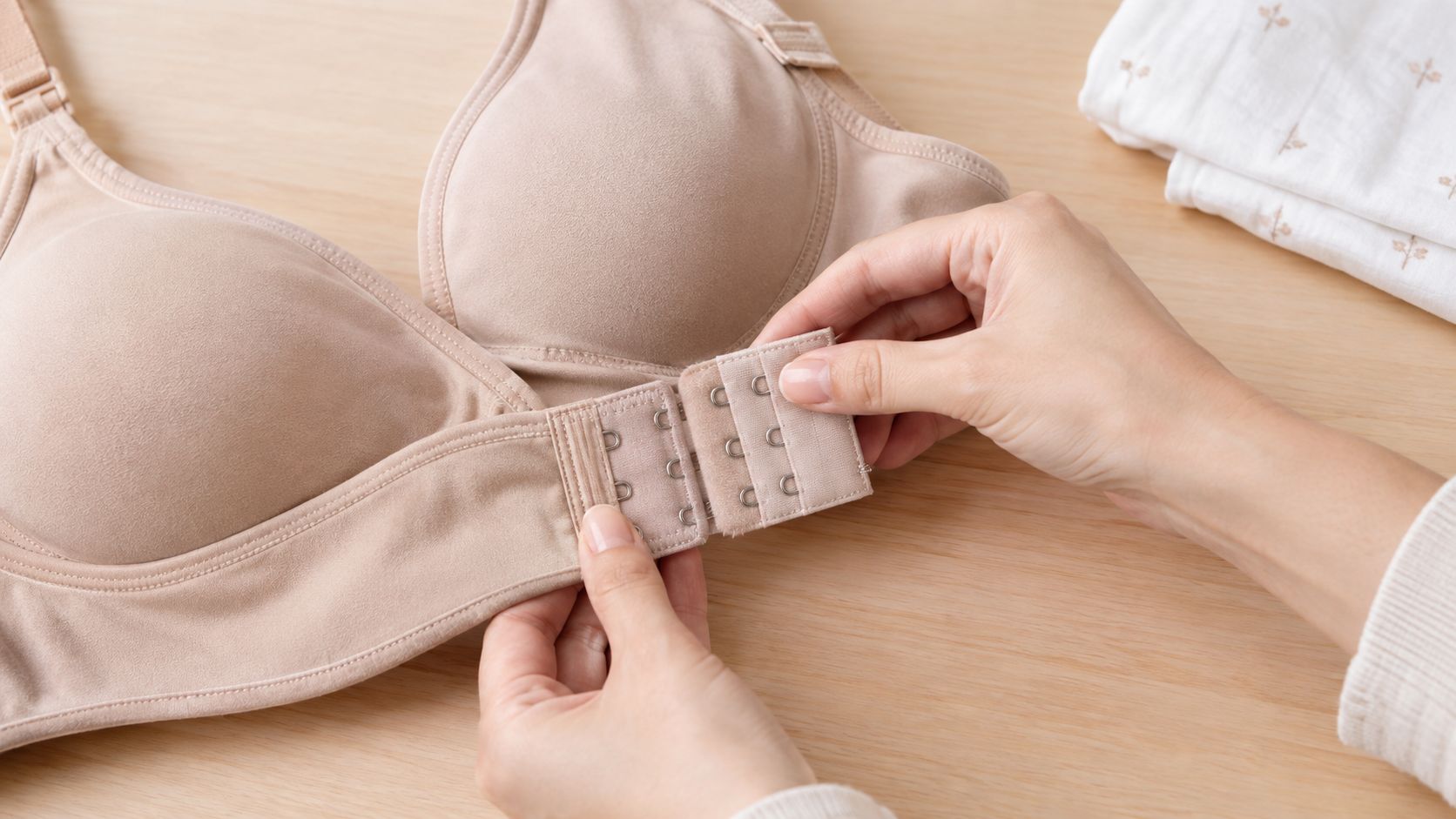
Begin with the tightest usable extender position, not the loosest. You want enough room to remove pressure while keeping some tension in the band. If you need more space later in the day, move out by one row rather than opening the entire adjustment at once.
In the mirror, check the front and back together. The band should remain level, the cups should stay in place, and the straps should rest securely without digging into your shoulders. Take a few comfortable breaths, lift your arms, sit down, and move as you would while caring for your baby.
The extender is doing its job when the bra feels easier but still anchored. It isn't doing its job when the back rides upward, the cups gap, or your breasts shift because the band has become too loose. Those signs may indicate that the bra needs resizing rather than more added length.
Strap changes can help fine-tune balance after the band is adjusted. Follow this guide to adjusting bra straps, but don't use tighter straps to compensate for a band that has lost its support.
Here's a visual demonstration of the closure adjustment in context:
Wear the bra for a short period before relying on it for a full day. Your skin, breathing, and posture will tell you more than the fastening position alone.
Care and Safety Tips for Sensitive Postpartum Skin
Postpartum skin can feel more reactive than usual, and a small piece of lingerie hardware can create irritation when it rubs repeatedly. Care protects both the elastic and the person wearing it.
Do this
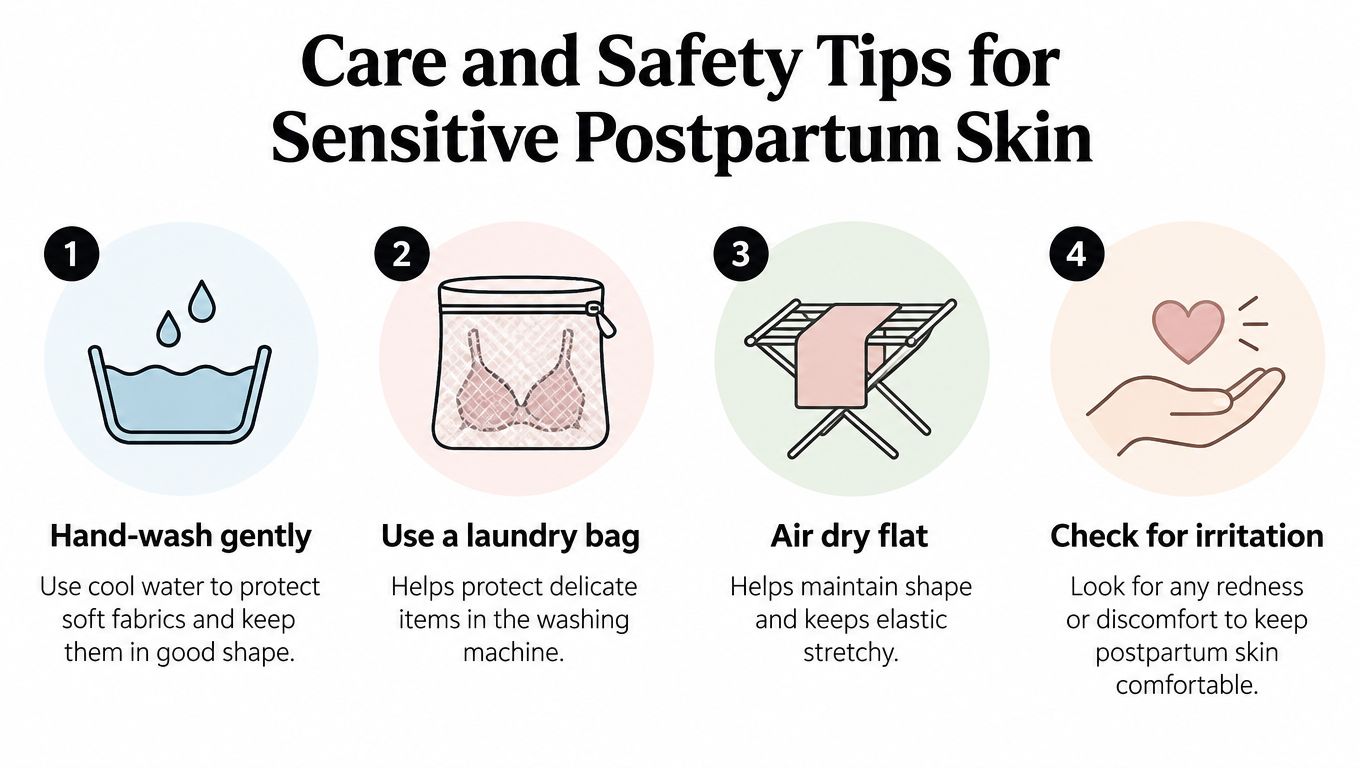
- Wash gently: Hand-wash the extender in cool water when possible. Gentle handling helps the elastic retain its flexibility and keeps the hooks aligned.
- Use a lingerie bag: If machine washing is necessary, place the extender in a laundry bag. The bag reduces tangling and protects the hardware from catching on other garments.
- Air dry: Let it air dry rather than applying direct heat. Heat can stress elastic, while air drying helps preserve its stretch.
- Choose a soft backing: A cotton-backed or smooth extender can reduce friction against tender skin. Check the edges before wearing it for a long nursing session.
You can find additional ideas for choosing comfortable fabrics in this guide to soft bras for sensitive skin.
Don't ignore pressure points
Remove the extender if it causes chafing, burning, persistent redness, or a sharp pressure spot. Wearing it at night isn't necessary if the closure bothers you, and sleepwear should never require you to tolerate pain.
If you own more than one suitable extender, rotate them. Alternating pieces gives elastic time to recover and lets you notice whether one particular backing or edge is irritating your skin.
Pros Cons and When to Choose an Alternative
An extender is valuable because it's immediate and simple. It can add useful room to a bra you already own and postpone replacement while your band measurement changes. Its limitation is just as clear: it alters circumference, not cup volume, and excessive loosening can reduce support.
| Solution | Cost level | Speed | Support quality | Best for |
|---|---|---|---|---|
| Maternity bra extender | Low | Immediate | Good when the original fit remains sound | Temporary band pressure |
| Professional resizing | Varies | Requires an appointment or fitting process | Tailored to the body and bra | Unclear or changing fit |
| Sister-sizing | Varies | Requires a new bra | Can preserve a similar overall fit | Band and cup relationship changes |
| Wireless nursing bra | Varies | Immediate after purchase | Flexible, comfort-led support | Sensitive stages and fluctuating fit |
| Structured underwire nursing bra | Varies | Immediate after purchase | More defined support when correctly fitted | Later postpartum support needs |
Where the boundary appears
Choose an extender when the band feels tight but stays level, the cups contain your breasts, and the center front sits as intended. Choose a different solution when the cups overflow, the band rides up, the underwire sits on breast tissue, or the extender must be opened so far that the bra no longer feels anchored.
The wider category is substantial. One 2026 projection estimates the nursing and maternity bras market at about USD 1.5 billion, reaching USD 2.2 billion by 2035, with a projected CAGR of around 4.5%, according to Business Research Insights' nursing and maternity bras market report. Another report estimates the maternity bras market at USD 1.92 billion in 2024 and projects USD 3.45 billion by 2033, with a 7.2% CAGR from 2026 to 2033, using a different market definition and forecast period from the same source. The figures aren't interchangeable, but they show that adaptable maternity fit is part of a significant intimate apparel category.
Embracing Confidence Beyond the Extender
An extender can be exactly right for a transitional moment. It gives your body room while you're healing, feeding, carrying, and learning a new rhythm. It also gives you permission to stop treating every change as an emergency shopping trip.
Later, your priorities may shift. You may still need nursing access, but you may also want defined support, a more intentional silhouette, or lace that feels connected to your personal style. That desire doesn't make you less practical. It means comfort and identity can exist in the same garment.
Milk&Lace designs maternity and nursing lingerie for that later postpartum stage, pairing elegant lace with everyday functionality, structured support, and discreet nursing access. Its flexible size-exchange policy is intended to help as bodies continue to evolve, while styles such as PETRA offer ultra-soft stretch lace, gentle underwire, and one-hand nursing access.
The right choice depends on the problem in front of you. An extender is a smart bridge when only the band needs modest extra room. A new bra is the kinder answer when the cups, support, or shape no longer fit. Either way, the goal isn't to return to an old body on someone else's schedule.
Motherhood expands who you are. It doesn't replace the woman who wants comfort, beauty, movement, and confidence. Today, that may mean fastening an extender before breakfast. Tomorrow, it may mean choosing nursing lingerie that feels unmistakably like you again.
Milk&Lace offers elegant nursing bras with lace, supportive construction, and discreet breastfeeding access for the stage when you're ready for more than a temporary fit adjustment. Visit Milk&Lace to explore nursing lingerie designed to support comfort and confidence as your body evolves.