

You reach up to lift your baby, and your nursing bra's band slides up your back. A band that climbs may be too loose, or the straps may be pulling it upward. Ease the straps first, then try a firmer hook if the band feels loose around your ribs. If it still rides up on the tightest comfortable setting, try a smaller band with enough cup room for your breasts.
For a larger bust, comfort starts with spreading the load, much as a wide handle makes a heavy shopping bag easier to carry.
Each pressure point gives you something specific to check. If an underwire rests on breast tissue, try a fuller cup or a shape with a wider wire rather than tightening the straps. You deserve support that stays comfortable through feeding and movement, and these small checks can help you decide what to adjust and what to exchange.
Why Nursing Bras Need to Work Harder for Larger Busts
During a fitting, a mother several months postpartum lowers one shoulder strap to show the groove underneath. Tightening it had lifted her breast, but by lunchtime her shoulder ached. Before adjusting the strap again, we check where the band sits across her back.
Start with band position. In a mirror, check whether it stays level around your ribs when you raise and lower your arms.
The band should carry most of the breast weight. The cups contain and support the breasts, while the straps help keep the cups in position. With a larger bust, a band that shifts can leave the straps carrying more load, concentrating pressure on a small area of your shoulders.
If the back rides up, ease straps that have been pulled too short, then check again. If it still rises, try a firmer hook setting that feels comfortable around your ribs. Continued movement is a reason to try another band size or style, rather than keep tightening the straps.
Cup fit matters to that weight distribution, too. A wire resting on breast tissue cannot sit securely against the rib cage. Gently settle your breast into the cup; if the wire still rests on tissue, exchange the bra for a larger cup or a shape with a better-fitting wire. Tightening the band can increase that pressure.
Repeat the band check when you open a cup for feeding.
Use the clasp as you would while holding your baby, then notice whether the band shifts upward or the other breast loses support. If opening the cup repeatedly displaces the bra, try a different nursing-access design. You should be able to reach your breast without having to rebuild the fit after every feed. That gives you a practical way to judge comfort beyond how soft a bra feels in your hands.
Why Your Bra Size Keeps Changing After Birth
Your postpartum bra size can change on two timelines: breast fullness shifts between feeds, while your body's recovery changes the fit over weeks and months. The cups and band may need different adjustments along the way.
In a UK study of pregnancy and postpartum bra size, 323 women reported an average increase of one underband size and two cup sizes from before pregnancy to postpartum, while the share reporting at least a D cup rose from 53% before pregnancy to 81% during pregnancy, remaining at 70% postpartum.
Your own changes may be smaller, larger, or follow a different pattern.
Compare fit at the same point in a feed
A measurement is a snapshot. To make comparisons useful, measure your underbust and fullest bust at the same point in your feeding routine each time, such as after a feed. Keep the tape position and tension consistent. Then check how the bra feels when your breasts are fuller, without delaying a feed to test it.
Use the nursing bra size guide as a starting point, then let these repeatable checks guide adjustments:
- Cups fit after feeding but pinch beforehand: try a cup with more room or flexible upper fabric. It needs space for the fuller part of your day.
- The band rides up at both checks: loosen overtightened straps and reassess. If it still rises, check whether a snugger band setting helps; persistent movement may call for a different band size.
- A wire rests on breast tissue: reposition your breast into the cup. If the wire still presses on tissue, exchange for a cup size or shape that surrounds the breast comfortably.
With a larger bust, changes in cup capacity can shift weight onto the straps or push the band out of position. Recording when discomfort happens helps you identify which part needs attention.
A later size change is a reason to reassess your fit. Choose an exchange window that gives you time to check comfort across feeds, and give yourself permission to adjust as your body changes.
Design Features That Add Comfort and Support
You lift your baby, reach for a muslin, and feel your bra shift. For a larger bust, comfort depends on how the bra shares the load across your ribs, cups, and shoulders. A supportive bra works like a well-fitted backpack: several parts carry the weight together, so one narrow area doesn't take all the pressure.
Look for features that share the load
A substantial underband creates the foundation. Look for a band with enough depth and firmness to anchor the cups, plus several hook settings for adjustment. Soft edges matter, too. A firm band with a scratchy seam can feel uncomfortable even when its size is right.
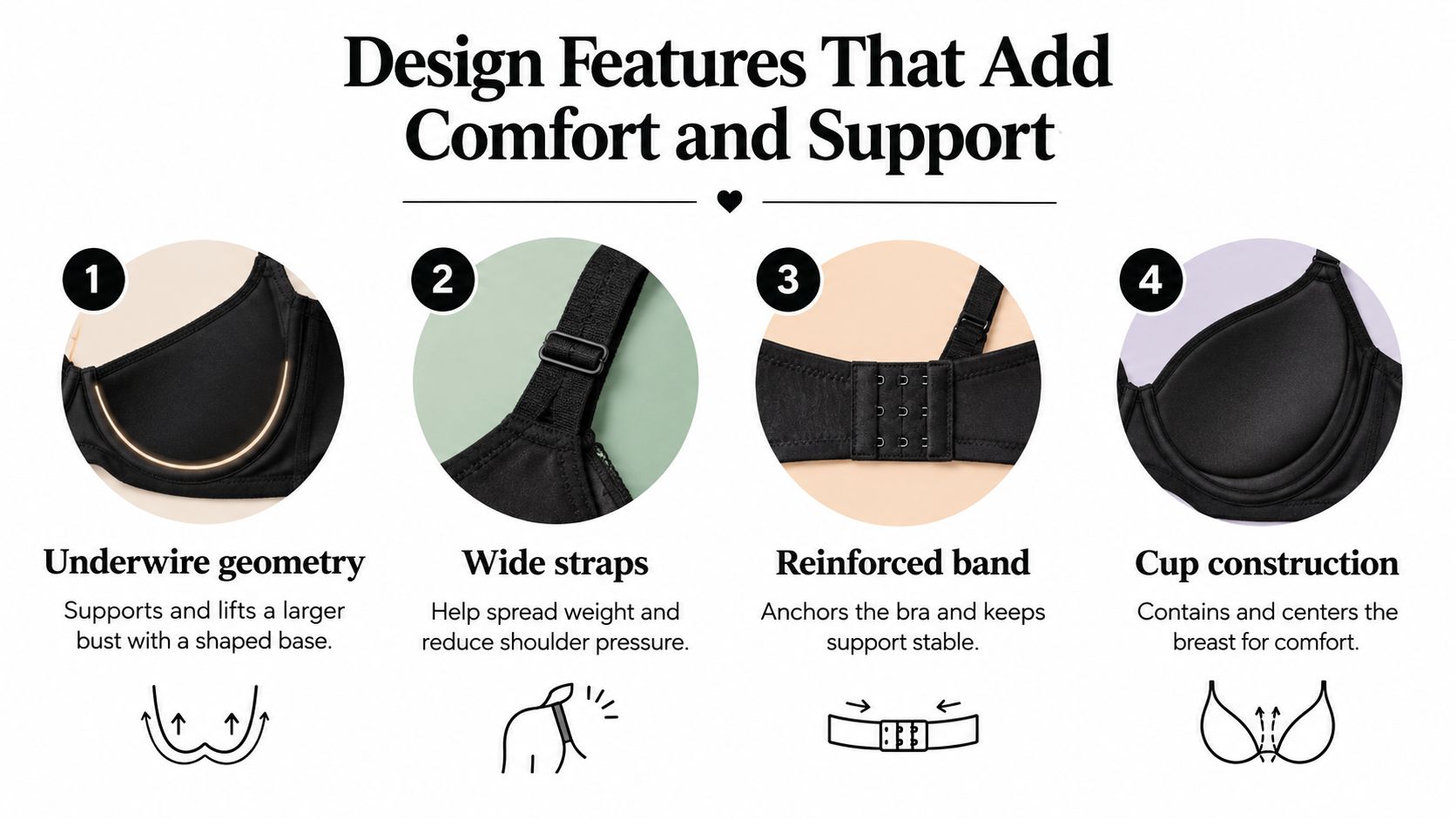
Cup construction gives stretchy fabric a supporting framework. Seamed cups, reinforced lower panels, or internal side slings can help support and contain each breast. Stretch across the upper cup offers room for changes in fullness, while firmer fabric underneath helps the cup keep its shape.
Check where the stretch is.
An entirely stretchy cup may feel gentle at first but allow more movement than you want. If that happens, exchanging for a style with firmer lower cups may help more than choosing a smaller size.
Separate cups can reduce the need for all-over compression. This design is called encapsulation: each breast has its own supported space. If a pull-on style presses your breasts together yet leaves them moving inside the bra, look for more defined cups rather than stronger compression.
Wider straps spread shoulder contact over more skin. Smooth edges, secure adjusters, and enough adjustment range matter alongside width. Padding can soften contact, though it cannot compensate for cups or a band that fail to carry their share.
Include feeding access in your comfort check
Try opening and closing the nursing clasp with one hand. The cup should fold away without bunching beneath your breast, and any inner sling should feel smooth against your skin.
When checking Milk&Lace's nursing-bra construction details, use these features as a checklist. Your goal is support that stays comfortable while you move and feed.
Deciding Between Underwire and Wire-Free Styles
At 3 a.m., when one breast feels full and the other has already softened after a feed, the underwire question becomes practical fast. With a larger bust, start with load distribution: the band is the shelf, the cups are the containers, and a wire, if present, is only the rim that traces the edge. If that rim sits on soft tissue, the shape is wrong for your body today.
Both structures can work. Choose the one that keeps weight mainly on the band, leaves breast tissue uncompressed at the edge, and lets you open the nursing access without the whole bra shifting. Early postpartum fullness, a history of clogged ducts, or mastitis are reasons to go slower, recheck fit often, and favor comfort while feeding patterns settle.
A wire earns its place when it fully surrounds the breast and rests on the rib cage. If it presses on tissue, tilts inward, or travels when you lift your arms, treat that as an exchange signal for size or wire shape. For a closer look at placement and fit checks, see this guide to nursing bras with underwire.
Choose by stage and fit
| Decide by | Structured underwire | Wire-free |
|---|---|---|
| Load path | A defined rim can outline the breast root and separate the cups when the band stays level. | The band and cup fabric carry the load, so check for steadiness without relying on stiffness. |
| Changing fullness | Works when size feels steadier. Reassess if fullness swings leave the rim touching tissue. | More forgiving during swings, while cups still need enough shape to contain. |
| Decision signal | Poking, rim on tissue, or red marks at the breast edge point to a shape or size change. | Collapse, a rolling band, or tissue drifting point to more structure or a different cup. |
A good test is quiet: inhale, lift your arms, bend, and latch. If the bra stays level and your shoulders feel less drafted, you found support. If it leaves new tenderness or a rim printed on breast tissue, change the fit before you ask your body to adapt.
Troubleshooting Common Fit Problems
A few simple checks can help you separate a sizing issue from a strap adjustment. Put the bra on while standing relaxed, then move your arms and open the nursing access as you normally would. See whether the band stays level and the cups remain in place.
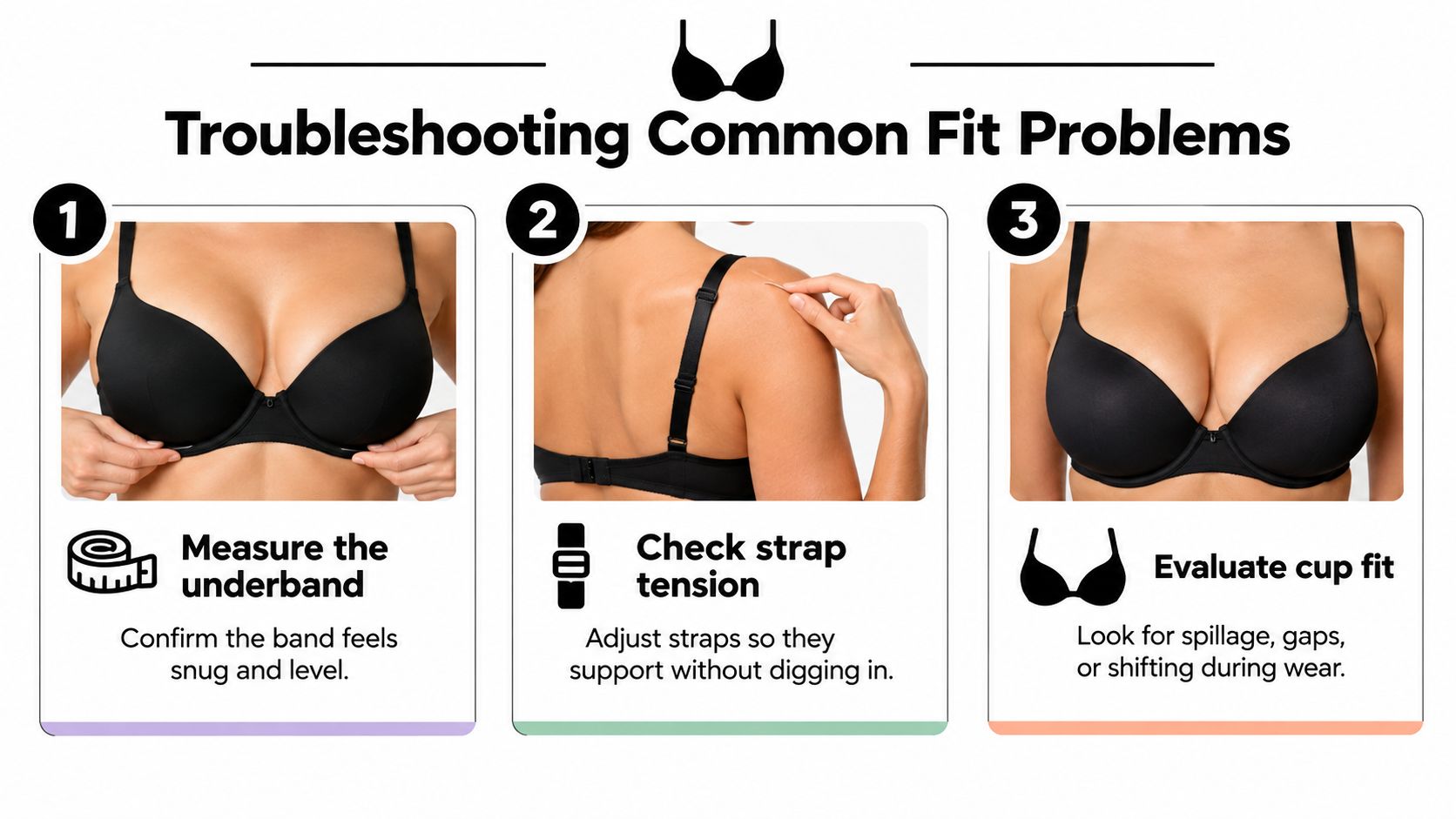
Match the symptom to the adjustment
- Band riding up: Check that it sits level across your back. If it climbs when you raise your arms, the band may be too loose or the bra's support may not be stable enough. Try a firmer band fit or consider an exchange.
- Wire sitting on breast tissue: Reposition the breast fully inside the cup, then check whether the wire rests on the rib cage around the breast. If it still presses on tissue, the cup or wire shape may be wrong. Don't try to solve it by tightening the band.
- Side spill: Smooth the breast tissue forward into the cup. If tissue still escapes near your underarm, look for a cup with more coverage or a different shape.
- Shoulder strain: Loosen the straps slightly and check what happens to the band. If the straps feel as though they're carrying the weight, revisit the band fit and cup containment rather than relying on tighter straps.
- Looseness after a feed: Check how the cups sit when your breasts are less full. A flexible cup may accommodate the change, but persistent gaps or shifting can mean the cup shape isn't right for you.
Then test the nursing access. It should open the cup without pulling the band upward or shifting the bra's support. Fitting guidance also emphasizes that a wire should rest on the rib cage, never press into breast tissue, and that nursing access shouldn't destabilize the bra, as outlined in this postpartum fitting guidance.
Decide whether to adjust or exchange
If the band stays level and the cups remain comfortable, a small strap adjustment may be enough. If the band rides up, the wire presses on tissue, or the cup spills even after you reposition it, consider a different size or shape instead of tightening everything around the problem.
Make these checks at both fuller and less-full feeding states when you can. That gives you a clearer picture of whether the bra adapts comfortably, rather than fitting only at one moment.
Choosing Nursing-Friendly Silhouettes Without Sacrificing Support
A flattering silhouette starts with a steady foundation. The band should stay level around your torso, and the straps shouldn't dig in or carry the breast weight by themselves. Once those parts work, you can choose the neckline, lace, and shape that feel like you.
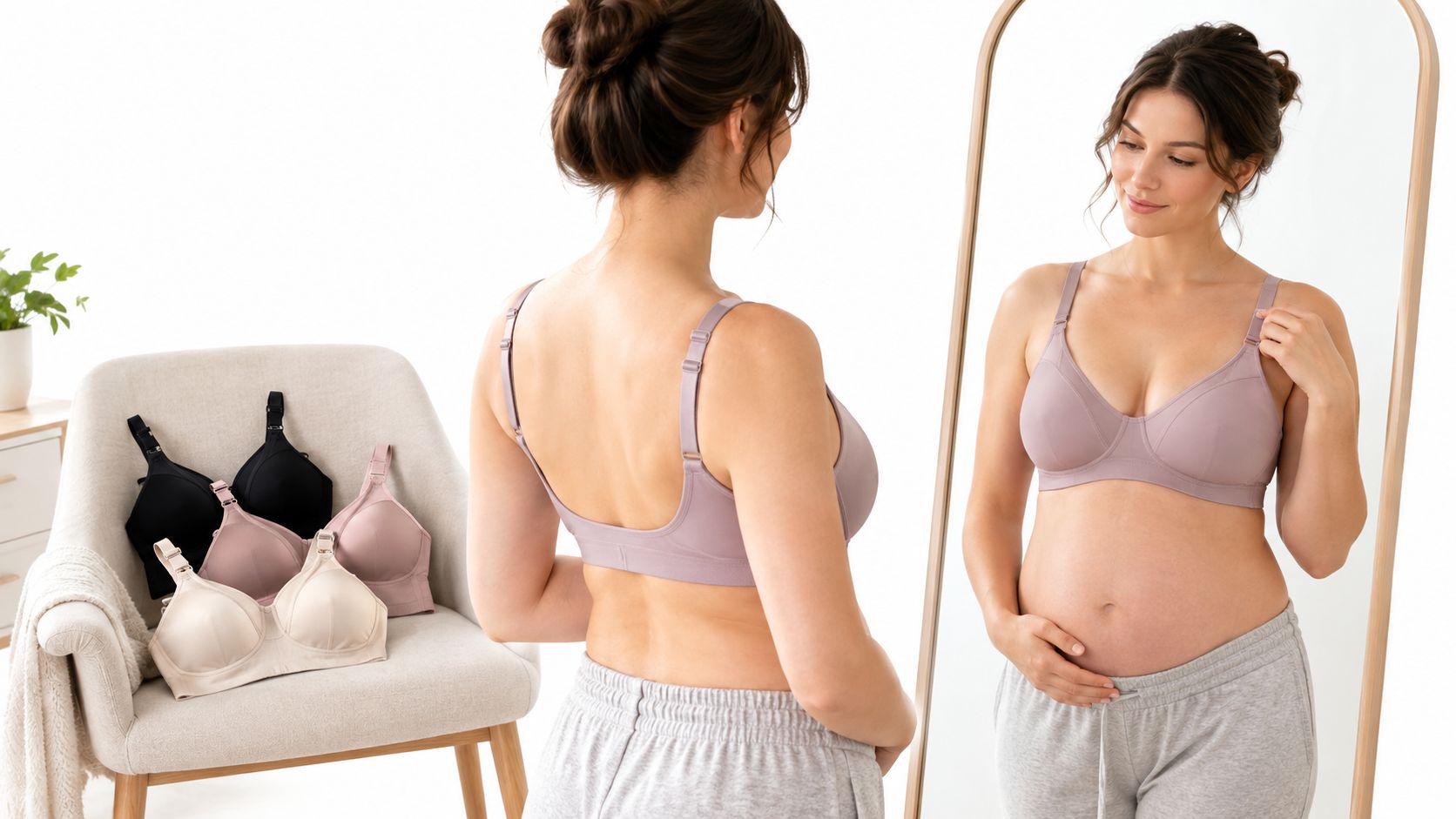
Support is also about how the rest of your body feels. The Academy of Breastfeeding Medicine notes that lactating breasts are highly vascular and need appropriately fitting support to help avoid dependent lymphedema and progressive back and neck pain, in its clinical protocol on the mastitis spectrum. A soft fabric can feel lovely against the skin, but the fit still needs to keep the band stable and distribute support well.
Let your routine shape the choice
A structured silhouette can suit days when you want a more defined, contained feel. A softer or more minimal design may appeal when you want ease and flexibility. Neither look is automatically the right one for a larger bust. Check how the band, cups, and nursing access work together on your body.
Milk&Lace's full-cup nursing bra guide offers another way to think about coverage and shape. Within the Milk&Lace collection, PETRA is described as featuring ultra-soft stretch lace, gentle underwire, and one-hand nursing access. Use those features as a starting point for your own questions: does the wire sit comfortably, and can you open the cup without the bra shifting?
If you're comparing a bra for daytime support with one for lounging, consider how long you'll wear each and what kind of movement your day involves. The right choice should feel supportive when you're dressed and undisturbed when you need to feed. For a visual walkthrough of nursing-bra fit, you can also watch this video.
Finding Your Next Step Toward a Better Fit
A bra feels comfortable before a feed, then leaves your shoulders aching afterward. That timing is useful information: it helps you work out whether changing breast fullness, strap tension, or the bra's shape is affecting support.
For a larger bust, support works like a well-packed backpack. Spreading the weight across a stable base reduces the load on your shoulders. Tightening the straps alone can leave them doing too much work.
Use your next wear to gather a few clues before buying or exchanging:
- Refer to the troubleshooting list above. Match your main symptom to its suggested adjustment, rather than repeating every fit check.
- Record when discomfort appears. A phone note such as “pressure before feeding, loose fabric afterward” gives a fitter more to work with than “the cups feel wrong.” Note whether it happens before, during, or after nursing.
- Change one thing at a time. Try the suggested adjustment, then note what improves. If the band still rides up, consider exchanging for a firmer band fit. If a wire remains on breast tissue after repositioning, try a different cup size or shape rather than tightening the straps.
Keep the bra's tags and packaging while you assess it, and follow the seller's try-on conditions.
Before ordering, read Milk&Lace's size-exchange, return, refund, and shipping guidelines, including any deadlines or costs. Your symptom notes can help you ask a specific exchange question: “Which size or shape would address this pressure without making the band looser?”
Milk&Lace offers nursing lingerie with breastfeeding access, support features, and lace styling. Compare the GAIA and PETRA nursing bras with your fit notes to choose which features to try next.