

You've found the white dress you can already picture at your shower or in your maternity photos. The skirt falls beautifully over your bump, but the moment you reach for your bag, the neckline shifts. Suddenly, you're wondering whether you'll spend the whole event pulling it back into place.
A white off the shoulder maternity dress should let you enjoy the occasion, not manage your outfit. Choose the neckline first, then judge the silhouette, fabric, and styling. A beautiful fit starts with what happens when you move, not how the dress hangs.
Find Your Fit Stage by Stage
The fit that matters changes throughout pregnancy and after birth. One set of measurements can't approve a dress for every stage. Start with your pre-pregnancy measurements if you have them, but don't delay shopping if you don't. Your current body is the useful starting point.
Use a flexible tape to record bust, underbust, waist, high hip, full hip, and vertical torso length. Keep the tape level for circumference measurements, and note where you measured torso length so you can repeat it consistently. The maternity-fit study published in PubMed Central supports considering body-shape changes alongside measurements rather than enlarging a standard pattern proportionally.
Fit checks by stage of pregnancy and postpartum
| Stage | Measure at this stage | Where to allow ease | Watch for |
|---|---|---|---|
| Pre-pregnancy baseline | Bust, underbust, waist, high hip, full hip, torso length | None, record true measurements | Baseline for every later comparison |
| First trimester | Bust and underbust | Bust room, neckline kept flexible | Neckline shifting as the bust changes early |
| Second trimester | Waist and abdomen | Growth ease at the abdomen, not the whole dress | Waist seam riding upward |
| Third trimester | Full abdomen and hem length | Front fullness and hem clearance | Insufficient front length and uneven hem |
| Postpartum and nursing | Bust and underbust again | Bust room for nursing and shoulder give | Neckline gaping or sliding as breast fullness changes |
Fit the shape you have
Say your bust becomes fuller early in pregnancy while your waist remains close to its previous measurement. Sizing up the entire dress might solve bust pressure but leave excess fabric at the sides. A flexible upper edge with controlled fullness below the bust is a better starting point than choosing a larger size.
Look for an adjustable empire seam, gathers concentrated toward the front, and enough front length to travel over your bump. Reject a fixed seam that climbs onto the bust or a skirt that pulls noticeably higher in front. Our guide to stylish maternity outfits offers more ways to build outfits around your changing proportions.
Fit priority: Buy for your intended wear date, then confirm the fit close to the occasion.
At that final fitting, sit, bend gently, walk, and raise both arms. You're checking whether the whole dress stays balanced, not just whether it closes.
How to Test the Neckline Before You Wear It
An off-the-shoulder neckline is the first place I'd challenge the fit. Tight elastic alone isn't a good retention system if it keeps the dress up by squeezing your upper bust or limiting your shoulders.
Maternity support-garment requirements discussed in the study indexed by the Korea Citation Index include ease of dressing, abdominal growth allowance, durability, and accommodation of breast-size variation. Those are useful buying criteria for a dress, too.
Use this visual checklist alongside the hands-on fitting.
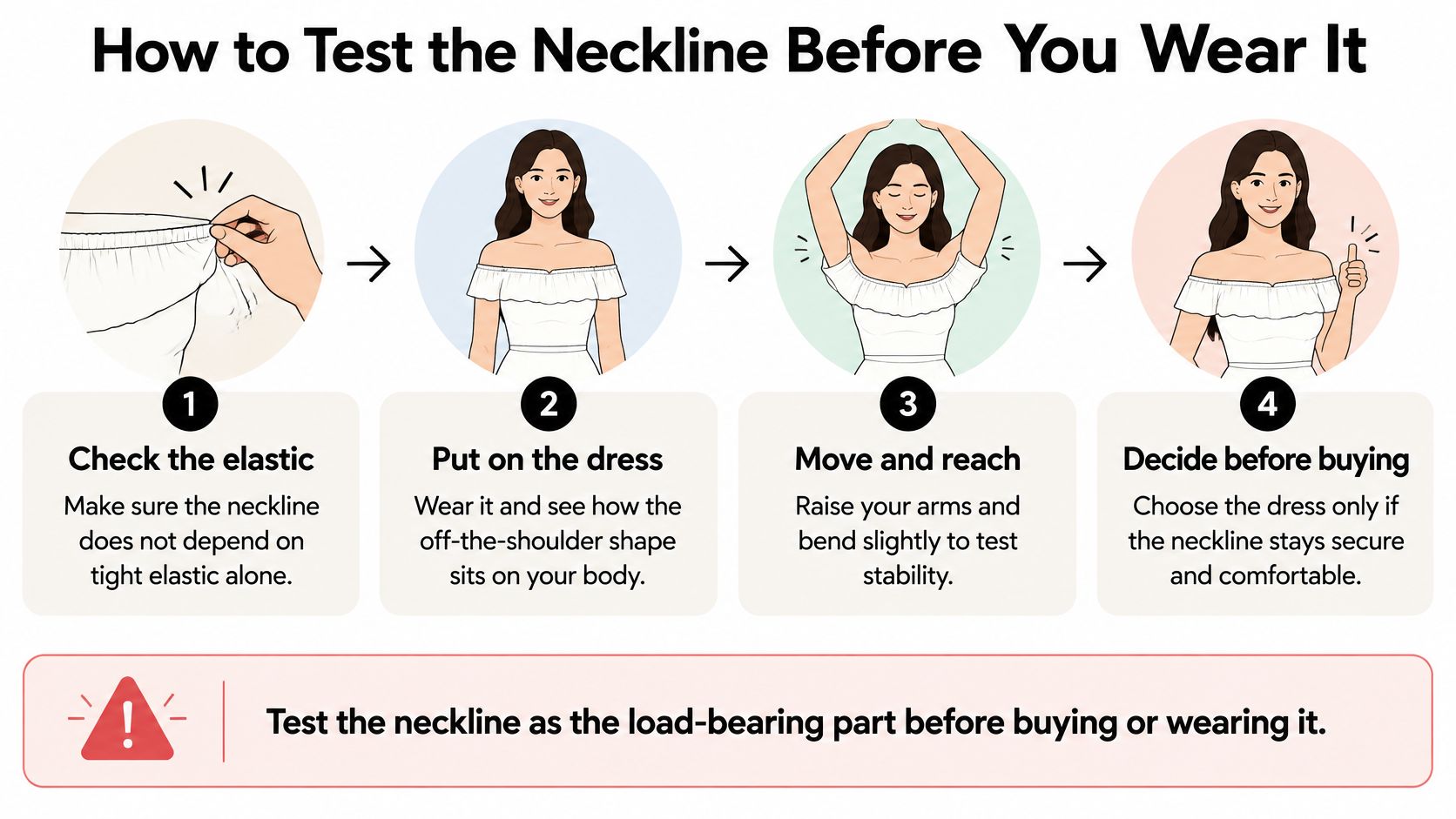
Run the movement test
- Establish the intended line. Use removable garment tape on a dress form, or note the neckline's position against your body in a mirror. You need a clear starting point to spot downward movement.
- Inspect the inside. Look for a stable facing or partial lining that supports the upper edge. An unsupported edge can twist even when the dress initially feels snug.
- Check elastic recovery. Gently stretch the shoulder edge, release it, and confirm it returns flat rather than staying rippled. Favor wide, soft elastic over a narrow cord that concentrates pressure.
- Wear it through ordinary movement. Keep both shoulders exposed, lift one shoulder, and extend your arms. Include reaching for a bag and sitting in the chair position you'll use at the event.
- Inspect the result. Look for rolling, gaping, downward slide, and localized pressure across the upper bust. A neckline you repeatedly correct hasn't passed.
Catch the white-fabric problems
- Heavy fabric: A substantial skirt can pull on an inadequately supported bodice.
- Narrow binding: A small, firm edge can dig in even when the rest of the dress feels loose.
- Visible construction: Check direct daylight and flash photographs for seam allowances, lining edges, and underlayers.
- Lining contrast: Try a lightweight lining close to your skin tone rather than automatically choosing stark white.
Judge comfort, movement retention, and appearance together. If the neckline slips, have the shoulder elastic adjusted or replaced first, but don't tighten an already uncomfortable edge. Next, consider a facing or partial lining; if the outer fabric still collapses, choose a firmer construction and repeat the complete test.
Fabrics That Keep an Off-the-Shoulder Line in Place
Choose fabric by how the finished dress behaves, not by softness alone. A stretchy swatch can feel lovely in your hand while the weight of the skirt pulls its neckline out of position.
The comparisons below are shopping starting points, not guarantees. Fabric weight, knit density, lining, and construction can change the result, so inspect the actual dress.
Fabric options for a white off-the-shoulder dress
| Fabric | Opacity in white | Neckline hold | Warm-weather comfort | Best use |
|---|---|---|---|---|
| Cotton jersey | Low in lightweight versions, usually needs lining | Good with soft elastic and a supported edge | Breathable | Baby showers and daytime outings |
| Stretch lace | Low to medium, choose lined | Good when lined and stabilized | Moderate | Evening events and photo days |
| Crepe | Medium to high in substantial weights | Strong when shaped with a facing | Moderate | Weddings and formal daytime |
| Chiffon | Low, sheer | Weak without underlying structure | Light and airy | Summer evenings with a slip |
| Ponte knit | High in substantial weights | Strong with suitable construction | Warm | Cooler weather and indoor events |
Be selective with lace and chiffon
Stretch lace needs more scrutiny than its pretty surface suggests. Check whether the lining stretches comfortably with the lace and whether their edges sit smoothly together. A restrictive lining defeats the point of a flexible outer fabric.
Chiffon works best as a floating outer layer over a properly fitted foundation. Don't expect the chiffon itself to hold the shoulder line. Inspect the dress from the side, where seams and the edge of a slip may become more noticeable.
Crepe is the option I'd shortlist for a cleaner, more defined silhouette. Check its stretch rather than assuming it has any, and make sure you can sit without tension across the abdomen. For another occasion-fabric comparison, explore our guide to maternity silk dresses.
More stretch doesn't automatically mean more versatility. A dress needs recovery and support as well as give.
Protect the construction
Follow the dress's care label first. For washable stretch pieces, cold washing and flat drying are sensible defaults; keep direct heat away from elastic, and don't hang a wet, heavy skirt from its shoulder edge.
Shortlist fabrics that suit your venue, then hold the finished dress toward a window to inspect transparency. Keep the option that combines the right coverage with a neckline that stays put.
Layering and Nursing Access Without Breaking the Look
Start with the underlayer, not the wrap. A bra can change where the bodice sits, and a camisole can add enough thickness to alter the neckline.
Use this layered look as a reference for checking coverage beneath a white dress.
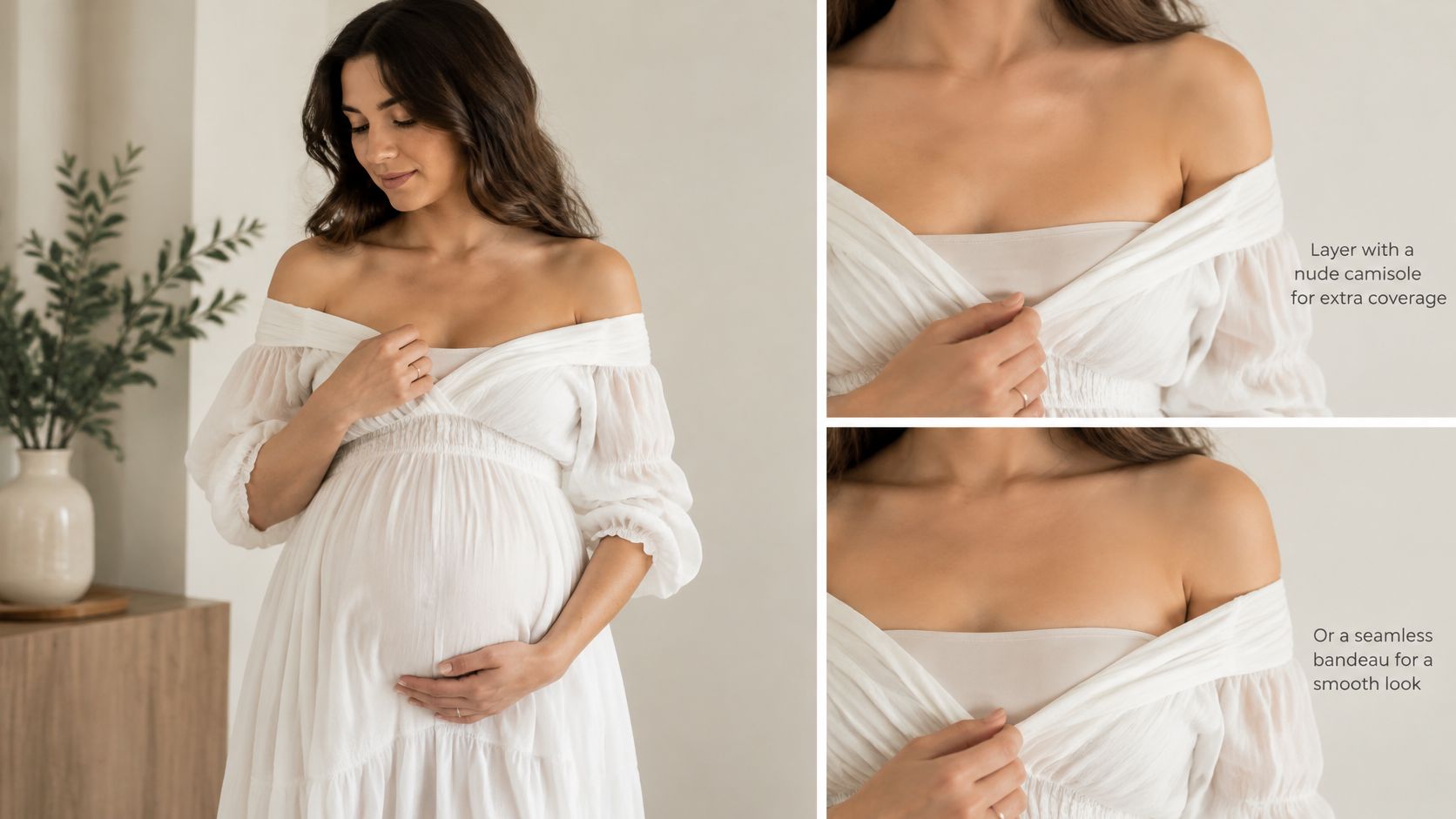
If you want completely bare shoulders, choose an appropriately fitted strapless underlayer. A bra with flat straps works only when those straps sit beneath the dress or you're comfortable making them visible. Don't buy a nursing bra expecting its straps to disappear under every off-the-shoulder cut.
Make access work while seated
Look for a bodice opening, concealed side access, or a neckline explicitly designed to move for feeding. Stretch alone isn't proof of nursing access. Pulling an ordinary neckline down may strain the elastic or leave you struggling to restore the dress afterward.
At a family lunch, you'll want to open the dress with one hand and lean toward your baby without the opposite side gaping. Rehearse the access while seated, with a cushion supporting the position where your baby would rest. If you test while holding your baby, keep them supported and have help nearby.
For more underlayer and opening options, use our guide to maternity clothes for breastfeeding.
Keep the complete outfit beside you while considering your feeding setup.
Choose removable coverage
- Air-conditioned lunch: Wear a fitted cardigan or light wrap that doesn't bunch beneath the shoulder edge.
- Evening event: Drape a shawl around your upper arms rather than tucking it into the bodice.
- Optional feeding coverage: Choose a separate removable cover if you prefer one, not a layer you must untie to reach the opening.
Say you're returning to the dress a few months postpartum. Refit the bra and rehearse seated access again rather than relying on how the outfit worked during pregnancy.
Finish by leaning forward and checking the feeding position on each side. Keep shoulder bulk minimal, choose an underlayer that disappears beneath your particular white fabric, and photograph the strap lines before leaving home.
Occasion Looks for Showers, Weddings and Daytime Days
The same white dress can feel relaxed at a shower and polished at an evening celebration. Change the texture around it, the shoe shape, and the jewelry rather than adding layers that interfere with the neckline.
For wedding guests, white needs explicit approval from the couple. A colored wrap doesn't turn a white dress into a nonwhite outfit. If white isn't welcome, save the dress for another occasion.
Occasion styling for a white off-the-shoulder maternity dress
| Occasion | Layer that works | Shoes and accessories | Watch for |
|---|---|---|---|
| Baby shower | Light cardigan or none in warm rooms | Flat or low sandals, simple earrings | Neckline sliding during seated games |
| Summer wedding guest, when white is approved | Pale pink or champagne wrap | Familiar block heels or wedges, gold jewelry | Glare and transparency in photos |
| Daytime brunch or family lunch | Fitted cardigan or none | Sandals, minimal jewelry | Gaping when leaning forward |
| Hospital or newborn photos | Soft wrap or cardigan | Comfortable flats, no heavy accessories | Strap lines and shoulder bulk |
| Evening celebration | Shawl or structured jacket worn open | Comfortable dress sandals, statement earrings | Stiffness and discomfort over the event |
Use color with intention
Pale pink adds a gentle contrast; champagne keeps the outfit tonal. Choose the shade against the actual dress, because a warm cream wrap and a crisp optical white can look more contrasting than expected. Gold jewelry is an easy evening choice, especially when the fabric is matte and simple.
For a baby shower, a relaxed sandal and a hair clip are enough. Leave room around the neckline rather than filling it with a large necklace, oversized earrings, and an elaborate wrap at once. Pick a focal point and let the dress remain uncomplicated.
Plan the transitions
Say you're attending an approved-white wedding late in pregnancy. Choose a shawl that slides off your upper arms for photographs rather than a wrap you must lift over your hair. Practice removing it while holding your small bag, then choose a chair-friendly length that won't gather beneath you.
For newborn photographs, prioritize easy removal and comfortable seated positions over elaborate accessories. A soft cardigan nearby gives you another look without a complete outfit change.
Styling rule: The dress should look relaxed on your body, not held in place by stiff layers or constant adjustment.
Choose shoes you already trust. An outfit isn't finished until you can walk to the venue, sit through the occasion, and leave comfortably.
Confirm Your Fit Before the Big Day
Approve the outfit as a complete system, not as separate attractive pieces. The dress, underlayer, shoes, and outer layer need to work together on the body you have when you wear them.
Your final decision needs clear passes: a secure, comfortable neckline; event-appropriate fabric; and compatible underlayers and access. If one fails, changing your earrings won't solve it. Make the practical adjustment or choose another dress.
Decide what deserves an alteration
A modest adjustment to replace tired elastic or stabilize an edge can be worthwhile when the rest of the dress fits well. A bodice that needs extensive rebuilding is a different purchase decision. Ask a dressmaker to assess the construction before committing to changes, particularly when lace, lining, and elastic are joined together.
Keep a fallback outfit ready if the event is important. That isn't pessimism. It lets you choose comfort without feeling trapped by the dress you originally imagined.
Finish with a clear fitting sequence
- Choose your fit stage and record your measurements. Write down your current measurements and the intended occasion. Recheck the areas that have changed before approving the outfit for wear.
- Shortlist dresses by fabric and construction. Compare an option suited to your venue with an alternative that offers a different balance of structure and drape. Inspect the inside as carefully as the outside.
- Run the neckline test on each. Wear your intended underlayer and make ordinary movements without deliberately holding the dress in place. Eliminate any option that needs repeated correction or creates pressure.
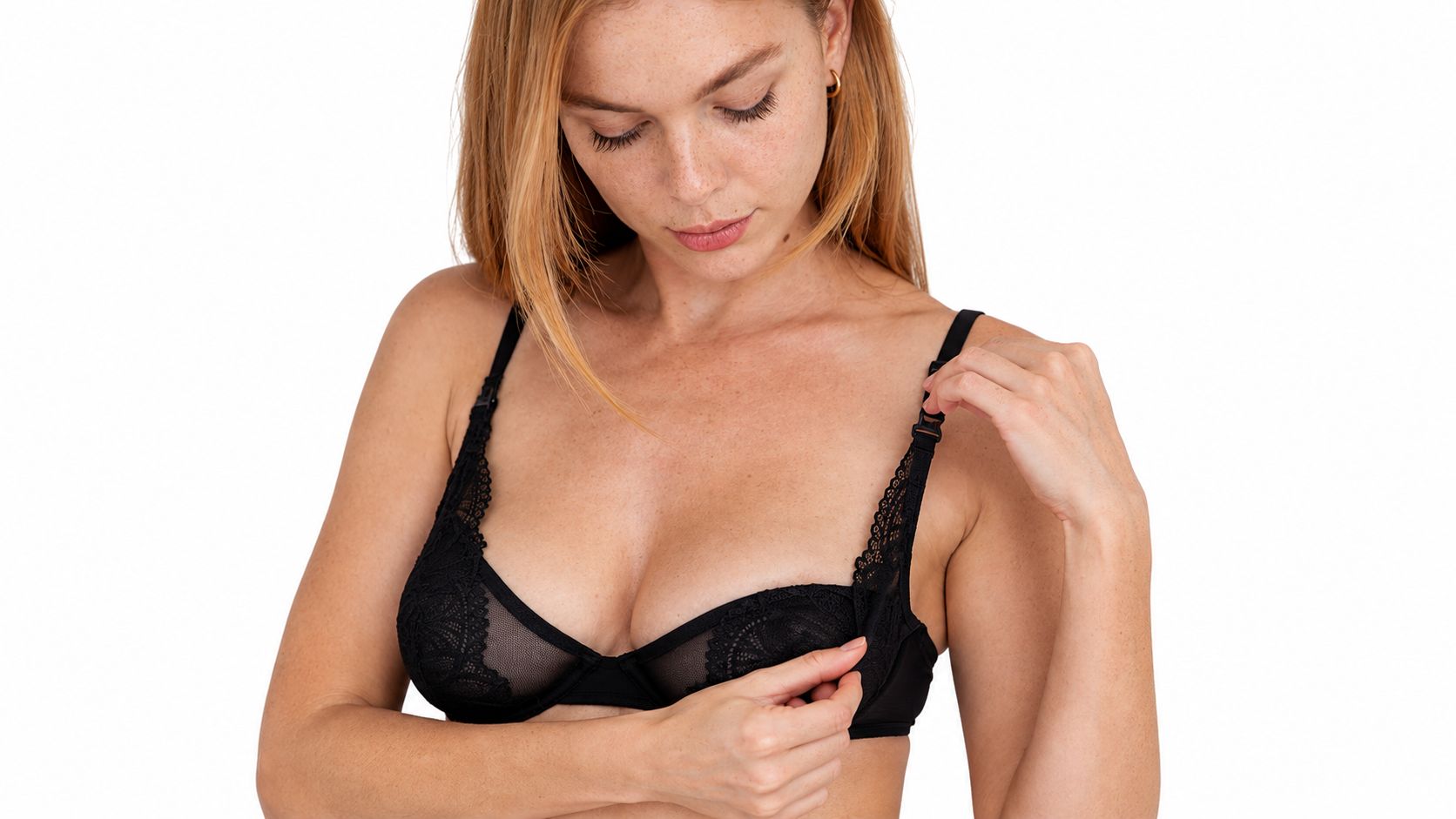
- Confirm the layer, underlayer, and feeding setup. At Milk&Lace, we sell maternity and nursing lingerie. Our PETRA has an adjustable fit, ultra-soft stretch lace, gentle underwire, and one-hand nursing access; our Gaia Lace Nursing Bra has flexible cups that provide nursing access. Consider either only where its straps and shape work with your chosen dress, rather than assuming a nursing bra is a strapless solution.
Use the underlayer as part of the fitting, not an afterthought.
The right white off-the-shoulder maternity dress should give you space to enjoy the person you're becoming without losing the style you recognize as yours. Through pregnancy, nursing, and your return to familiar routines, that means clothes you can move in and details you genuinely like.
Milk&Lace offers maternity and nursing lingerie that combines lace with practical feeding access. Visit Milk&Lace to explore an underlayer for your dress, then try the complete outfit together before your occasion.