

You're sitting on the sofa with your baby tucked against you, trying to remember whether the last feed felt better than the one before it. Your shoulders ache, your breasts feel tender, and the nursing bra that seemed comfortable yesterday now feels tight. You may also be thinking about an upcoming return to work, feeding in public, or how to keep going when every part of the day feels new.
That's where the question what is nursing support becomes more meaningful than “How do I get the latch right?” Nursing support can include a knowledgeable professional, a partner who brings water and protects your rest, clothing that supports your changing body without squeezing it, and someone who listens when feeding feels emotionally heavy.
Support isn't a single fix. It's a system that helps you care for your baby without losing care for yourself.

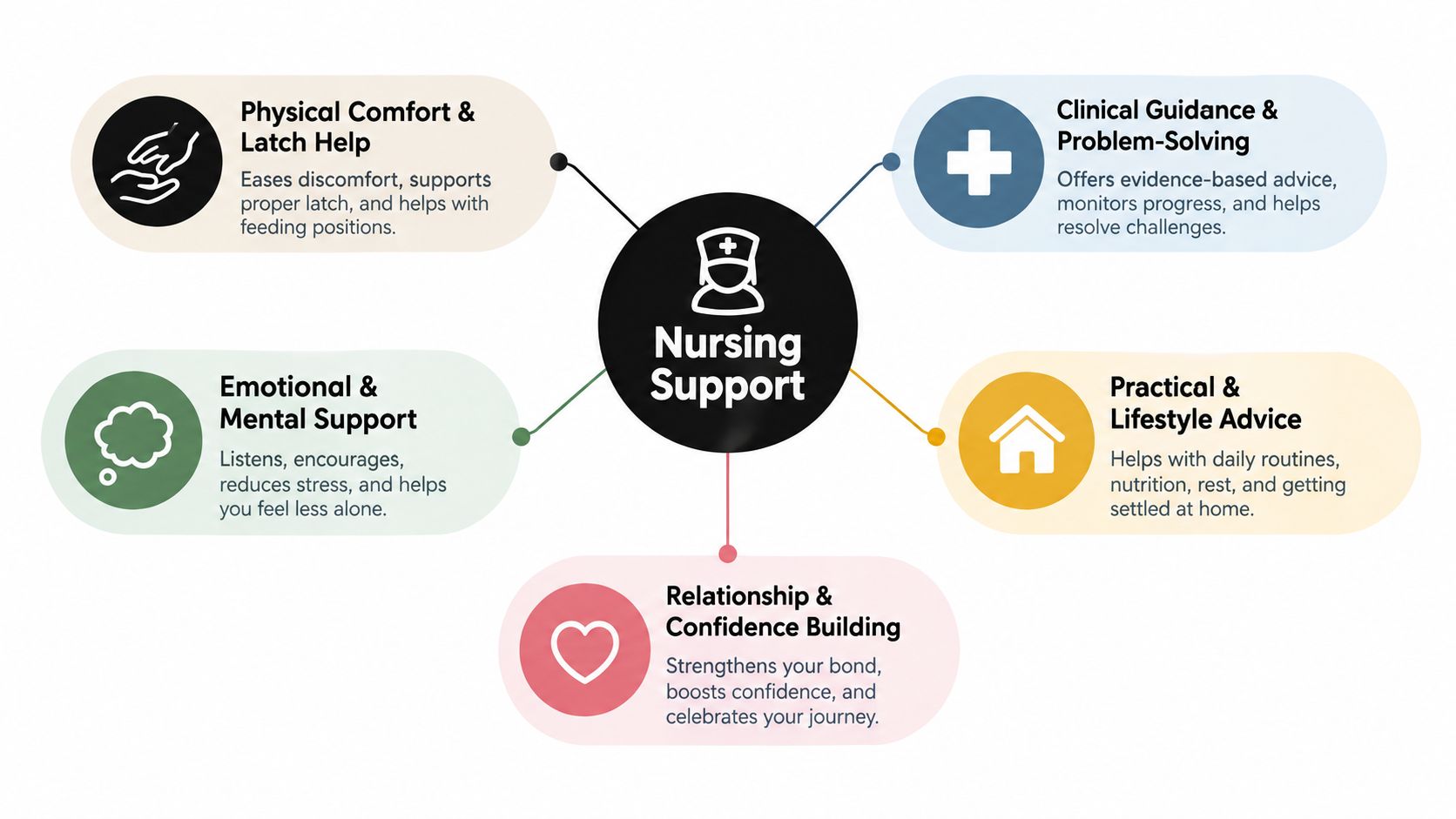
This system has three connected parts: physical comfort, clinical guidance, and emotional and identity support. A feeding position can be technically sound but difficult to repeat if your back hurts. A well-fitting bra can reduce distraction, but it can't answer a question about milk transfer. A lactation consultant can solve a feeding problem, but ongoing confidence often grows through practical help and compassionate company.
You don't have to wait until you're in crisis to ask for support. The right help can change as your baby grows, your body settles, and your daily responsibilities return.
What Nursing Support Really Means Beyond Feeding Help
At three in the morning, a feed may leave your shoulders aching, your questions unanswered, and your confidence shaken. Latch guidance matters, yet nursing support reaches further. It includes the people, knowledge, routines, and physical tools that make breastfeeding more comfortable, sustainable, and emotionally manageable.
Nursing support works like a bridge with three connected pillars: one steadies your body, one helps you make informed feeding decisions, and one protects your sense of self. A missing pillar can make the whole journey harder to cross, even when feeding itself appears to be going well.
The physical pillar
Physical support reduces unnecessary work for your body. It can mean bringing your baby closer instead of leaning forward, supporting your arms with a pillow, adjusting the feeding position, or choosing a nursing bra that accommodates normal changes in breast volume.
Lactating breasts may change size during the day. Guidance on nursing bra fit and comfort recommends avoiding rigid underwires, tight seams, and restrictive structures during early lactation because localized pressure can interfere with milk flow and contribute to blocked ducts or mastitis. The goal is flexible, steady support rather than maximum compression.
Small changes often shape the entire feeding experience. A setup that protects your back and leaves room for comfortable movement can make it easier to repeat feeds throughout the day.
The clinical pillar
Clinical support helps you understand what is happening and choose a useful next step. An International Board Certified Lactation Consultant, midwife, nurse, physician, or trained peer counselor may assess latch, positioning, milk transfer, pumping, nipple pain, or concerns about supply.
Good guidance also respects your feeding goals. It does not reduce you to a checklist or assume every family needs the same plan. For practical first-time-parent guidance, these breastfeeding tips for new mothers can complement, but not replace, individualized care.
The emotional pillar
Feeding happens within relationships and daily responsibilities. You may need reassurance after a difficult feed, privacy without shame, help responding to relatives, or a partner who understands that nursing and pumping require time and energy. This support protects more than mood. It helps you feel like a whole person while your identity is changing.
The GAIA nursing bra by Milk&Lace combines stretch lace, flexible support, and breastfeeding access. A garment like this is one practical part of a wider system, particularly when comfort and confidence matter alongside function.
Nursing support also belongs to a broader public-health effort. The World Health Organization identifies milestones including the International Code of Marketing of Breast-milk Substitutes, adopted in 1981, the Innocenti Declaration agreed in 1990, and the Global Strategy for Infant and Young Child Feeding endorsed in 2002. These efforts recognize that families need supportive conditions, not determination alone, to make informed feeding choices.
The Three Main Types of Nursing Support Explained
The three types of nursing support overlap, but each solves a different kind of problem. Use the comparison below as a starting point, not a test you can pass or fail.
| Support Type | What It Provides | Best For | Example |
|---|---|---|---|
| Physical | Comfort, positioning, fit, and movement support | Soreness, back strain, changing breast volume, difficult feeding positions | A pillow supports the baby's weight while a flexible nursing bra avoids pressure points |
| Clinical | Assessment, education, and problem-solving | Persistent pain, latch concerns, pumping questions, or worries about feeding effectiveness | An IBCLC observes a feed and suggests a position change |
| Emotional | Reassurance, practical protection, and belonging | Shame, isolation, anxiety, identity changes, or stress around public feeding | A partner handles household tasks and a peer group offers nonjudgmental encouragement |
Physical support belongs in everyday details
Physical support is often easiest to recognize because you can feel its absence. Your shoulders may creep upward during feeds. You may curl your spine toward your baby, hold your breath while waiting for let-down, or keep shifting because your bra cuts into sensitive tissue.
A supportive setup brings the baby to you. It doesn't ask you to fold your body around the baby for every feed. A pillow, footrest, side-lying arrangement where appropriate, and clothing with simple nursing access can reduce friction throughout the day.
If pumping is part of your routine, this guide to hands-free pumping may help you think about how equipment, clothing, and daily tasks fit together. Hands-free access isn't a substitute for comfort or clinical guidance, but it can make a demanding routine easier to organize.
Clinical support turns uncertainty into a plan
Clinical help is especially useful when you've been trying the same adjustment repeatedly without relief. A professional can observe the whole feed rather than relying only on a description of what hurts.
You might ask for help with:
- Latch and positioning: Whether your baby is well attached and whether your body is adequately supported.
- Milk transfer: Whether feeding behavior suggests your baby is receiving milk effectively.
- Pumping: Flange comfort, pumping patterns, and how to avoid creating more pain.
- Breast symptoms: Recurring blocked ducts, unusual tenderness, or signs that need medical attention.
Emotional support protects your capacity
Emotional support isn't merely kind language. It creates the conditions in which you can keep learning, adapting, and making decisions. A partner who listens without immediately trying to fix the problem can be more helpful than someone who offers pressure or criticism.
Practical support counts too. Someone can prepare food, refill your water, care for an older child, accompany you to an appointment, or help you find a private place to pump. Those actions tell you that feeding your baby is shared work, even when your body performs the feeding.
How Nursing Support Helps You and Your Baby Thrive
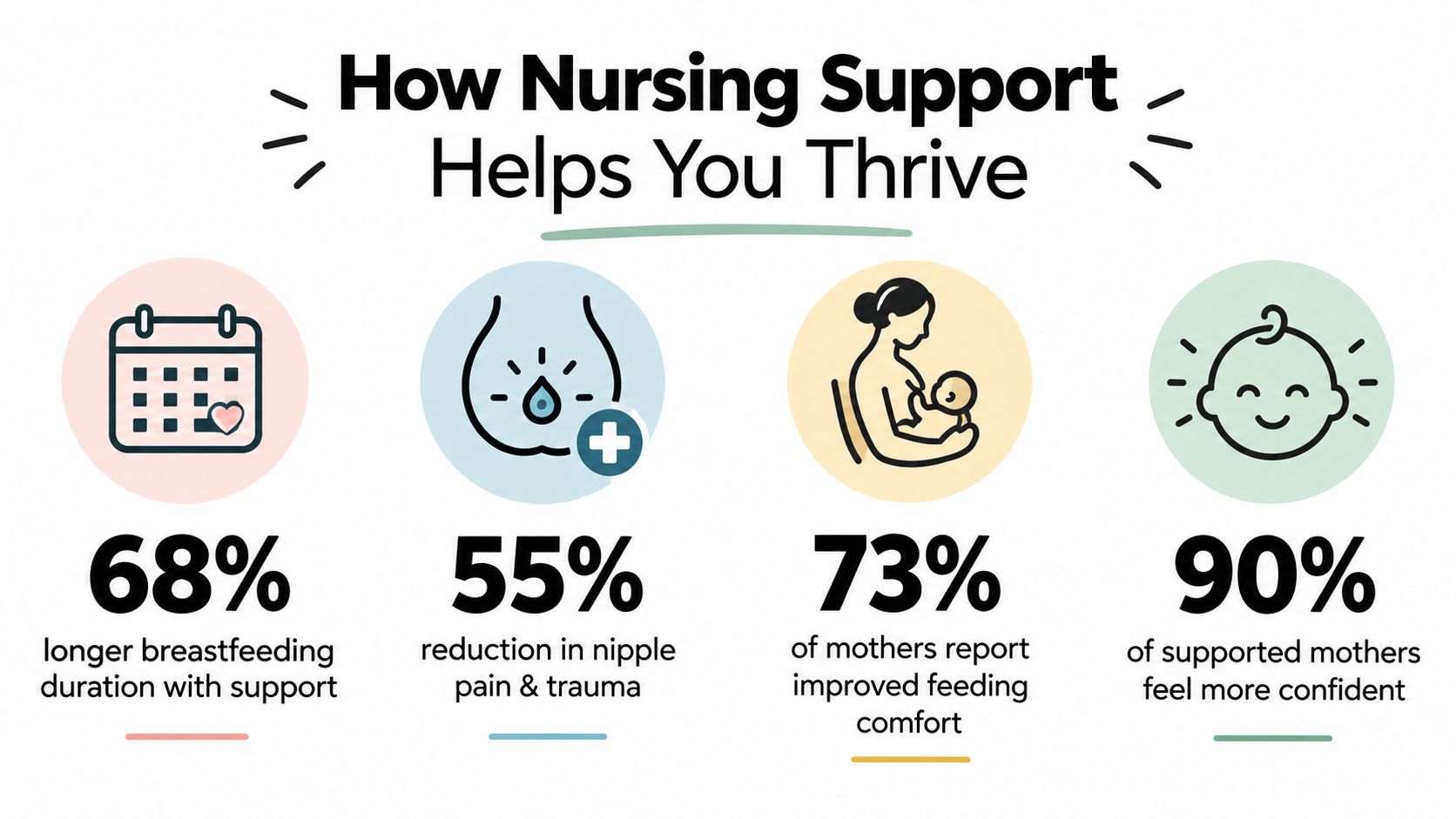
The clearest benefit of nursing support is that it makes feeding more sustainable. In a WHO-reviewed evidence base of 51 trials involving 21,418 women, 53% of women who received additional support had stopped any breastfeeding by six months postpartum, compared with 57% receiving standard care. The pooled result showed a 9% lower risk of stopping breastfeeding before six months, with a relative risk of 0.91 and a 95% confidence interval of 0.88 to 0.95, as reported in the WHO-reviewed evidence summary.
That result doesn't mean support guarantees a particular feeding outcome. It shows something more useful: structured help can influence how long breastfeeding continues, particularly when the support is accessible, timely, and responsive to real problems.
Support can protect feeding goals
Face-to-face interventions in the same evidence base reduced the risk of stopping exclusive breastfeeding by six months by 14%, with a relative risk of 0.86 and a 95% confidence interval of 0.81 to 0.90. Human guidance matters because feeding problems rarely occur in isolation. Pain affects positioning, positioning affects milk transfer, and worry can make each feed feel harder to approach.
Clinical support can also reduce confusion. Instead of trying a new technique from a short video every few hours, you can receive feedback suited to your baby, your anatomy, and your routine.
Comfort changes the physical experience
A better-supported posture distributes load more evenly across the body. In a pre-clinical study, all participants failed fit assessment in their usual bra, and 67% still failed after professional fitting. The professionally fitted bra produced immediate changes in breast support and spinal posture, showing that garment quality can affect movement control and load distribution, as described in the biomechanical fitting study.
This doesn't mean a bra can solve every postpartum ache. It means fit deserves attention when your breasts are changing and your feeding posture is repeated many times each day.
Confidence is a health resource
Confidence grows when your environment stops making every feed feel like a public performance. It can come from knowing whom to call, having clothes that allow discreet access, and hearing that changing your plan doesn't erase your effort.
Support helps you and your baby thrive by making room for both of you. Your baby receives care, while you receive information, physical ease, and permission to remain a whole person.
Signs You May Need More Nursing Support Right Now
Needing more help doesn't mean you're doing something wrong. It means your body, your baby, or your circumstances are giving you information. The earlier you respond to that information, the more options you may have.
Notice physical signals
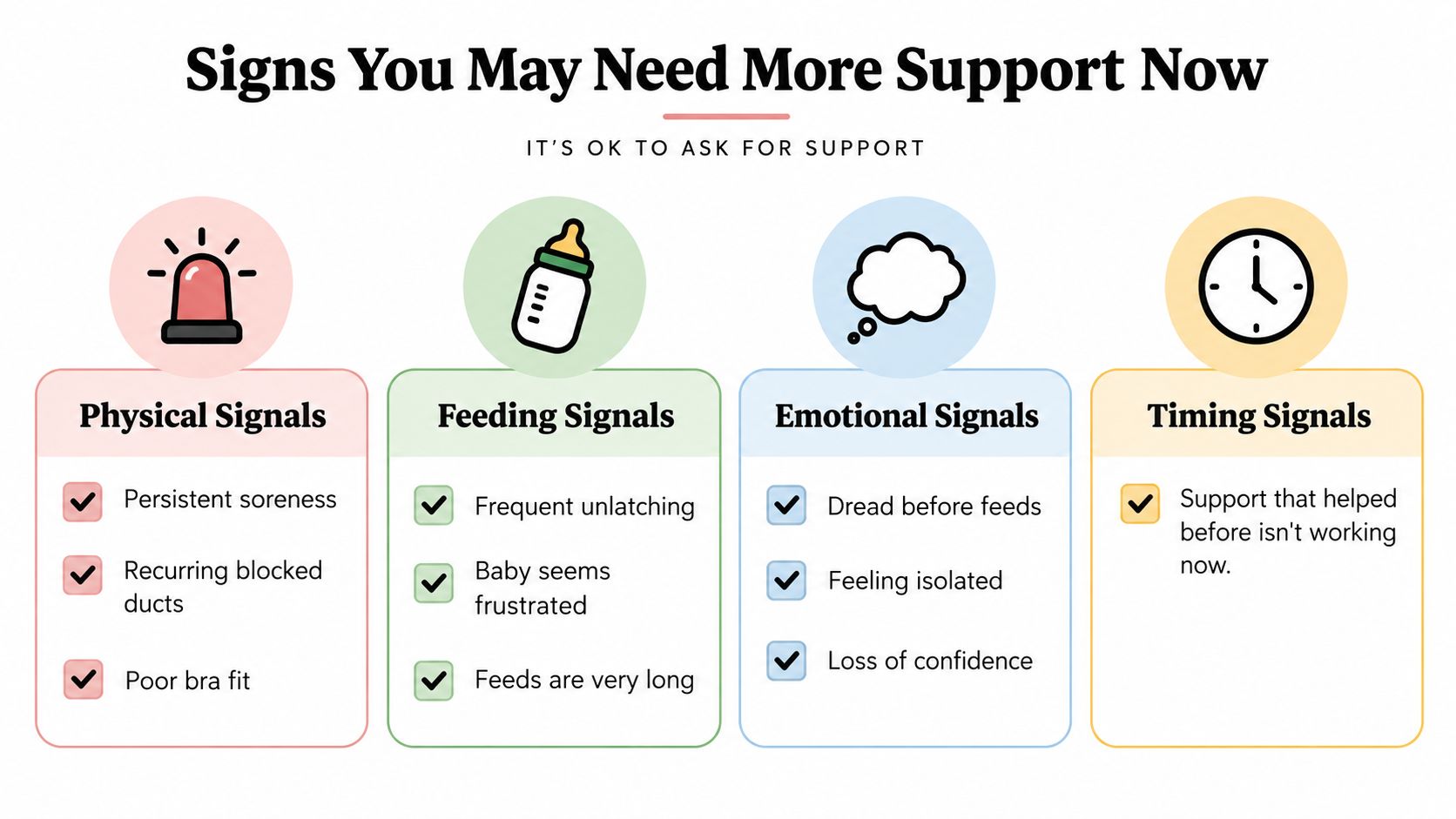
Persistent nipple or breast soreness deserves attention, particularly when it continues beyond the initial adjustment period or worsens with each feed. Recurring blocked ducts, a bra that leaves marks, and new back, neck, or shoulder pain can also signal that your physical setup needs to change.
Check the basics first. Is the baby supported at the right height? Are you leaning forward? Does the band or cup feel restrictive as your breasts fill? If the answer to any of these questions is yes, consider a fit review and clinical assessment rather than tolerating the discomfort.
Listen to feeding signals
Frequent unlatching, a baby who seems frustrated, or feeds that feel unusually long can leave you wondering whether something is wrong. These signs have several possible explanations, so they're best treated as reasons to seek observation, not as proof of low supply or poor feeding.
Write down what you're noticing before an appointment. Note when the difficulty occurs, what positions you've tried, and whether pain appears at the beginning, throughout the feed, or afterward. Clear details help a professional see patterns.
Take emotional signals seriously
Dreading feeds, feeling isolated, losing confidence, or feeling ashamed about nursing in public are meaningful signs. A 2026 survey reported that 60% of breastfeeding mothers said they'd been given a hard time for nursing or pumping in public, 58% regularly felt guilt or shame, and 65% said returning to work made continuing difficult. The same survey identified understanding and emotional support as the leading forms of help respondents wanted, at 31% and 30%, respectively, according to the survey report.
Your emotional response isn't a side issue. Tell someone trusted, contact a postpartum mental-health professional when needed, and seek urgent medical help if you're concerned about your safety or your baby's safety.
Watch for timing signals
Support that worked during the first weeks may stop working when your baby becomes more active, your breasts change, pumping begins, or work resumes. A new stage calls for a new plan, not self-blame.
How to Find Trusted Nursing Support and Ask the Right Questions
Start with the problem you can name. If you're experiencing pain or latch uncertainty, look for an IBCLC, midwife, physician, nurse, or trained feeding professional who can assess you and your baby together. If the main problem is isolation or judgment, a peer group, postpartum support circle, or trusted community may be the better first step.
A telehealth appointment can be useful when travel, mobility, or childcare makes in-person care difficult. Still, ask whether the provider can observe a feed clearly, explain what they're assessing, and arrange follow-up if the first plan doesn't help.
Questions for a clinical provider
Bring your goals and your concerns. You might ask:
- Experience: “Do you regularly support families with my feeding situation?”
- Assessment: “Can you observe a full feed or pumping session?”
- Plan: “What should I try first, and what would tell us it's working?”
- Follow-up: “When should I check back if the pain or feeding difficulty continues?”
- Escalation: “Which symptoms require my midwife, physician, or pediatric clinician?”
A trustworthy provider won't promise that one technique works for everyone. They'll explain options, respect your decisions, and tell you when another professional should become involved. A breastfeeding support system works best when clinical care, household help, and personal routines reinforce one another.
Questions for physical support products
Look for flexibility, smooth construction, and a fit that changes with your body rather than fighting it. Early in lactation, expert guidance generally cautions against rigid underwires, tight seams, and restrictive materials because pressure can affect milk flow and contribute to blocked ducts or mastitis.
Try the garment at a time when your breasts aren't unusually empty or full. Check whether you can breathe comfortably, move your arms, and insert a finger beneath the band without sharp pressure. Nursing access should be simple enough that you don't have to pull the garment forcefully or twist your torso.
Later postpartum needs may differ from early-lactation needs. As routines expand, you may want a bra that combines nursing access with a more considered silhouette. The PETRA nursing bra uses ultra-soft stretch lace, gentle underwire, and one-hand nursing access, making it an example of a later-stage garment to evaluate carefully for personal comfort and fit.
Common Myths About Nursing Support and What to Trust Instead
Myth: Pain is part of breastfeeding.
Some tenderness may appear while you and your baby learn together. Pain that persists or worsens deserves attention. Your body's feedback is useful information, so ask a qualified professional to observe a feed and check positioning, latch, and comfort.
Myth: Nursing support is only for the first weeks.
Support can change as your baby grows, pumping becomes part of the routine, or you return to work. Physical comfort, clinical guidance, and emotional confidence remain connected, even when your daily needs shift.
Myth: Any bra will do.
Breast volume can fluctuate, and a regular bra may create pressure at sensitive points. A flexible fit, comfortable nursing access, and gentle construction can help you move, feed, and rest without feeling constrained. Practical guidance on nursing bras can help you identify unnecessary compression and assess fit for your changing body.
Myth: Asking for help means you aren't capable.
Capability grows through accurate information, responsive care, and support that respects your goals. Seeking help is one way to protect comfort and make informed choices, not evidence that you have failed.
Global breastfeeding figures also show why support systems matter. WHO reported that 47% of newborns initiated breastfeeding within one hour of birth during 2015 to 2021, below the 70% target, while exclusive breastfeeding under six months reached 48%, up from about 38% a decade earlier. A later WHO fact sheet stated that about 47% of infants aged 0 to 6 months worldwide were exclusively breastfed over 2018 to 2025, as summarized in the WHO breastfeeding support review.
Nursing support cares for both people in the feeding relationship. It helps your baby receive care while helping you stay comfortable, informed, and connected to your identity beyond feeding.
Milk&Lace offers nursing bras designed for breastfeeding access, soft materials, and changing postpartum needs. Visit Milk&Lace to explore options that may complement clinical, physical, and emotional support.