

At 3 a.m., your baby is rooting against your chest, one nipple is cracked, and your phone is lighting up with advice that somehow makes you feel worse. You're tired, sore, and wondering whether this is normal or whether you've already missed your chance to get breastfeeding right.
You haven't. But you do need more than determination. A reliable breastfeeding support system gives you a clear person, tool, or plan for each problem before it becomes a middle-of-the-night emergency. It also recognizes that breastfeeding depends on hospital practices, trained care, emotional safety, practical equipment, and the conditions waiting for you when you return to daily life.
Global progress shows both the value of support and the size of the gap. In 2024, 48% of infants under six months worldwide were exclusively breastfed, close to the WHO target of 50% for 2025, while only 46% of newborns were breastfed within the first hour of birth during 2016 to 2022, below the collective 2030 target of 70% (WHO and UNICEF's breastfeeding support update). You deserve a plan that works in the hospital, at home, in public, at work, and during the messy hours when confidence disappears.
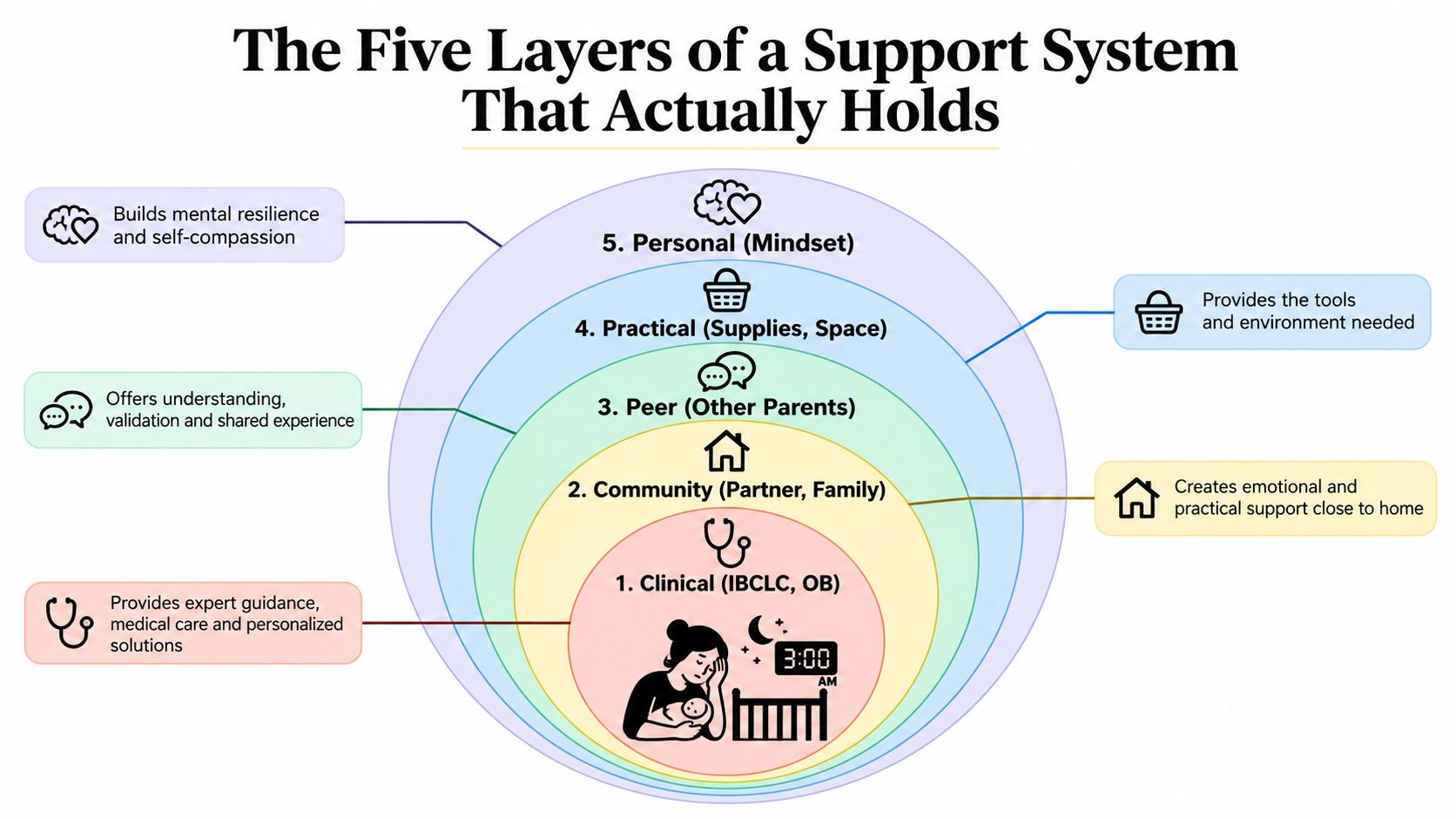
The Five Layers of a Support System That Actually Holds
A single lactation appointment can help, but it isn't a complete system. You need five layers, each with a different job.
Clinical support is your IBCLC, obstetric clinician, midwife, pediatrician, or other qualified health professional. This layer handles pain, poor milk transfer, damaged nipples, weight concerns, and problems that require assessment rather than reassurance.
Peer support comes from trained counselors, parent groups, and other breastfeeding parents. You take the 11 p.m. question, “Is this feeding pattern normal?” and get practical reassurance from someone who understands the reality of feeding a newborn.
Partner support is the person who protects your recovery while you feed the baby. Their role isn't to give you inspirational speeches. It's to refill your water, bring food, change the diaper, manage visitors, and make it possible for you to stay focused on feeding.
Workplace support includes time, privacy, storage, equipment, and a manager or HR contact who understands the plan. It becomes essential as soon as paid leave ends or your routine takes you away from home.
Personal gear includes a pump that fits your life, clothing that opens easily, bras that don't press painfully, bottles if you'll use them, and a feeding station stocked before exhaustion takes over.
These layers reflect how breastfeeding support evolved into an organized health system. The WHO and UNICEF joint statement appeared in 1989, the Innocenti Declaration followed in 1990, and the Baby-friendly Hospital Initiative launched in 1991 around the Ten Steps to Successful Breastfeeding (WHO record on the Baby-friendly Hospital Initiative). Those steps connect early skin-to-skin contact, rooming-in, responsive feeding, skilled counseling, and careful formula practices to the way facilities support families.
The practical rule: never ask one person to be your entire support system.
The rest of your plan should answer one question for each layer: Who do I contact, what do I need from them, and what is my backup? That's how the 3 a.m. moment gets an answer instead of another hour of scrolling.
What to Set Up Before Baby Arrives
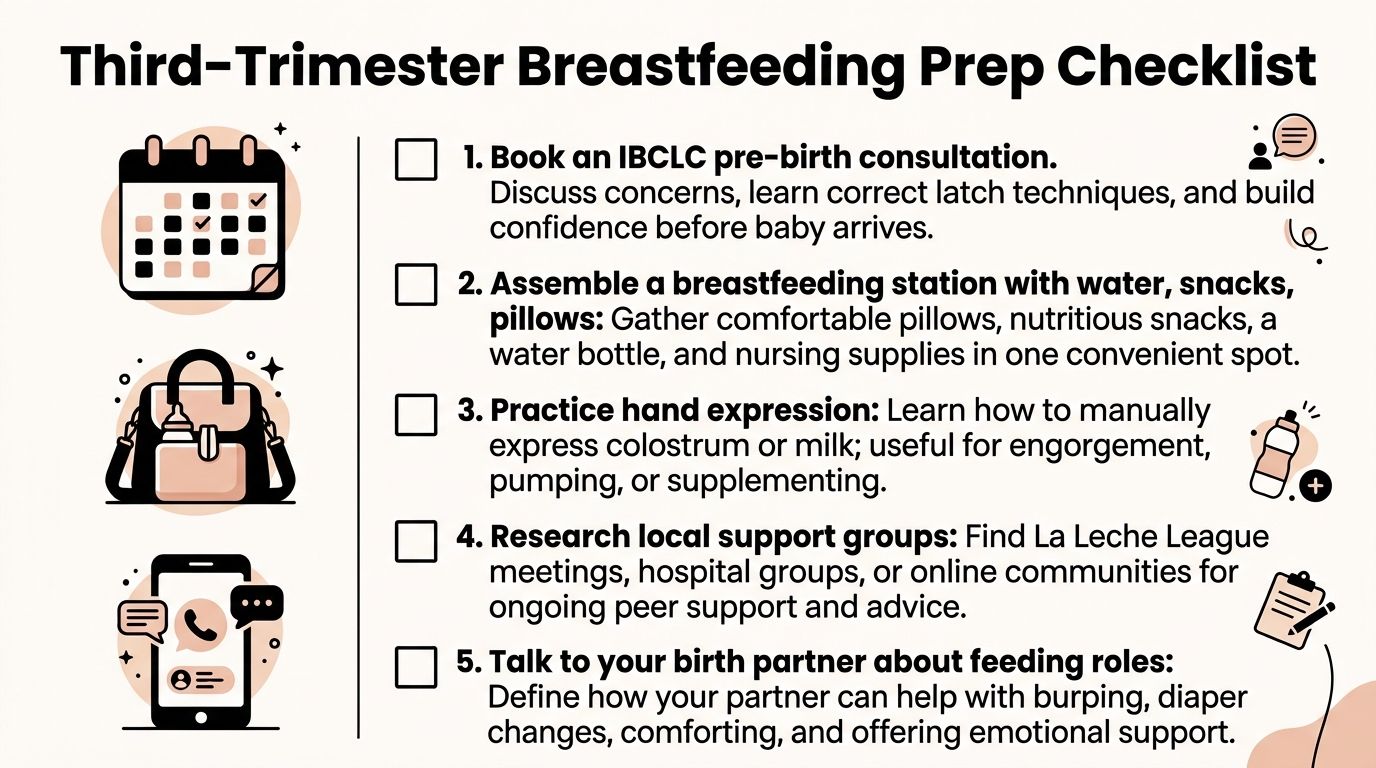
By the second week home, a feeding question can appear at 3 a.m. with no patience left for searching. Set up a short, usable plan in the third trimester. You do not need perfect preparation. You need named people, confirmed services, and supplies that work.
Start with the hospital. Ask your maternity unit about the Ten Steps practices, including skin-to-skin contact soon after birth, rooming-in, feeding based on the baby's cues, skilled breastfeeding assistance, and avoiding unnecessary teats or pacifiers in the early days:
- First-hour contact: Will the baby go skin-to-skin promptly when medically appropriate?
- Rooming-in: Will the baby stay with you rather than being routinely separated?
- Responsive feeding: Will staff help you recognize rooting, hand-to-mouth movements, and other early cues?
- Skilled assistance: Who can observe a full feed and help with positioning?
- Supplement decisions: How will the team discuss formula or expressed milk if supplementation becomes medically necessary?
Write the answers on one page and put it in your hospital bag. Use this practical guide on what to pack in a maternity hospital bag as you assemble the rest of your supplies.
Book the people before you need them
Schedule one prenatal lactation consultation for around week 36. Review your goals, practise positioning, discuss hand expression, and save the consultant's contact information. Choose a pediatrician who listens to feeding concerns and supports informed decisions instead of treating every difficulty as a personal failure.
Name two peer contacts as well. One can be a trained counselor through a local program, and the other can be a parent group or La Leche League-style meeting. Save both names and phone numbers under a label you can find while half asleep. You take the 11 p.m. question there and get practical reassurance from someone who understands the demands of feeding a newborn.
Confirm your pump benefit with your insurer and arrange for the pump to be in your home before week 38. Test the flange size, power source, and cleaning routine before birth. Do not wait until milk is coming in to discover that the equipment does not suit your day.
For early clothing, GAIA is one option, with stretch lace, flexible support, and breastfeeding access. Keep the rest restrained. Skip the six-bottle starter set until you know whether you need bottles, which style your baby accepts, and how often you pump. Skip a house full of visitors during week one. Your first job is feeding, healing, sleeping whenever possible, and learning your baby.
Who to Call When Latch or Supply Goes Sideways
Don't send every breastfeeding question to the same person. The right helper depends on whether you need clinical assessment, quick reassurance, or shared experience.
An IBCLC is the choice for pain, damaged skin, suspected low supply, poor milk transfer, or anything that feels medical. Ask whether the consultant works with your insurance and how quickly appointments are available. A prenatal booking gives you a known contact instead of leaving you to search during a crisis.
A peer counselor is useful for a late-night question about feeding frequency, newborn behavior, or whether a particular pattern sounds familiar. Many peer programs connect parents with trained counselors through community services, and WIC can be a practical starting point for eligible families.
A La Leche League-style group offers lived experience and normalization. Meetings may not solve an urgent latch problem immediately, but they can help you recognize patterns, hear how others handled ordinary challenges, and stop interpreting every difficult feeding as proof that you're failing.
Decision rule: pain, concerning weight change, or anything medical goes to the IBCLC. Reassurance and pattern questions go to a peer.
| Helper | Best for | Cost | When to reach out |
|---|---|---|---|
| IBCLC | Pain, low transfer, damaged nipples, supply concerns, complex feeding issues | Ask about insurance coverage and fees before booking | Promptly when feeding is painful, progress is worrying, or the problem keeps returning |
| Peer counselor | Reassurance, feeding patterns, practical questions, emotional support | Often free through community programs | The same day for a question that needs a calm, experienced human answer |
| La Leche League-style group | Normalization, shared experience, longer-term encouragement | Often free or low-cost, depending on the group | Before birth for connection, and regularly after birth for pattern questions |
The evidence supports repeated contact rather than one-off education. A review of 51 trials involving 21,418 women found that additional professional, peer, or remote support reduced cessation of any breastfeeding by six months from 57% with standard care to 53%; across 46 trials involving 18,591 women, cessation of exclusive breastfeeding fell from 83% to 75% with additional support (WHO evidence review on continued breastfeeding support). Save this practical guide to breastfeeding tips for first-time mothers, but use it as preparation, not as a substitute for a person who can assess you and your baby.
A Realistic Daily Feeding and Pumping Rhythm
At 6:15 a.m., the baby stirs. You notice squirming, hands moving toward the mouth, and a small rooting motion before the crying starts. You feed then, while the baby is still organized enough to latch calmly.
Forget a rigid clock schedule. In the early weeks, think in terms of 8 to 12 feeds in 24 hours, with variation from one day to the next. The point is not to force a timetable. The point is to notice early cues and offer the breast before distress makes feeding harder.
At around 9 a.m., after the morning feed and a little rest, you pump for 15 to 20 minutes if pumping is part of your plan. Many parents find that a session about an hour after the morning feed gives them a useful window, but output varies. Treat the pump as a tool, not a daily test of your worth.
By noon, you're feeding again around lunch. Your partner can bring food, wash the pump parts, and keep your water within reach. At 3 p.m., cluster feeding may begin. The baby may nurse repeatedly, seem unsatisfied, nap briefly, and root again. This pattern can feel like proof of low supply, but it's also a common way newborns behave. If you're worried, contact the clinical layer instead of trying to diagnose the problem from a search page.
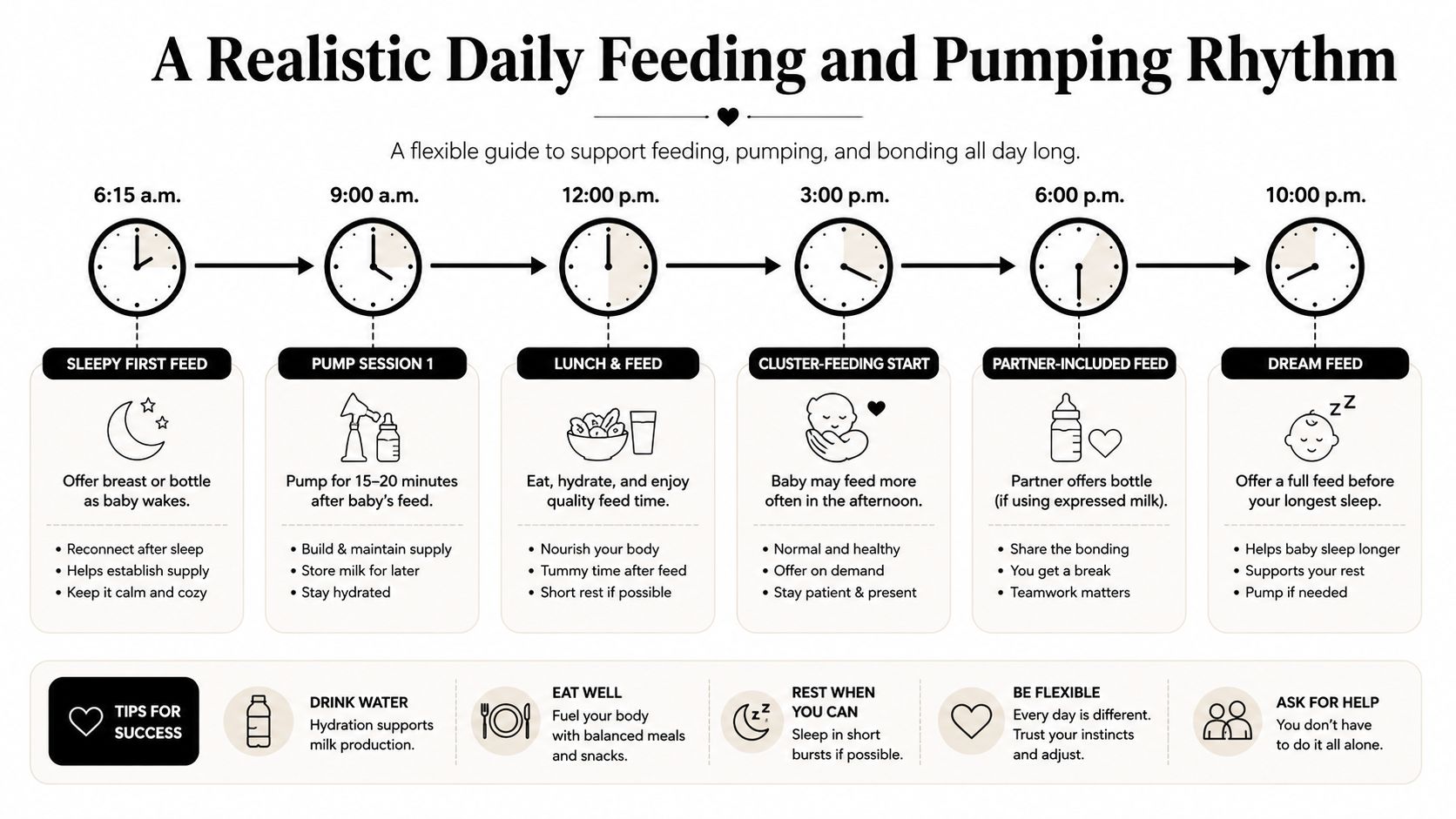
At 6 p.m., your partner takes over everything except the feeding itself. They handle the diaper, settle the baby afterward, and protect your dinner. If supply needs support, an evening power-pumping session may be discussed with your lactation professional. Don't add one automatically when you're already depleted.
At 10 p.m., you offer a quiet feed before sleep. Store expressed milk using clear safety rules: up to 4 hours at room temperature, up to 4 days in the refrigerator, and 6 to 12 months in a deep freezer, following the guidance in the hands-free pumping guide. Thaw the oldest stored milk first, label containers with dates, and avoid turning your freezer into another source of pressure.
Clothing and Bras That Make Everything Easier
Your early postpartum body is changing quickly. Milk volume, breast fullness, ribcage measurements, swelling, and tenderness can all fluctuate while feeding becomes established, so this is a poor time to force yourself into rigid underwire.
Start with one wireless, stretchy nursing bra late in pregnancy. The band should feel secure without digging, and the cups should leave room for fluctuation. Reassess around week two, then again around six weeks, when your fit and feeding pattern may feel more predictable.
Structured wires can press against breast tissue when your size changes. If a bra creates a hard line, tenderness, or pressure in one area, take it off and choose a softer option. Don't accept discomfort as the price of looking put together. A bra that leaves you wincing before every feed is the wrong bra for this stage.
Look for these features:
- Easy access: Drop-down cups or pull-aside designs let you feed without exposing your whole torso.
- Stable support: Wide straps and broad bands distribute weight more comfortably.
- Useful coverage: Full coverage can reduce spills, rubbing, and constant readjustment.
- Sleep-friendly construction: A soft sleep bra can keep nursing pads in place without adding pressure.
- One-handed operation: Test the clasp with one hand before buying. Your other hand will often be holding the baby.
For tops, choose button-front shirts, wrap styles, and nursing layers. A tank with a shelf bra under an open shirt can give you access without requiring you to pull fabric over the baby's head. Keep one complete feeding outfit near your main nursing chair, because searching for a clean shirt with a hungry newborn in your arms is avoidable chaos.
Later, when your body feels more settled and you want clothing that reconnects with your personal style, reassess your needs. Early comfort and later confidence don't have to come from the same garment.
Partner Roles and Workplace Planning
Your partner's job isn't to feed the baby. It's to feed the person who is doing the feeding.
Assign responsibilities before birth, especially for the first two weeks. “Help more” is too vague to work at 2 a.m. Decide who fills water bottles, prepares snacks, changes diapers, burps the baby, handles laundry, filters visitors, and manages pump parts. At night, your partner can bring the baby to you, handle the diaper, and settle the baby afterward while you remain horizontal as long as possible.
Put the work plan in writing
Workplace support needs the same clarity. In the United States, the PUMP Act covers most hourly workers and requires break time and a private, non-bathroom space for pumping for up to one year postpartum. Your exact protections can depend on your employment situation, so confirm the details with HR and use the law as a floor, not as your whole plan.
A 2025 survey found that 76% of respondents worked full or part time, only 44% felt supported at work, one in three lacked reliable lactation space, and 55% didn't feel supported in public places (2025 State of Breastfeeding Survey). Pumping issues ranked among the top challenges. That's why you should have this conversation in the third trimester, not during your first week back while trying to negotiate from goodwill.
| Responsibility | Partner at home | Workplace after leave |
|---|---|---|
| Time | Protects feeding, rest, meals, and recovery | Provides agreed pumping breaks |
| Space | Sets up a clean, comfortable feeding area | Provides a private space that isn't a bathroom |
| Supplies | Washes parts and keeps water, snacks, and backup items ready | Provides access to power and a workable storage arrangement |
| Communication | Notices when you're overwhelmed and takes over non-feeding tasks | Names an HR or management contact for problems |
| Planning | Covers visitors, meals, diapers, and nighttime logistics | Confirms the written plan before your return |
Put four items in your written workplace plan: pump location, break timing, milk storage, and the HR point person who has approved the arrangement. Add a backup location and a process for schedule changes. You're not being difficult. You're removing uncertainty from a routine that already requires concentration.
Troubleshooting the Problems You Will Probably Hit
Low supply, pain, and breast refusal aren't character tests. White-knuckling them can delay useful assessment and leave you exhausted. The evidence on professional lactation support is practical, not abstract. A 2025 systematic review and meta-analysis of lactation consultant interventions across 40 randomized trials found a 4% reduction in the risk of stopping exclusive breastfeeding, an 8% reduction in the risk of stopping any breastfeeding, and an increase of 3.6 weeks in any breastfeeding duration compared with usual care (JAMA Pediatrics review of lactation consultant interventions).
Perceived low supply
First, look at the whole feeding picture, including diaper output, swallowing, latch, feeding behavior, and weight checks. A baby who wants to nurse frequently isn't automatically a baby who isn't getting enough.
Your first action is to contact the IBCLC and request an observed feed. If transfer is uncertain, ask whether a weighted-feed check is appropriate. Don't respond by adding random supplements, pumping constantly, or changing your plan based only on how full your breasts feel. The clinical layer can help distinguish normal newborn behavior from inadequate transfer and identify whether latch mechanics, feeding frequency, or another issue needs attention.
Your peer counselor can reassure you while you wait, but reassurance shouldn't replace assessment. Your partner should handle food, water, and logistics so you can attend the appointment without carrying the entire problem alone.
Nipple pain that crosses the line
Tenderness can happen while you and the baby learn. Persistent pain, cracked skin, bleeding, sharp pain, or pain that makes you dread every feed needs escalation.
Start by contacting a clinical lactation consultant for an in-person or video assessment of positioning and latch. Ask for evaluation of possible tongue-tie concerns, thrush, vasospasm, or other medical causes when the symptoms fit. Don't keep adjusting pillows indefinitely if every feed still hurts.
While you arrange help, your partner can take over diapering and settling, and a peer counselor can help you feel less alone. If you develop symptoms that concern you medically, contact your healthcare clinician rather than treating the issue as a normal breastfeeding hurdle.
A baby who refuses the breast
A sudden nursing strike is different from a baby who occasionally fusses at the breast. Begin with a quiet skin-to-skin reset, reduce stimulation, and offer the breast when the baby is calm rather than frantic. Your peer counselor can help you think through recent changes, while the IBCLC can observe what happens during an attempted feed.
Ask the pediatrician or IBCLC to consider physical causes, including whether an ear infection or another illness could make nursing uncomfortable. Protect milk removal according to your established plan if the baby continues refusing, and get individual guidance rather than relying on a generic schedule.
If you've asked the same question twice and still don't have an answer, call the clinical layer.
The support system works when each person has a defined task. Screenshot this action plan and put it on the fridge.
| Layer | One name | One task | Backup |
|---|---|---|---|
| Clinical | IBCLC booked around week 36 | Assess latch, transfer, pain, or supply | Pediatrician or obstetric clinician |
| Peer | Counselor or local parent group | Answer the late-night reassurance question | La Leche League-style meeting |
| Partner | Named support person | Bring water, food, baby, and clean pump parts | Trusted family member |
| Workplace | HR point person | Confirm pump space, breaks, power, and storage before return | Direct manager |
| Gear | Pump, bra, feeding station | Keep the tools clean, accessible, and comfortable | Manual expression supplies |
Daily anchor: feed on cue, log diapers, hydrate.
Call now: seek prompt clinical help for severe or worsening pain, a baby who appears unwell, concerning feeding or output changes, or any symptom that makes you feel something is medically wrong. Don't spend another night trying to solve a clinical problem with scrolling.
Baby's pediatrician: ____________________
After-hours lactation line: ____________________
Milk&Lace offers nursing lingerie designed around breastfeeding access, including soft stretch-lace options that can support comfort and confidence as your needs change. Visit Milk&Lace to explore nursing bras that fit into the practical layer of your breastfeeding support system.