

A baby's hunger rarely follows a convenient schedule. You may be half-awake, holding your newborn with one arm, searching for a clasp with the other, and wishing your regular bra would just get out of the way. That small moment explains the purpose of a nursing bra better than any product label can: it needs to provide dependable support while making feeding access quick, discreet, and manageable.
So, how do nursing bras work? They combine two systems in one garment. A support chassis holds the breasts and distributes weight across the ribcage and shoulders, while access hardware lets you open part of the bra without removing it. The best designs balance both systems, because easy access means little if the bra shifts, digs in, or fails to contain changing breast tissue.
The Late-Night Fumble Every Mother Knows
It's late, the room is dark, and your baby has started rooting. You lift your shirt, try to move your baby into position, and then reach behind yourself for a regular bra clasp. The fabric doesn't move easily. One strap slips. You need both hands, but one is already supporting a sleepy baby.
A nursing bra changes that interaction. Instead of removing the garment or pulling the entire cup aside, you release a purpose-built opening and lower or move the fabric away from the breast. The bra stays around your body, so you keep some coverage and support while feeding. That can make a short, repetitive task feel calmer and less exposed.

From adaptation to purpose-built design
Nursing bras are a relatively modern adaptation of the bra, not an ancient separate garment. The first U.S. bra patent was granted to Mary Phelps Jacob in 1913, while Albert A. Glasser obtained the first patent specifically called a “nursing brassiere” in 1943, as documented in the history of nursing bras.
Early nursing designs often modified ordinary bras with openings, hooks, or snaps. Later designs made access more deliberate, using clip-down cups, stretch fabrics, and mechanisms intended for one-handed operation. The category eventually expanded to include garments designed for pumping and more active routines.
The real purpose: A nursing bra reduces the number of steps between a hungry baby and comfortable feeding without asking you to give up structural support.
That distinction matters. A nursing bra is not just a softer bra or a larger bra. It's a garment engineered around repeated access, postpartum fit changes, and the practical need to stay dressed while feeding. Once you understand those functions, the clips, panels, bands, and cups become much easier to evaluate.
Understanding Nursing Bra Anatomy and Access Mechanisms
Think of a nursing bra as a small tool with two coordinated systems. The support chassis does the holding, while the access hardware does the opening. Neither system should undermine the other.
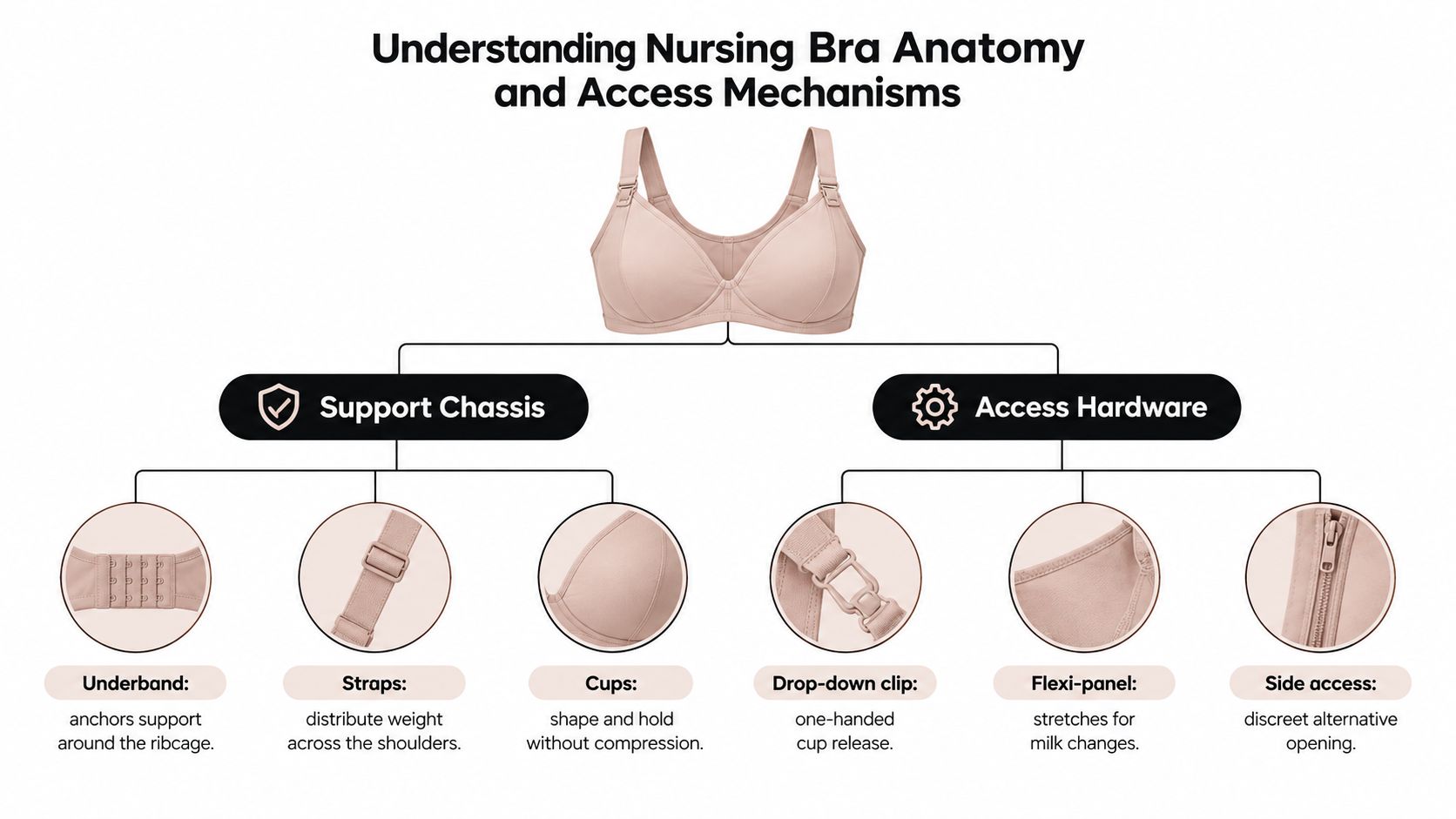
The support chassis
The underband sits around your ribcage and should provide the garment's main anchor. It keeps the bra from riding upward as the cups carry breast tissue. Straps then distribute some of the remaining weight across the shoulders, while cups shape and contain the breasts without forcing them into an uncomfortable position.
A stable band, properly adjusted straps, and enough cup coverage work together. If the band is loose, the straps may end up doing too much. If the cups are too shallow, breast tissue can spill over or press against the opening mechanism.
The access hardware
The most familiar design uses a clip at the point where the cup meets the strap. Pressing or releasing the clip allows the cup to fold downward. This is often called a drop-down cup, and the goal is simple: you can operate it with one hand while holding your baby with the other.
Other designs use different routes:
- Pull-aside cups: Stretch fabric moves toward the side, creating an opening without a mechanical clip.
- Crossover fronts: Overlapping fabric separates at the center or side and can provide a softer, more flexible feel.
- Panels or layered cups: Stretch zones adjust around the breast while preserving coverage and shape.
The bra should remain anchored when the cup moves. That's why the sling, band, and strap connection matter. The dropped cup shouldn't pull the entire garment out of position or leave the opposite breast unsupported.
A soft, elegant option such as GAIA combines stretch lace, flexible support, and breastfeeding access in a lingerie-style format. It illustrates how access can be integrated into a garment without making the entire design look purely utilitarian.
Consumer Reports' nursing bra buying guidance emphasizes the practical test: you should be able to operate the opening easily with one hand, while the band and straps remain supportive. That's the basic anatomy in action. The clip opens the path, but the rest of the bra keeps the garment useful.
The Three Core Design Challenges Nursing Bras Solve
A nursing bra has to solve access, support, and adaptability at the same time. A garment that handles only one or two of these jobs may feel convenient in a narrow situation but frustrating across a full day.
Access without a wrestling match
Feeding can happen while you're seated, standing, travelling, or holding a restless baby. The opening mechanism therefore needs to be predictable. A clip should release without excessive force, and a pull-aside design should move far enough to create useful access without stretching the fabric out of shape.
One-handed operation is more than a convenience. It lets you keep one hand on your baby and reduces the need to remove the entire bra. A design that stays on your torso also helps preserve coverage around the other breast.
Support that comes from the right places
Breast tissue can feel heavier and more sensitive during lactation. Support should come primarily from a stable underband and well-contained cups, not from aggressively tightened shoulder straps. Wide straps can spread pressure, but they can't compensate for a band that rides up or a cup that doesn't contain the breast.
This is why the word “nursing” on a label doesn't guarantee a good fit. The access feature may be excellent while the underlying structure is weak. Your body needs the opening and the support architecture to function as one system.
Adaptability for changing days
Postpartum fit isn't static. Breast fullness can change throughout the day, and a bra that feels comfortable at one point may feel restrictive later. Stretch materials, adjustable closures, flexible cups, and removable padding can give the garment room to respond without becoming shapeless.
Market data cited in 2026 estimates approximately 145.6 million nursing and breastfeeding bras sold globally in the last calendar year, according to Nursing and Breastfeeding Bras Market data. The same source reports that 84.3% of American mothers initiate breastfeeding, 57.6% continue for at least six months, and 40% of U.S. consumers buy 3 to 5 nursing bras during the first six months postpartum. These figures help explain why the category focuses on repeated access, washing, adjustment, and daily wear rather than occasional use.
A useful test: Ask whether the bra will still feel supportive after the cup has been opened, your breast has changed in fullness, and you've worn it for several hours.
Comparing Different Nursing Bra Mechanisms and Styles
The right mechanism depends on what you do most often. A clip-down bra may suit frequent direct feeding, while a pull-aside style may feel better for lounging or sleeping. A pumping design has another job entirely, because it must hold equipment in place as well as provide breast access.
| Style | How it opens | Often suits |
|---|---|---|
| Clip-down cup | A clasp releases the cup from the strap connection | Quick, one-handed feeding access |
| Pull-aside design | Stretch fabric moves toward the side | Soft flexibility and fewer hardware components |
| Crossover closure | Overlapping panels separate for access | Coverage and a less structured feel |
| Nursing sports bra | Stretch or panels combine access with active support | Walking, movement, or exercise |
| Pumping-compatible bra | Openings or firm sections hold pump flanges | Hands-free expressing and multitasking |
Clip-down cups
This is the classic nursing mechanism. The cup drops while the rest of the bra stays in place, which can make it easier to feed discreetly. The quality of the experience depends on the clip's shape, release tension, and placement. If you can't find or operate it with one hand, the theoretical convenience disappears.
Pull-aside and crossover designs
Pull-aside bras rely on flexible fabric rather than a prominent release point. They can feel gentle and simple, but the fabric needs enough recovery to return to position after repeated use. Crossover designs may offer generous coverage, although some wearers find them less stable during movement.
Active and pumping designs
Sports nursing bras need to manage movement without creating harsh pressure. Pumping bras add another requirement: they must hold flanges or wearable pump components securely while allowing you to sit, work, or move. Not every nursing bra can do both jobs well, so check whether pumping compatibility is explicitly part of the design.
For a deeper look at a soft, non-underwired construction, see this guide to a wire-free nursing bra. The important comparison isn't which mechanism is universally best. It's whether the opening, coverage, and support match your routine.
Try each mechanism with one hand before committing. Raise an arm, bend forward, and simulate holding a baby. A bra that works only while you stand still in a fitting room may not work during an actual feed.
The Missing Piece - Proper Fitting Mechanics for Real Support
The opening gets attention, but fit determines whether the bra supports you. A nursing bra can have an ingenious clip and still feel uncomfortable if the underband is unstable, the cups are too shallow, or the wire presses on breast tissue.

Start with the underband
Fasten the bra on the loosest setting if it has multiple hooks. The band should sit level around your body and feel firm without restricting breathing. If it climbs up your back, the band may be too loose or the straps may be overtightened.
The underband should carry most of the load. Straps are there to stabilize and distribute weight, not to pull the breasts upward by themselves. Deep shoulder marks, neck tension, or straps that constantly slide can signal that the band or cup fit needs attention.
Check the cups and wire
The cup should contain the breast tissue without cutting across the top or sides. Look for smooth coverage after you move your arms and open the nursing cup. If the breast pushes against the edge, the cup may be too small or the shape may not match your body.
Underwire can work for some people, but it must sit flat against the ribcage and surround the breast rather than press into it. Any wire that rests on breast tissue, digs into the side, or becomes painful during fullness is a warning sign. Guidance from the National Childbirth Trust on maternity and nursing bras also highlights the importance of accommodating changing breast size and choosing support that doesn't create unnecessary pressure.
Fit check: The band stays level, the cups contain the breast, the straps don't do all the lifting, and the opening still works when the bra is correctly adjusted.
Use a current, product-specific measuring guide rather than assuming your old size still applies. This guide to measuring for a nursing bra can help you begin, but comfort and cup containment still matter after measurements.
Test the garment in motion before judging it. Open and close the cup one-handed, sit down, lift your arms, and check whether the band shifts. If you notice persistent pain, pressure, or breast changes that concern you, seek advice from a qualified healthcare professional.
When to Upgrade - Structured Nursing Bras for Later Postpartum
Early postpartum clothing often prioritizes softness, flexibility, and easy laundering. Those features can be exactly right when your body feels tender and your days revolve around feeding, resting, and recovering. Later, you may want a bra that offers more shape, firmer anchoring, and a silhouette that feels closer to your ordinary lingerie.
That change isn't a rejection of comfort. It's a recognition that comfort includes feeling supported and like yourself. A structured nursing bra can provide a more defined fit while preserving practical access, provided the underwire and cup placement suit your body.

Signs you may be ready
Consider a more structured style when:
- Your current bra rolls or collapses: The garment no longer keeps a stable shape under clothing.
- You want more defined support: A firmer band and shaped cup may feel more secure for outings and longer days.
- You're returning to familiar clothing: Smooth lines, lace, or a lingerie-inspired silhouette can work better with dresses and fitted tops.
- You still need feeding access: A beautiful design only makes sense if the cup opens easily and safely.
Milk&Lace's underwire nursing bra guidance is useful when weighing structure against comfort. The key question isn't whether underwire is automatically good or bad. It's whether the wire lies flat, avoids breast tissue, and remains comfortable as your fit changes.
A later-stage bra should support your whole routine, not just a single feeding. Look for adjustable closures, a stable band, soft materials, and access you can operate without a complicated sequence. You're allowed to want function and femininity in the same garment.
Care, Maintenance, and Making Your Final Choice
Nursing bras often face frequent wear, milk leaks, body-lotion residue, and repeated washing. Follow the garment's care label, use a lingerie bag when machine washing is permitted, and avoid high heat that can weaken elastic or alter delicate lace. Fasten hooks before washing and let the bra dry naturally when the instructions allow it.
Store bras without crushing molded cups or twisting the nursing clips. Replace a bra when the band no longer stays level, the fabric has lost recovery, the cups no longer contain your breast, or the hardware no longer releases reliably.
Use this short decision checklist:
- Access: Can you open it with one hand while holding your baby?
- Support: Does the underband stay anchored without painful pressure?
- Adaptability: Can the cups and closures accommodate changes in fullness?
- Routine: Is it intended for feeding, pumping, sleep, movement, or more than one use?
- Fit: Do the cups contain your breast, and does any wire sit flat away from breast tissue?
- Care: Can you wash and dry it in a way that fits your actual schedule?
The best nursing bra isn't the one with the most features. It's the one whose mechanism, structure, and care requirements fit your body and your daily life.
Milk&Lace offers structured nursing lingerie such as lace-based bras designed to combine breastfeeding access with a more refined postpartum silhouette. Visit Milk&Lace to explore options that support feeding while helping you feel more connected to your personal style.