

You're standing in front of the mirror before a feed, one hand supporting your baby and the other tugging at a strap that has already left a groove in your shoulder. Your old bra doesn't close comfortably anymore, your soft sleep bra offers almost no lift, and every search for an underwire nursing bra plus size option seems to end with the same warning. Don't wear a wire. That advice sounds simple, but it doesn't answer the question you're asking.
You don't need a rigid rule. You need to know when structure helps, where the wire should sit, and how to test it while you're walking, lifting, reaching, and feeding. For a fuller bust, timing and placement usually matter more than the presence of a wire alone. Work through your stage, your measurements, and your daily routine in that order, and the choice becomes much clearer.
When an Underwire Nursing Bra Suits a Plus-Size Body
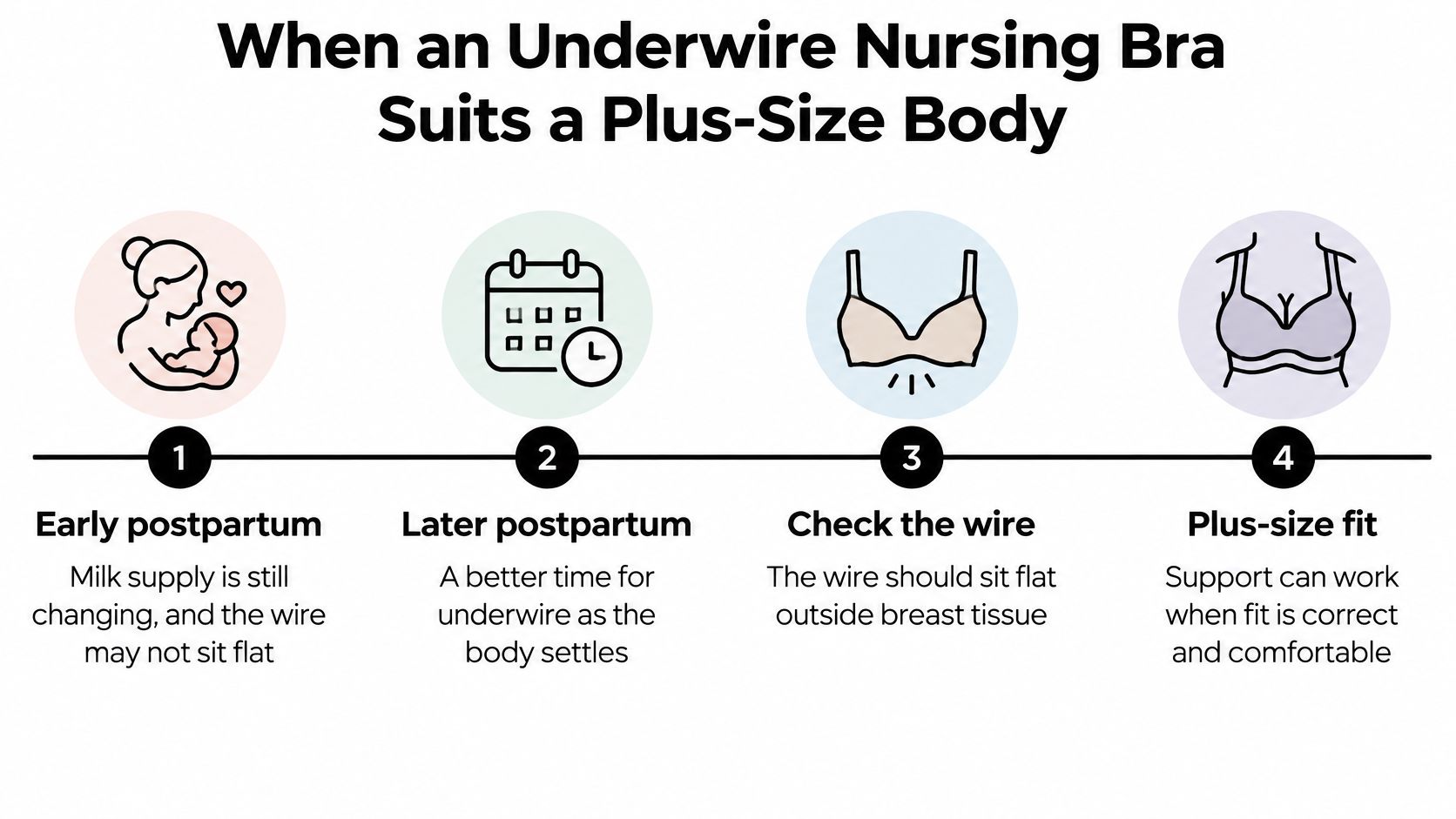
An underwire nursing bra can suit a plus size body in the later postpartum months, once milk supply has settled and the wire can sit flat on the ribcage outside breast tissue. In the first days, fullness can change quickly, so soft, nonrestrictive support is usually the safer starting point. The main challenge is matching structure to what your body is doing right now.
Match the Bra to Your Stage
| Stage | What Is Happening | Underwire Decision | Check Before Wearing |
|---|---|---|---|
| First days after birth | Milk supply is establishing and volume shifts quickly | Avoid rigid wires | Fullness should feel supported without pressure marks after a feed |
| Engorgement period | Fullness changes between feeds | Avoid rigid wires, pressure risk is high | Leave room for size swings between feeds and overnight |
| Settled supply, later postpartum months | Volume is more stable and the body is back in routine | Structured underwire can suit if it lies flat outside tissue | The wire rests on ribcage and stays quiet while walking, lifting, reaching and feeding |
| Pain, redness or blocked duct signs | Any stage | Stop wearing the underwire style | Get lactation or clinical support before choosing again |
The main concern is compression from poor fit. Healthline's nursing bra guidance reports that La Leche League and March of Dimes advise caution during early milk production, while newer guidance identifies an overly tight or incorrectly fitted bra as the key concern.
That distinction matters when the bust is heavier. A soft cup can feel gentle in the morning and still leave the shoulders and upper back aching after hours of bounce. A wire earns its place by reducing that movement; it has to sit like a boundary marker on firm ground, clear of soft tissue.
Plus Size Is Not One Shape
Two people can wear the same labeled size and need very different wires. Projected breasts may need deeper cups, broad roots may need wider wires, and close-set breasts may need a lower or narrower center. A large band-to-cup difference can also change how the wire angles toward the underarm, which is why a wire that fits one fuller bust can still gouge another.
Stop rule: If you notice a persistent tender area, blocked duct symptoms, or signs of mastitis, stop wearing the underwire style and contact a lactation professional or clinician.
Once supply feels more predictable and none of those warning signs are present, test structure during real movement. If the wire stays flat, the band stays level and feeding feels easy, the added support is working with your stage rather than against it.
Measuring Your Size Across Pregnancy and Postpartum
One measurement rarely tells the whole story because your ribcage and cup volume don't stop changing when pregnancy ends. A recent UK study of bra size changes during and after pregnancy found participants' average bra size increased by one underband size and two cup sizes from before pregnancy to during and after pregnancy. That's why buying your pre-pregnancy size and hoping for the best often leads to digging wires, spillover, or a band that rides up.
Think in three measurement moments instead of one permanent size. Measure in late pregnancy to prepare for the early weeks, measure again once your milk supply begins regulating, and measure once more just before you buy a structured style. Each set of numbers answers a different question.
Take Four Measurements
| Measurement | How to Take It | What It Tells You | When to Repeat |
|---|---|---|---|
| Underbust (band) | Tape snug around the ribcage just below the breasts, level and not pulling | Band size starting point | Late pregnancy, then once supply settles |
| Fullest bust | Tape around the fullest point without squeezing | Cup volume baseline | Morning and after a feed, then at each stage |
| Breast root width | Measure across the breastbone-side edges where the wire will sit | Wire placement and shape need | Before buying and at any size change |
| Band-to-cup difference | Subtract underbust from fullest bust, then match to the brand chart | Estimated cup size | Every re-measure, then confirm by wearing |
Stand upright, breathe out normally, and keep the tape level. For your underbust, the tape should feel snug against your ribcage without pulling your skin inward. For your fullest bust, let the tape rest around the fullest point without compressing your tissue, because squeezing here can make the cup estimate too small.
Then subtract the underbust number from the bust number and match that difference to the chart for the brand you're considering. Cup letters aren't universal across brands, so the chart matters. If you're between sizes, write down both rather than rounding away the problem.
Separate Temporary Fullness From Your Settled Size
Early engorgement can make you measure larger for a short period. If you buy a structured cup for that temporary fullness, it may gape once feeding becomes more regular. If you buy for your smaller after-feed measurement too early, the same bra may compress you before the next feed.
A practical workaround is to measure before and after a feed on the same day. That pair of numbers shows your current range, not just a single snapshot. Use forgiving styles while the range is wide, then use the narrower, more repeatable range when you're ready for a fitted wire.
Measurements give you a starting size, not a guarantee. Confirm the result through a full day of wear, because heat, movement, and feeding can reveal problems a tape can't predict. A flexible size-exchange policy gives you a useful safety net if the first size isn't right, and this step-by-step guide to measuring for a nursing bra can help you check your numbers before ordering.
Re-measure at each stage and buy for the body you'll have next month, not the one you wore last year.
If your numbers have changed, that isn't a fitting failure. It's useful information, and it's exactly what your next size should be based on.
Support Features That Stop Movement Without Digging
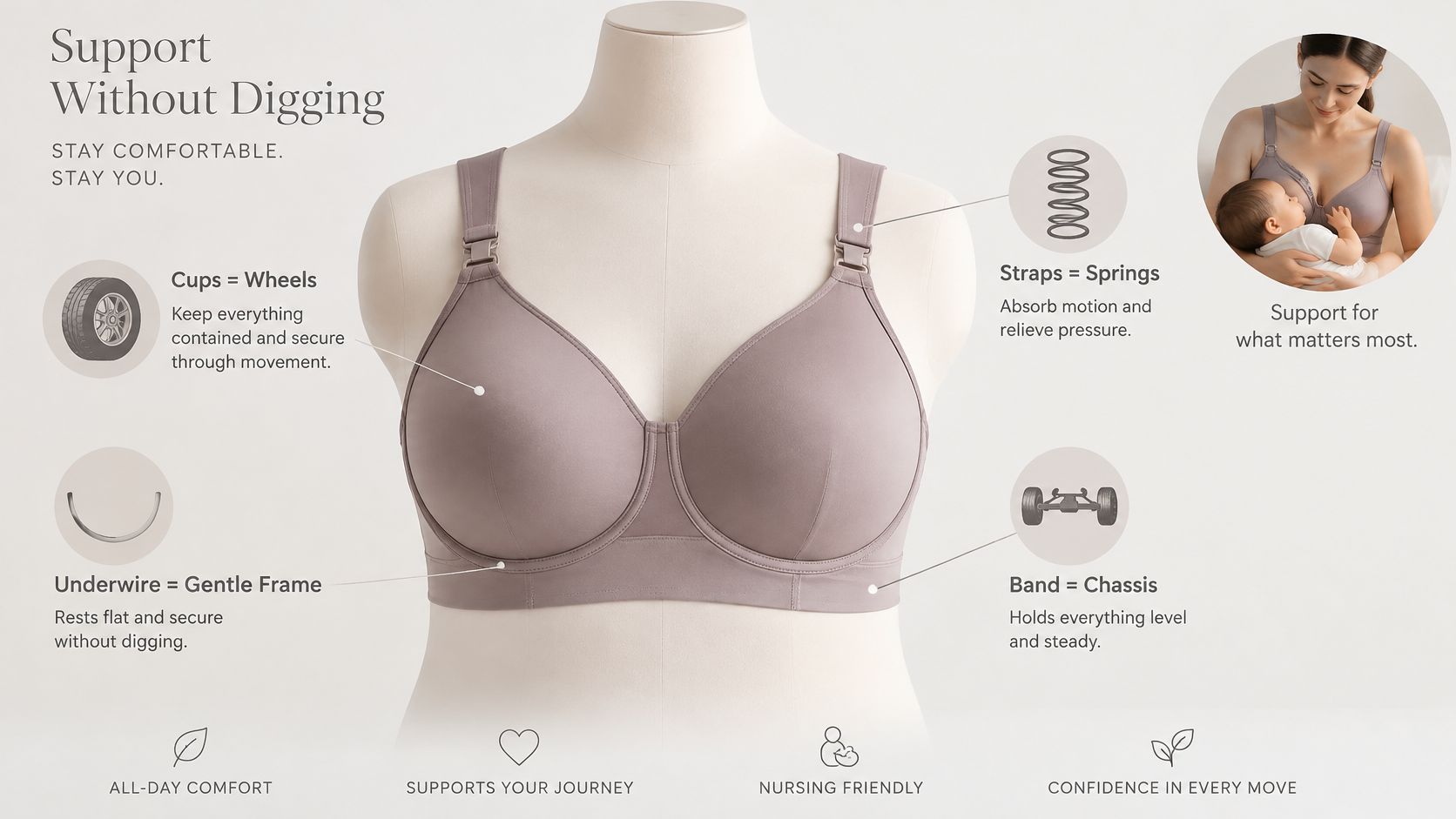
Think of support like a suspension system. The band is the chassis that keeps everything level, the straps are the springs that help manage motion, the cups contain the load, and the underwire is the frame that follows the curve under each breast. When one part does all the work, pressure builds in one place and comfort disappears.
The diagram below shows how those parts should work together on the body.
Spread the Load Across Four Points
- Wide, stable band: Look for a band that stays level and carries most of the support, instead of letting the straps haul everything upward.
- Firm, adjustable straps: Choose straps wide enough to spread pressure, with adjustment you can change as your posture and fullness shift.
- Shaped, containing cup: Pick a cup that encloses tissue toward the underarm, rather than stopping short and creating spillover at the side.
- Wire that traces the fold: Check that the wire follows your natural inframammary fold and ends without pressing into the outer breast.
More stiffness isn't always better. A 2026 biomechanics study of C to F cup participants tested strap elastic modulus from 834.6 to 3,087.2 N/m and found increasing modulus reduced vertical breast oscillation, although the benefit plateaued at higher stiffness because breast tissue is viscoelastic. In plain terms, once the strap is firm enough, making it harsher won't keep giving you the same improvement.
That's why good plus-size grading shouldn't just scale a smaller pattern upward. It should preserve strap width, band stability, and wire geometry as sizes increase, because tissue softness and shape vary from body to body. If a larger size only adds fabric but keeps narrow straps and a flimsy band, you'll feel the shortcuts by midday.
The short video below is useful for seeing how support should look once the bra is on and adjusted.
On a product page, scan for a level wide band, adjustable straps, side coverage toward the underarm, a wire described as following the fold, and covered wire tips. The structured GAIA style from Milk&Lace uses stretch lace, flexible support, and breastfeeding access within that multi-point approach. For a deeper breakdown of band and cup support, read this guide to supportive nursing bras for large breasts before you compare styles.
Fabric and Wire Construction for All-Day Comfort
A bra can support you beautifully at 9 a.m. and still feel wrong by mid-afternoon. Heat builds under the bust, elastic softens, skin gets sensitive, and a cup that felt smooth in the morning may start rubbing after several feeds. Fabric and wire construction decide whether good support stays comfortable for a full day.
Compare Fabrics by How They Behave
| Fabric | Breathability | Stretch and Recovery | Best Use |
|---|---|---|---|
| Stretch lace with elastane | Moderate, lined cups reduce airflow | High stretch with good recovery | Everyday wear that needs a soft, skin-like feel |
| Cotton-rich jersey | High | Moderate stretch | Early postpartum comfort and warm days |
| Smooth microfiber | Moderate | Good recovery | Wear under fitted clothing |
| Breathable mesh panels | High | Low to moderate stretch | Warm weather and back or side panels |
Stretch lace with elastane moves with small volume changes and can feel like a second skin. A lined version gives more shape and coverage, but it usually lets less air through. That trade-off is worth noticing if you run warm or wear the bra for long stretches at home.
Cotton-rich jersey feels familiar and breathable, which many people prefer when skin is tender. Smooth microfiber sits flatter under fitted tops and recovers well after stretching. Mesh panels work best where you need airflow more than stretch, especially along the back and sides. This overview of bra fabric materials explains how those fabric choices affect feel and durability.
Understand What Flexible Wire Means
A rigid wire holds a fixed curve and resists bending. A flexible, low-gauge wire still gives the cup a frame, but it bends more readily as you twist, lean, or carry your baby. Flexible doesn't mean unsupported. It means the frame can follow your movement instead of fighting it.
Look for covered wire tips, so the ends don't poke through the casing, and secure channel stitching, so the wire stays in its track instead of creeping out of place. Run your fingers along the channel before wearing it. You should feel a smooth path with no sharp end pushing toward the fabric.
Care protects those details. Wash on a gentle cycle, avoid high heat that weakens elastic, and dry the bra flat so the cups and wire channel keep their shape. Don't wring the cups or fold one cup inside the other for storage.
Say you'll be out in warm weather with your baby in a carrier. Prioritize breathable panels, a lighter cup, and a flexible wire. If you're dressing for a full day of errands and want a smoother outline, you may accept a firmer lined cup, knowing it will feel warmer.
Choosing the Right Style for Your Stage and Routine
A bra for broken sleep and cluster feeding does a different job than a bra for school runs, errands, or a return to work. A small rotation serves you better than one perfect bra: soft, nonrestrictive cups for the first weeks and overnight feeds, then a structured option once your days expand and your supply settles. That sequence protects healing early without giving up support later, and it keeps you from expecting one bra to solve every problem.
Three Everyday Scenarios
- Week two, waking three times a night: Choose a wire-free soft cup you can open quickly and sleep in without pressure points.
- Week twelve, mostly at home with mild movement: Try a flexible low-gauge wire if your supply feels settled and the wire stays outside your tissue all day.
- Later postpartum, out for hours with a larger bust: Choose a structured underwire on a wide, stable band, then test it while walking, lifting, and reaching.
What changes across these scenarios is how long you stay upright, how predictable your fullness is between feeds, and how much movement your day includes. Wire pressure becomes a problem when volume swings widely or the band can't hold the frame steady, so the right moment to add structure is when your routine demands it and your fit stays stable through real movement. A blanket rule against underwire misses that stage-based answer: the same structured bra that would press into engorged tissue at week two can feel secure on a plus-size frame months later.
The stages can also run backward. On a day when fullness swings again or your skin feels tender, move back to the soft cup and let the rotation flex with your body. Whatever style you land on, the trade-off stays the same: the more support a style gives, the more exact the fit has to be.
Start with the style matched to your stage, then upgrade only when fit stays stable through real movement.
Structured lace styles such as PETRA, with gentle underwire and one-hand nursing access, belong in that later stage of the rotation, alongside the soft essentials that carried you through the earliest weeks.
Fit Checks and the First-Week Test
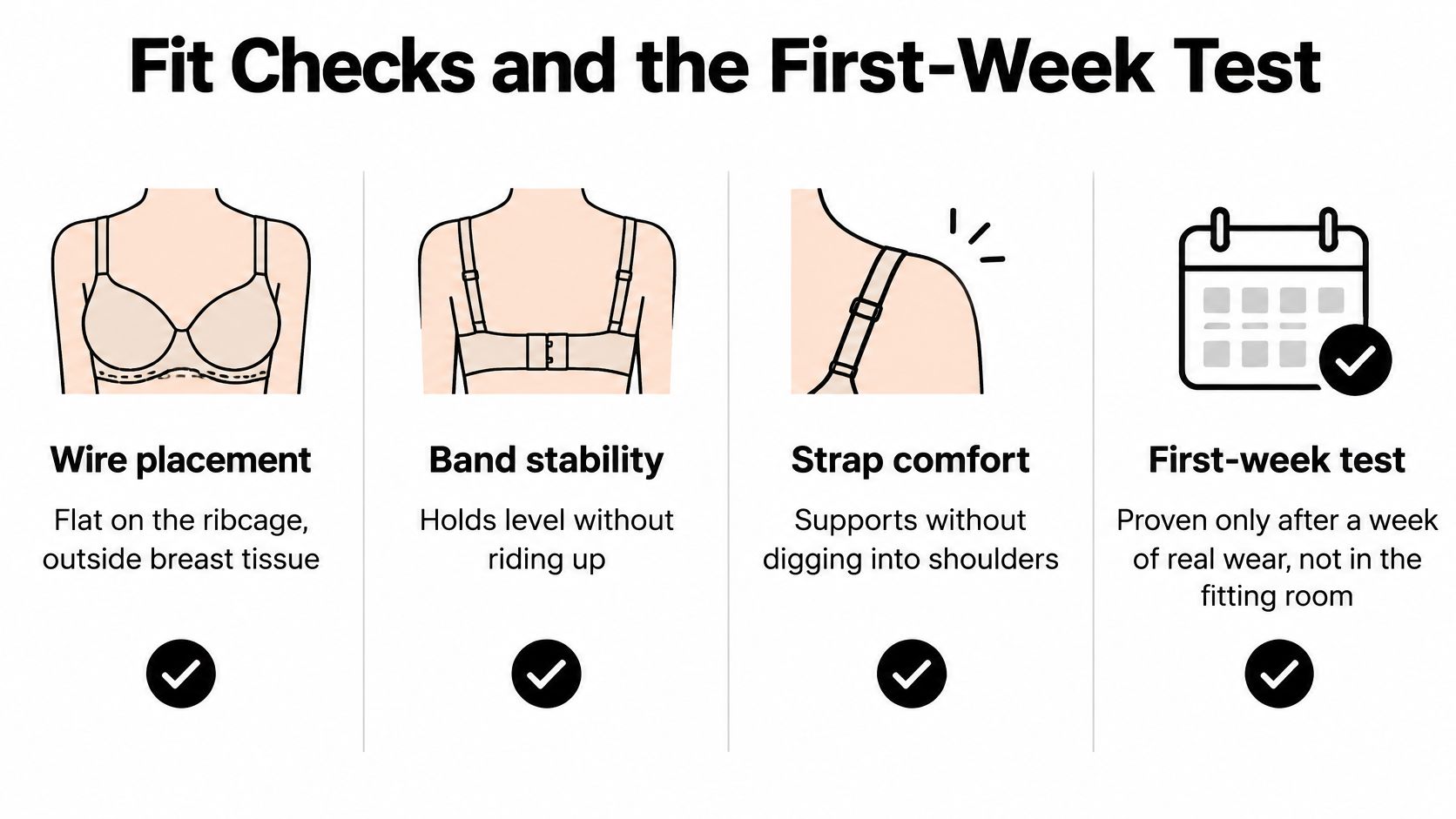
A fitting room can tell you whether a bra closes. It can't tell you whether the band will creep up while you're lifting your baby, whether the wire will press before a feed, or whether the clasp works when your other arm is full. Treat the first fitting as a screening test, then let a week of real wear make the final decision.
Check Five Points at the Fitting
| Fit Point | Good Fit Sign | Red Flag | Action |
|---|---|---|---|
| Wire placement | Wire lies flat on the ribcage, outside breast tissue | Wire sits on tissue or digs into the outer quadrant | Try a different wire shape or a flexible low-gauge wire |
| Band | Level and snug, carrying most of the support | Rides up at the back or shifts during arm movement | Check band tightness and back width before changing cup size |
| Cup | Tissue fully contained with no overflow or gaping | Overflow at the top or gaping at the neckline | Test a different cup size |
| Nursing clasp | Opens one-handed and the cup stays in place | Cup shifts or pulls when the clasp is opened | Recheck the fit with the bra fastened and the clasp opened |
| Skin after wear | No indentation after several hours | Red marks or indentation that lasts | Stop wearing the style and reassess |
Start with the wire. It should sit flat around the breast root, following the curve where your breast meets your ribcage. It shouldn't rest on breast tissue, dig into the outer quadrant, or slide upward when you open the cup for feeding.
That placement matters because lactating tissue isn't confined to the front of the cup. The Australian Breastfeeding Association maternity bra guidance advises caution with rigid wires and identifies flexible, low-gauge wires as a lower-pressure alternative. Restrictive or poorly fitted garments may compress milk-making tissue, which extends toward the armpit and rib cage, so side pressure deserves the same attention as pressure underneath.
Next, check the band while you move. Raise your arms, bend forward, and mimic lifting your baby from a crib or car seat. The band should stay level and snug, not ride up your back or shift enough to pull the wires with it. If the band moves, fix that first, because changing the cup alone won't stabilize the frame.
Then look at containment. Your tissue should sit inside the cup without overflow at the top, bulging near the underarm, or gaping at the neckline when you lean forward. Open and close the nursing clasp one-handed several times, since a clasp that's manageable with two hands at home may frustrate you during a real feed.
Run the First-Week Test
- Wear it for a full day: Include at least one feeding session, ordinary house movement, and time sitting, standing, and carrying your baby.
- Check before and after feeds: Note whether the wire still sits outside tissue when you're fullest and whether the cup gaps once you've fed.
- Inspect your skin after several hours: Look for redness, deep indentation, or a tender spot, especially under the breast and toward the underarm.
- Test real movement: Walk briskly, lift your baby, reach overhead, and bend to pick something up while watching for band migration or cup overflow.
- Practice one-handed access: Open the clasp, feed or simulate feeding, then close it and confirm the cup returns to the same position without pulling.
- Repeat on a second day: One good afternoon isn't enough, because fullness, activity, and laundry-day posture can change the result.
- Decide from the evidence: Keep the size if placement and comfort stay stable, or exchange it if the band, cup, or wire shape fails repeatedly.
Change one variable at a time when you exchange. If the band is level but the wire ends on tissue, try a different wire shape before changing everything. If the cups overflow only before feeds, a cup adjustment may help, but if the band also rides up, the whole size balance may be wrong.
A good fit shouldn't require constant tugging, checking, or enduring. If you're thinking about the wire all day, the bra hasn't passed.
Stop the test if pressure, pain, or redness lasts after you remove the bra. Stop sooner if you develop a persistent tender area, blocked duct symptoms, or mastitis, and seek clinical or lactation support. No style is worth pushing through those signs just to finish a trial week.
Before you buy, check the current size-exchange, return, and shipping guidelines on the retailer's website so you know your options if the second-day test points to another size. Keep your notes simple: wire position, band movement, skin marks, and clasp use. Those four observations will tell you far more than whether the bra merely looked right under a shirt.
When you're ready for structured support that still feels soft against your skin, explore the lace nursing bras at Milk&Lace, measure at your current stage, and use the first-week test to confirm the wire, band, and cup on your real routine. Choose the size that stays flat, level, and comfortable from the first feed to the last errand, and exchange it if your notes say the fit isn't there yet.