

At 3 a.m., your baby is hungry, your breasts feel fuller than they did at bedtime, and the stretchy sleep bra that seemed comfortable earlier has collapsed beneath the weight. The band creeps upward, the cups offer little separation, and your shoulders are doing work the bra should handle. You need quick nursing access, but you also need to feel held together when you stand up, walk around, and start the day.
A supportive nursing bra for large breasts isn't a larger version of a standard nursing bra. It's a coordinated fit system. The band, cups, straps, side panels, fabric, and nursing mechanism must work together while your breast volume, ribcage, skin sensitivity, and daily routine continue to change. A 2022 study of larger-breasted women found that every participant failed the fit assessment in her usual bra, while 67% of participants still failed in the tested support garment, showing how difficult stable support can be even when a bra is designed for the task (PubMed study on breast support garments).
What Large-Breasted Nursing Mothers Need
The first problem usually appears at night. A soft pull-on bra makes feeding easy, but after a few hours of lying down, milk fullness and breast weight stretch the front panel. When you sit up, the cups no longer contain the sides of the breasts, the underband has shifted, and the straps either slide away or cut into your shoulders. That bra may still be useful for sleep, but it isn't doing the same job as a structured daytime nursing bra.
Cup size alone won't tell you whether a bra can support you. Two women with the same cup volume may have different breast shapes, torso lengths, ribcage widths, and root widths. A component-level fit analysis of 309 women found that fit errors occurred most often around the cups, front band, and straps, with breast-size differences affecting the front band, underwire, and strap components (2018 fit analysis). The researchers argued for using breast-volume, breast-shape, and torso information in bra design, rather than relying on limited measurements.
The support priorities that matter
Your bra should redistribute breast weight instead of allowing tissue to pull constantly from the shoulders. Look for:
- A stable back band: It should sit level around the ribcage and remain anchored as you move.
- Full cups without compression: The cups should enclose the breast, not flatten it into the armpit or create pressure across the fullest area.
- Adjustable straps: They should stay flat and provide refinement, not carry the entire bust.
- One-handed nursing access: You need to open the cup while holding your baby, often in low light.
- Breathable fabric: Moisture, heat, leaking, and repeated feeds make airflow a practical requirement.
Practical rule: If tightening the straps is the only way to create lift, the band or cup fit needs attention.
The history of support bras reinforces this engineering-first approach. Historical research traces breast supporters patented in the United States between 1863 and 1940 to concerns including posture, sport, and reproductive health, while physicians began encouraging women to replace corsets with breast supporters in 1890 (historical research on brassieres). Nursing lingerie belongs to that same tradition of adapting support to changing bodies. You're not choosing between comfort and femininity. You're choosing construction that respects both.
For practical guidance on fuller-bust sizing and support features, use this guide to nursing bras for plus-size bodies as a companion when comparing styles.
How Supportive Nursing Bra Construction Works
Think of a larger breast as a suspended load. A reliable bra holds that load through three connected anchor points: the band around the ribcage, the straps over the shoulders, and the cup frame around the breast tissue. If one anchor fails, the others compensate, which is why loose bands create digging straps and why small cups can make the whole bra feel painfully tight.
Start with the band
The band should provide most of the lift. A commonly used design principle assigns roughly 80% of support to the underband, as represented in the construction diagram below, so a wide, firm back section matters more than aggressively tightened straps.
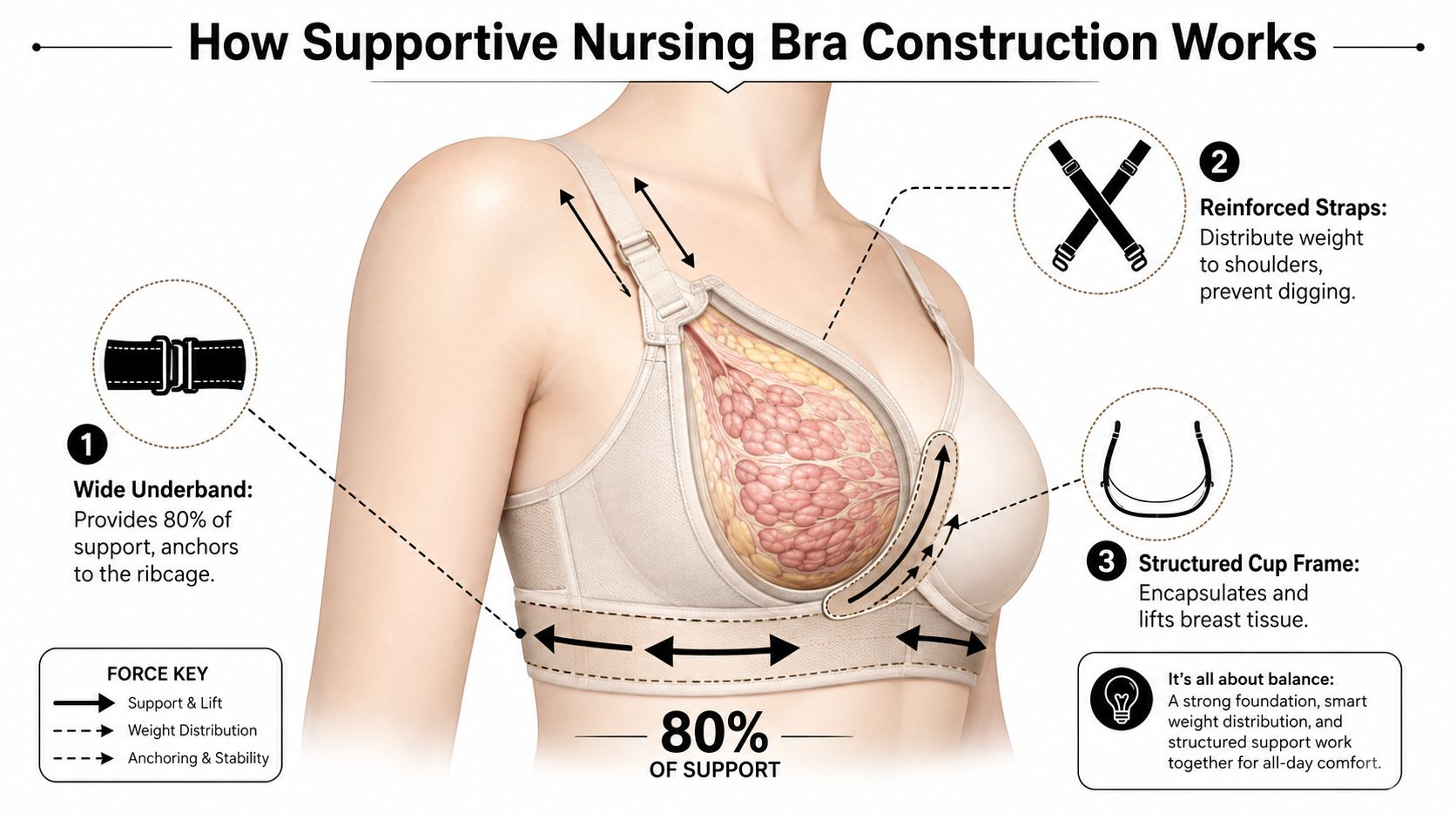
A nursing bra needs enough hook adjustment to accommodate daily changes, but the loosest hook should still feel secure. The band shouldn't ride toward the shoulder blades when you raise your arms. If it does, tightening the straps won't solve the underlying issue.
Then assess the cup frame
Seamed three-panel and four-panel cups generally shape larger breasts through controlled sections rather than squeezing the entire bust inward. These seams can create lift, separation, and forward projection. Molded cups offer a smooth outline, but their fixed shape may flatten a breast that needs more depth, especially if the cup is shallow.
Side-support panels are equally important. They help keep tissue from drifting toward the armpit and connect the outer breast area to the band. A properly sized underwire, when comfortable for you and appropriate to your postpartum stage, should follow the breast root and sit on the ribcage rather than on breast tissue.
The straps should be wide enough to distribute pressure, with padding placed where your shoulders need it. Their job is to stabilize the upper cup and fine-tune lift, not rescue an unstable band. During repeated nursing cycles, prioritize strong recovery in the band, reinforced strap attachment, secure clips, and cup seams that remain flat after washing.
For an example of how support and appearance can coexist, PETRA combines ultra-soft stretch lace, gentle underwire, and one-hand nursing access.
How to Measure and Assess Your Nursing Bra Fit
Postpartum fitting starts with fresh measurements, not the size you wore before pregnancy. Measure your ribcage with the tape level and snug while exhaling normally. Then take a leaning bust measurement, allowing the breasts to fall naturally so the tape captures fuller projection instead of compressing it.
Use those measurements with the brand's own size chart. Nursing bands can feel firmer than expected, and some people get a better result by moving to a larger band with a correspondingly smaller cup volume. That adjustment only works when the cup shape and wire width also suit your breasts, so treat the chart as a starting point rather than a verdict.
The mirror test
Put the bra on using the loosest hook setting, scoop the breast tissue fully into the cups, and stand naturally. Check the fit from the front and side before you judge the appearance under clothing.
| Check Point | What to Look For |
|---|---|
| Band | It sits level around the body without riding up. |
| Cups | All breast tissue is enclosed, with no top or side spillage. |
| Side panels | They lie flat against the ribcage and don't fold into the underarm. |
| Underwire | It follows the breast root and rests on the ribcage, never the breast. |
| Straps | They lie flat, stay in place, and don't dig into the shoulders. |
| Nursing mechanism | You can open and close it with one hand without losing control of the cup. |
Check the wire and straps
A wire that's too narrow presses into the breast root or underarm. A wire that's too wide may sit away from the breast and fail to contain the outer tissue. Postpartum swelling can make a previously acceptable wire feel intrusive, so don't ignore persistent pressure, pinching, or tenderness.
For straps, slide a finger beneath the strap near the shoulder. You want contact without a deep groove. If the strap gap feels excessive, first check the band and cup before shortening the strap. More fitting guidance is available in this step-by-step nursing bra measurement guide.
Your body won't hold one fixed measurement through the early postpartum period. Retake the measurements every few weeks, particularly during the first twelve weeks, and reassess the bra when fullness, ribcage comfort, or nursing frequency changes.
Choosing Underwire or Wireless Support
Wireless and underwire nursing bras aren't rivals. They serve different moments and different comfort priorities. Buying one of each, if your budget allows, is more sensible than demanding that a single bra perform as a sleep bra, daytime support bra, and nursing-and-pumping garment.
| Feature | Wireless Nursing Bra | Underwire Nursing Bra |
|---|---|---|
| Best use | Early postpartum, sleep, recovery, and frequent feeds | Later postpartum, stable measurements, and longer daytime wear |
| Breast movement | Controls movement through stretch and seamed panels | Separates and contains through a defined frame |
| Comfort profile | Soft, flexible, and forgiving during fluctuation | More precise, with pressure concentrated at the wire channel |
| Shape | Often natural and less lifted | Usually more lifted and separated |
| Fit sensitivity | Band and cup stretch can hide errors | Wire width and placement must be exact |
| Nursing access | Pull-aside or drop-down designs are common | Drop-down cups with stable cup frames are practical |
Use wireless support early
During the first six weeks, breast volume can fluctuate sharply and tender tissue may prefer flexible containment. Choose a wireless bra with a firm but forgiving band, seamed cups, broad straps, and enough room for fullness. Avoid a thin, single-layer triangle that stretches over the bust. It may feel gentle, but it won't necessarily control movement or maintain separation.
Stretch foam can be comfortable for sleeping, while multi-panel fabric cups offer more directional support for daytime. Either way, the cup should hold the breast rather than compress it into one flat shape.
Move to structured support later
Once your size feels more stable, a structured underwire can give larger breasts the lift and separation that wireless styles often can't match. Choose a flat, wide channel that follows the inframammary fold without pressing into the breast. Stop wearing the bra if the wire pinches, sits on breast tissue, digs into a healing area, or leaves persistent pressure.
A wire isn't automatically unsuitable for breastfeeding, but an incorrect wire is unsuitable for any breast. This guide to nursing bras with underwire can help you compare construction details before you buy. Your most practical rotation may be a wireless bra for sleep and early fluctuation, then a structured nursing bra for established breastfeeding and dressed-up occasions.
Evaluating Fabric and Nursing Access
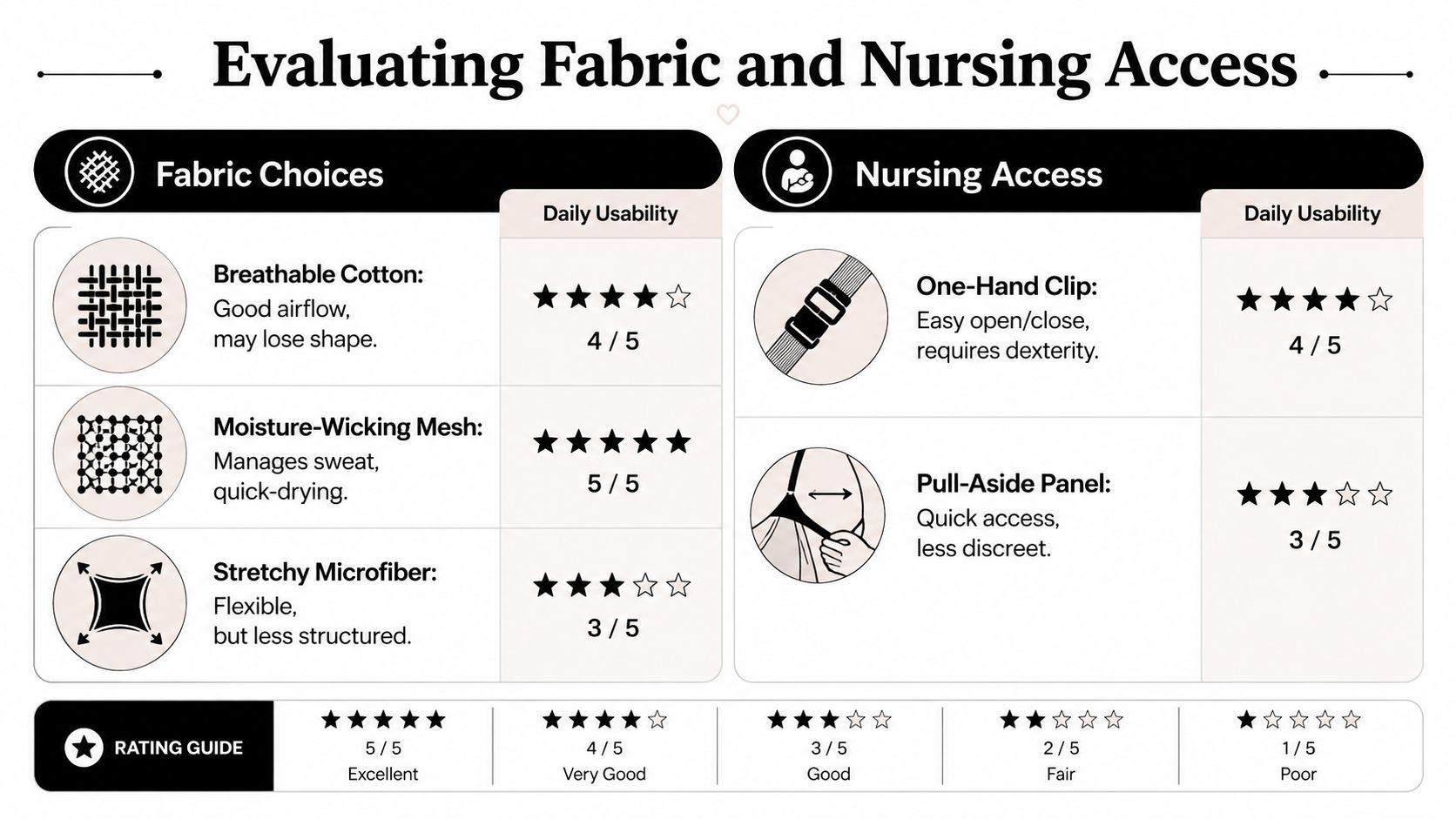
Fabric determines how a nursing bra feels between feeds, during warm weather, and after repeated laundering. Construction determines whether that fabric retains enough shape to support a fuller bust. Treat both as functional decisions, not decoration.
Breathable cotton-modal knits feel gentle against sensitive skin and work well for sleep or relaxed daytime wear. Their limitation is recovery. Soft natural-fiber blends can lose shape, pill, or remain damp if they're washed aggressively or dried with high heat.
Moisture-wicking microfiber suits hot climates, active routines, and people who dislike lingering dampness beneath the bust. It dries quickly, but some microfiber feels less soft than cotton and may need a lining or smooth finishing layer to avoid irritation. Stretch lace can provide flexibility and a more feminine surface while adapting to breast fluctuation, but its support depends on the band, seams, and lining beneath it.
Choose access for the way you feed
A full drop-down cup gives broad exposure and can keep fabric away from the baby's face. For a larger bust, the cup should open widely enough to expose the areola without folding into a bulky bundle.
Magnetic clasps can be quick, but test whether they align reliably and stay closed during movement. A standard one-hand clip is often the most secure option when the release is easy to find by touch. Pull-aside panels are fast and discreet, though they may provide less separation for a fuller breast. Front-zip sleep bras work for lounging, but the zipper placement and stretch must not create a hard edge across sensitive tissue.
Before buying, open and close the mechanism repeatedly with one hand. Examine whether the cup snaps back into place, whether the sling supports the breast while open, and whether the clasp feels likely to fatigue. Wash according to the care label, use a lingerie bag when appropriate, and avoid treating delicate lace as if it were a rigid support fabric.
The video below offers a visual reference for evaluating nursing-bra usability in everyday situations.
Selecting a Bra for Daily Breastfeeding
Start with the product page, not the product photo. Read the actual size chart, identify whether sizing is based on underbust and bust measurements, and check whether the brand distinguishes standard, full-bust, or fuller-cup fits. A polished photograph can't tell you whether the cup has enough depth or whether the band will remain stable.
Verified customer reviews are useful only when they describe fit. Give more weight to comments about cup depth, band firmness, wire pressure, side containment, strap slippage, and clasp operation than to broad statements such as “runs small.” Look for reviewers whose ribcage and cup proportions resemble yours.
Reduce the cost of a bad guess
Before ordering, locate the exchange and return terms. Free exchanges, fit consultations, and trial periods reduce risk because postpartum sizing is provisional. Check whether the bra must be unworn, whether tags must remain attached, and whether nursing or trying on affects eligibility.
When the bra arrives, perform an at-home test:
- Put it on with the cups fully scooped and the band on its loosest setting.
- Raise both arms and observe whether the band stays level.
- Feed or pump, then check whether the cup still contains the breast at a fuller or softer point.
- Wear it for about an hour and inspect the skin for persistent red marks, pinching, or rubbing.
- Open and close the nursing mechanism with one hand while seated.
Buy one well-fitting bra first. Build a rotation only after you know the band, cup, access, and fabric work for your body. This approach costs less in returns and leaves you with useful information instead of a drawer full of nearly-right bras.
Troubleshooting Common Support and Fit Problems
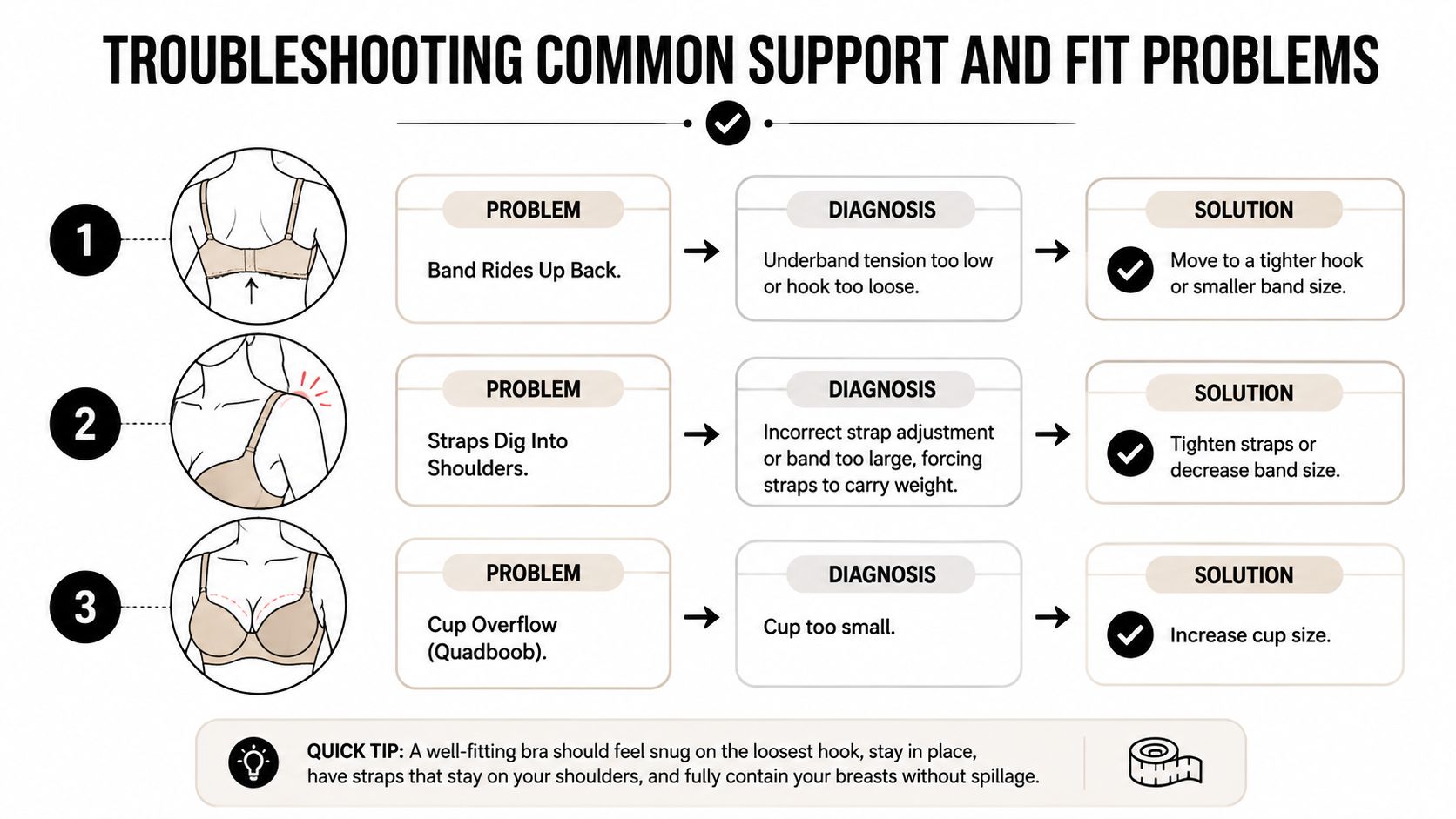
A fit complaint is usually a clue, not proof that your body is impossible to fit. Diagnose the failure in the order the bra carries weight. Start with the band, then examine the cups, wire, straps, and access mechanism.
Match the symptom to the adjustment
- Band rides up: Move to a tighter hook if the bra is otherwise new and correctly sized. If it still climbs, the band is too loose or lacks sufficient tension.
- Straps dig in: Loosen them slightly and reassess the band. If the shoulders still carry the bust, try a firmer band or a different cup fit rather than tightening further.
- Cups overflow: Scoop the tissue forward and upward first. If the breast still spills over the top or side, increase cup volume or choose a deeper cup.
- Cups wrinkle: Wrinkling can indicate excess cup volume, a shape mismatch, or a molded cup that doesn't follow your projection. Try a seamed cup or a different cup shape.
- Wire presses: Check whether the wire sits on breast tissue, ends too soon at the side, or feels intrusive because of postpartum swelling. A wider wire or wireless construction may be more appropriate.
- Nursing access feels awkward: The clip may be too small for the cup depth, the drop-down cup may not stay supported, or the pull-aside opening may expose too little. Test a wider-opening mechanism.
The correct adjustment is the one that removes the cause, not the one that hides the symptom.
Don't keep wearing a bra that creates persistent pain, numbness, skin injury, or pressure. If several styles fail at the same point, seek a professional fitting or change construction entirely. A bra with a stable band and the wrong cup shape will remain wrong no matter how carefully you adjust the straps.
Finding the Right Bra for Your Postpartum Stage
Your best choice depends on what your body is doing now, not what you expect it to do later.
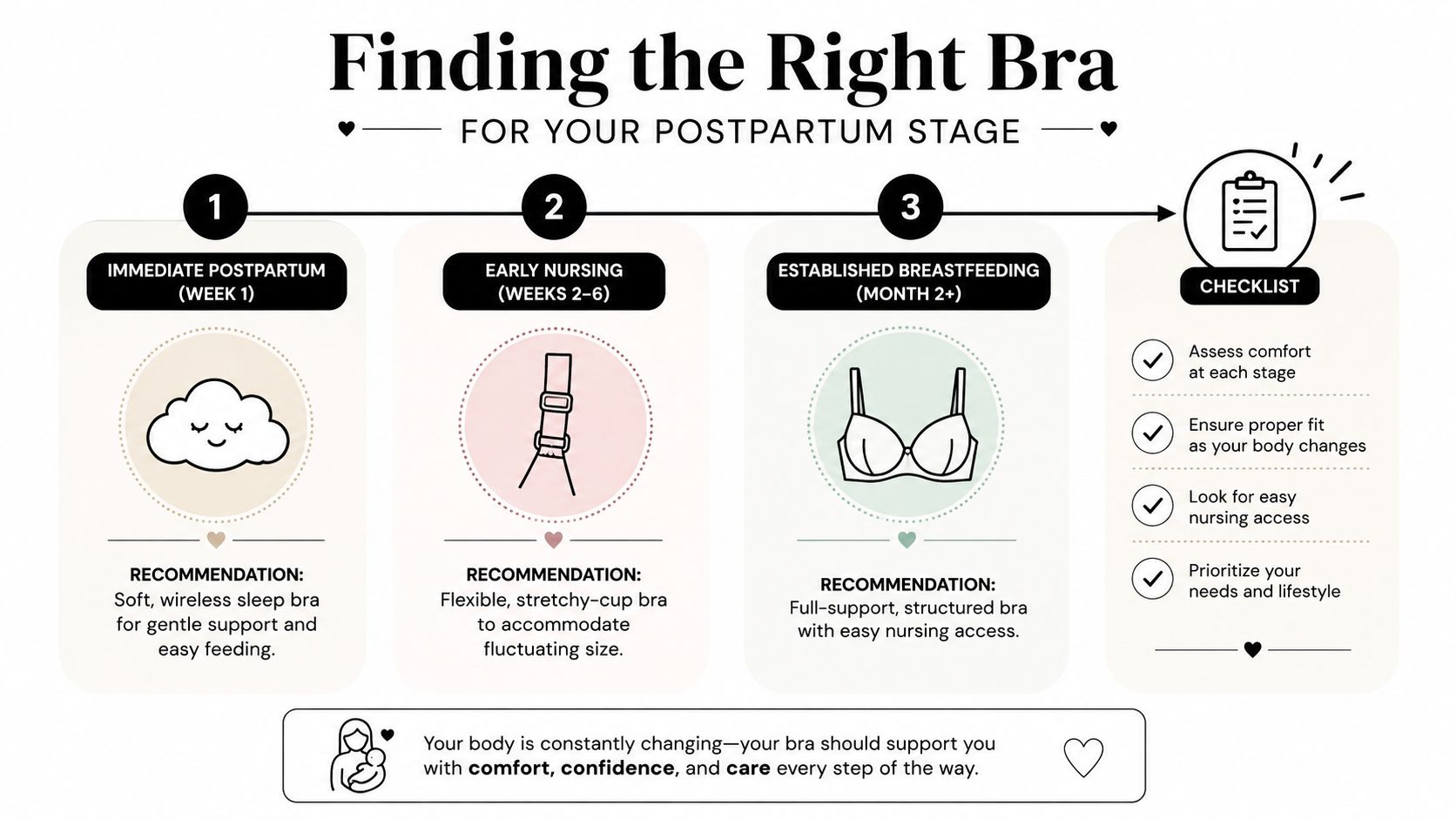
- Immediate postpartum: Choose a soft wireless sleep bra for gentle containment, easy access, and minimal pressure while your body recovers.
- Early nursing: Select flexible cups, adjustable straps, and a forgiving band that can accommodate noticeable changes in fullness.
- Established breastfeeding: Once measurements and breast shape feel steadier, move toward a full-support structured bra with reliable access, fuller coverage, and a cup frame that separates rather than compresses.
The progression isn't a rule you must follow on a calendar. It's a decision based on comfort, healing, breast stability, and how long you need to wear the bra. Recheck the fit whenever the band starts moving, the cups stop enclosing tissue, or feeding leaves you feeling compressed.
Your personal checklist is simple: band first, cup depth second, wire or wireless construction according to stage, nursing access according to routine, and breathable fabric against the skin. Choose the bra that solves the problem you have today, then reassess as your body changes.
Milk&Lace offers nursing lingerie with an emphasis on elegant lace, everyday comfort, structured support, and discreet breastfeeding access for the later postpartum stage. Visit Milk&Lace to explore nursing bras designed to support your changing body without asking you to give up femininity or personal style.