

At about three weeks postpartum, a lot of mothers stand in front of a drawer and have the same quiet argument with themselves. One hand holds the bra they used to wear before pregnancy. The other hovers over a soft, stretchy nursing bra that doesn't look glamorous but feels like relief the second it goes on.
That moment matters more than it seems.
Your breasts may feel full, sore, warm, unpredictable, and almost unfamiliar. You might be feeding around the clock, waking up damp from leaking, and trying to protect skin that suddenly reacts to everything. A bra can either feel like a gentle layer that helps you get through the day, or like a small problem you have to manage every few hours.
A soft cup nursing bra is often the first bra that makes sense in this season. But it's not only an early-postpartum item. For many women, it becomes one part of a larger wardrobe journey. First comes comfort. Later comes the question many mothers whisper to themselves: When do I get to feel like me again?
Why Your Nursing Bra Choice Matters So Early
The early postpartum weeks are physical in a way no one can fully explain beforehand. Your body isn't changing week to week. It's changing hour to hour. A bra that felt fine after the morning feed can feel too tight by midafternoon if your breasts refill quickly or you've skipped a pumping session.
That's why the first nursing bras you wear deserve more thought than people usually give them. This isn't just about what looks decent under a T-shirt. It's about what sits against tender tissue for long stretches of the day and night.
In the first weeks, pressure feels louder
When milk comes in, even small pressure points can feel exaggerated. A seam that never would have bothered you before may suddenly rub. A firm band can feel sharp. A cup edge can leave a mark that lingers.
Many mothers also aren't dealing with just breast tenderness. They're moving around a healing abdomen after a C-section, or sitting differently because of stitches and pelvic soreness. If your bra makes your upper body tense, everything below it often feels worse too.
A postpartum bra doesn't need to be perfect. It needs to be forgiving.
This choice repeats every day
One reason nursing bra advice often falls flat is that it treats the bra like a one-time purchase. It isn't. You wear it to sleep, to feed, to pump, to leave the house, to come back home exhausted and still keep it on because laundry hasn't happened.
The wrong bra can dig in for hours. The right one can disappear enough that you stop thinking about it.
That's where a soft cup style earns its place. It gives your body room during the phase when “consistent size” doesn't really exist. Later, you may want more lift, more separation, or a smoother outline under clothes. But in the beginning, softness is often what lets you get through the day without bracing against your own bra.
What a Soft Cup Nursing Bra Actually Is
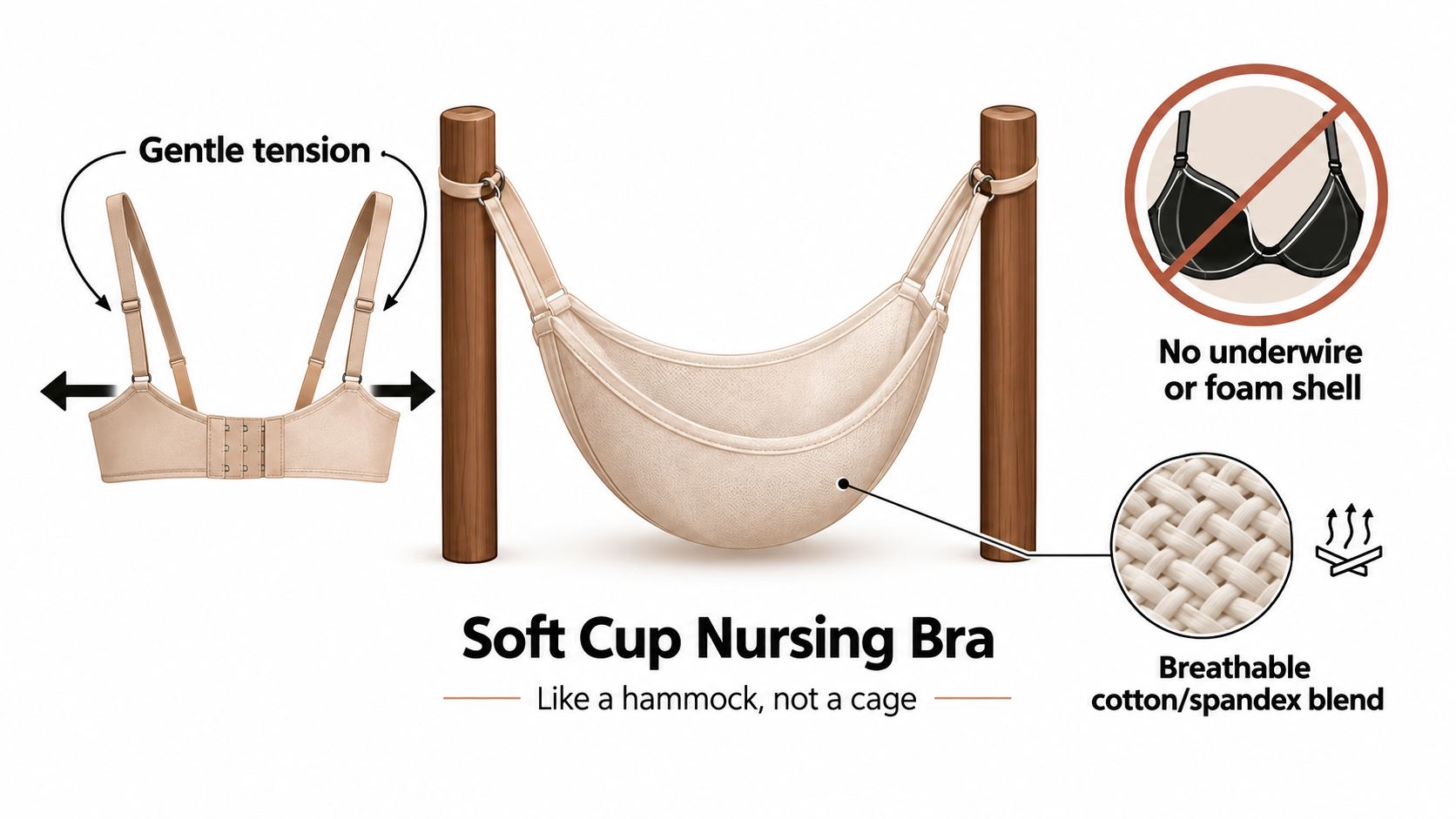
A soft cup nursing bra is easiest to understand if you stop thinking about rigid bra architecture and think instead about a fabric hammock. The cup holds breast tissue through gentle tension from the band and straps, not through a hard frame built underneath it.
That's the heart of the design. No wire under the bust. No molded foam shell forcing the breast into one fixed shape. No rigid cup panel that expects your body to stay the same all day.
What it includes
Most soft cup styles use stretch-knit fabric, sometimes in two or three layers, to create containment and flexibility at the same time. Instead of shaping the breast with hard components, they rely on:
- A supportive band that anchors the bra around the ribcage
- Flexible cups that expand and settle with feeding changes
- Straps that help distribute weight without pulling all the load upward
- Seaming or knit zones that add structure without turning the bra stiff
That's why a soft cup bra can still be supportive even though it feels gentle.
What it doesn't include
A soft cup is different from other nursing bra types in a few important ways:
- Not an underwire bra: there's no wire tracing the base of the breast
- Not a molded T-shirt bra: it doesn't come with a fixed dome shape
- Not always a sleep bra: some soft cup styles are light enough for bed, but others are made for daytime wear
This category is broad. It includes crossover sleep bras, pull-aside bras, bralette-style nursing bras, and lightly shaped day bras. The shared trait is simple: they're wire-free.
That matters because wireless styles aren't a tiny corner of the market. In one market study, wireless nursing bras held the largest share at 42.5% in 2025, ahead of sleep bras, underwire bras, and pumping bras, which suggests that comfort-led construction is a mainstream preference, not a niche one, according to this nursing and breastfeeding bras market analysis.
Soft doesn't have to mean plain
Some mothers hear “soft cup” and picture something purely practical. That's not always true. A style like GAIA fits into the broader conversation because it's described as a soft, elegant nursing bra with stretch lace, flexible support, and effortless breastfeeding access. That's useful when you're past the rawest weeks and want softness without feeling stripped of style.
How Soft Cup Construction Supports Comfort and Skin
Comfort isn't magic. It's engineering.
A soft cup nursing bra feels different because it spreads force differently. Instead of one hard edge pressing into one narrow line of tissue, the bra uses fabric, band tension, and strap placement to distribute load across a wider area.
Pressure matters more than many mothers realize
Research on bra pressure shows that higher tensile resistance in strap and hem materials increases clothing pressure, and pressure also rises with smaller body-curvature areas and with breathing or post-exercise expansion, according to this clothing pressure study. In plain language, stiffer materials and tighter edges can create more concentrated pressure exactly where postpartum bodies are already sensitive.
For nursing bras, that matters at three common trouble spots:
- Underband area: where pressure can feel sharp under fuller breasts
- Straps: where heavy tissue can turn a narrow strap into a groove
- Cup edge and neckline: where fabric can rub or cut in as breast size shifts
A well-made soft cup bra responds by using lower-rebound materials, flexible tension, and adjustability instead of rigid containment.
Practical rule: If a bra leaves deep marks that still feel sore after you take it off, it isn't “supportive.” It's overloading one area.
Breathability is a skin issue, not just a comfort issue
Leaking milk, sweat, nipple balm, and breast pads all change how a bra feels by midday. Once fabric gets damp, a bra that seemed fine in the morning can start to rub or trap heat.
Textile research found that air permeability varies sharply by knit structure, with one plain panel measuring 202.55 in dry conditions and dropping to 121.41 cc/cm²/s when wet, while more open constructions allowed better airflow, according to this bra fabric and nursing-bra design research summary. The takeaway is practical: fabric structure changes breathability, especially once moisture enters the equation.
That's why soft cup bras often work best in breathable blends and smooth knits that don't hold dampness against the skin longer than necessary. If your skin reacts easily, this guide on soft bras for sensitive skin is a helpful next read.
Support can still be gentle
Many mothers think they must choose between softness and support. Usually, the choice is between concentrated support and distributed support.
In a soft cup bra, support comes from the whole system working together:
- A wider underband steadies the bra without a wire
- Thoughtful seaming helps contain fuller tissue
- Better straps carry weight without slicing into the shoulders
- Softer cup surfaces reduce friction against tender nipples and changing breast tissue
That's why the best soft cup bras don't feel limp. They feel cooperative.
Soft Cup Versus Underwire and Structured Nursing Bras
A lot of bra frustration comes from asking one category to do every job. A soft cup bra, a structured molded bra, and an underwire nursing bra all solve different problems. None is automatically the right answer for every postpartum stage.
The quick side-by-side view
| Feature | Soft Cup | Structured (Molded/Lined) | Underwire |
|---|---|---|---|
| Feel on tender breasts | Gentle and flexible | More defined, less adaptive | Most fixed against the body |
| Shape under clothes | Natural outline | Smoother and more rounded | Most lifted and separated |
| Response to size changes | Best for fluctuating fullness | Moderate tolerance | Least forgiving if fit drifts |
| Sleep compatibility | Often suitable | Usually less comfortable for sleep | Usually not ideal for sleep |
| Movement control | Light to moderate | Moderate | Often strongest control |
| Risk when fit shifts | Lower localized pressure | Depends on cup firmness | More sensitive to precise fit |
| Best phase | Early postpartum and home wear | Mid-transition daily wear | Later postpartum or shape-focused wear |
Where soft cup shines
Soft cup bras work well when your body is still unpredictable. They're often the easiest option for:
- Engorgement days
- Night feeds
- At-home wear
- Breasts that change volume fast
- Skin that's reacting to seams, heat, or pressure
They also sit in a useful middle zone. More supportive than a minimal sleep bra, less demanding than a molded or underwire bra.
Where structure starts to help
As some mothers move further postpartum, they start wanting a bra to do more than allow access. They want shape under clothes, less breast movement while walking, and a more separated silhouette.
Structured nursing bras and underwire options enter the picture. Research on maternity and nursing sports bras found that only 15% of purchasers got exactly what they wanted, while 94% rated support and 98% rated comfort as essential, according to this independent review of maternity and nursing sports bras. That tells you something important: mothers don't stop caring about comfort when they start wanting support. They want both.
A separate study discussed in that same research context found underwire reduced vertical breast displacement and perceived discomfort during exercise compared with underwire-free bras. That doesn't mean every nursing mother needs underwire. It means the old idea that wire-free is always better for every stage is too simple.
If you're weighing that trade-off, this article on the wirefree nursing bra is a useful companion.
Some mothers don't replace the soft cup bra. They outgrow using it for every single situation.
Finding the Right Fit on a Body That Keeps Changing
Most bra fitting advice assumes your size is stable long enough to measure once and trust the result. Postpartum bodies don't always cooperate with that.
One recent fit-analysis study found that all participants had bra-fit issues, with 77 issues total, and the most common problems were large cups, a front band that didn't contact the sternum, and loose straps. Even more telling, subjective fit judgments matched objective findings only 51% of the time, according to this 2025 bra fit analysis.
That explains why so many mothers say, “It seemed fine when I put it on, but by later it felt wrong.”
Start with the band
The band does most of the work. If it's too loose, the straps start overcompensating. If it's too tight, the whole bra can feel restrictive.
Check these first:
- Level all around: the band should sit straight, not climb up your back
- Secure but breathable: you should feel held, not compressed
- Stable during movement: if you lift your arms and the band shifts dramatically, it's likely too loose
In the early weeks, ribcage changes can be fast. A bra that fits this week may need a hook adjustment or extender soon.
Check the cups after a full feed
This is one of the simplest tricks I teach mothers. Try on and evaluate your bra after a full feed or pumping session, when your breast tissue is softer and least full. That helps you see whether the cup still supports the breast itself, rather than only accommodating fullness.
Look for:
- Cup gaping: often a sign the cup is too roomy or too tall
- Side spill or center spill: usually means the cup isn't containing tissue well
- Fabric collapse: the bra may be too stretchy for your breast weight
- Nipple friction points: a clue that cup seams or layers are landing badly
Use dynamic fit checks
A nursing bra shouldn't only fit for five minutes in front of a mirror. It should work through a normal day.
Ask yourself:
- How does it feel two hours after a feed?
- Does the band stay steady by afternoon?
- Do the straps start digging as the day goes on?
- Does the cup still sit smoothly after unclipping and refastening?
If the answer changes dramatically across the day, the bra may not be wrong in size alone. It may be wrong in construction for your current stage.
For measuring help, how to measure for a nursing bra offers a practical starting point.
If a bra only fits when your breasts are at one exact fullness level, it probably isn't the bra you need right now.
Nursing Access Styles That Fit Real Daily Life
“Nursing bra” describes access as much as support. Two bras can feel equally soft but function very differently at 2 a.m., in the car, or at a café with a hungry baby and one free hand.
Full drop-down cup
This style opens the cup more completely, giving broad access to the breast. It's especially useful in the newborn stage, when latching may still be awkward and you want more visibility and skin-to-skin contact.
It often works well for:
- early feeds
- babies who need help positioning
- mothers who want less fabric in the way
The trade-off is that some drop-down styles feel more exposed when unclipped, which not everyone enjoys outside the house.
Clip-down or snap-down strap
This is the style many mothers use once feeding becomes more routine. The cup releases from the top while the strap stays anchored, so the bra keeps some structure during the feed.
That can be helpful if you:
- have fuller breasts and want continued support
- feed in public and prefer a little more control
- need one-handed access while doing three other things
This design often feels easier to manage once you've moved past the earliest trial-and-error latches.
Crossover or pull-aside style
A crossover bra skips hardware and lets you pull fabric aside. For night feeds, sore skin, and very low-pressure wear, it can be a relief.
It suits:
- sleeping
- cluster-feeding nights
- highly sensitive breasts
- mothers who hate clips and clasps during recovery
The downside is usually support. Pull-aside bras are great for ease, but they rarely offer the containment or shape many mothers want later.
Match the access style to your day
A simple way to choose is to think about where and how you feed most often.
- At night: crossover styles often feel easiest
- At home with a newborn: fuller drop-down access can help
- Out of the house: clip-down styles usually offer the best balance of support and convenience
Access matters because the bra has to work in motion, not just when you're standing still.
When a Soft Cup Is Enough and When You Need More
A soft cup nursing bra is often exactly right. It just isn't right forever for every purpose.
That's an important distinction. Mothers can feel oddly guilty when a once-perfect bra starts feeling insufficient, as if needing more support means they've chosen badly. It doesn't. It usually means their body, schedule, or priorities have changed.
When soft cup is enough
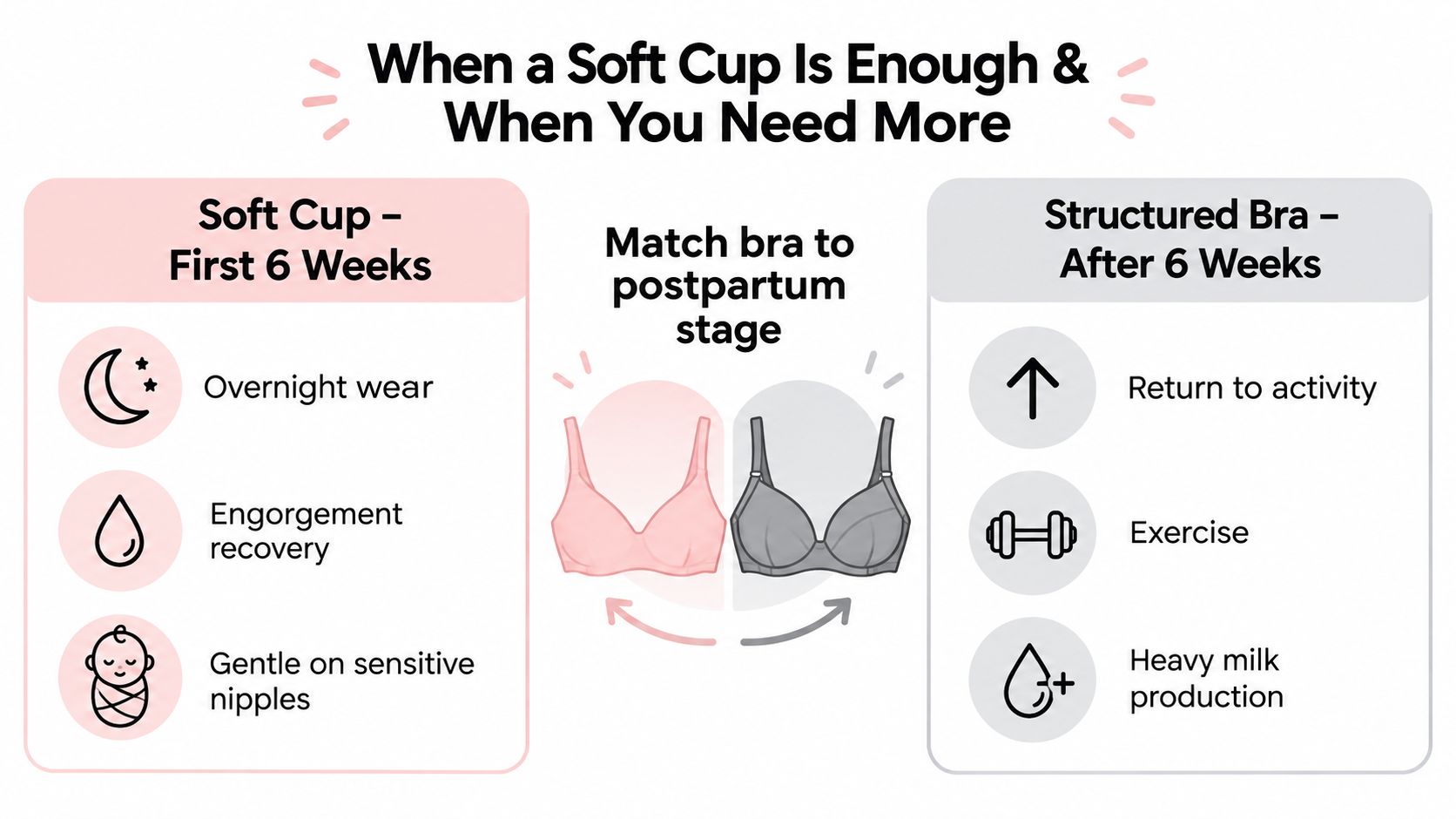
A soft cup often makes the most sense when you need flexibility more than shape.
Common examples include:
- The first postpartum stretch, when fullness changes constantly
- Overnight wear, when comfort matters more than silhouette
- Recovery from engorgement, when rigid pressure feels awful
- Quiet home days, when low-friction support is enough
In that phase, asking for strong lift and polished shaping from a soft bra is like asking slippers to do the job of walking boots. They're not failing. They're serving a different purpose.
When more structure becomes the better tool
Later, many mothers want a bra that helps them re-enter daily life with more definition and control. That shift can happen when:
- clothing gets more fitted
- work routines return
- walking turns into workouts
- heavy breasts start feeling uncomfortable in low-structure bras
- personal style begins to matter again
The broader market context supports that this isn't a niche transition. Soft cups sit inside a large and growing category. One report estimates the global nursing and breastfeeding bras market at USD 1,951.2 million in 2024, USD 2,056.5 million in 2025, and projects USD 3,500 million by 2035 at about 5.4% CAGR over 2025 to 2035, while another places the broader 2025 market at roughly USD 1.5 billion and projects USD 2.2 billion by 2035 at around 4.5% CAGR, according to this market overview of the feeding bra segment. In practical terms, mothers aren't shopping one fixed bra need. They're shopping an evolving category because their needs evolve too.
Readiness signs
You may be ready for more structure if:
- your size feels more stable than it did earlier
- you want more separation under clothes
- you're returning to activity and dislike bounce
- you miss a defined silhouette
- you're tired of every bra feeling purely functional
That doesn't mean abandoning soft cup bras. It means building a rotation.
Care, Styling, and Stepping Into Your Next Chapter
A soft cup bra only stays supportive if the fabric keeps its recovery. Once the band stretches out or the cup loses resilience, the bra stops doing its quiet work and starts feeling sloppy.
That's why care matters more than many people think.
Care habits that protect the bra
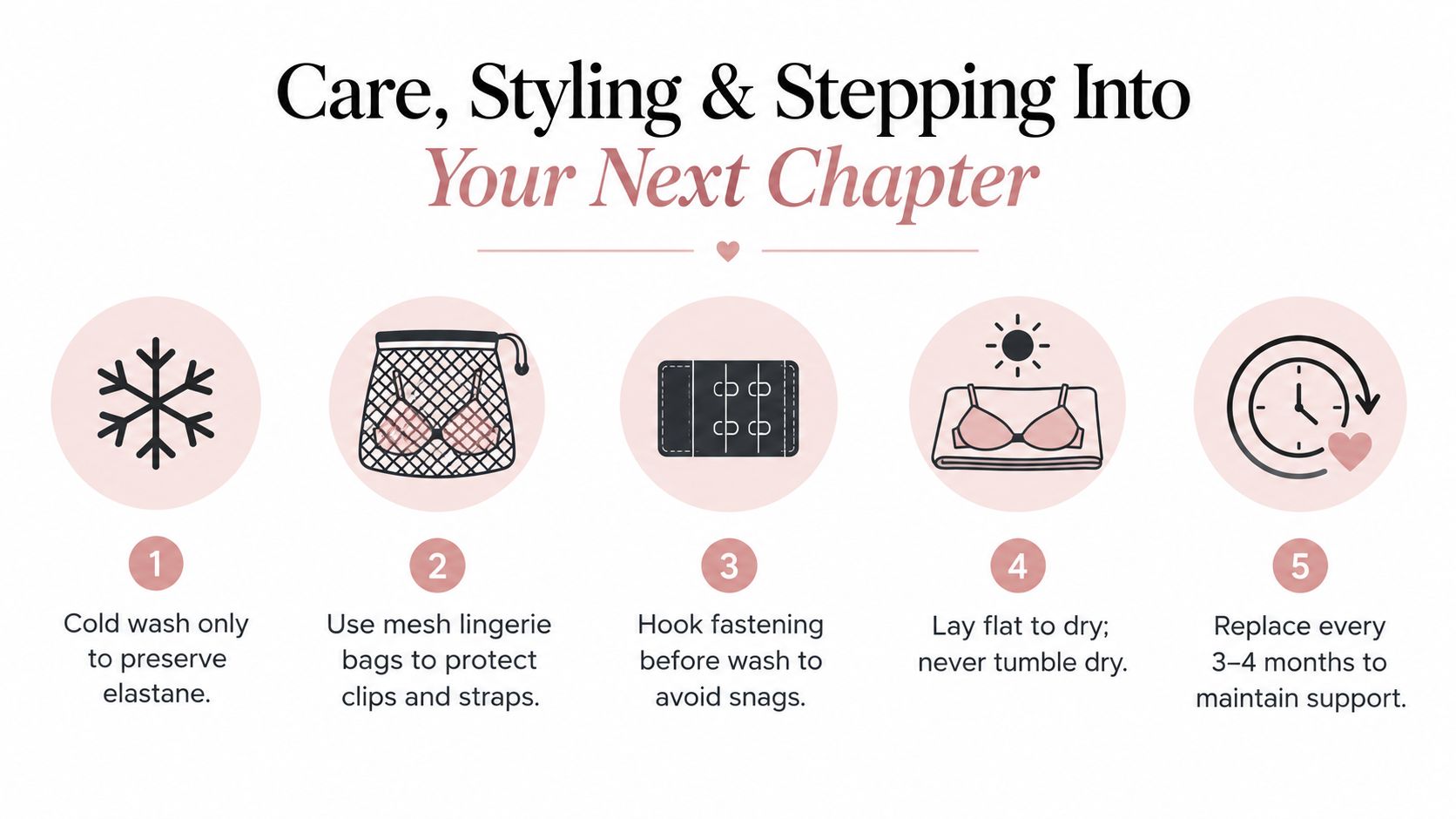
A few habits make a real difference:
- Wash cold: cooler water is gentler on elastane and helps preserve stretch
- Fasten hooks first: this helps prevent snagging on lace, mesh, or straps
- Use a mesh bag: nursing clips and delicate straps last better with less friction
- Lay flat to dry: heat from a dryer can shorten the life of supportive fibers
If a bra starts feeling unsupportive even on the tightest hook, or the fabric no longer springs back after wear, it's usually time to retire it from daytime duty.
Styling a soft cup bra without feeling “unfinished”
A soft cup nursing bra doesn't have to read as compromise. It often disappears beautifully under the kinds of clothes many mothers already reach for postpartum.
Try it under:
- Wrap dresses, where nursing access and neckline shape already work together
- Oversized button-downs, where a natural bust line feels relaxed and intentional
- Loose knits and sweaters, where smooth, soft support matters more than hard shaping
- Relaxed blazers, where comfort underneath keeps the whole outfit wearable
If you're rebuilding confidence in your clothes, start simple. Neutral tones. Soft textures. Necklines that cooperate with feeding instead of fighting it. One outfit that feels easy is worth more than five that make you feel like a stranger in your own body.
You don't need to “bounce back” to care how you look. You're allowed to want comfort and self-recognition at the same time.
Your bra drawer can grow with you
One of the healthiest shifts a mother can make is letting go of the idea that one bra should meet every need from birth through weaning. Early postpartum asks for softness, forgiveness, and easy access. Later postpartum may ask for polish, support, shape, and a little emotional lift when you catch yourself in the mirror.
A soft cup nursing bra often belongs at the beginning of that journey. For many women, it stays in the rotation long after the newborn phase because there will always be nights, recovery days, and comfort-first mornings.
But it can also be a bridge. Not the end point. Not a surrender to function. Just one honest stage in getting dressed in a body that's still yours, even if it's changed.
Milk&Lace creates maternity and nursing lingerie for the stage when feeding access still matters, but confidence starts mattering again too. If you're building a nursing wardrobe that moves from soft early support into more polished everyday options, visit Milk&Lace to explore pieces designed for comfort, function, and a more like-yourself feeling.