

At 3 a.m., your baby is hungry, your breasts feel full and tender, and the band you wore yesterday suddenly seems to press into every rib. Your cup volume may change between feeds, your skin may still feel sensitive, and even fastening a bra can become a small act of endurance.
That's why a nursing bra matters so much after birth. It sits against a body that's healing, swelling, regulating milk production, and learning a new daily rhythm. A wirefree nursing bra can be a practical response to that transition, not a retreat from support. The important question isn't whether wirefree means comfortable or supportive. It's whether the bra is engineered for your current postpartum stage.
The Moment the Bra Starts to Matter Again
Before pregnancy, you may have chosen a bra by silhouette, outfit, or personal preference. After birth, the decision becomes more physical. A mother feeding in the early morning might notice that a narrow band leaves a mark across her ribs, while a rigid cup feels unforgiving when her breasts fill between feeds. The discomfort can make her brace before putting the bra on, which is a clear sign that the garment isn't working with her body.
Postpartum breast tissue can feel different from hour to hour. Engorgement, milk let-down, leaking, and sensitive skin all change how pressure feels. A bra that seems fine after a feed may feel too restrictive later, especially if its band or cup compresses rather than contains.
A wirefree design can help. Without a rigid metal edge pressing along the underside of the breast, the bra can distribute tension through its band, cup shape, and seams. Independent nursing-bra research describes wirefree support as a result of pattern engineering, fabric shaping, seams, and structured construction, rather than metal reinforcement (Wirecutter's nursing-bra research).
Practical rule: If putting on your bra makes you flinch, start with pressure and fit before judging your need for support.
The right choice may change as your body settles. Early on, softness and flexibility may matter most. Later, you may want more lift, separation, and polish without returning to a rigid structure. Understanding how wirefree support works makes that decision much easier.
What a Wirefree Nursing Bra Actually Is
You may reach for a wirefree nursing bra after a feed, then wonder whether its softness means less support. The answer depends on its construction and on your postpartum stage. A wirefree nursing bra removes the rigid metal underwire, then builds support through a stable underbust band, shaped cups, seams, side panels, adjustable straps, and nursing access. Some designs add a soft underbust channel, which anchors the bra without concentrating pressure at one hard edge.
Support travels through the garment. The band carries much of the load around the torso, while the cups contain and shape the breast. Seams direct the fabric so it resists stretching downward, side panels help limit outward movement, and adjustable straps fine-tune how the bra sits on your changing body.
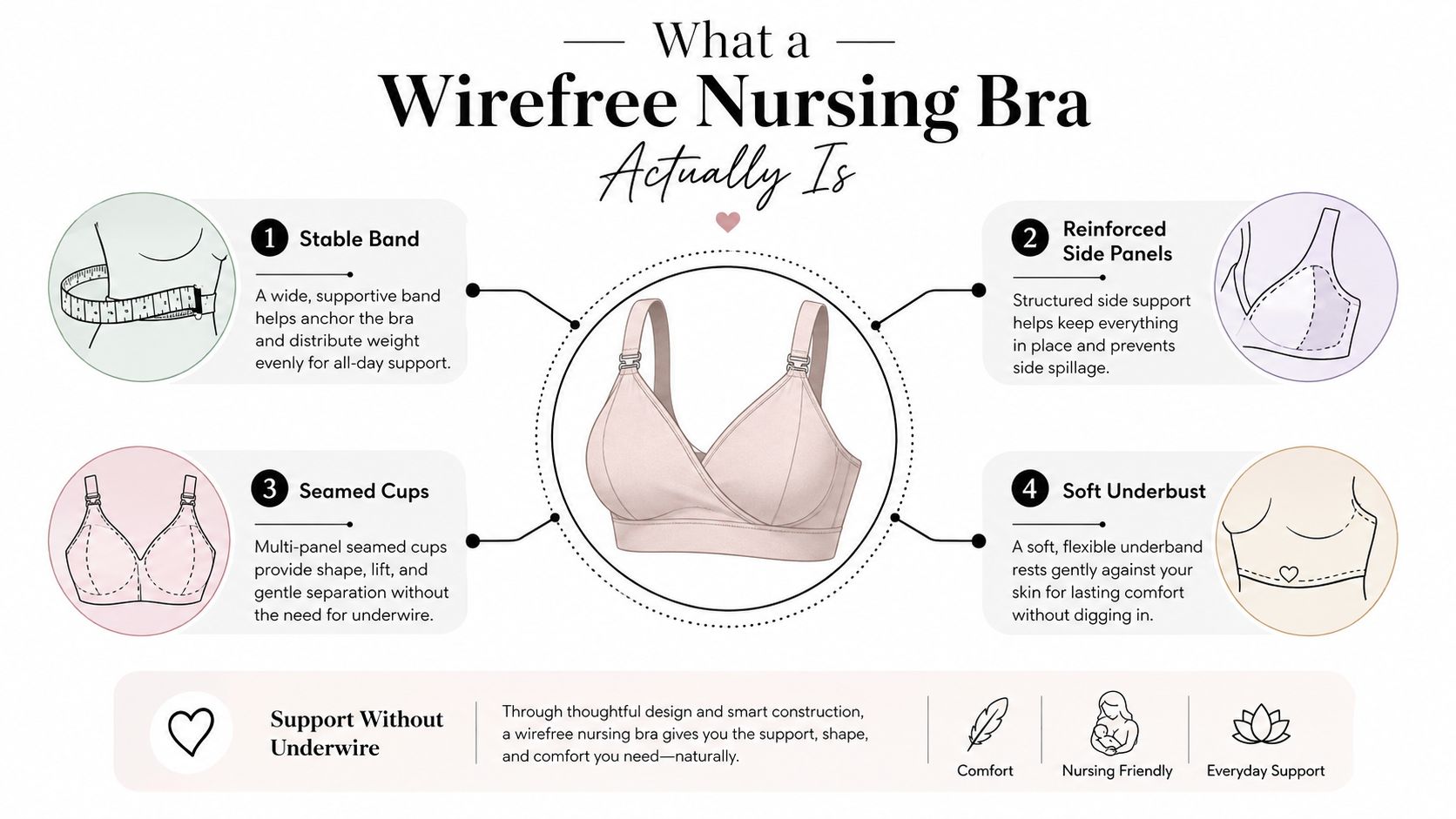
The structure behind the softness
A soft sleep bra is built mainly for ease and stretch. That makes it useful for resting, but it may offer limited control during walking, bending, or a full day of wear. A structured wirefree nursing bra has a broader job: it must recover its shape after movement, contain breast tissue, and still flex enough for feeding.
The key question is where the fabric resists movement. Independent nursing-bra research describes band and cup geometry, seam placement, and controlled fabric stretch as ways to create lift and support without metal (independent nursing-bra research). A cup made from several panels works like a carefully shaped pattern, directing support to specific areas instead of relying on one highly elastic piece.
Fabric changes the feel as well. Cotton and modal can feel gentle against sensitive skin. Nylon and spandex blends can improve recovery and durability. The suitable mix depends on the stretch needed in the cup, the firmness required from the band, and whether the bra is intended for sleep, everyday wear, or more active use.
A style such as GAIA combines stretch lace, flexible support, and breastfeeding access in a softer format. It shows why wirefree should be judged by engineering, not the absence of metal. As your body changes, the right time to wear one may change too.
Benefits and Honest Drawbacks of Going Wirefree
The strongest reason to choose wirefree is often simple: less rigid pressure on tissue that's already changing. During engorgement, a firm edge can feel especially intrusive. A supportive band and shaped cup spread that tension over a broader area, which may feel easier during long periods of wear.
Wirefree styles can also work well for sleep and frequent feeding because there's less hardware to manage. Drop-down cups or pull-aside openings give quick access when you're tired, and flexible fabric can accommodate the difference between a full breast and a recently fed breast. For someone recovering from abdominal birth, a longer or softer band may also feel less distracting than a firm bra that interacts with a healing midsection.
Material research adds another layer. Academic work on breastfeeding apparel identifies soft, non-abrasive, moisture-managing textiles as important for ergonomic and psycho-aesthetic comfort. Related bra-design research recommends low-stretch cup areas, stable bridge construction, and high-recovery materials such as powernet or spandex-rich knits to reduce deformation under breast weight (peer-reviewed nursing-apparel research).
The tradeoffs are real
Wirefree support has limits. A very soft design may provide less lift for a fuller bust, especially during high-impact movement. Flexible cups can also lose their original shape after repeated washing if the fabric and construction don't recover well. And because wirefree cups may bring the breasts closer together, some wearers notice more warmth or friction between heavy breasts.
| Benefit / Drawback | Why It Matters Postpartum |
|---|---|
| Gentler pressure | Broad support can feel more comfortable when breast volume changes throughout the day. |
| Flexible fit | Stretch can accommodate swelling and feeding-related fluctuation. |
| Easy access | Drop-down or pull-aside construction can simplify frequent feeds. |
| Less separation | Breasts may sit closer together, which can increase warmth and friction. |
| Potential shape loss | Weak recovery in the band or cups can reduce support over time. |
| Lower activity support | A soft style may not control movement sufficiently for exercise or a fuller bust. |
The answer isn't to reject wirefree. It's to match the design to the task. A sleep bra, an everyday seamed bra, and an exercise-friendly nursing bra may all be wirefree, but they shouldn't be expected to perform identically.
Wirefree vs Underwire Nursing Bras
You may reach for a wirefree bra during the first weeks, then reconsider it once feeding patterns and breast volume become steadier. The choice is shaped less by a comfort-versus-support contest than by what your body needs at that postpartum stage.
An underwire creates a defined boundary beneath each breast. A wirefree design distributes control through the band, cup shape, seams, and side panels, much like a suspension system that spreads load instead of placing it along one narrow edge. That structure can be supportive when those parts are engineered to work together.
Swollen or sensitive tissue can make a rigid wire less forgiving, especially when the cup is too small or the wire rests on breast tissue. A snug, accurate fit matters with either style. Excessive compression can also contribute to clogged ducts, so the band should feel secure without creating a concentrated pressure point.
| Criterion | Wirefree Nursing Bra | Underwire Nursing Bra |
|---|---|---|
| Load-bearing structure | Uses the band, cup geometry, seams, and side panels to distribute support. | Uses a rigid wire to define and lift from beneath the breast. |
| Daily comfort | Often accommodates swelling and let-down with fewer hard pressure points. | Can feel precise and supportive, but pressure is less forgiving when fit changes. |
| Nursing access | Commonly uses flexible drop-down or pull-aside construction. | Can offer equally convenient access, though the overall fit may feel more structured. |
| Postpartum stage | Often suits earlier sensitivity and changing breast volume. | May suit later stages when tissue and comfort have become more stable. |
Neither style wins for every mother. During early recovery, wirefree may feel more adaptable as the breasts and ribcage change. Later, a carefully fitted underwire may provide the separation and shaping you want without discomfort. Guidance on nursing bras with underwire can help explain that more structured option.
Test the bra through ordinary movement. Sit, bend, feed, and breathe. Check whether the breast stays inside the cup and whether any narrow area digs in. A wirefree bra is not automatically less supportive, and an underwire is not automatically unsuitable. The better match is the one whose structure fits your current stage and daily task.
How to Choose the Right Fit, Fabric, and Access
A wirefree bra can feel soft while working like a carefully arranged support frame. Start with the band, which anchors the cups and distributes movement around the ribcage. Measure snugly, then assess the bra standing, sitting, and raising your arms. The back band should remain level and secure without making breathing or feeding harder. For a detailed measuring sequence, follow this nursing bra measuring guide.
Leave space for changes in fullness, but keep the breast contained. The cup should not cut across upper tissue or create a compressed ridge. If the center bridge rests against your chest, it should lie flat enough to steady the cups without digging into the skin.
Match the cup to your changing shape
Full cups can contain tissue that feels heavier or fuller near the top. Molded cups create a smoother outline under clothing, while stretch cups can accommodate larger differences between feeds. A lower-stretch cup zone helps maintain shape; surrounding areas still need enough flexibility for comfort and movement.
The bridge and band work together. Research on bra construction supports stable, low-stretch bridge areas and high-recovery band materials because these features help maintain lift and limit deformation (academic bra-design research). The goal is not uniform firmness. Each panel should stretch where the body needs movement and resist movement where the bra needs stability.
Fabric should match your skin and routine:
- Sensitive skin: Breathable cotton or modal can make rough fibers feel less abrasive.
- Night leaking: Moisture-managing blends can help the bra feel drier between feeds.
- Variable fullness: Flexible knits can adjust to engorgement, provided they recover their shape afterward.
- Daily shaping: Seamed or molded cups usually create a more controlled contour than one soft layer.
Access also affects whether the fit works in real life. Drop-down cups open quickly and suit frequent feeds. Pull-aside designs may feel less restrictive, while front-zip styles can suit some routines but may create pressure at the center. Refasten the cup and check whether it returns to its original position. You should be able to open and close it with one hand while holding your baby.
Try the bra with your usual nursing pads. Sit, bend, feed, and breathe. Look for a band that rides up, shoulder marks that deepen during wear, cups that compress instead of contain, or straps that slip despite adjustment. These signs indicate a construction or size mismatch, not a failure on your part.
Matching the Bra to Your Postpartum Stage
Two weeks after birth, you may want the softest bra available. A few weeks later, that same bra can feel loose when you are upright, crowded when your breasts are full, or too casual for leaving home. Postpartum support is a stage-based decision, because breast volume, sensitivity, and daily movement change over time.
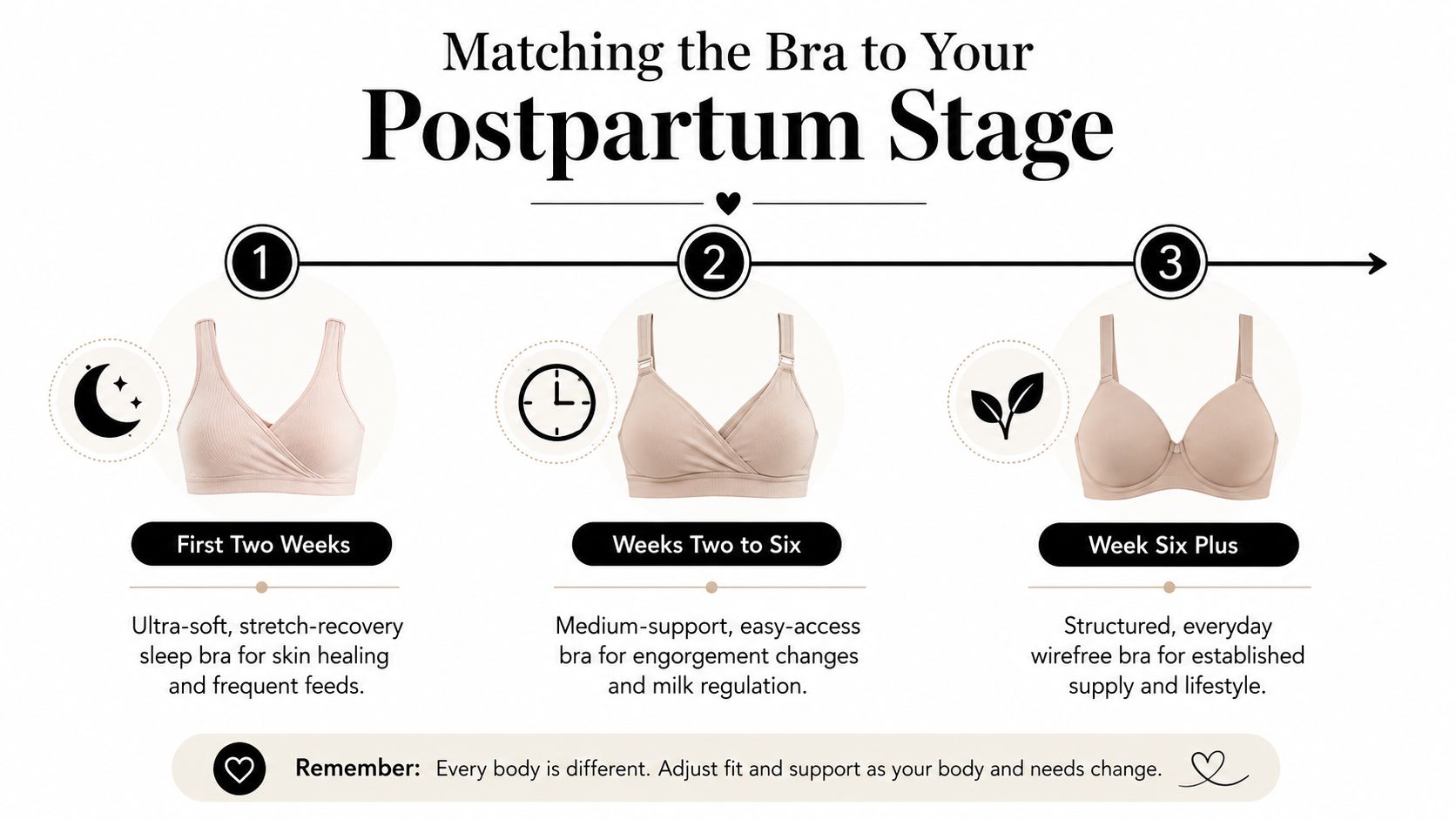
Early recovery
During the first two weeks, frequent feeding, rest, and sensitive skin often make an ultra-soft, flexible bra the practical choice. A stretch-recovery sleep bra can accommodate changing fullness without pressing the breast into a fixed shape. Its band should feel gentle yet stable, like a soft shelf that stays in place rather than a garment you must endure.
Postpartum guidance commonly favors a well-fitting wirefree bra while swelling and size fluctuation are pronounced. That does not mean wirefree must be unstructured. At this stage, comfort and room for change come first (postpartum nursing-bra guidance).
Regulation and rebuilding routine
Between weeks two and six, a structured wirefree style may serve you better for errands, appointments, and longer periods upright. Look for a wider band, controlled cup stretch, and nursing access that works repeatedly. The fabric can flex with fullness while seams, panels, and the band provide the resistance that keeps the breasts supported.
After six weeks, you may prefer a more shaped everyday bra. Some mothers remain comfortable in wirefree construction, while others try underwire as volume becomes steadier. Either choice depends on fit through movement, not the calendar. Supply can still regulate, so a bra that fits at three weeks may feel different at three months.
Match the bra to the task. A workday may need smooth shaping, nighttime may call for softness, and exercise needs firmer movement control. During weaning, reduced fullness can create gaping or looseness. Recheck the fit instead of wearing the same size indefinitely.
Care, Hygiene, and Safety Habits That Extend Its Life
A wirefree bra depends on elastic recovery, seam stability, and cup shape. Care protects all three. Use a cold or lukewarm wash cycle, place the bra in a mesh lingerie bag, choose mild detergent, and skip fabric softener.
Softener can leave residue on fibers that need to recover after stretching. Body oils, milk residue, and detergent buildup can also make sensitive skin feel irritated, particularly when the bra stays damp after a leak.

Flat drying helps preserve elastic and molded cups. Avoid high heat when possible, and don't wring the bra aggressively because twisting can distort the band and cup relationship. More guidance on how different textiles behave is available in this overview of bra fabric and material choices.
Rotate between bras so each garment can dry and recover between wears. Change nursing pads when they're damp, air the bra after feeding when practical, and spot-clean milk residue instead of allowing it to remain in the fabric.
Retire the bra when the band stays stretched, the cups remain misshapen, the straps gap or slip despite adjustment, or the fabric no longer contains the breast comfortably. A bra that has lost its recovery may still look wearable, but it no longer performs its structural job.
Choosing With Confidence, Not Compromise
Your stage postpartum should guide the choice before the label does. A wirefree bra can provide real structure when its band, cup, seams, and fabric share the work. Fit and construction create lift, while soft, moisture-managing textiles and controlled stretch help the garment stay supportive without pressing sensitive tissue.
Early sensitivity may call for flexible support and gentle pressure. Later, as your body settles into a feeding routine, you may prefer seamed cups, stronger elastic recovery, or a smoother outline under clothing. The right moment for wirefree support can shift as breast volume, tenderness, and daily movement change.
Test the bra during ordinary activities, including reaching, bending, sitting, feeding, and wearing your usual nursing pads. Check whether the band stays level, the cups contain breast tissue without compression, and the nursing clips open without forcing your posture. A bra that feels fine while standing can reveal poor fit when you bend or lift.
Fabric and access deserve the same attention as the brand name. A familiar label cannot correct a riding band or a compressed cup. Choose fewer bras with distinct roles rather than asking one garment to serve sleep, work, feeding, and exercise equally well. Recheck fit as milk supply changes, and treat discomfort as useful information.
Milk&Lace offers nursing lingerie with breastfeeding access, considered structure, and a feminine finish, including the flexible-support GAIA nursing bra. Explore nursing bras designed for a stage when comfort matters, while feeling like yourself matters too.