

You're several months postpartum, standing in front of a wardrobe that no longer quite matches your day. The first nursing bras you bought were useful when your breasts felt full, tender, and unpredictable, but now they look bulky beneath a blouse. A regular underwire bra feels too rigid, while a soft sleep bra doesn't give you the shape or confidence you want.
That in-between moment is where a second-skin nursing bra can fit beautifully. It's designed to feel close to the body, move with changing breast volume, and provide discreet nursing access without making you feel as though you're still dressed only for recovery. It isn't a replacement for every early-postpartum bra. It's a later wardrobe stage for the point when comfort still matters, but you're ready for softness, refinement, and more intentional support.
What a Second Skin Nursing Bra Really Means
A second-skin nursing bra should feel more like a smooth undershirt than a piece of rigid lingerie. The fabric lies close to the body, the edges don't announce themselves beneath clothing, and the nursing opening works without a search for complicated hardware.
The category rests on three practical qualities:
- Barely-there material: The fabric feels light and flexible rather than stiff, scratchy, or heavily padded.
- Adaptive structure: Stretch, adjustable straps, and a forgiving band allow the bra to follow normal postpartum changes.
- Quiet access: A drop-down cup, pull-aside panel, or similarly simple opening lets you feed without removing the entire bra.
That last point matters more than it may seem. Feeding often happens while you're sitting in a car, holding a sleeping baby, answering a message, or wearing a fitted top. A nursing bra should reduce the number of things you have to manage, not add another small problem.
The broader breastfeeding context is substantial. The World Health Organization's global breastfeeding report records that 48% of infants younger than six months were exclusively breastfed in 2024, compared with 37% in 2013. It also reports that 68% of women continued breastfeeding for at least one year and 44% continued to two years. Those figures describe why nursing access and all-day comfort remain relevant well beyond the first weeks.
The right stage matters
Early postpartum breasts can change noticeably between feeds. A stretchy, wireless bra may be the most forgiving choice when fullness is still difficult to predict. Later, as your routine becomes more familiar, you may want a bra that offers a smoother line beneath clothing and a more defined shape.
That doesn't mean every mother reaches the same stage at the same time. Your feeding pattern, breast size, sensitivity, activity level, and personal preference should guide the change. A second-skin style is appropriate when it solves your current problems, not just because a calendar says you should move on.
Practical rule: Choose the bra that supports the body you have today, while leaving enough flexibility for the body you'll have after the next feed.
A Brief History of the Nursing Bra
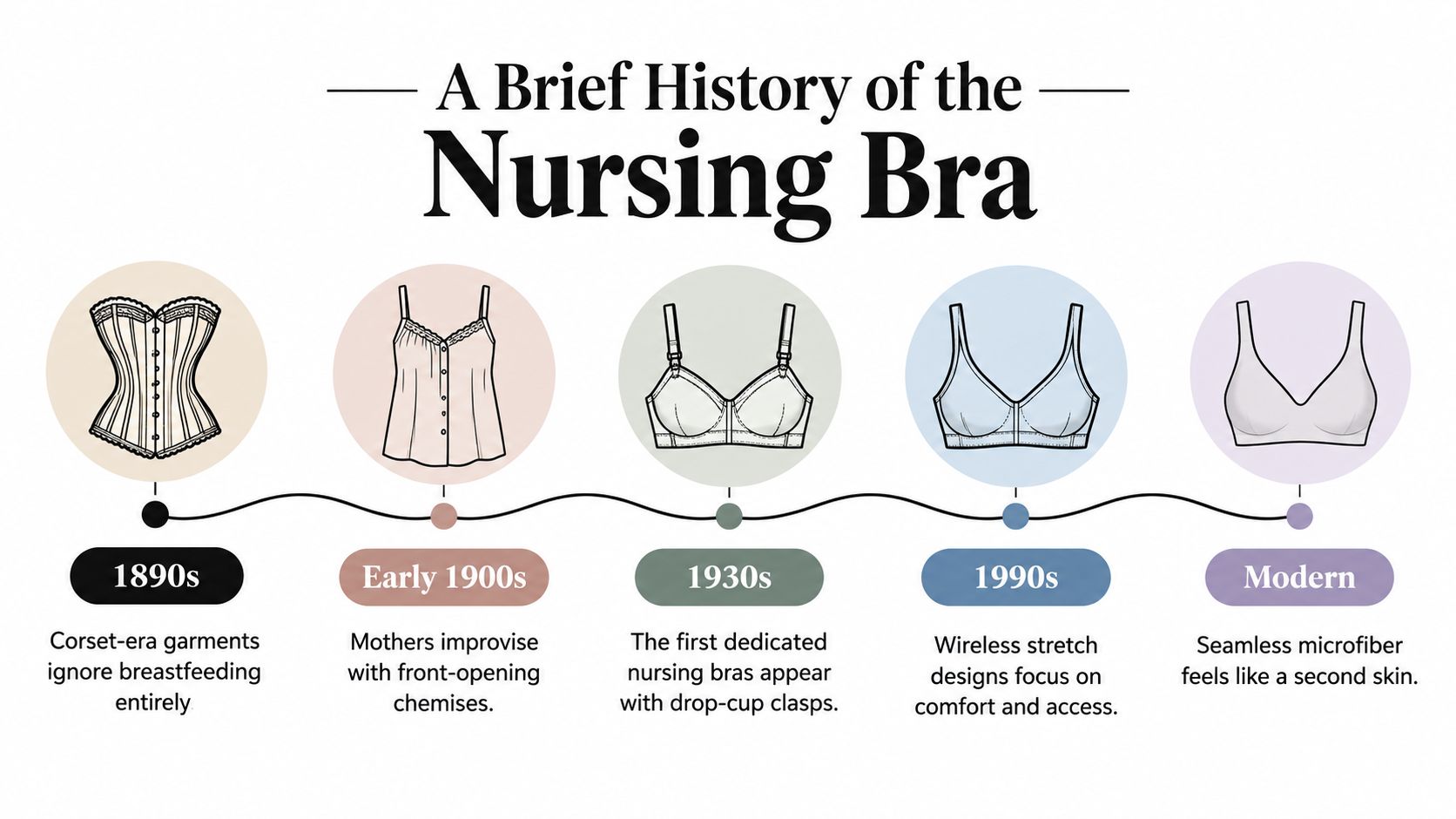
Nursing lingerie has always responded to a simple practical need: a mother should be able to feed her baby without removing all of her clothing. The materials and silhouettes have changed, but the underlying design problem has remained remarkably consistent.
The modern story includes a documented predecessor in 1913, when Mary Phelps Jacob received the first U.S. patent for a bra-like garment. A dedicated “nursing brassiere” patent followed in 1943, obtained by Albert A. Glasser. The postwar baby boom then helped expand demand for garments that combined breast support with easier feeding access. These milestones are documented in the history of the nursing bra.
From access to adaptability
Early specialized designs concentrated on opening the garment. Later developments began to address the challenges around that opening, including changing breast volume, straps that could be adjusted, and cups that offered more coverage.
A further milestone arrived in 1991, when Mary Sanchez received a patent associated with one-handed fastening and adjustable cup volume. That detail captures the direction nursing design was taking. Access still mattered, but convenience and adaptability were becoming equally important.
Today's second-skin nursing bra belongs to that longer progression. It borrows the practical purpose of earlier nursing garments, then combines it with lighter textiles, smoother edges, flexible lace, and less conspicuous hardware. The result is intended to feel less like equipment and more like part of an ordinary wardrobe.
The historical lesson is useful when choosing one. Nursing access isn't a recent marketing idea, and softness isn't merely decorative. The best designs reduce disruption during feeding while recognizing that a mother may also be working, traveling, resting, dressing for an occasion, or wanting to feel comfortable in her own clothes.
Materials and Construction That Create the Skin-Like Feel
Softness alone doesn't create a second-skin experience. A bra can feel smooth in your hand and still become irritating after hours of warmth, movement, moisture, and pressure. The meaningful combination is softness plus moisture control plus low friction.
Skin-on-skin or skin-to-textile friction becomes more troublesome when moisture is trapped in a warm fold. Nursing bras may encounter sweat, milk leakage, repeated washing, and long stretches of contact with the underbust and side-breast areas. A clinical review on moisture-wicking textiles and intertriginous skin comfort explains why moving moisture away from the skin and allowing evaporation can help keep the microclimate drier.
Look beyond the fabric label
A fine-gauge knit, smooth microfiber, or soft stretch lace can work well, but construction determines how that material behaves. Check the underband, side panels, cup edges, and nursing hardware with the same care you give the main fabric.
- Underband: A wide, soft band spreads pressure instead of concentrating it in a narrow elastic strip.
- Seams: Bonded, covered, or carefully placed seams are less likely to rub than bulky stitching over sensitive areas.
- Lace: Stretch lace should lie flat and move with the body. An ornate edge that digs into the breast or underbust isn't skin-like in practice.
- Cups: Thin, flexible molded cups can smooth a silhouette, but thick foam may add bulk and hold warmth.
- Hardware: Clips, sliders, and strap adjusters shouldn't create hard pressure points when you bend forward or lie down.
- Labels: Printed or tagless care information removes another source of rubbing.
For a closer explanation of how skin-mimicking textiles behave, see fabric that looks like skin. The useful question isn't whether a product uses the phrase “second skin.” Ask whether the surfaces touching you are smooth, breathable, flexible, and stable after washing.
| Component | Skin-Like Choice | Bulkier Everyday Choice |
|---|---|---|
| Main fabric | Smooth stretch knit or fine stretch lace | Thick, rigid textile with limited recovery |
| Cup structure | Thin, flexible support | Heavy foam that adds volume |
| Underband | Wide, soft elastic that distributes pressure | Narrow elastic that concentrates pressure |
| Seams | Covered, bonded, or low-profile construction | Raised stitching against the skin |
| Nursing access | Quiet clip or pull-aside opening | Large hardware or a full-cup release |
| Care label | Printed or tagless finish | Rough sewn-in label |
The GAIA nursing bra is described as a soft nursing bra with stretch lace, flexible support, and breastfeeding access. That kind of design can suit someone seeking a more refined second-skin feel, provided the fit remains comfortable and the lace doesn't create pressure points.
When a Structured or Underwire Nursing Bra Makes Sense
You are several months postpartum, your breast size has become less unpredictable, and a soft nursing bra feels too loose under a fitted blouse. On a workday or a walk, you want the steadiness of a shaped cup. That is often the point at which a structured nursing bra can join your wardrobe. It does not replace an early nursing bra designed for frequent changes. It serves a later stage, when your body and clothing call for more containment.
Wire-free support remains useful during periods of rapid breast changes, tenderness, or fullness. A structured style can suit fuller breasts and days with more movement, especially when you want less bounce beneath clothing. A biomechanics study of women with larger breasts found that underwired bras reduced vertical breast displacement, perceived motion, and discomfort during exercise compared with wire-free bras. The findings are recorded in this peer-reviewed study record on underwire support and breast movement.
Fit decides whether the wire helps
An underwire works like a boundary around the breast, not a clamp across it. Its lower edge should follow the inframammary fold, the natural crease beneath the breast, while remaining outside the breast tissue. The cup should contain the whole breast, and the band should stay level as you move. Those details help limit concentrated pressure and rubbing.
Check the bra during ordinary movements rather than judging it while standing still. Stand, bend forward, sit, raise your arms, and walk. Notice whether the wire follows the crease, the cup keeps tissue contained, and the band stays in place. Open the nursing clasp as well. The remaining support should still feel stable while you feed.
Persistent red marks, a sharp sore spot, upward shifting, or tightness as the breasts fill indicate a poor match. Do not try to break in a bra that causes ongoing discomfort. Blocked-duct symptoms, possible mastitis, continuing tenderness, or scar sensitivity call for individual advice from a lactation consultant or physician before choosing a structured style.
For a closer comparison of construction, read this guide to nursing bras with underwire. The useful decision is how the bra's stage, shape, and fit work together for your body.
How to Measure, Fit, and Plan for Size Changes
Several months postpartum, you may pull on a second-skin nursing bra before leaving the house and notice only whether your shirt lies smoothly. That quiet fit comes from accurate measurement and a shape that suits your body. It also explains why this style often works better as a later-postpartum wardrobe stage, after early fullness and frequent changes have settled, rather than as a replacement for every nursing bra.
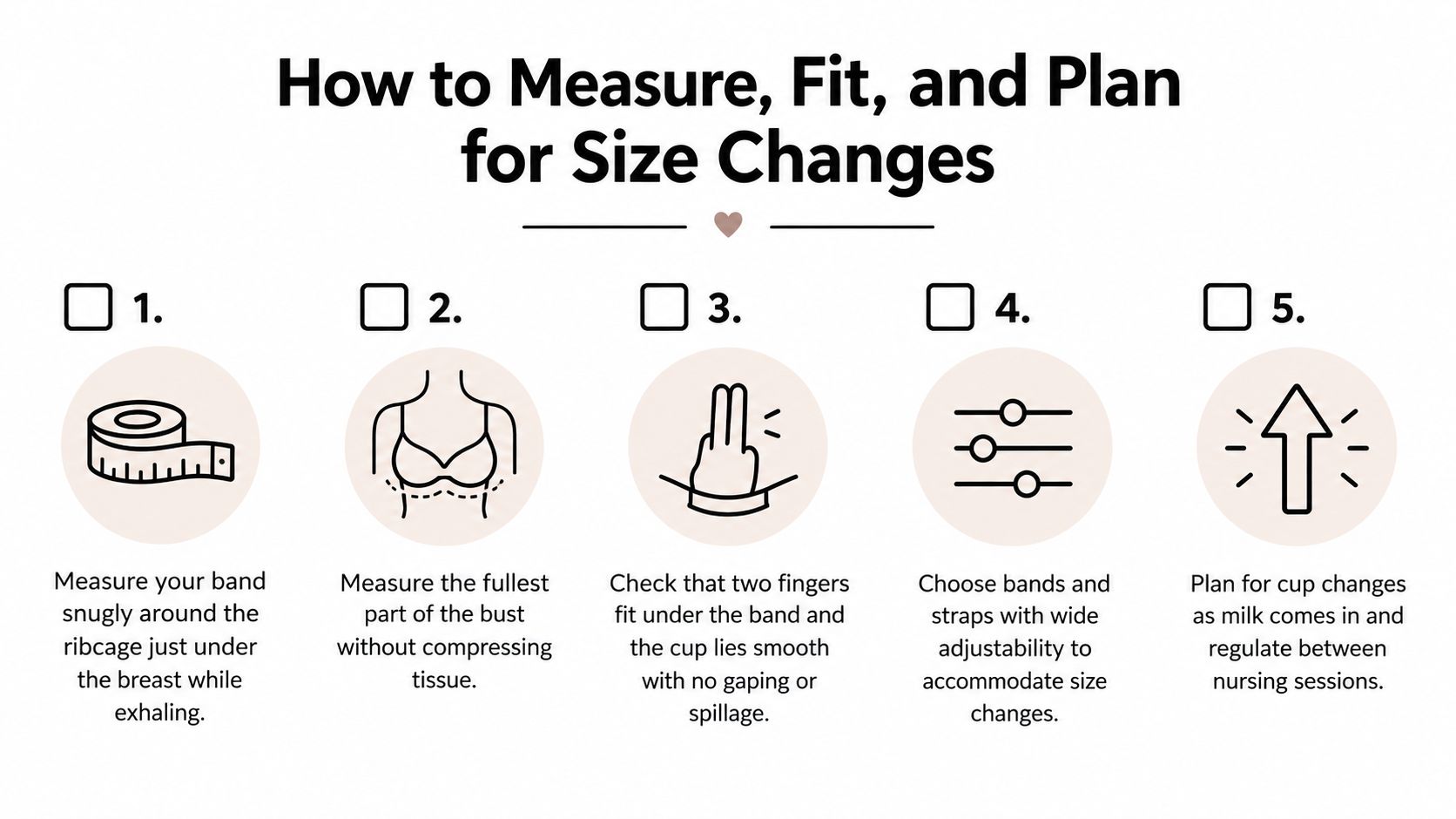
Start with the ribcage. Wrap the tape firmly beneath the breasts, keep it level across your back, and measure after a relaxed exhale. Then measure around the fullest part of the bust without compressing the tissue. Enter both measurements in the brand's chart, since band and cup systems vary between makers. A guide to measuring for a nursing bra can help you repeat the process consistently.
Let movement confirm the size
A label is only a starting address. Put the bra on its loosest hook setting if it has several rows, adjust the straps, and settle the breast tissue into the cups. Then raise your arms, sit, bend, and reach. The band should remain level instead of climbing between the shoulder blades. The cups should contain the breast without overflow, gaping, or wrinkles. The centre panel, when the design includes one, should rest comfortably against the sternum. Straps should support without cutting into the shoulders, and the nursing opening should release without pulling the other breast sharply downward. Any underwire should follow the breast root while staying clear of breast tissue.
Breast volume can shift considerably through pregnancy and postpartum. A study of 323 pregnant, postpartum, and breastfeeding women found that self-reported bra size increased by an average of one underband size and two cup sizes from before pregnancy to pregnancy and afterward, with breast pain especially prevalent among pregnant and breastfeeding participants. The study on postpartum bra fit and breast pain supports adjustable closures and flexible panels, along with an exchange process that allows for normal changes.
Bodies do not all follow that pattern. Another study of postpartum breast size and shape changes found that 46% of respondents reported no breast-size change after pregnancy, 37% became smaller, and 16% became larger. It also found that breastfeeding was not an independent risk factor for breast ptosis. Measure when your breasts are neither unusually full nor recently emptied, keep the tags attached until the fit feels reliable, and reassess when daily comfort changes.
After feeding, sitting, and reaching, check the band, cup edges, and skin again. A second-skin bra should feel like a close-fitting base layer, not a garment that asks your body to adapt to it.
A Realistic Day in a Second Skin Nursing Bra
The first test happens before breakfast. You put on the bra and notice that the band settles against your ribs instead of demanding constant adjustment. The cups sit smoothly beneath a knit top, and the straps stay quiet under the shoulders of your clothing.
Later, you join a video call. You lean toward the screen, lift your arms to reach for a mug, and sit back down. The bra should move with you rather than creep upward or press a seam into the fold beneath your breast.
Then your baby needs to feed. You release one cup with one hand, guide the fabric aside, and keep the rest of the bra supporting the other side. When the feed is over, you close the cup without removing your blouse or balancing a separate garment on your lap.
The day continues with ordinary movement. You buckle a car seat, bend to pick up a toy, carry a bag, and walk through a shop. A well-fitted second-skin style won't make those activities feel dramatic. It should stay close without compressing, and its opening should remain accessible without becoming loose.
Comfort has an evening test
At dinner, you wear a draped blouse and notice that the bra creates a clean line instead of visible ridges. By bedtime, check your skin rather than relying only on your first impression. Persistent red marks at the shoulders, underband, or cup edge suggest that pressure is being concentrated somewhere.
Also notice moisture. If the fabric feels damp after a long day, the issue may be the textile, the fit, the weather, or the need for a change of bra. Moisture management supports comfort, but it doesn't replace regular washing or medical attention for ongoing redness, pain, fissuring, discharge, or suspected mastitis.
Care Instructions to Protect Softness and Shape
A second-skin nursing bra often becomes useful later in the postpartum wardrobe, when you want a low-profile layer that still handles milk, body oils, repeated nursing clips, and frequent washing. Its softness depends on how you clean it, especially when stretch fibers and fine fabrics sit directly against sensitive skin.
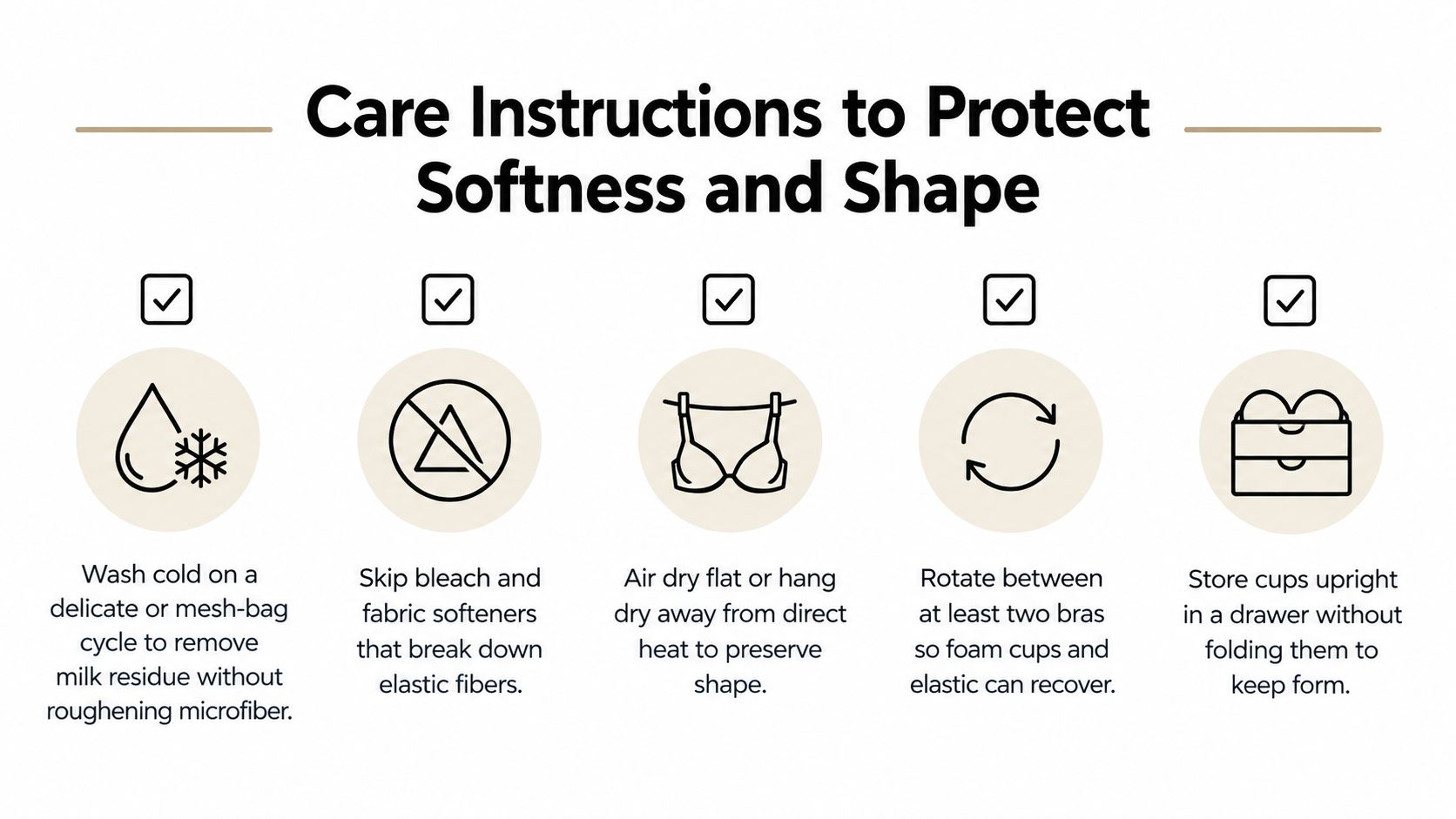
Read the care label first. Then choose the least aggressive routine that removes residue: a cold, delicate wash inside a mesh lingerie bag. Use a mild, fragrance-free detergent and rinse thoroughly. Skip bleach and fabric softener. Fabric softener can coat technical fibers and change the feel of lace or elastic, much like a thin film over a soft towel.
Drying protects the stretch
Heat weakens elastane over time. Keep the bra away from radiators and hot dryers. Press out excess water without twisting, reshape the cups, and lay it flat on a clean towel. Hanging is also suitable when the care label allows it, provided the bra dries away from direct heat.
Molded cups need space to keep their shape. Store them gently folded or supported rather than rolled into a ball, which can turn temporary creases into lasting ones. If the manufacturer recommends closing nursing clips for washing, follow that instruction. Check sliders afterward so they have not caught in lace or straps.
Small habits reduce wear. Wash promptly while milk residue is still fresh. Use a mesh bag to limit snags on straps, lace, and clips. Air-dry completely before returning the bra to a drawer. Rotate garments so each elastic band has time to recover between wears. Inspect regularly for a band that rides up, straps that no longer adjust securely, or fabric that has lost its recovery.
A bra does not have a universal replacement date. Its useful stage depends on the fabric, washing routine, body changes, and frequency of wear. Replace it when it no longer supports you, lies flat, or feels comfortable, even if its appearance remains acceptable. A clean silhouette is helpful, but reliable fit and gentle contact with the skin matter more.
Finding the Right Moment for Your Next Bra
A second-skin nursing bra isn't the final destination of postpartum lingerie. It's one stage between the forgiving softness many mothers need early on and the more structured, shape-focused pieces they may want later.
You may be ready for a different bra when the current one no longer matches your routine. Perhaps the band has lost its recovery, the cups gape after your breast volume changes, or the fabric no longer feels smooth. You may also find that your clothing has changed. A fitted work top, a dress with a defined neckline, or a lighter blouse can make a low-profile nursing bra more useful than a generous sleep style.
Let your day make the decision
Ask yourself what your body and schedule require now:
- Do you need maximum flexibility between feeds?
- Are you looking for a cleaner silhouette beneath clothing?
- Do you want more lift for walking or daily activity?
- Are you comfortable testing a structured style?
- Does your breast tissue feel settled enough for a cup-specific fit?
- Can you exchange the bra easily if your measurements shift?
The answer may be a second-skin bra, another wireless nursing style, or a carefully fitted structured option. You don't have to abandon the early bra that still works. Many postpartum wardrobes function better when they include different levels of support, access, and coverage for different parts of the day.
A later-stage bra should also leave room for uncertainty. Breast size can change after milk supply stabilizes and again after breastfeeding ends, so don't treat a premium purchase as a permanent answer to a temporary body. Choose a retailer with clear fit guidance and exchanges, and reassess when the bra begins to feel different rather than forcing yourself to wait for a predetermined milestone.
The most useful question is simple: Does this bra help me live the day I'm living now? If it supports feeding, movement, clothing, and confidence without creating new discomfort, you've found the right wardrobe stage.
Milk&Lace offers nursing lingerie designed for the later postpartum moment, including soft lace, structured support, and discreet breastfeeding access in its GAIA and PETRA styles. Visit Milk&Lace to explore the collection, review fit and exchange information, and choose a bra that meets your body where it is today.