

By the time evening arrives, your bra may feel like one more thing you've had to carry. You've fed the baby, managed milk leaks, adjusted straps, and spent the day moving through a body that can feel different from morning to night. Then you unhook the band and see the marks it left behind, as if your clothing has been keeping its own diary on your skin.
“Fabric that looks like skin” sounds like a fashion phrase, but it can describe something more useful: a textile engineered to stretch, recover, drape, breathe, and sit against the body. For postpartum and nursing wear, that difference matters. The right material shouldn't merely pass a quick touch test. It should remain comfortable through heat, friction, repeated nursing access, and changing breast fullness.
The most helpful way to judge it is to look beyond the shade or the promise of a “second-skin feel.” You need to understand the sensory tests, the material families behind the effect, and the evidence that supports safe skin contact. By the end, you'll know what to feel for, what to inspect, and what to leave on the hanger.
The Moment You Realize Your Bra Has Been Talking All Day
At the end of a long postpartum day, taking off your bra can feel like a small ceremony. You reach behind your back, release the clasp, and feel your shoulders drop before the garment has even come away. Underneath, the underwire has left a narrow line across your ribcage, the elastic has curled into the back band, and a seam has pressed into skin that was already tender.
Maybe the cups have pilled where they rubbed against your breasts. Maybe the shoulder straps have created a dull ache that follows you into the evening. If you're nursing, the fabric may also have shifted during every feeding, while the cup edge pulled each time you opened it. These aren't minor annoyances when they repeat throughout the day. They become part of how your body experiences clothing.
A softer bra can help, but softness alone doesn't solve everything. A fabric may feel pleasant in your hand yet trap heat, lose its shape, or become rough at the edges after washing. The more useful question is whether the discomfort comes from your body, or from a textile and construction that aren't suited to the demands placed on it.
A fabric category, not a mood
Fabric that looks like skin describes an engineering category built around disappearance. The material follows the body instead of fighting it, stretches when you reach or lean, and returns to its intended shape when tension leaves. In clothing, that effect comes from the relationship between fiber, knit structure, finishing, seams, and fit.
For a new mother, the evaluation needs to go beyond appearance. A skin-like nursing bra should feel smooth against reactive skin, allow movement without riding up, and provide access without making the whole garment twist. It also needs enough recovery to cope with repeated opening, pulling, and repositioning.
The useful test isn't “Does it feel soft in the fitting room?” It's “Will I still notice the fabric after hours of movement, warmth, and nursing?”
The pages ahead break the idea down through three sensory tests, four material families, and a postpartum-specific way to compare comfort with support. You'll learn how to recognize a real second-skin construction, how to read its care requirements, and how to choose a bra that makes the end-of-day relief ritual much less necessary.
What Skin-Like Fabric Actually Means
Start with your hands, not the fiber label. A fabric that looks like skin earns that description through how it behaves against the body.
Test one, stretch and recovery
Take a section of fabric and pull it gently in more than one direction. A convincing second-skin textile should extend without feeling stiff, then return without leaving a sagging pocket. Watch the cup edge, the underarm area, and any place likely to stretch during nursing access. If those areas stay loose after you release the fabric, the garment may look sleek at first but won't continue to look or feel close to the body.
The textile vocabulary for this quality includes four-way stretch, low modulus, and high recovery. Four-way stretch describes movement across both the length and width of the fabric. Low modulus means the material doesn't require much force to extend, which often makes it feel gentler. High recovery describes its ability to return toward its original dimensions after being stretched.
Test two, drape and weight
Hold the garment by one edge. A second-skin fabric usually falls toward the body rather than holding a rigid outline. It should follow curves without creating a heavy fold, bulky ridge, or board-like cup. Weight matters because a close-fitting bra needs enough structure to support you, but not so much material that it becomes another warm layer to manage.
A low-weight fabric isn't automatically better. A very thin textile may lose opacity or support. The goal is balance, a fabric that drapes closely while working with the bra's panels, elastic, and support zones.
Test three, opacity and edges
Stretch the material while holding it over a contrasting surface, then view it from more than one angle. Look for white flashing, unexpected sheerness, or fuzzing at the stress points. Run your thumb across the edges as well. A flat edge usually feels quieter than a curling or rough one.
Working definition: fabric that looks like skin is a close-fitting textile with a smooth hand, comfortable multidirectional stretch, reliable recovery, body-following drape, and stable opacity at the places where the garment is pulled.
Thread count doesn't tell you enough here. Hand-feel is the load-bearing feature because the fabric sits directly against skin that may be warmer and more reactive after birth.
The Four Material Families Behind the Feel
Different fibers can produce a skin-like result, but they don't behave identically. The construction determines what you gain, while the material family usually reveals what you'll have to compromise.
Spandex knits
Spandex, also called elastane, is the workhorse behind much of the modern stretch textile category. DuPont chemist Joseph C. Shivers developed it in 1958, after earlier polyurethane research dating to 1937 and 1939. By 1959, U.S. labeling rules had led regulators to choose the generic name “spandex,” derived as an anagram of “expands,” and DuPont later marketed the fiber as Lycra in 1962. This history places the key commercial milestone period in the late 1950s and early 1960s, as described by the history of spandex from Fulgar.
Its strength is elastic movement. LYCRA fiber is described as stretching up to 500% of its original length, while other industry descriptions place spandex extension at 5 to 8 times its original size in this technical overview from TVF. The tradeoff is care sensitivity and, in some close-support designs, too much compression during periods of breast fullness.
Microfiber polyamides and polyesters
Microfiber uses very fine filaments to create more surface area and stronger capillary pathways than standard polyester. That construction can improve softness, drape, and moisture transport. Research on microfiber knits notes strong moisture-comfort properties and testing that can meet or exceed the 10 cm AATCC vertical wicking benchmark, as documented in this textile study.
This family suits close-fit garments where a smooth, silken hand and fast drying matter. Its tradeoff is that a dense knit can reduce airflow, and some microfiber fabrics may hold odors when they lack an appropriate finishing treatment.
Silicone and polyurethane membranes
Thin silicone elastomer or silicone membrane layers appear in advanced wearable constructions, adhesive designs, and supportive inserts. DuPont describes silicone materials that combine breathability, waterproofing, elastic recovery, adjustable thickness and hardness, flexibility, and stress resistance in its wearable materials brochure.
The visual result can be remarkably close to the body because a thin film follows movement while creating a stable barrier. The unavoidable compromise is breathability. A membrane may be useful for targeted support or adhesion, but prolonged direct contact deserves more careful attention than a breathable knit.
Smart thermoresponsive textiles
The newest family uses moisture response or temperature-sensitive structures to influence the microclimate next to the skin. Research has described a skin-like textile with temperature-responsive channels that increase sweat transport as heat rises and reduce liquid loss as temperatures fall. A later cooling garment combined directional sweat routing with spectrum-selective cooling and lowered skin temperature by about 5°C compared with conventional fabrics, according to the ACS research on thermoresponsive cooling textiles.
These textiles could be relevant to night sweats and temperature swings, but their tradeoffs include higher cost, more complicated care, and less familiar performance evidence in everyday nursing lingerie.
| Material Family | Key Fiber | Signature Feel | Main Tradeoff |
|---|---|---|---|
| Spandex knits | Elastane or spandex blended into a knit | Stretchy, close, flexible | Recovery and compression must be managed |
| Microfiber fabrics | Fine polyester or polyamide filaments | Silken, smooth, moisture-moving | Dense constructions may reduce airflow |
| Silicone membranes | Silicone elastomer or membrane layer | Sleek, stable, body-conforming | Direct contact can feel warmer |
| Smart thermoresponsive textiles | Responsive knit or channel structure | Adaptive, cooling, moisture-aware | Care and performance can be more complex |
A nursing bra such as GAIA sits within the practical overlap between stretch lace, flexible support, and easy breastfeeding access. That overlap matters because real maternity designs often combine material families rather than using one in isolation.
Why Postpartum and Nursing Change the Rules
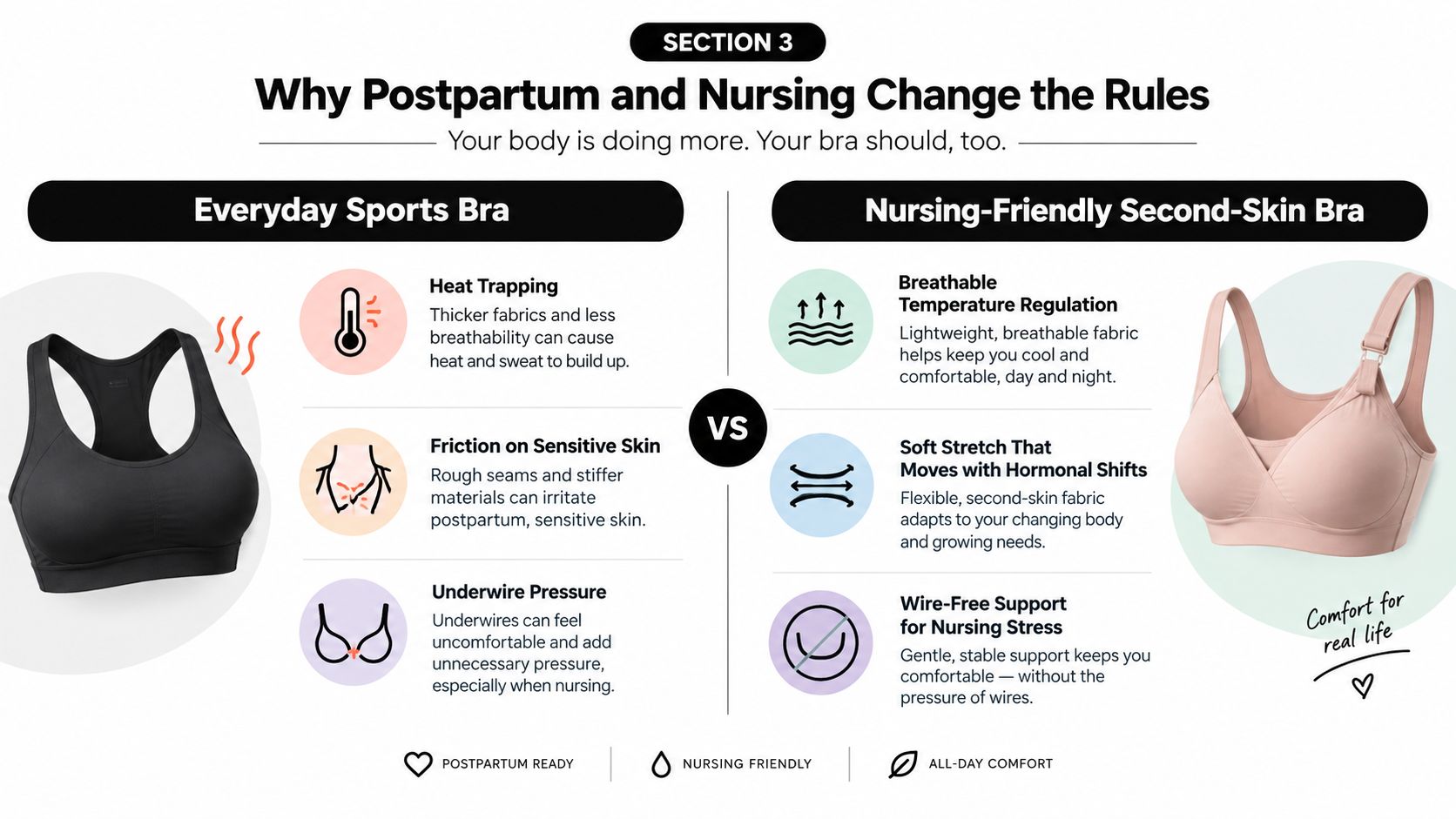
A sports bra and a nursing bra may both promise stretch, but they serve different daily realities. Sportswear is often judged during movement and exercise. A nursing bra has to remain against the body through feeding, rest, warmth, milk let-down, shoulder movement, and repeated cup opening.
Postpartum skin can feel more reactive, while body temperature and breast fullness can change throughout the day. A garment that feels fine during a short walk may become irritating when moisture collects under the band or when the same edge presses into engorged tissue for hours.
The criteria shift from stretch to tolerance
For postpartum wear, breathability and moisture-vapor movement deserve as much attention as stretch. A fabric can expand beautifully and still feel clammy if its structure doesn't let heat and moisture leave the body.
Seam construction also becomes central. Bonded or flat seams can reduce pressure points compared with bulky raised stitching. A wire-free design may feel gentler for some people, while others want carefully placed support. The important point is that support should be distributed rather than concentrated in one painful edge.
Repeated nursing pulls test recovery differently from a workout. Each feeding can open, fold, and reposition the cup, so inspect whether the cup edge and shoulder area return to place without dragging the rest of the bra out of alignment.
A garment that passes a yoga test may still fail a postpartum test because nursing asks it to move, dry, recover, and stay gentle for much longer.
For practical fit guidance, this guide to postpartum undergarments is useful alongside your own skin and feeding needs. No textile can decide comfort for you. A seam that feels harmless on one person may sit directly on a tender area for another.
The safest approach is to treat skin contact as an ongoing question. Recent research describes textiles that can act as secondary skin interfaces and carry antimicrobial, anti-inflammatory, antioxidant, or prebiotic agents, as well as smart fabrics designed to sense pH, temperature, or microbial activity and respond with released compounds. Separate ACS reporting in 2025 described human-skin cell culture testing suggesting that one coated fabric could be safe for wear for up to 8 hours, which points to the need for clearer evidence about longer contact, irritation, and microbiome effects. The practical discussion is captured in this 2025 review of skin-interfacing textiles.
The Honest Pros and Cons
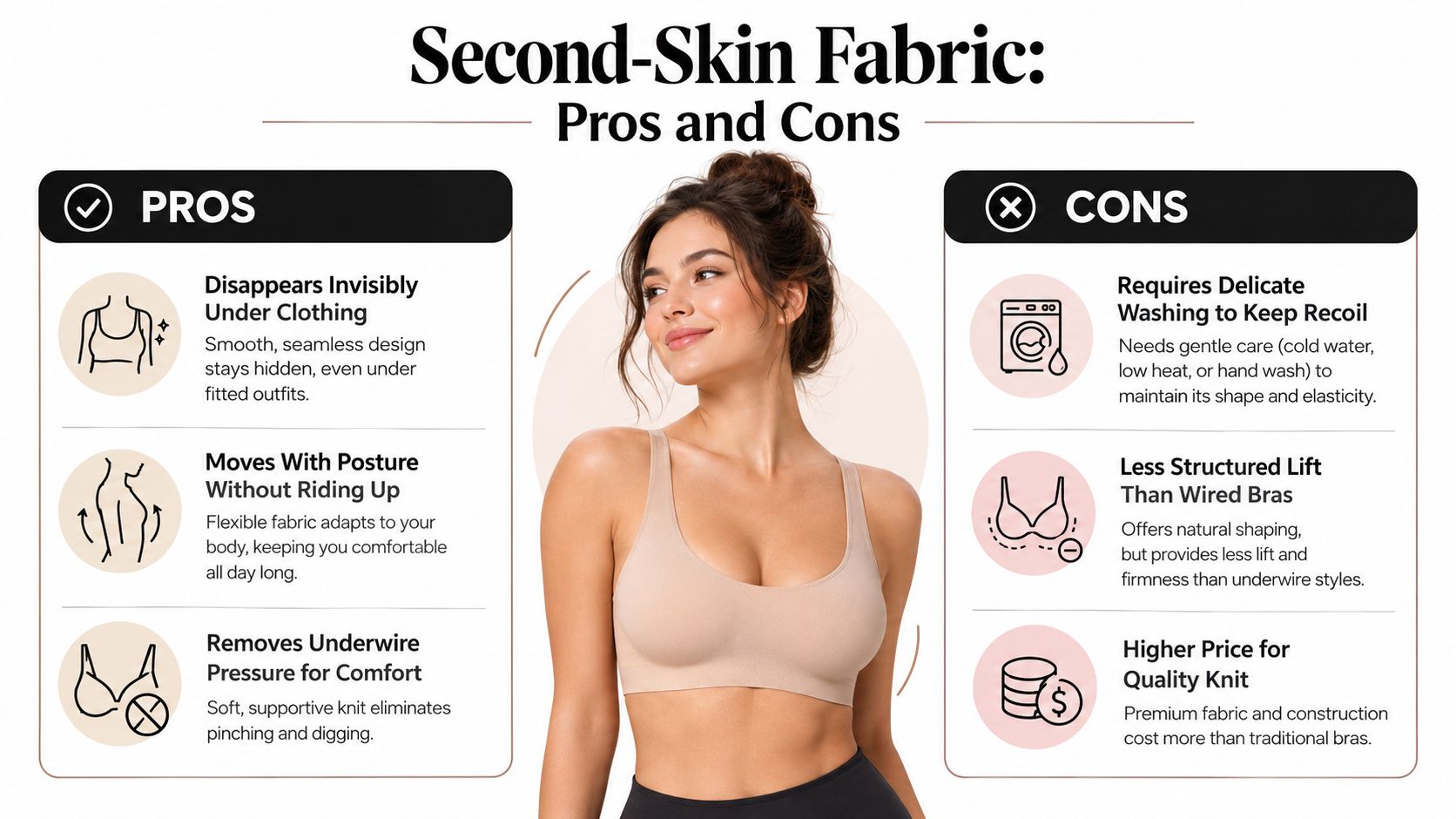
The appeal is easy to understand. A well-made second-skin knit can disappear beneath clothing, follow changes in posture, and avoid the sharp pressure that an underwire may create on a tender ribcage. Smooth stretch can also reduce the feeling that you're constantly adjusting the band, cup, or shoulder straps.
Those benefits become more meaningful when the bra supports nursing access without making the fabric fight back. If the cup opens smoothly and the surrounding knit recovers, you can feed without turning a simple adjustment into a full garment rearrangement.
What the touch test won't tell you
The same thinness that creates an invisible line can reduce opacity in bright daylight. The same membrane that feels sleek can hold warmth. A heavily elastic knit may feel wonderfully yielding when new but lose some of its spring when care is too rough.
The label also may not tell you how the bra behaves after repeated nursing tugs. Stress concentrates at the cup edge, the clasp area, and the strap connection. These points deserve a physical inspection, not just a glance at the product photograph.
| Benefit | Limitation |
|---|---|
| Smooth fabric can disappear under clothing | Thin fabric may show more in strong light |
| Flexible construction can follow posture | Less rigid structure may provide a different kind of lift |
| Reduced wire pressure can feel gentler | Support may depend more on band and panel design |
| Close fit can reduce shifting | Heat and moisture may become more noticeable in dense fabrics |
| Soft hand can suit sensitive skin | Rough care can change the hand and recovery |
Skin contact also has a wear-duration question. Marketing language often focuses on softness without explaining how long a material is intended to sit against warm, damp, friction-prone skin. If you have a C-section incision, nipple irritation, a rash, or unusual tenderness, don't treat a “second-skin” claim as proof that the garment is appropriate for that area.
Comfort is a performance feature, but comfort isn't the same as unlimited wear or universal skin compatibility.
Choose the bra for the day you're having. A light knit may suit quiet time at home, while a more supportive construction may be useful for leaving the house. The most honest purchase is one whose strengths match your routine and whose limitations you can accept.
How to Spot the Real Thing While Shopping
Shopping for a skin-like bra should involve more than checking whether the color disappears under a shirt. Whether you're holding a hanger or reviewing a product page, use a small inspection ritual that tests the textile and the construction together.
Begin with the fabric in your hands
Lift the garment and notice whether it feels dense, airy, papery, or slick. Weight alone can't prove quality, but it can reveal whether the bra is likely to feel bulky under close clothing. Then stretch a section along the grain and across it. Watch the fabric after release. A close-fit garment should return without a visible pouch or a delayed, uneven pullback.
Run your thumb along the cup edge, neckline, and underarm seam. Bonded or enclosed edges usually feel flatter than exposed overlock stitching. Overlock stitching isn't automatically poor, but a raised, scratchy finish deserves extra attention if the bra will sit against sensitive skin for long periods.
Read the composition, not just the trade name
Trade names can sound impressive while hiding the actual construction. Look for a clear fiber breakdown that identifies elastane or spandex and names the primary textile, such as polyamide, modal, polyester, or microfiber. The exact blend isn't a guarantee, but transparent labeling gives you something concrete to evaluate.
Hold the fabric over a contrasting surface. Check it in ordinary light and from a backlit angle. Opacity can change when the knit is stretched, particularly across the cup, so a fitting-room mirror may not show what daylight will reveal.
Treat the care label as evidence
Care instructions tell you how demanding the fabric is. If the label warns against heat, rough agitation, or certain detergents, take that seriously. Those instructions aren't merely housekeeping. They're part of how the manufacturer expects the elastic and surface finish to retain their intended behavior.
Look for practical details:
- Fiber disclosure: The label should identify the principal fibers and elastic content clearly.
- Recovery check: Stretch the cup and band, then observe whether they settle back evenly.
- Seam feel: Search for edges that lie flat instead of curling, scratching, or digging.
- Light check: Examine opacity against a contrasting background, not only on the body.
- Care realism: Ask whether you'll follow the washing and drying requirements.
A fabric that looks like skin should survive inspection from the label to the seam, not only the first touch.
Caring for Skin-Like Fabrics So They Last
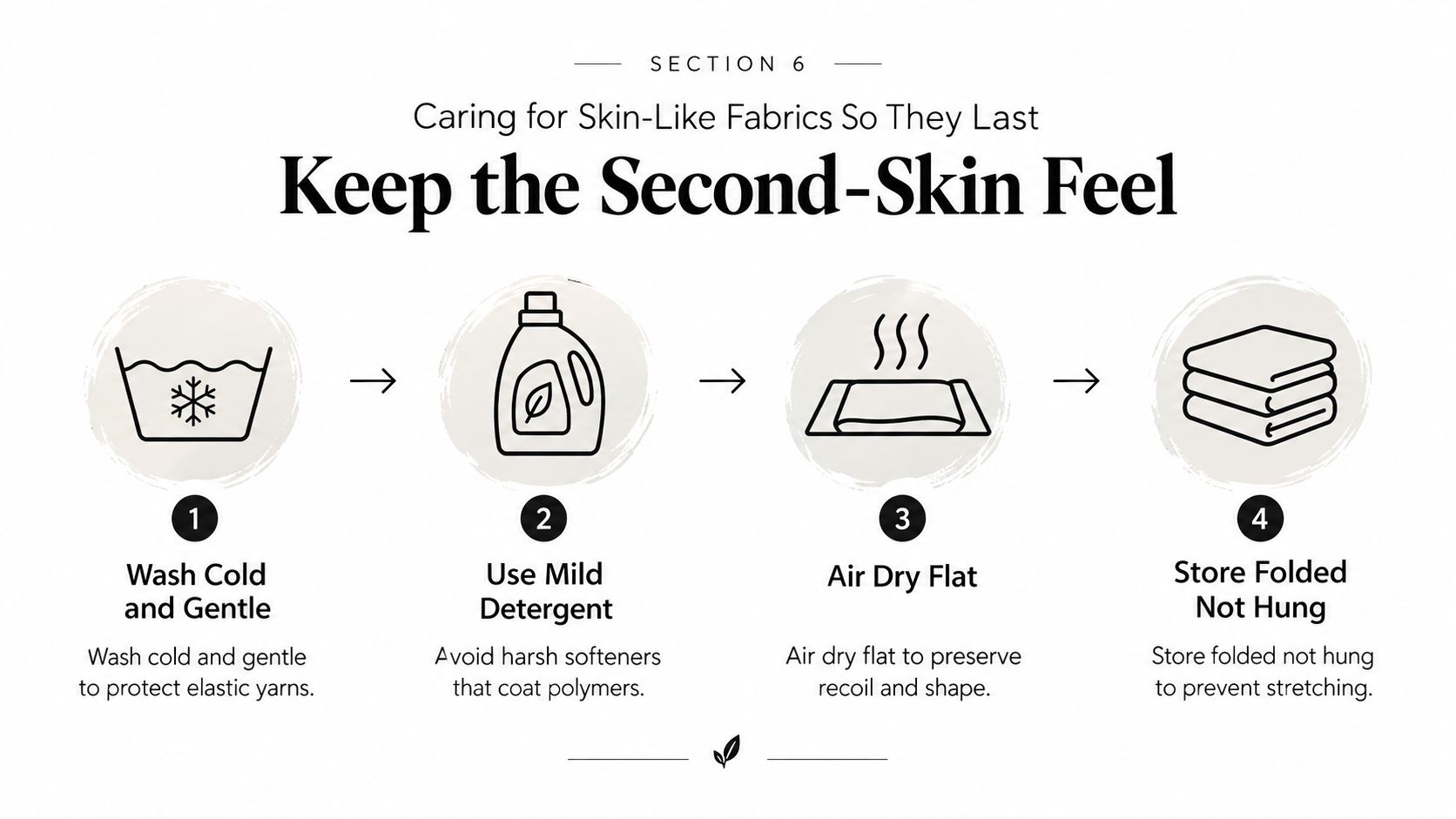
Care isn't separate from the product experience. The polymers and elastic yarns that create a barely-there fit can lose recoil or softness when heat, agitation, and harsh cleaning repeatedly stress them. A bra that once followed your body may start to ride up, sag, or develop rough friction points.
Wash skin-like lingerie in cold water on a gentle cycle, ideally inside a mesh bag. Use a mild, pH-neutral detergent and skip fabric softener. Softener can leave a coating on elastic fibers and alter the clean, responsive hand that made the fabric comfortable in the first place.
Build a gentler rotation
Leaks can make a hot wash tempting, especially during the early weeks. Before reaching for high heat or aggressive chemicals, follow the garment's care label and use a thorough lower-heat wash that suits the material. If you're concerned about hygiene, wash promptly, dry completely, and rotate clean bras rather than repeatedly overheating one favorite.
Air-dry the bra flat or in its natural shape, away from direct heat. Don't wring the cups or stretch the band over a narrow hanger. Store it folded so the elastic isn't left under constant downward tension.
A small rotation helps the fabric recover between wears. It also gives you a practical alternative when one bra is drying or has been soiled. This guide to soft bras for sensitive skin can help you think about fabric softness alongside fit and daily care.
Use the routine as an early warning system. If the textile pills, feels scratchy, loses its return, or begins to curl at the edge, don't wait until the discomfort becomes familiar. Gentle care is the cheapest protection against the return of seams you can feel all day.
A Simple Way to Choose Your Next Bra
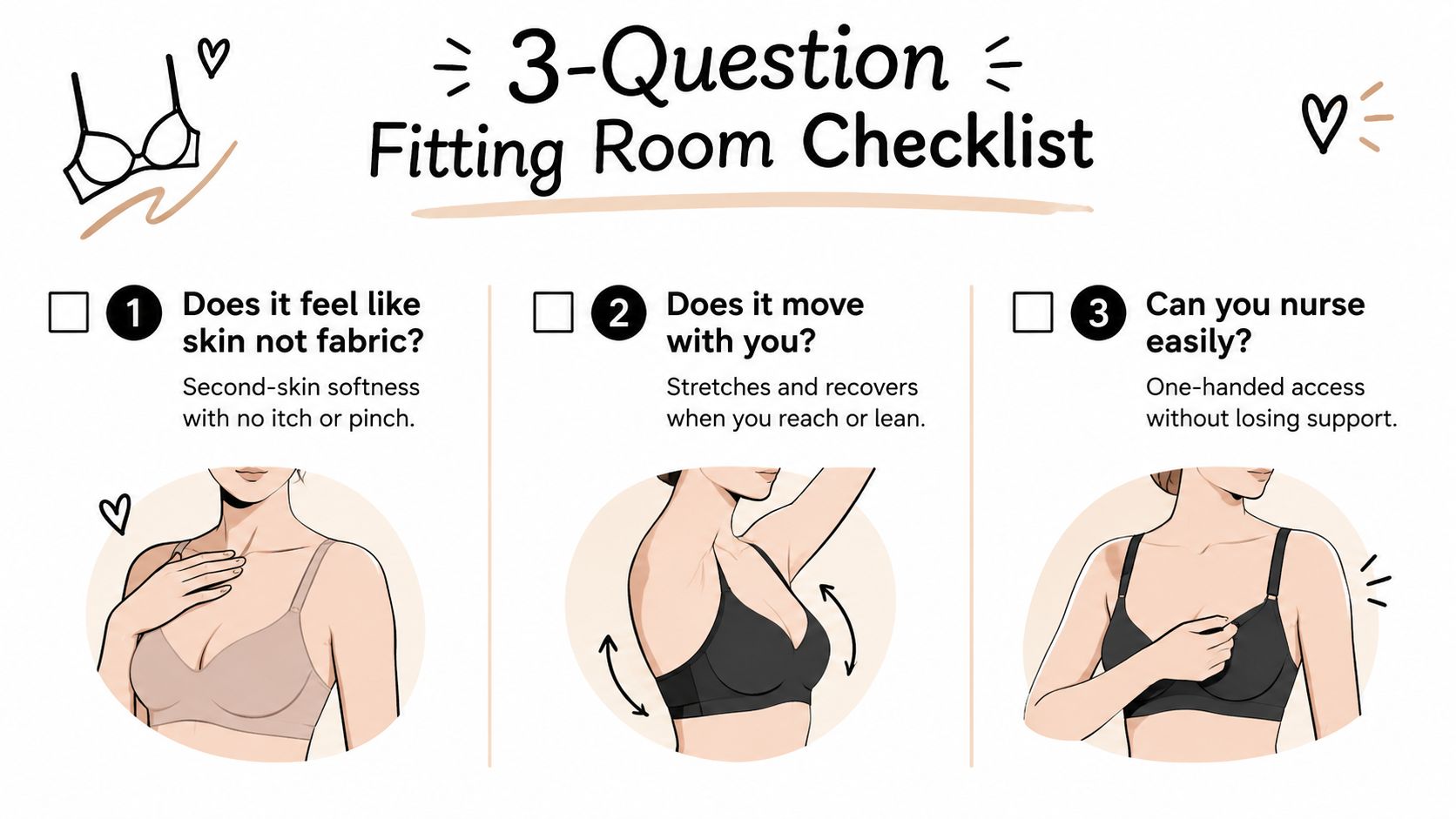
You don't need to memorize textile science to make a better choice. Three questions can guide you in a fitting room, at home, or while scrolling through a product page.
Does it feel like skin when it moves?
Hold the bra against your hand, then stretch the cup and band. Does the surface remain smooth, or does it turn sheer, rough, or tight? Put it on and reach forward, lean, and lift your arms. The fabric should move with you without pinching, riding, or creating a sharp pressure line.
Notice the recovery after movement. A good skin-like construction shouldn't need constant smoothing after each change in posture. If the band rolls or the cup edge stays displaced, the fit or recovery may not suit your body.
Can you nurse without fighting the garment?
Try the nursing mechanism with one hand. You shouldn't have to twist your shoulder, pull hard on the strap, or drag the whole cup sideways to create access. The fabric around the opening should remain supportive instead of collapsing into a loose fold.
Think about changing fullness, too. A nursing bra should have enough flexibility for your body to feel different across a feeding cycle, but not so much looseness that the garment stops anchoring you. The distinction between raw stretch and controlled recovery becomes practical.
Does the label support your routine?
Check the fiber contents, care symbols, and construction details. Is elastane or spandex identified? Does the garment explain how it should be washed? Can you realistically follow those instructions when you're tired, busy, and caring for a baby?
The right bra doesn't erase your changing body. It gives that body fewer problems to solve.
This checklist replaces guesswork with observation. You're checking whether the textile feels quiet, whether the construction supports the feeding reality, and whether the care demands fit your life. A skin-like bra won't make every postpartum day easy, but it can make the end-of-day unhooking ritual feel like a choice instead of a rescue.
Milk&Lace offers maternity and nursing lingerie that combines soft stretch materials, feminine lace, flexible support, and discreet breastfeeding access, including the GAIA and PETRA nursing bra designs. Visit Milk&Lace to explore options that treat postpartum comfort and confidence as part of the same decision.