

The most common advice about pregnancy dressing is wrong. You're told to pick navy or black, buy something loose, and wait until your body feels like yours again. That advice treats visibility as a problem to solve.
Red maternity dresses ask a better question. How much shape do you want to show today, and what construction lets you control that answer? You don't have to hide the bump. You don't have to put it on display, either.
Why Red Belongs on a Changing Body
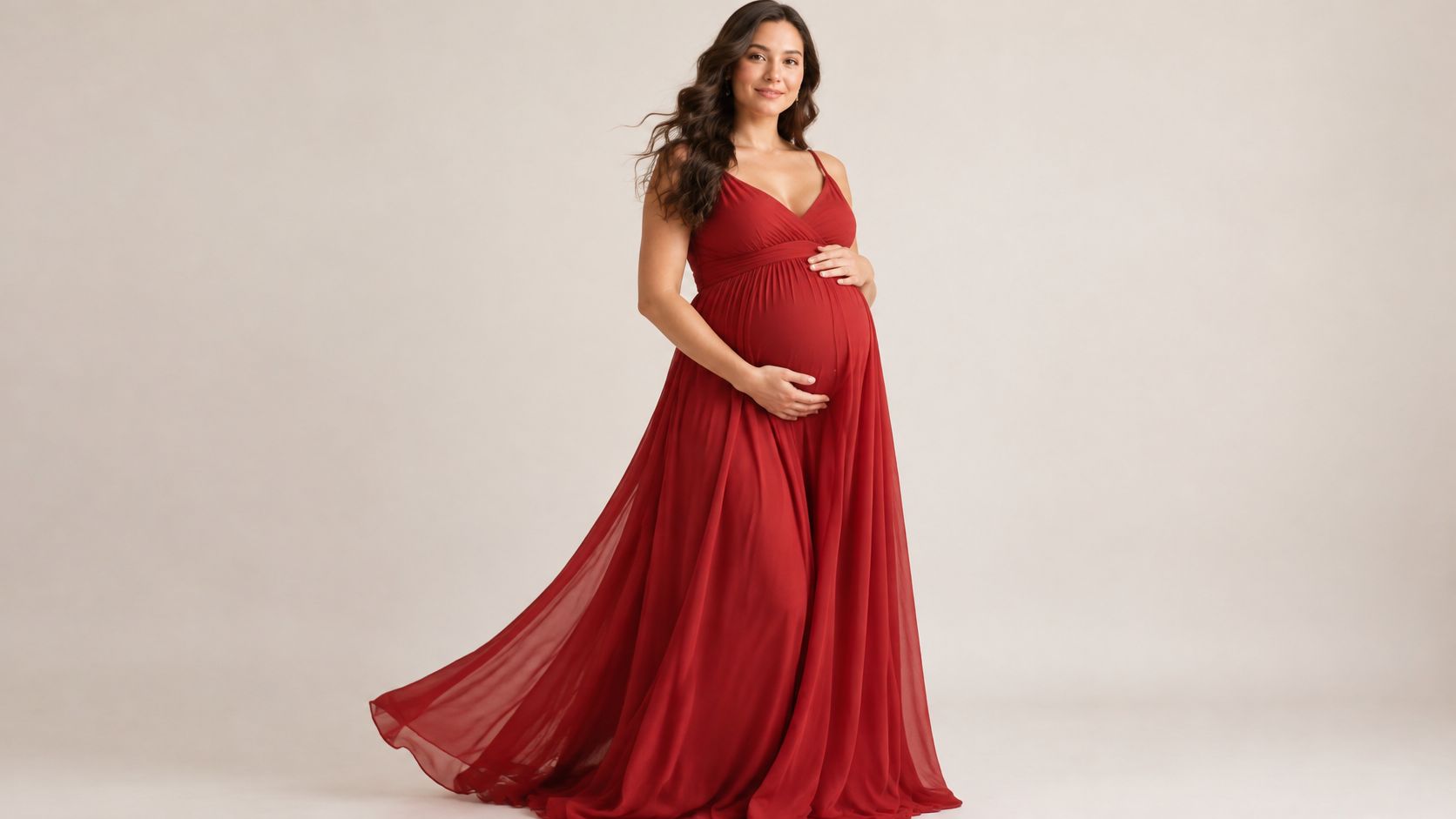
The standard script says a pregnant body should be minimized. Choose dark colors, add volume, and let the dress do the camouflaging. That's a narrow view of what you want from clothes right now.
One study of 137 women in the second or third trimester found that maternity clothing was worn primarily for comfort and assurance rather than camouflage, and that body image influenced appearance management and self-presentation. You're managing how you present yourself. That's not the same as trying to disappear.
Concealment Is Not the Same as Control
Concealment asks a dress to make the bump less noticeable. Control asks a dress to let you decide how defined it looks at a shower, in a portrait, at work, or on a date. Red fits the second goal because it's a deliberate color, tied to confidence and identity rather than only to festive decoration.
That choice comes with practical friction. Red shows bra lines, it can feel hot if the cloth traps air, and an itchy seam gets harder to ignore over a long event. Your bump changes week to week, and your postpartum middle won't be your old waist right away.
- Ruching works like a dimmer: gathered fabric softens or defines the curve without forcing one fixed line.
- Wraps adjust with you: you can loosen the tie after a meal or tighten it when you want more shape.
- A breathable single layer keeps red wearable: you avoid the heavy, embellished, multilayered feel that gets uncomfortable fast.
Wear red when the construction lets you set the terms, not when the dress makes the decision for you.
Start by matching a shape to a real day. A photo can wait until the silhouette earns its place on your calendar.
Match the Silhouette to the Day
Choose your row before you fall for a neckline. Read the chart by the latest month you'll wear the dress, not by the month you're in today, then check occasion and nursing access across that same line.
Red maternity dress silhouettes by stage and occasion
| Silhouette | Best window | Strongest occasion | Nursing access | What it emphasizes |
|---|---|---|---|---|
| Wrap | First trimester through early postpartum | Date night or shower | Tie or crossover front | Adjustable side or front bump |
| Empire | Second and third trimester | Daytime portraits | Usually a separate nursing layer | Bust, with a soft belly |
| A-line | All trimesters | Office or family events | Neckline opening or separate layer | Balanced shape without cling |
| Shirt dress | Second trimester onward | Work or weekends | Real button front if it does not gape | Polished vertical line |
| Ruched jersey | Early pregnancy and postpartum; third if ruched | Close portraits | Pull-aside or built-in clips | Defined bump |
| Ruched maxi | Third trimester | Showers and holidays | Side panel or wrap opening | Controlled volume |
| Fit-and-flare | First, second, and early postpartum | Parties | Zip or nursing-friendly bodice | Waist, then flare |
Three Rules for Using the Chart
Rule one is timing. If you'll wear the dress at a shower at 32 weeks and again two weeks after birth, shop for that full span. A dress that fits beautifully at 20 weeks but pulls at the bust by 30 weeks isn't a smart buy, however good the first try-on felt.
Rule two is adjustability. When your size is still moving, make the wrap your default. Ties and a crossover front expand without asking you to size up and lose shape everywhere else. Shirring and side ruching do similar work when you prefer a closer line.
Rule three is occasion first. Portraits point you toward empire or ruched jersey because both read clearly on camera. A shower points toward a wrap, ruched maxi, or fit-and-flare because you'll sit, eat, stand for photos, and want the skirt to behave through all of it.
Read Across, Not Down
Say your due date falls inside the third trimester window and you plan to nurse. A ruched maxi gives you controlled volume for a shower, but you need to confirm the side panel or wrap opening opens wide enough. An empire dress may photograph softly, yet it usually needs a separate nursing layer under it.
Say you need something for the office from the second trimester onward. A shirt dress gives you a polished vertical line and real buttons, but only if the placket closes without gaping at the bust. An A-line is the safer office pick when you want balance without cling and don't need to pump during the day.
Pick by your latest wearing date: Your future body is the one that has to sit, walk, and feed in this dress.
Once you've picked a row, look closely at how that shape is built. Then measure before you buy, because a good row on paper still fails if the seam lands in the wrong place.
How Each Shape Controls the Bump
Think of construction as plumbing for fabric. Room has to come from somewhere, and each silhouette releases it in a different spot.
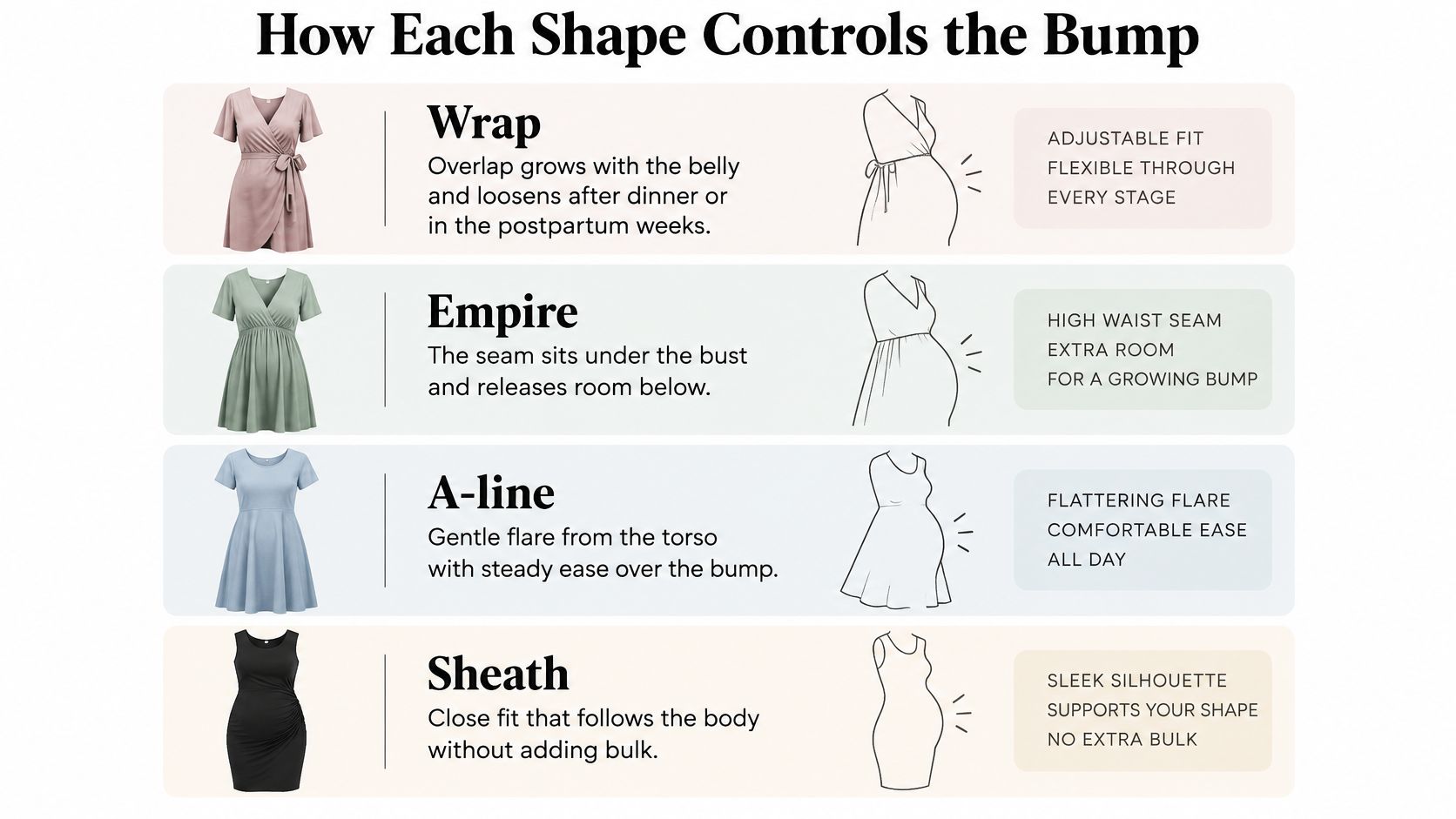
This diagram shows where four common shapes make their room.
Wraps, Empire Lines, and A-Lines
A wrap works like a robe belt. The overlap grows with your belly because the front panels aren't sewn to a fixed circumference. You can loosen it after dinner, tighten it for a photo, and rewrap it lower in the postpartum weeks when your waist sits differently.
An empire line works like a high anchor. The seam sits under the bust, which is usually the narrowest stable point, and the skirt falls from there instead of fighting the widest part of your belly. You get a defined bust and a soft belly because the dress releases room early.
An A-line is a gentle triangle from the shoulder or underbust. It doesn't release room at one dramatic point. It adds ease gradually, so you get shape at the top and steady clearance over the bump without jersey clinging to your hips when you sit.
Maternity construction with fashionable intent isn't new. The Metropolitan Museum of Art identifies an American maternity dress from the 1880s whose design incorporates Watteau box pleats, polonaise-like drapery, and a bustle. Dressmakers have long used structure to manage a changing shape rather than adding loose cloth.
Shirt Dresses, Ruching, and Fit-and-Flare
Watch how button spacing and gathers behave when the body moves, not only when you're standing still.
A shirt dress borrows menswear structure, a collar, a placket, and a straighter torso. It works only if the bust darts and button spacing include maternity room. If the placket gapes at the bust when you reach or sit, the dress fails at once, and no belt will fix it.
Ruching is gathered slack. Horizontal gathers at the sides store extra jersey that unfolds as your belly grows. You can smooth it for a defined line in a portrait or leave more gather for a softer line at dinner, which is why ruched jersey and ruched maxi dresses feel so controllable.
Fit-and-flare needs a defined underbust or high waist to anchor the flare. That anchor turns uncomfortable once your belly sits above the seam and pushes against it. It suits early pregnancy and early postpartum better than the late third trimester.
If a seam crosses the fullest part of your belly or bust and can't stretch, skip the dress, however good the red looks online.
Shades and Fabrics That Stay Wearable
Red isn't one color. It's a family, and each shade does a different job in different light.
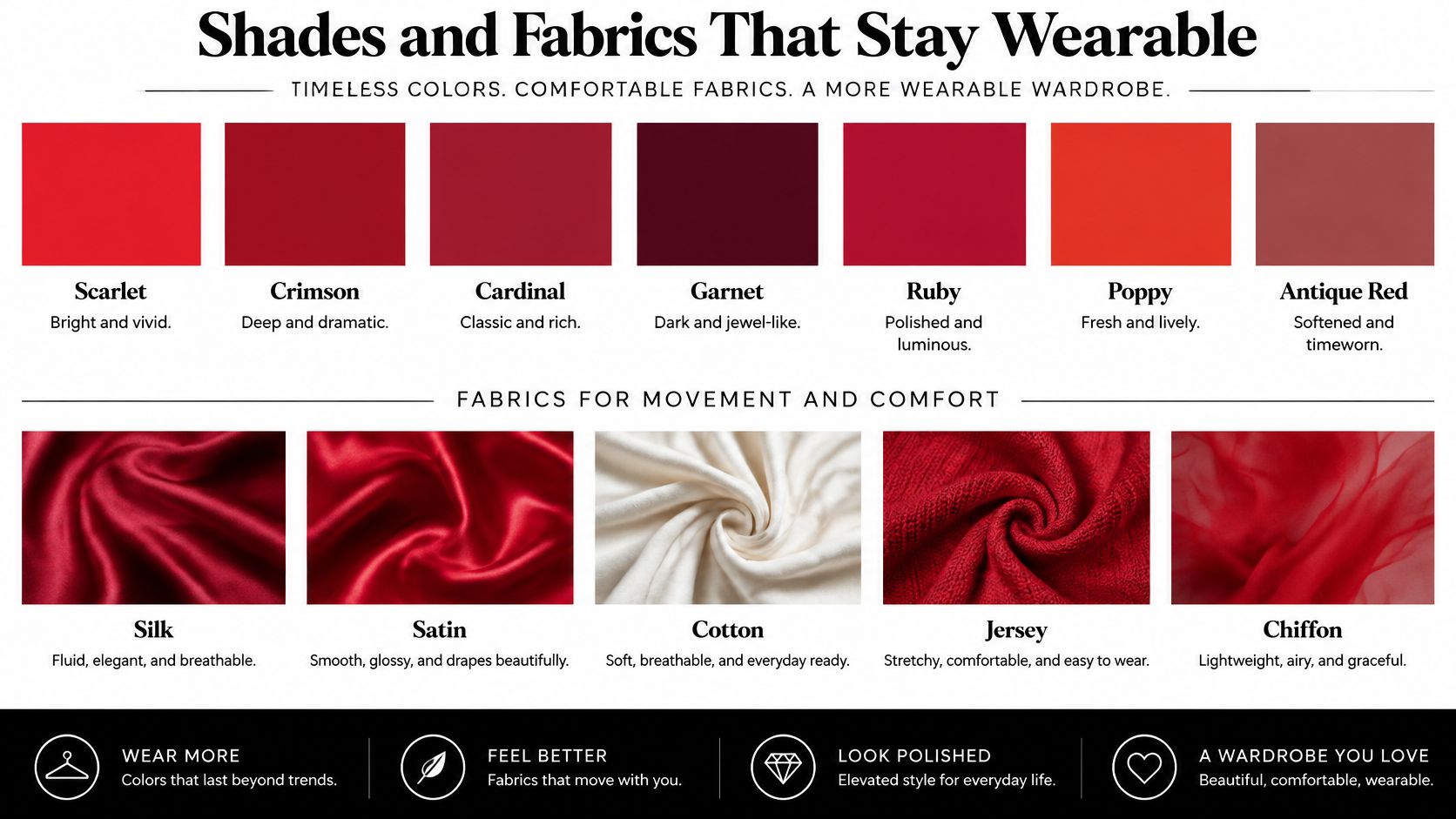
The palette below pairs seven named reds with cloth that can carry them for hours.
Red shades for maternity dresses
| Shade | Character | Best setting | Wear note |
|---|---|---|---|
| Scarlet | Clear bright red | Summer day events | Shows sweat; needs a breathable knit |
| Crimson | Deep blue-red | Evening and portraits | Flatters widely; watch wet dye transfer |
| Cardinal | Rich yellow-red | Holidays | Formal classic; pairs with gold metal |
| Garnet | Dark wine | Office and winter | Hides small marks; reads dressed |
| Ruby | Saturated jewel | Date night | High contrast with lace or skin |
| Poppy | Warm orange-red | Showers and casual days | Cheerful; can fight cool pink undertones |
| Antique red | Muted brown-red | Everyday | Softer and more forgiving if it fades |
These names have history behind them. The Victoria and Albert Museum records that, from the late 1860s through the mid-1870s, women's magazines advised expectant mothers to modify ordinary garments so they could accommodate pregnancy and nursing. In that same era, fashionable reds already included scarlet, crimson, cardinal, garnet, ruby, poppy, and antique red.
Pair the Shade With the Cloth
Skip the skin-tone quiz and pair shade with fabric. Breathable jersey carries scarlet and poppy through a daytime shower without trapping heat. Cotton sateen with stretch gives garnet enough polish for the office, and a soft woven with a stretch panel at the belly keeps crimson comfortable through an evening event.
Avoid stiff embellishment, heavy layers, and shiny synthetics for long wear. Pregnancy raises your sensitivity to warmth, so a single layer with airflow beats a lined fashion fabric at a three-hour party. If you're comparing a brighter option for a special event, our guide to maternity silk dresses covers when a smoother cloth earns the extra care.
Why Red Needs Stricter Care
Saturated dye can crock, or rub off, onto a nursing bra, a car seat, or a pale sofa when the fabric is damp. Perspiration plus friction is the ultimate test, especially under the bust and where a seatbelt crosses. Read the label for wash temperature, note the no bleach instruction, and wash the dress apart from light clothes at first.
After the first laundering, check a hidden seam and the inside of the bodice. If color has lifted unevenly there, it'll show on the front soon. Choose the shade for your light, poppy and scarlet for daylight, garnet and crimson for low evening light, and antique red when you want everyday wear that forgives softening.
Nursing Access That Survives a Real Feed
Feeding is a design test, not a footnote on the product page. A dress that looks nursing friendly on a hanger can fail the first time you're holding a hungry baby with one arm.
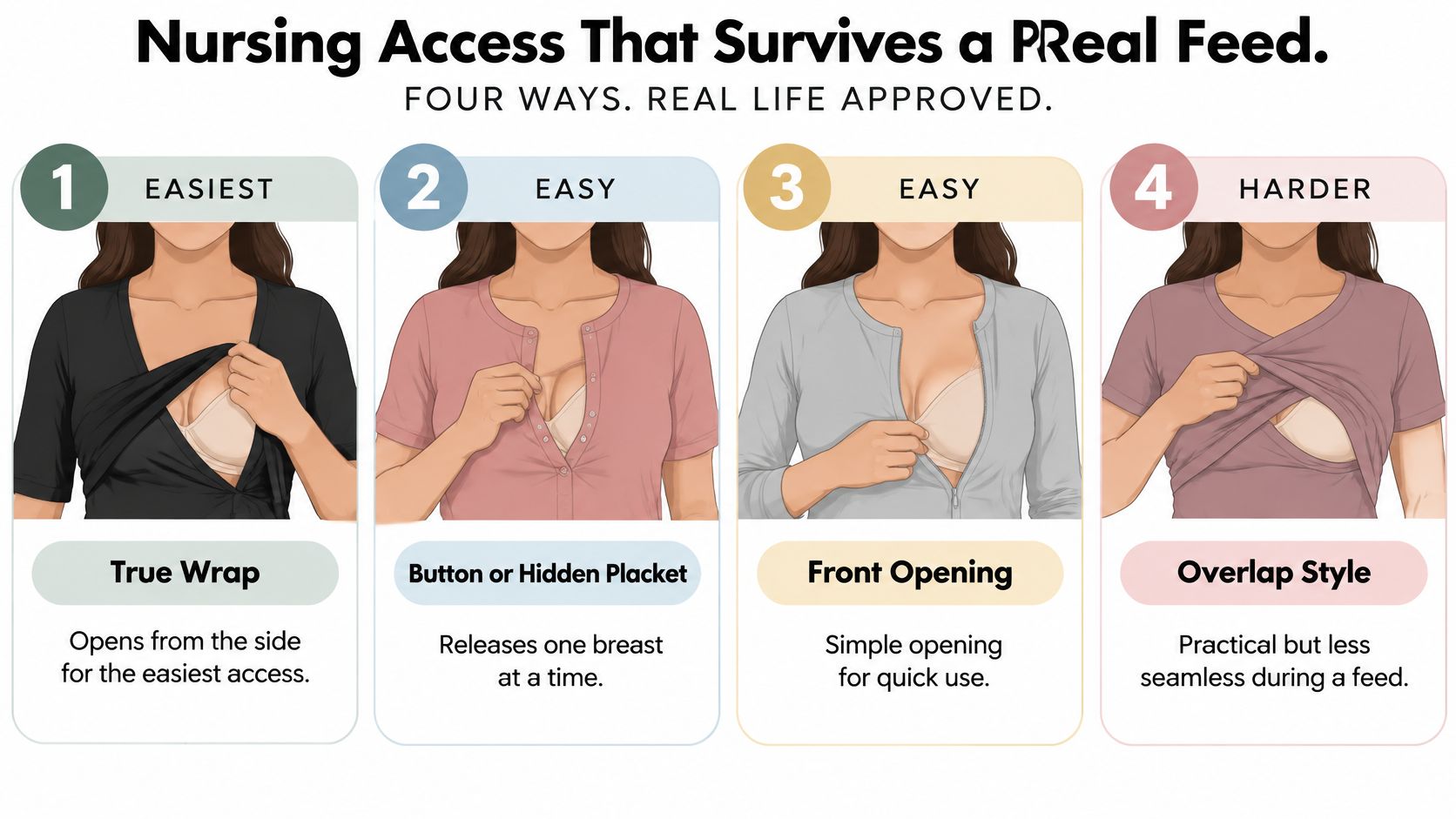
These four access types are ordered from easiest to most awkward in public.
Four Ways a Dress Opens
- True wrap: You untie or loosen the side and open one panel. It's the easiest option because you control how wide it opens and you can reclose it without looking down.
- Button or hidden placket: You release one breast at a time. Confirm the buttons are real, because false buttons sewn over a closed front give you no access at all.
- Stretch neckline or shoulder: You pull the fabric aside. This works in soft jersey, but a neckline that stretches too far can gape and show the whole bra when you lean forward.
- No opening: The dress must come off or lift over a nursing layer. That's fine at home and miserable in a restaurant.
A lined bodice can bunch at the nipple and block a latch, even when the outer layer opens well. A back zip you can't reach one-handed is another quiet failure. For a wider set of cuts built around feeding, see our roundup of the best nursing friendly dresses.
The Two-Layer Method and Pumping
Empire and fit-and-flare dresses often work best as the top layer. Your soft nursing bra stays on, the dress lifts or opens above it, and the bra clip does the actual release. A bra like GAIA, described as a soft, elegant nursing bra with stretch lace, flexible support, and effortless breastfeeding access, fits that role because the clip, not the dress fabric, does the work.
Pumping raises the bar. A dress that only works when fully removed is a poor office choice. A button-front shirt dress or a wrap over a clip bra lets you use a pump without undressing in a bathroom stall.
Watch the contact point, too. Red dye against a damp nursing pad is a reason to prefer a colorfast lining or a bra that covers where the pad sits.
One-minute home test: Sit down, unclip with one hand, mime a feed, re-cover, and check that the red panel returns without a gap at the sternum.
If that sequence needs a mirror and both hands, choose another cut. You won't have either to spare during a real feed.
Fit Rules for a Body That Keeps Changing
Measuring takes five minutes and saves you a return. Use a soft tape, stand normally, and wear the bra you'll wear under the dress.
Measure in This Order
- Bust: Measure at the fullest point, keeping the tape level across your back.
- Underbust: Measure snugly where the bra band sits, since empire and wrap bodices anchor here.
- Belly: Measure at the current fullest point, then again a little higher where it'll sit in later weeks.
- Hips: Measure at the fullest point so an A-line or fit-and-flare skirt has enough clearance when you sit.
- Compare: Match those numbers to the brand's maternity chart, not a standard dress chart.
Buy for the latest month you plan to wear the dress. Prefer ties, shirring, or a stretch belly panel over a fixed waist, because a fixed waist gives you one correct week and several uncomfortable ones.
If your bust and hips fall into different columns, buy for the bust. Let the hips and belly take extra volume only where the cut allows it, through ties, shirring, or a stretch panel. A skirt that's a little full still works. A bodice that compresses your bust doesn't.
What Comfort Testing Tells You
A wear trial of eight maternity support garments found that thermophysiological comfort was driven mainly by fiber content and breathability, while movement comfort depended on garment type and style features. It also found a strong association between non-itchiness and the absence of red marks (r = 0.78). That trial tested support garments, not dresses, so use the finding to guide your seam checks rather than reading it as a dress-specific result.
Translate it into three checks. There's no rigid seam across your bust or belly. The elastic doesn't dig after you've sat for a while. The knit recovers instead of bagging at the seat when you stand.
Run a twenty-minute home trial. Sit at a table, walk around, lift your arms as if you're reaching into a car seat, and sit again. If red pressure lines appear on your skin, the size or the cut is wrong, even if the mirror liked it.
Postpartum fit has one trap. A dress with an adjustable waist can work early after birth, but a belly panel that only stretches forward may hang once the bump drops. Keep the receipt and use an exchange if your bust grows faster than your hips.
Choose the Dress and the Layer Under It
Lock four choices in order and stop second-guessing. First, the occasion. Second, how much bump you want to show. Third, the nursing access you tested one-handed. Fourth, the size for your latest month of wear.
Three Outfits That Use the Rules
For a baby shower where you'll sit, eat, and possibly feed, choose a crimson wrap with simple heels. You can loosen the tie after lunch and open one panel without leaving the table. On a cooler day, a layer from our guide to maternity cardigan sweaters keeps the wrap front accessible.
For a work day that includes a pump, choose a garnet A-line or a shirt dress with flats. Garnet reads dressed, hides small marks, and doesn't cling through meetings. Confirm the buttons or neckline open far enough for pump flanges before the day arrives.
For maternity portraits or a date, choose a ruby ruched jersey. The gathers define the bump on camera and store room for sitting through dinner. Check that the seams leave no marks after your home trial, because a close portrait shows pressure lines at the armhole and underbust.
What Shows Under Red
A plain nursing bra can outline at the neckline and dull the point of a special color. Choose a bra whose edge sits inside the dress opening and whose clips release with one hand. We sell the Gaia Lace Nursing Bra with Gentle Underwire, and one customer, Maggie, put the practical test plainly, "The fabric has a nice stretch, and the nursing clips are easy to use with one hand."
That detail matches why we make these pieces. Our philosophy is that motherhood doesn't replace women but adds to and enhances them, so the layer under a red dress should feel like yours, not like medical equipment. Before the event, confirm your bust measurement, run the one-handed clip test, read the wash instructions, and check the exchange window.
Then wear the red as a choice you can move in. You've picked the shade, the shape, and the amount of definition. The dress is doing its job.
You don't have to choose between feeding access and feeling like yourself in a red dress. At Milk&Lace, we make maternity and nursing lingerie with soft lace, flexible support, and clips you can release with one hand, so the layer under your dress works as deliberately as the dress itself. Visit us to find the nursing bra that sits cleanly under your wrap, empire, or ruched neckline and keeps up with the day you've planned.