

You're standing in a fitting room late in pregnancy, holding two bras that look almost identical. One is labeled maternity, the other nursing. Your ribcage feels different, your breasts have changed again, and you're wondering whether buying one now means buying another after birth.
The question behind maternity bra vs nursing bra is rarely just about labels. It's about comfort today, feeding access later, changing proportions, and whether one thoughtful purchase can carry you through more than one stage. The right answer depends on how your body feels, how soon you expect to breastfeed, how much structure you prefer, and whether you want a temporary comfort piece or a longer-use wardrobe essential.
Maternity bras and nursing bras overlap, but they aren't identical. One focuses primarily on adapting to pregnancy. The other adds breastfeeding functionality while often preserving the flexibility needed during late pregnancy. Once you understand that difference, the choice becomes far less confusing.
Introduction Finding Comfort and Confidence Through Change
A first-time mother often begins shopping for a new bra after a familiar pattern stops working. The band rides up, the straps dig in, or the cups feel full by midday even though the bra fit comfortably before pregnancy. By the third trimester, the decision can feel surprisingly emotional. You want relief from pressure and sensitivity, but you also want something that still feels like you.
That's why the maternity bra versus nursing bra decision deserves more than a simple “buy this during pregnancy, then switch later” answer. Pregnancy and postpartum aren't isolated moments. They're connected stages, and your lingerie can either support that transition or force you into unnecessary replacement shopping.
A maternity bra usually prioritizes softness, stretch, and room for a changing ribcage. A nursing bra includes those qualities in many designs, then adds a way to expose the breast for feeding. Some nursing bras use drop-down cups. Others use pull-aside construction. The important point is that breastfeeding access changes the bra's function, not necessarily its suitability for pregnancy.
The practical question: Are you choosing a bra for a short stage, or are you building a small wardrobe that can follow your body through several stages?
This guide looks at the difference through that lifecycle lens. You'll see how the two styles differ in construction, support, access, fit, care, and everyday use. You'll also learn why the softest early-postpartum bra may not be the bra you want months later, when you're ready for more shape, lift, and confidence.
By the end, you should be able to decide whether a maternity bra is enough, whether a nursing bra makes more sense now, or whether you need both for different moments. You'll also have a clearer way to judge underwire, flexible sizing, and later-postpartum styles without treating comfort and femininity as opposites.
What Each Bra Is Really Made For
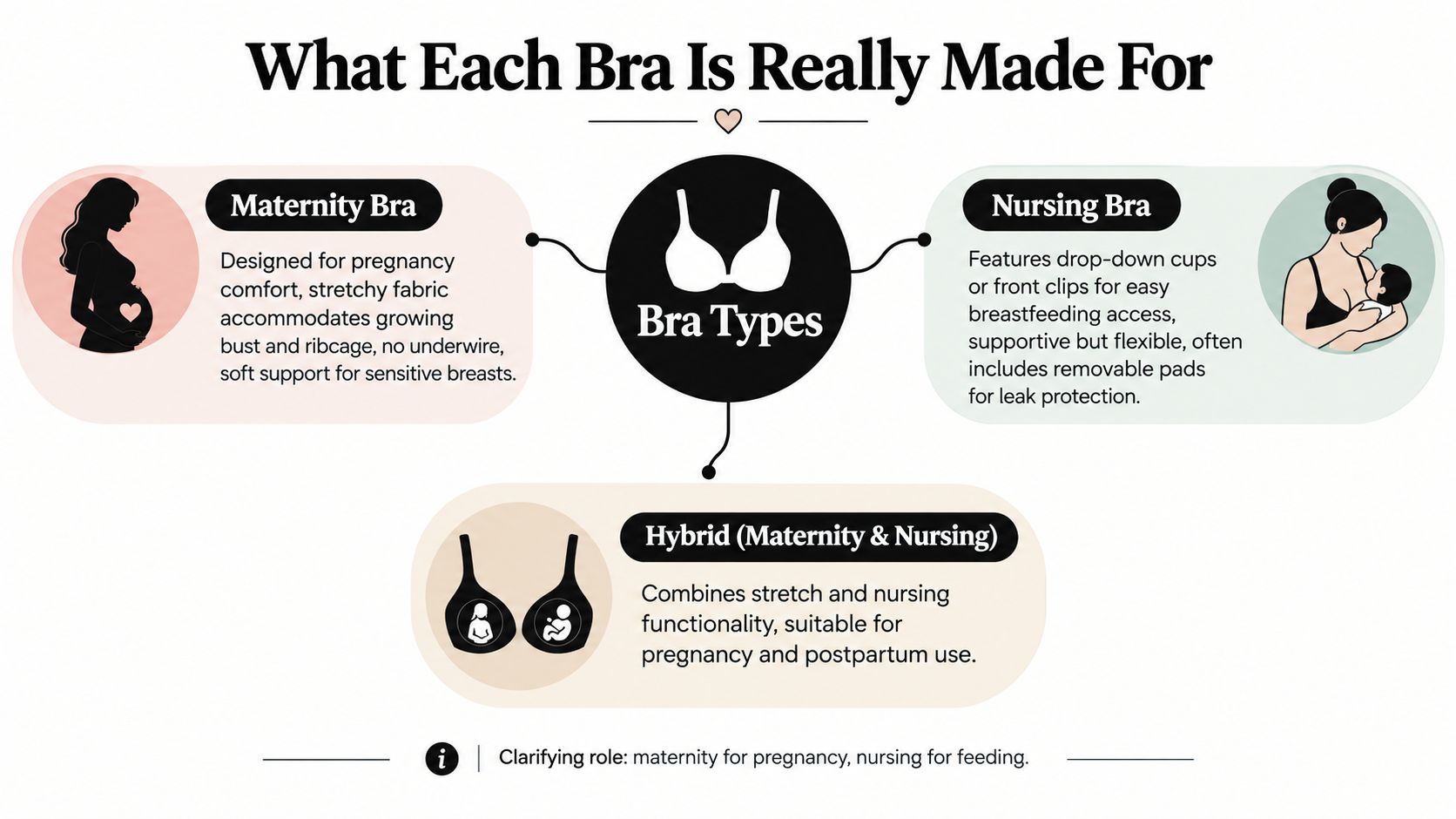
A maternity bra is designed primarily for pregnancy. Its fabric usually has enough stretch to accommodate a fuller bust and changing ribcage, while its construction reduces pressure on sensitive breasts. Many maternity styles are wire-free or made with flexible panels rather than rigid molded cups.
A maternity bra is useful when your immediate priority is comfort. It can be especially appealing during periods of tenderness, when firm wires, stiff seams, or strongly shaped cups feel distracting. Its main job is to give your body space to change while maintaining a stable, gentle fit.
A nursing bra is designed for breastfeeding access. The cups may drop down with a clip, fold aside, or open through another nursing-specific mechanism. It often retains pregnancy-friendly details such as stretch fabric, adjustable bands, and flexible support, but adds a practical way to feed without removing the whole bra.
This distinction is also historical. Mary Phelps Jacob received the first U.S. bra patent in 1913, while the first patent specifically for a “nursing brassiere” was granted to Albert A. Glasser in 1943, showing that nursing bras developed later as a specialized postpartum solution. Earlier innovations, including Maidenform's cups in 1933 and broader adoption of cup sizing by 1949, helped make bras more structured and adaptable for changing bodies. The history of nursing bras places the category's later growth within the post-World War II baby boom, when demand expanded alongside a major demographic shift.
The lifespan difference
Think of the two categories as overlapping circles rather than opposite choices.
- Maternity bra: Primarily pregnancy-focused, with comfort and expansion as its central purpose.
- Nursing bra: Pregnancy-friendly in many designs, with added breastfeeding access and a longer potential use window.
- Hybrid bra: Combines stretch, adjustability, and nursing access for people who want one adaptable option.
An independent guide describes nursing bras as commonly suitable for both pregnancy and postpartum use, while maternity bras are more often intended for pregnancy alone. You can also explore what a maternity bra is if you want a closer look at the pregnancy-focused category.
For a soft, elegant nursing option with stretch lace, flexible support, and breastfeeding access, GAIA fits the nursing category rather than the maternity-only category.
The most useful takeaway is simple: a maternity bra answers, “How can I feel comfortable while my body grows?” A nursing bra answers, “How can I stay comfortable while also feeding easily?” If you're already close to birth and expect to breastfeed, the second question may be the one you need to solve.
How They Differ in Support Access and Feel
The biggest functional difference is access, but the meaningful comparison goes deeper. A nursing bra must open without losing the support that holds the breast in place. A maternity bra can focus almost entirely on comfort and expansion because it doesn't need to create a feeding opening.
A maternity style often uses soft stretch fabric, a broad underband, and a wire-free shape. It may feel forgiving when your size shifts during the day. That flexibility can be welcome during pregnancy, particularly when a firm cup feels too restrictive.
A more structured nursing bra may use a supportive lower cup and a flexible upper cup. The lower section carries more of the weight, while the upper area allows room for changes in fullness. Wider straps, multi-hook backs, double-layer wings, and reinforced panels can distribute pressure more evenly.
Construction side by side
| Feature | Maternity Bra | Nursing Bra |
|---|---|---|
| Primary purpose | Pregnancy comfort and adaptability | Breastfeeding access with adaptable support |
| Cup design | Stretch-first, often soft or seamless | Supportive lower cup with flexible upper area |
| Breastfeeding access | Usually none | Drop-down cup or pull-aside mechanism |
| Underwire approach | Often wire-free | Wire-free, flexible-wire, or structured depending on design |
| Back adjustment | Adjustable band to accommodate growth | Adjustable band for pregnancy and postpartum changes |
| Support details | Soft support with room to expand | Lower-cup support, sling construction, wider bands, and reinforced wings |
| Best use window | Primarily pregnancy | Late pregnancy through breastfeeding, depending on fit and design |
A nursing sling is more than a decorative layer. It helps stabilize the breast when the outer cup opens for feeding, so the bra doesn't become loose or shift at the moment you need access. Higher-spec designs may also use double-layer back wings and wide elastic underbands to create a steadier base.
The key differentiator: Maternity design gives your body room. Nursing design gives your body room plus a feeding route.
Why feel can change with the design
A soft maternity bra may feel almost weightless, but that doesn't mean it's the right choice for every activity. A fuller bust, a long day, or a desire for more lift may call for firmer lower-cup construction. Conversely, a structured nursing bra can feel too present during early tenderness if the fabric, wire, or cup shape doesn't suit you.
Access also affects the experience of getting dressed. A drop-down cup is useful when you're holding a baby and need to work with one hand. A pull-aside style can feel less technical, but it must still hold the breast securely when the cup moves.
Your clothes matter too. A maternity bra may disappear beneath a T-shirt. A lace nursing bra may give you a more defined shape under a blouse or dress. Neither is automatically better. The right option matches the support and silhouette you want from that particular stage.
Fit and Sizing Through Pregnancy and Postpartum
A bra can have excellent construction and still feel wrong if the size no longer matches your body. During pregnancy, both the ribcage and breast volume can change. After birth, the band may feel different as the ribcage settles, while cup fullness can shift with feeding, pumping, and the time since the last feed.
Measure when you're calm and your breasts feel relatively full, rather than judging the size from a single uncomfortable moment. A measurement gives you a starting point, not a permanent verdict. Your body may need another adjustment, and that's normal.
What to check in the fitting room
Start with the band. It should sit level around your body, feel secure without creating sharp pressure, and offer room to tighten or loosen through the hooks. If you're buying late in pregnancy, an adjustable band gives you more flexibility as your ribcage changes after birth.
Next, check the cups. Breast tissue should sit fully inside the cup without spilling at the top or sides. At the same time, the cup shouldn't collapse, wrinkle, or leave a large empty area. Stretch can accommodate some fluctuation, but it can't correct an unsuitable shape.
Then test the straps and nursing mechanism:
- Band: It should support the bra from the torso rather than relying on the straps.
- Straps: They should stay in place without digging into your shoulders.
- Hooks: Multiple positions help you respond to changes instead of replacing the bra immediately.
- Clips: Open and close them with one hand before buying.
- Lower cup: It should feel stable, especially when the cup is open.
- Upper cup: Some give is useful when fullness changes across the day.
A study of maternity and nursing sports bras found that only 15% of purchasers found exactly what they wanted, with complaints focused mainly on support, design, and fit, as reported in this industry research on nursing and maternity bras. That finding supports a practical lesson: don't judge a bra only while standing still. Raise your arms, sit down, bend slightly, and test the closure.
When to re-measure
Many people find the third trimester a useful time to buy an initial nursing bra because the body may be closer to its early postpartum proportions than it was earlier in pregnancy. That doesn't guarantee an exact future fit. Milk-related changes can still make the cup feel different, especially during the early weeks.
Choose retailers with clear size-exchange policies when possible. Keep tags attached until you've tried the bra under clothing, checked the band on its loosest setting, and tested the nursing clips. You're not failing at sizing if you exchange it. You're responding intelligently to a body that's still changing.
For a more detailed fitting process, use this guide on how to measure for a nursing bra. The goal isn't to force your body into a fixed number. It's to find a supportive starting point that can adapt with you.
Choosing the Right Bra for Your Stage and Lifestyle
The most useful choice depends on what your day looks like. A person who needs sleep comfort has a different requirement from someone who wants discreet pumping access at work. A person in early pregnancy may value softness above all else, while someone months into breastfeeding may want lift, shape, and a bra that feels like lingerie again.
Match the bra to the moment
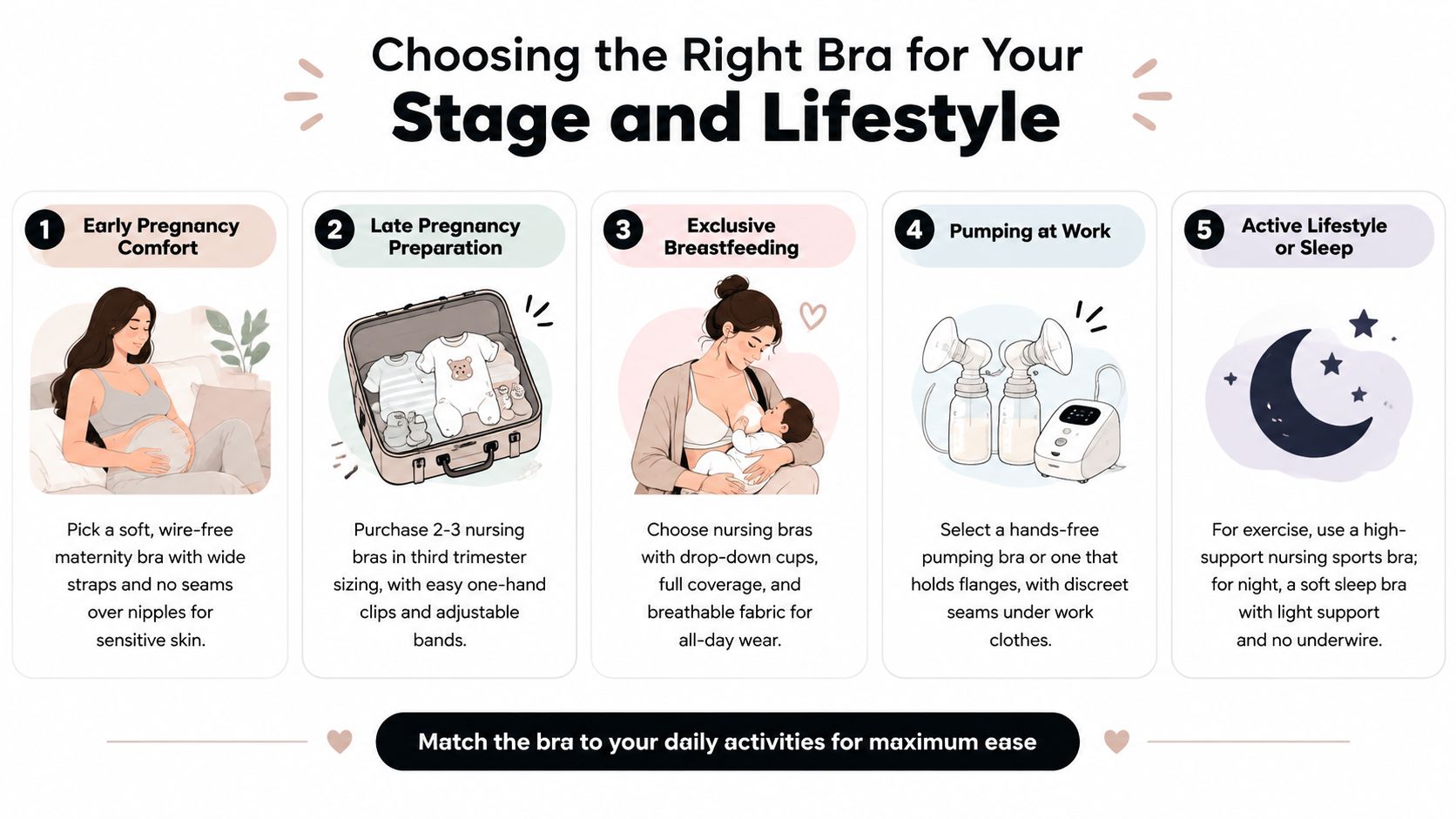
Early pregnancy comfort often points toward a wire-free maternity bra. Look for soft fabric, broad straps, smooth seams, and enough stretch to avoid pressing on sensitive areas. If breastfeeding is still a distant possibility in your planning, you don't need to prioritize nursing clips yet.
Late pregnancy preparation is where the one-bra strategy becomes realistic. If you expect to breastfeed and want to reduce duplicate purchases, choose a nursing bra with stretch, adjustable hooks, comfortable access, and enough support for your current size. Independent guidance notes that nursing bras can work during pregnancy because the clips stay closed while the fabric accommodates change, and they're often purchased around the third trimester when sizing is closer to postpartum proportions. Read the guidance on maternity and nursing bras for that broader lifecycle perspective.
Early breastfeeding usually makes access the priority. A full-coverage nursing bra with a stable lower cup and soft interior can simplify repeated feeds. If your breasts feel especially changeable, stretch and adjustability may be more useful than molded shape.
Pumping at work requires a different kind of engineering. A pumping bra needs to hold flanges securely or work with a hands-free setup, while remaining discreet beneath clothing. A standard nursing bra may not meet that need, even if its drop-down cups are easy to use for direct feeding.
Exercise and sleep deserve separate solutions. A nursing sports bra needs enough stability for movement, while a sleep bra should prioritize softness, breathability, and light support. Using one bra for every activity can leave you compromising in all of them.
A simple decision filter
Ask yourself:
- Do I need breastfeeding access soon? If yes, a nursing bra may serve more than one stage.
- Is tenderness my main concern? Start with a soft, wire-free maternity or nursing design.
- Do I want to buy once for late pregnancy and early breastfeeding? Choose a nursing style with meaningful stretch and adjustability.
- Do I need shape beneath clothing? Look for supportive lower cups and a stable band.
- Am I later postpartum and ready for more structure? Consider a nursing bra that combines flexible support with a refined silhouette.
A nursing bra isn't automatically the only purchase you'll need. It can, however, become the default choice when lifecycle planning matters more than strict category labels. You might still add a sleep bra, sports bra, or later structured style, but your main everyday bra can cover a wider window.
Care Underwire and Comfort in Later Postpartum
A well-fitting bra lasts longer when you treat its elastic and lace gently. Fasten the hooks before washing, use a lingerie bag, choose a mild detergent, and avoid high heat when the care label permits. Heat and aggressive washing can weaken stretch fibers, distort nursing clips, and reduce the recovery that makes an adaptable bra useful.
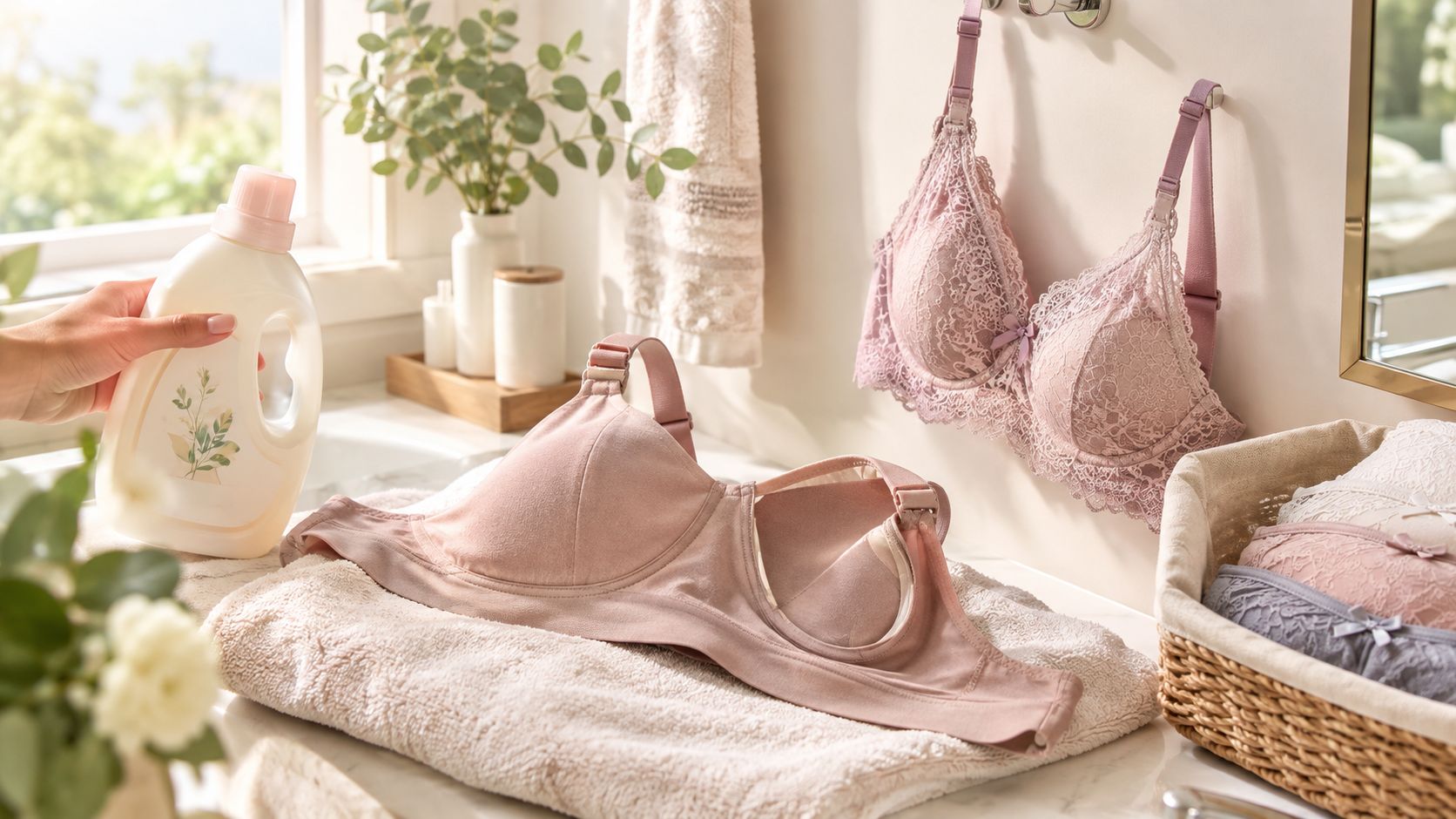
Rotation also helps. Giving a bra time between wears allows dampness to evaporate and reduces constant stress on the same band and straps. Keep lace away from rough fasteners, and reshape cups while the bra is damp instead of twisting or wringing them.
The underwire question needs more nuance than a universal ban. WebMD and lactation-focused commentary acknowledge the common concern that an underwire could restrict milk ducts, but the available support for a blanket claim that underwire itself causes breastfeeding problems is weak and largely anecdotal. Recent consumer guidance also focuses more on pressure, poor fit, and discomfort than on the mere presence of wire, and notes that underwire isn't linked to cancer risk, as discussed in guidance about bras during pregnancy.
Comfort rule: The issue isn't whether a wire sounds structured. The issue is whether it presses, pinches, shifts, or leaves you uncomfortable.
If a wire sits on breast tissue, digs into the underarm, creates a hard pressure point, or leaves a persistent mark, stop wearing that bra and reassess the size or style. If you notice concerning breast symptoms, contact a qualified healthcare professional or lactation specialist rather than trying to solve the problem through lingerie alone.
Later postpartum, your needs may change. You may still want easy access, but you might also want a smoother silhouette, a defined neckline, or gentle lift under everyday clothes. A flexible underwire can provide structure without requiring the rigid feel of a traditional fashion bra. You can also review this practical guide to a supportive underwire nursing bra.
Here's a visual guide to handling delicate nursing lingerie in everyday use:
Softness remains valuable, but softness doesn't have to mean shapelessness. As sensitivity settles and your routine expands, comfort may include feeling polished, supported, and recognizable to yourself.
Your Confident Choice and How Milk and Lace Fits In
Choose a maternity-only bra when pregnancy comfort is your immediate need and breastfeeding access isn't part of your current plan. Choose a nursing bra when you want clips or pull-aside access, expect to breastfeed, and prefer a style that may serve from late pregnancy into postpartum. Choose both when your body or lifestyle calls for different experiences, such as a bra for sleep and a more supportive cup for daytime.
The one-bra strategy makes the most sense in late pregnancy when you want to simplify your wardrobe. Select a nursing design with stretch, adjustable closure positions, a stable band, and an access system you can operate easily. Remember that one bra can be versatile without being suitable for every activity or every phase.
Later postpartum often brings a new question: can your bra support feeding while also helping you feel composed and feminine? Milk&Lace's PETRA is described as a nursing bra with ultra-soft stretch lace, gentle underwire, and one-hand nursing access. The brand positions it, along with GAIA, for later postpartum use, when flexible structure, a soft second-skin feel, and discreet access matter alongside comfort.
You don't have to choose between being cared for and feeling like yourself. The right bra can acknowledge tenderness, changing proportions, feeding needs, and the part of you that still wants beautiful, intentional design.
Explore Milk&Lace's nursing lingerie when you're ready to plan beyond basic coverage, whether you need adaptable access during breastfeeding or more structured confidence later postpartum. Visit Milk&Lace to find a style that respects both your changing body and the woman you're continuing to become.