

You're halfway through folding laundry when you bend to lift the basket, and your breasts feel heavier than they did before pregnancy. The band of your old bra has stretched, the straps are doing too much work, and the thought of putting an underwire against tender tissue brings mixed feelings. You want the lift and stability, but you don't want pinching, pressure, or a bra that makes nursing harder.
That uncertainty makes sense. A support underwire bra isn't automatically the right answer for every postpartum day, and wireless isn't automatically the gentler or more practical choice. The useful question is more specific: how do the wire geometry, band tension, cup shape, and nursing features work with your body right now?
When Support Becomes More Than Comfort
Postpartum support changes as your breasts change. Fuller volume, feeding cycles, engorgement, sensitive skin, and a shifting ribcage can make a previously reliable bra feel strangely unstable. A band that once anchored your bust may ride up, while straps pull harder on your shoulders because the lower frame no longer carries its share of the load.
Many mothers reach for wireless bras first, and that can be a sensible choice during periods of tenderness or swelling. Yet there may come a point when you want more than softness. You may want clearer separation under a blouse, better control while commuting or working, or a structured base that keeps breast movement from becoming a constant distraction.
Research on bra biomechanics describes the underwire as part of a load-sharing system. It can lift the breasts, redirect movement forces toward the underband, and reduce vertical displacement when the wire's rigidity and shape are appropriate. A separate study also found a decreasing trend in breast displacement, perceived movement, and discomfort as underwire rigidity increased, with the strongest benefit depending on how the wire interacted with the body's shape. You can read the research on underwire rigidity and breast biomechanics for the technical detail.
The practical question isn't whether underwire is good or bad. It's whether the bra's structure matches the tissue, movement, and daily demands you're experiencing.
The following guide treats underwire as an engineering decision rather than a comfort-versus-support argument. You'll learn how the load travels through a bra, when wireless designs may serve you better, how to check fit while your measurements fluctuate, and which nursing details make structured support easier to live with.
How an Underwire Bra Supports You
A well-fitted bra functions much like a small suspension bridge. The underwire traces the breast root, forming a curved support beneath the breast. The underband forms the structural base, wrapping around the ribcage and maintaining tension. Straps guide the cups upward, but they should not carry the breasts' full weight.
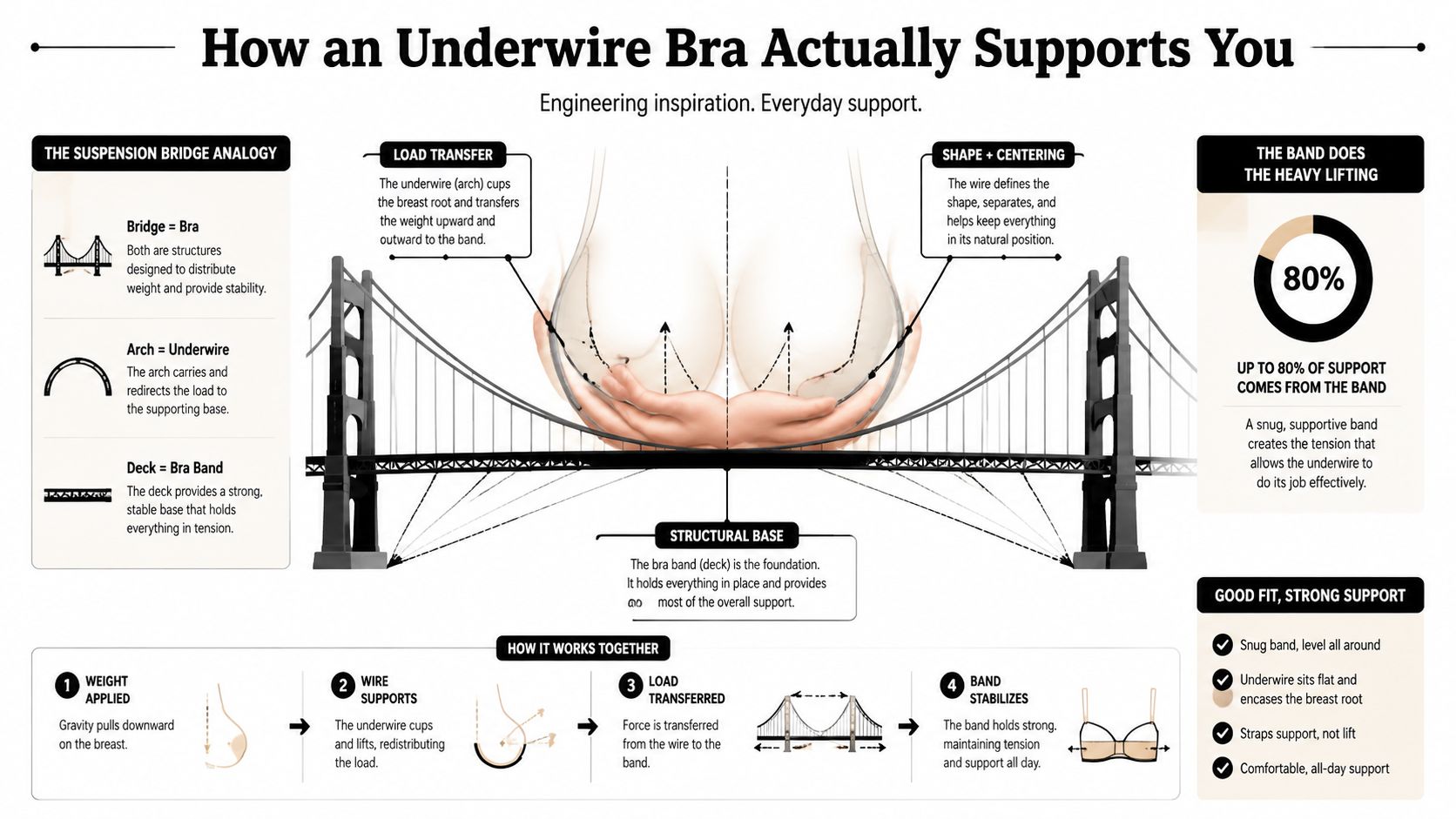
The load path is straightforward:
- The cups contain and shape the breast tissue. They support the breasts from below and the sides, limiting movement that would otherwise pull the tissue forward.
- The wire follows the inframammary fold. This natural crease marks where the breast meets the chest. When the wire sits around that root, it supports the breast without pressing directly on breast tissue.
- The band receives the transferred force. Tension moves from the wire and cups into the band, then around the torso. A stable band therefore matters more than tightening the straps aggressively.
- The straps fine-tune position. They provide upward guidance. If they dig into the shoulders, the band or cups may not be distributing the load well.
Wire comfort depends largely on geometry. A rigid wire with a narrow or poorly matched curve can press into tissue, particularly when postpartum fullness has changed the breast root. A flexible, contoured wire can follow the fold more naturally and spread pressure across a broader area.
A support underwire bra works through several parts at once. Band tension, wire shape, cup depth, side coverage, and strap angle affect how the bra performs during movement. A strong wire cannot compensate for a loose band, while a firm band cannot make an undersized cup comfortable.
For example, GAIA combines stretch lace, flexible support, and breastfeeding access in a nursing design. Its construction reflects the wider principle: structure and softness can work together when the components suit one another.
Underwire Versus Wireless for Postpartum Bodies
Postpartum breast volume doesn't stay constant. A breast may feel relatively soft at one point in the day and much fuller later, so the best bra can depend on feeding patterns, tenderness, activity, and how long you'll be wearing it.
Wireless designs often earn their place during early recovery, overnight, or periods of pronounced engorgement. Their cups can accommodate swelling without creating a concentrated edge beneath the breast. They're also useful when any pressure feels distracting or when you're resting more than moving.
An underwire design becomes more useful when your size feels steadier and you need separation, shaping, and load transfer for work, errands, or a fuller bust. The right wire can keep the breast root supported without asking the shoulders to manage the entire load. The wrong wire can create pressure precisely where postpartum tissue is already sensitive.
| Criterion | Underwire Bra | Wireless Bra |
|---|---|---|
| Daily volume swings | Can work well with flexible cups and a correctly shaped wire, but a rigid or narrow frame may feel restrictive as fullness changes. | More forgiving when the breasts swell or soften, especially when the cups are flexible. |
| Let-down and feeding changes | Needs enough cup adaptability to avoid sudden overflow or pressure. | Usually accommodates changing volume more easily, though it may provide less separation. |
| Sensitive areas and healing | Requires careful placement so the wire stays on the ribcage and away from breast tissue. | Avoids a wire edge, but a tight lower band can still create pressure. |
| Appearance under clothing | Often offers clearer shaping and separation. | Can provide a softer outline and relaxed fit, depending on the cup construction. |
There's no requirement to choose one category permanently. A rotation can include wireless comfort for recovery-focused days and a flexible support underwire bra for times when you need a more defined foundation. For additional guidance on structured nursing options, explore nursing bras with underwire.
The history of underwire also helps explain why the style became so established. Marie Tucek received a U.S. patent in 1893 for a “breast supporter” using separate breast pockets and a metal supporting plate, an early precursor to the modern design. The contemporary underwire bra emerged in the 1930s, was first commercially produced in the United States in 1931, and became widely popular in the 1950s. By 2000, underwire bras represented 60% of the United Kingdom bra market, rising to 70% by 2005, according to the history of the underwire bra.
Finding the Right Fit as Your Body Changes
You fasten your bra in the morning, then notice pressure after feeding or pumping. Your ribcage has not necessarily changed size, but breast volume, tissue position, and your tolerance for compression can shift throughout the day. Postpartum fit therefore works better as an adjustment process than as one permanent measurement. Start with the numbers, then judge how the wire geometry, band tension, and cup shape work together while you move.
Start with the band and bust
Measure when your breasts are neither unusually empty nor uncomfortably full, if possible. Checking at more than one time of day can also reveal a useful pattern. A bra that feels balanced in the morning may become restrictive after fullness increases, much like a shoe that fits before swelling but pinches later.
The band should sit level around your back and feel secure without making breathing uncomfortable. It should carry much of the support, so the straps do not need to pull the cups upward. If the back rises, the band may be too loose, or the cups may be too small and pushing the bra away from the body. In either case, tightening the straps treats the symptom rather than correcting the frame.
For a more detailed process, follow this guide on how to measure for a nursing bra.
Use a simple home check
Try these checks while wearing the bra on its loosest hook:
- Scoop and swoop: Lean slightly forward, guide breast tissue from the side and underneath into the cup, then stand upright. Recheck the neckline and wire position. This places the tissue where the cup and wire were designed to support it.
- Band check: Slide your fingers beneath the band. You should be able to move comfortably without the band feeling loose or cutting sharply into the ribs. A secure band should anchor the bra without becoming a rigid clamp.
- Wire check: Look for the wire's full curve around the breast root. It should rest on the ribcage, not breast tissue, stop short behind the breast, or point inward at the center.
- Cup check: Spillage at the neckline or side can mean the cup is too small, the breast is fuller at that moment, or the cup shape does not suit your tissue. Wrinkling can point to the opposite problem, such as excess room or a cup that is too rigid.
- Strap check: Adjust straps only enough to keep the cups positioned. Shoulder pressure usually means the band or cup is not containing the breast well enough, rather than that the straps need more tension.
A wire should frame the breast, not compete with it for space.
A correctly placed wire lies flat against the ribs, while the band, straps, material stretch, cup flexibility, and wire insertion all influence pressure and breast movement. That is why two bras in the same size can feel completely different. Fit depends on how their parts interact with your changing anatomy, not on the label alone.
| Fit Problem | Likely Cause | Adjustment to Try |
|---|---|---|
| Wire presses on breast tissue | Wire is too narrow, too shallow, or sitting too high | Try a wider or more flexible wire and reposition the breast fully into the cup |
| Band rides up the back | Band is too loose or straps are compensating for poor anchoring | Try a firmer band or reassess cup size before tightening straps |
| Straps dig in | Band isn't carrying enough of the load | Check band tension and cup containment |
| Cups overflow after feeding | Cup volume is too small for current fullness | Try a larger cup or a more adaptable upper cup |
| Wire splays outward | Band may be too tight, or the frame may be under tension | Recheck band size and try a wire with a closer match to your breast root |
| Cup wrinkles or collapses | Cup is too large, too rigid, or mismatched to breast shape | Try a softer cup or a different cup proportion |
A flexible support style such as GAIA can suit days when you want nursing access with stretch lace and flexible construction. The product name matters less than whether its wire follows your breast root, its band stays level, and its cups contain your fullest point without pressure. Recheck those details as your feeding pattern changes, because a good fit today may need a small adjustment later.
Nursing-Friendly Design Details That Matter
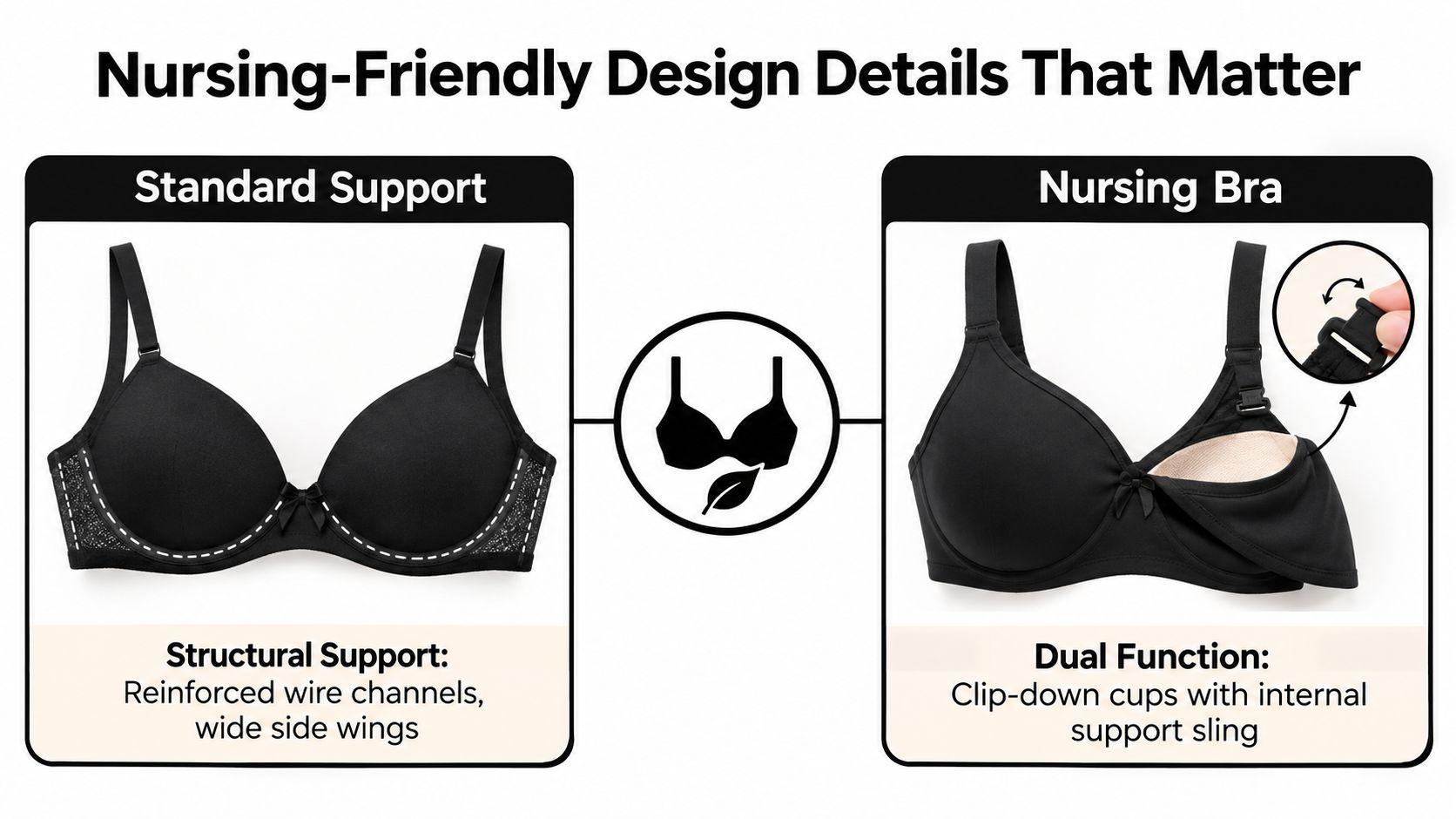
A nursing bra has two jobs. It must support the breasts through a structured frame, and it must open quickly when a baby needs to feed. If one function undermines the other, the bra becomes frustrating no matter how attractive it looks.
Look for access that preserves support
One-handed drop-down clasps are useful because they let you open the cup while holding your baby with the other arm. A full drop cup can expose enough of the breast for feeding without forcing the whole bra out of position. An internal support sling may preserve some structure beneath the lowered cup, which can make the bra feel less like it has stopped functioning during a feed.
Stretch in the upper cup also matters. It allows the fabric to respond to changing fullness instead of cutting into the breast at the neckline. That doesn't mean the entire bra should be loose. The lower cup and wire still need enough stability to hold the breast root.
Separate structure from pressure
A flexible wire channel, cushioned casing, or soft fabric around the wire can reduce the harsh edge associated with traditional rigid frames. Wider side wings and a reinforced back can spread pressure over more of the torso, helping the band do its structural work instead of transferring the load to narrow strap points.
Consider the difference between two roles in a postpartum rotation. A structured everyday nursing bra with cushioned flex wires and full drop cups may suit a longer day when shaping and stability matter. A lighter flexi-wire style may be more appropriate during sensitive fullness or when you want less concentrated structure.
PETRA is described as a nursing bra with ultra-soft stretch lace, gentle underwire, and one-hand nursing access. Those details provide a useful example of how a bra can combine a gentler frame with feeding functionality.
Nursing access should reduce disruption, not make you rebuild the fit after every feed.
The technical research supports this component-by-component view. Underwire rigidity, band tension, strap length, cup flexibility, and the way the wire is inserted all influence pressure and movement. A clasp alone doesn't make a nursing bra supportive, just as a wire alone doesn't make it suitable for postpartum wear.
Watch the video below for a visual look at how nursing access and structured design can work together.
The most practical design is the one that matches the moment. You may prefer a softer, more accommodating bra when fullness is unpredictable, then choose a more defined support underwire bra when you're dressing for work, leaving the house, or returning to activities that make movement control important.
Caring for Your Bra So It Keeps Supporting You
A structured bra is a piece of fabric engineering. Elastic stretches, foam loses recovery, clasps collect wear, and wire channels can shift when the bra is repeatedly twisted or overheated. Good care won't make a bra permanent, but it can help preserve the fit you chose.
Wash gently and dry with patience
Hand-washing in cool water with a mild detergent is the gentlest routine. Press water out rather than wringing the cups, then reshape the bra and let it air-dry flat on a towel or another clean surface.
If machine washing is more realistic, place the bra in a mesh lingerie bag and use a delicate cycle. Keep hooks closed so they don't catch on lace or stretch fabric. Avoid the dryer because heat can distort the wire shape and weaken elastic.
For a closer look at how fabric choices affect care and feel, read this guide to bra fabric and material.
Rotate and inspect
Wearing one structured bra continuously exposes the same elastic and channels to repeated tension. Rotating several bras gives each one time between wears, while also helping you notice when a change is caused by your body or by the garment.
Use this quick inspection:
- Check the band: If it stays stretched and no longer anchors comfortably, support has declined.
- Check the wire casing: A wire that bends, pokes, or moves inside the channel needs attention.
- Check the cups: Fabric that no longer returns to shape can create gaps, overflow, or uneven support.
- Check storage: Nest bras rather than folding them sharply in half, especially when the cups are molded. Protecting the curve helps the frame retain its intended shape.
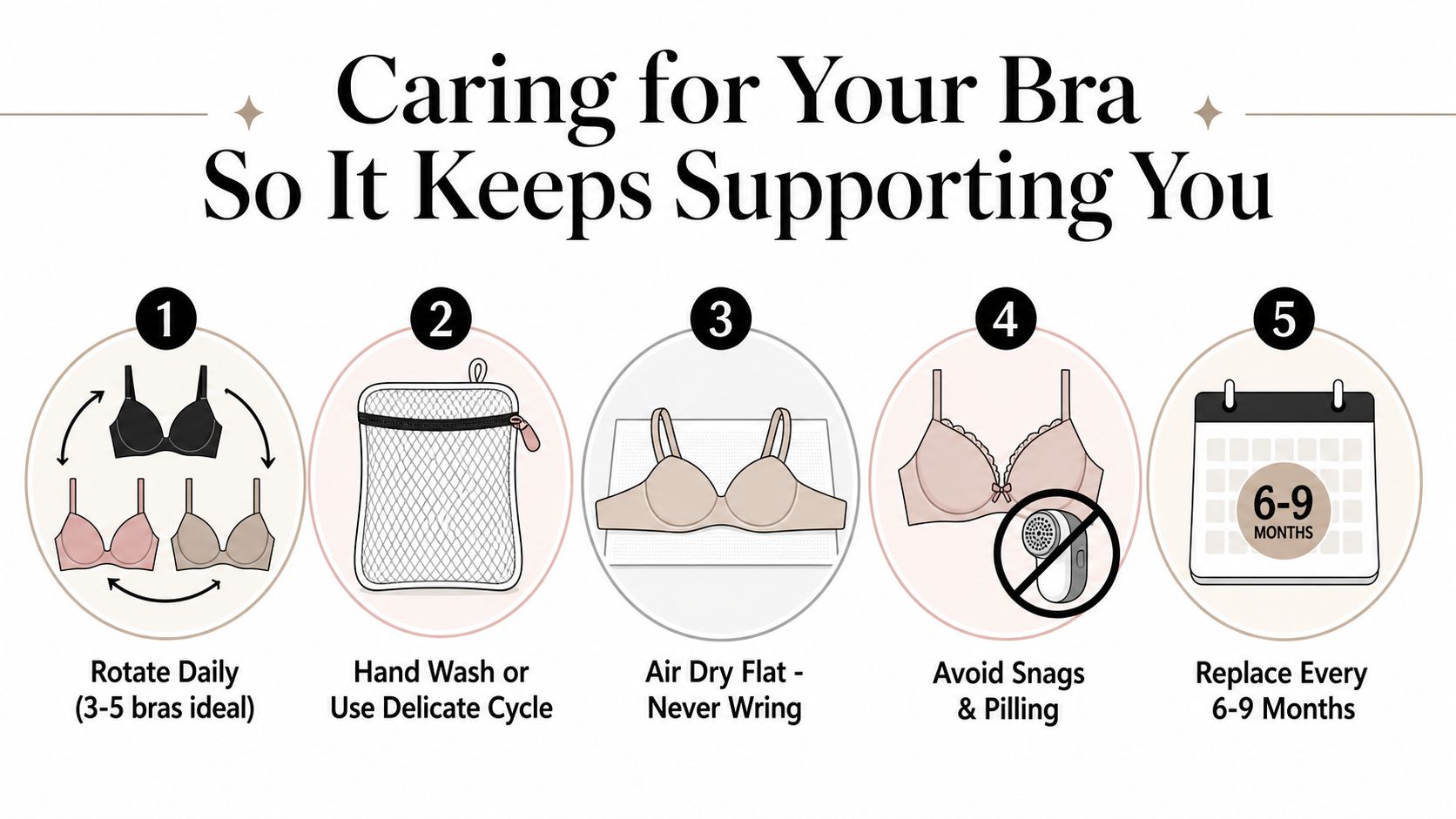
A bra that feels uncomfortable after washing may not need replacing immediately. Let it dry fully, inspect the wire and band, then test it again through normal movement. If the band has lost recovery, the wire is exposed, or the cups remain misshapen, replacing the bra is safer than trying to force it back into service.
Stepping Back Into Yourself with the Right Support
The right support underwire bra doesn't ask you to ignore your postpartum body. It responds to that body with a frame that has a clear job. The wire follows the breast root, the cup contains and shapes the tissue, the band carries tension around the ribcage, and the straps provide guidance rather than punishment.
That arrangement can matter when you're returning to ordinary routines. A commute, a workday, a walk, or a social event may feel easier when you aren't constantly adjusting a shifting bra. Structured support can also give clothing a cleaner line, which may help you feel more like yourself when your wardrobe and body both feel unfamiliar.
The choice still needs to be flexible. Wireless bras may be more comfortable during sensitive periods, while a flexible underwire may provide the separation and stability you want later in the day. A nursing clasp, adaptable cup, soft wire channel, and supportive band can turn a structured bra into a practical part of that rotation rather than a rigid all-or-nothing decision.
Let fit guide confidence
Postpartum research has linked support-bra recommendations with breast-support contexts, while also identifying comfort for nonbreastfeeding postpartum mothers as an area needing more attention. Separate fit research found that the front band, underwire, and straps were among the components most associated with fit problems, with those problems varying by breast size. The takeaway is clear: support isn't a single feature, and tolerance isn't a personal failure.
Choose based on what your body reports. If the wire sits on tissue, the cup is too small, or the band rides up, change the construction or size instead of assuming you need to get used to it. If the bra stays anchored, keeps the wire on the ribs, accommodates feeding changes, and lets you move without distraction, it's doing the work it was designed to do.
Motherhood has changed your routine, but it hasn't erased your identity. A bra can't solve every postpartum discomfort, yet the right foundation can remove one small source of daily negotiation. Support becomes a source of confidence when it lets you lift your baby, get dressed, work, rest, and reconnect with your own reflection without second-guessing the garment underneath.
Milk&Lace offers nursing lingerie such as GAIA and PETRA, with structured support, soft lace, and discreet nursing access for later postpartum months. Visit Milk&Lace to explore nursing bras designed to support changing bodies while helping you feel connected to your personal style.