

You're getting dressed with a baby balanced against your shoulder, and the nursing bra that felt comfortable yesterday is cutting across the top of your breasts. You loosen the straps, then tighten them again. By lunchtime, the band has crept up your back, and you're wondering whether you bought the wrong size or whether your body has changed again.
It might be either. If your search for “maternity bra plus size” has turned into a drawer full of almost-right bras, the answer isn't necessarily another size up. It's learning which part of the fit needs to change, and choosing support for the body you have today.
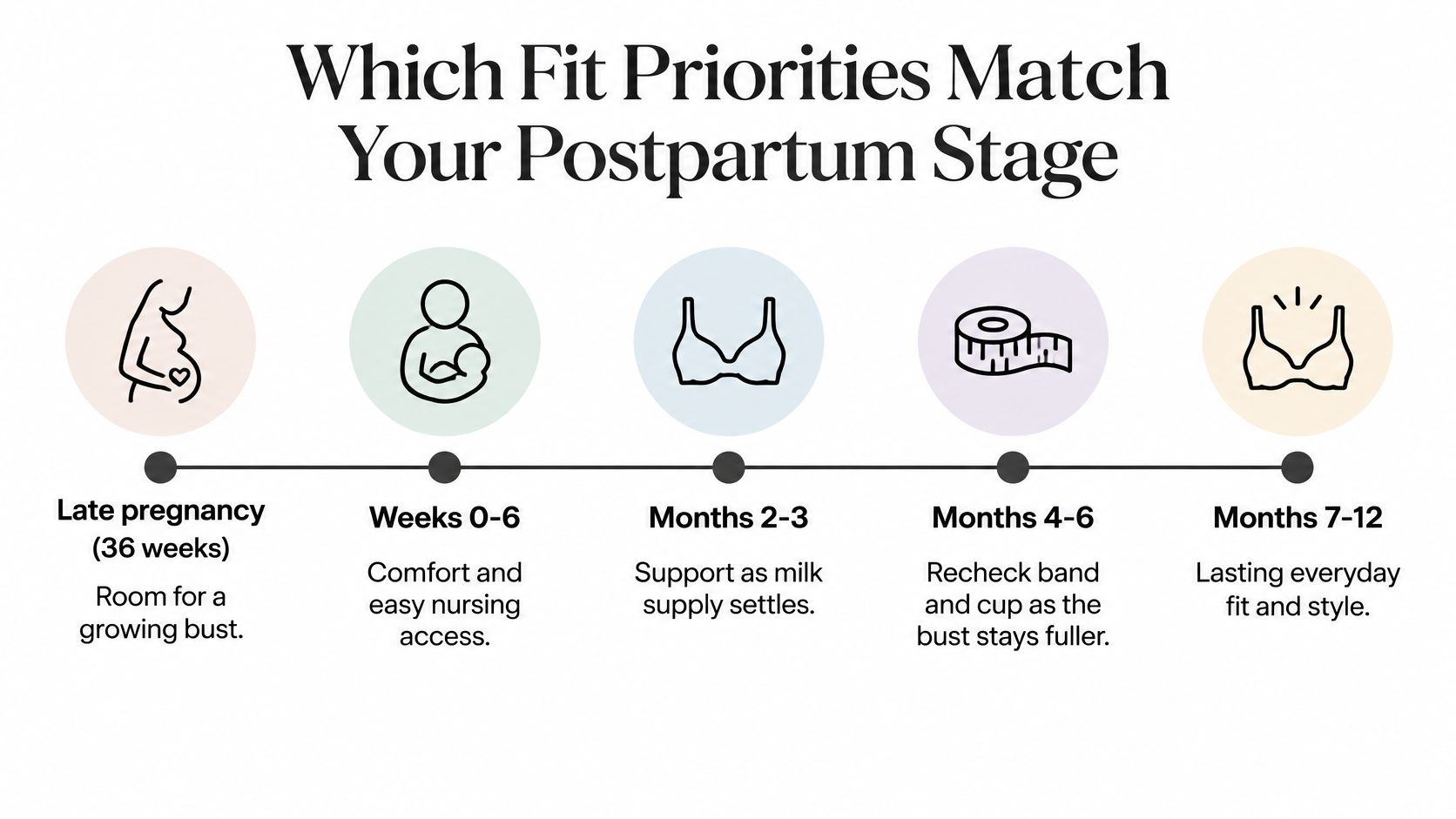
Which Fit Priorities Match Your Postpartum Stage
A bra that fits late in pregnancy isn't a promise of postpartum fit. Your breasts may need more room while your ribcage needs a different band setting, and those changes don't necessarily happen together. Fuller busts also need support that does more than stretch.
Think of postpartum stages as fitting checkpoints, not deadlines. Milk production, feeding patterns, breast shape, and comfort don't follow an identical calendar for everyone.
Fit priorities by postpartum stage
The timing below is a practical way to organise your checks, not a prediction of when your body must change.
| Stage | Typical timing | What changes | Fit priority |
|---|---|---|---|
| Late pregnancy | Later pregnancy, especially as your usual bras become restrictive | Breast enlargement and changes around the ribcage can alter both measurements | Room to grow, several hook positions, soft stretch |
| Milk coming in | Early days after birth | Breasts may feel fuller, firmer, and more sensitive | Soft, forgiving cups without pressure on engorged tissue |
| Establishing supply | Early feeding weeks | Fullness can swing between feeds | Easy one-hand access, accommodating fabric, quick adjustment |
| Regulated supply | When fullness becomes more predictable | Your usable size range may become easier to identify | A structured cup and stable underband fitted to your current shape |
| Later postpartum | As feeding and everyday routines evolve | Volume may shift with fewer feeds or weaning | Daily support plus a finish that feels like you |
Use this timeline as a reminder to check fit rather than automatically replace everything.
Why a blanket size increase doesn't work
A 2025 study of 323 pregnant and postpartum women found an average self-reported increase of one underband and two cup sizes, while 81% reported at least a D cup during pregnancy, compared with 53% before pregnancy. Those averages describe the participants, not a sizing formula for your next purchase.
Say your cups overflow, but your band still sits comfortably and level. Buying a larger band just because you're postpartum may solve the wrong problem. Another person might need extra ribcage room without needing the same increase in cup depth.
Practical rule: Fit the stage you're in now, not the stage you were in last month.
During sensitive, unpredictable periods, favour adjustability. When fullness becomes more consistent, look for controlled lift rather than maximum stretch alone. Reassess when the bra starts behaving differently, even if its label still looks like your size.
How to Measure for a Plus-Size Nursing Bra
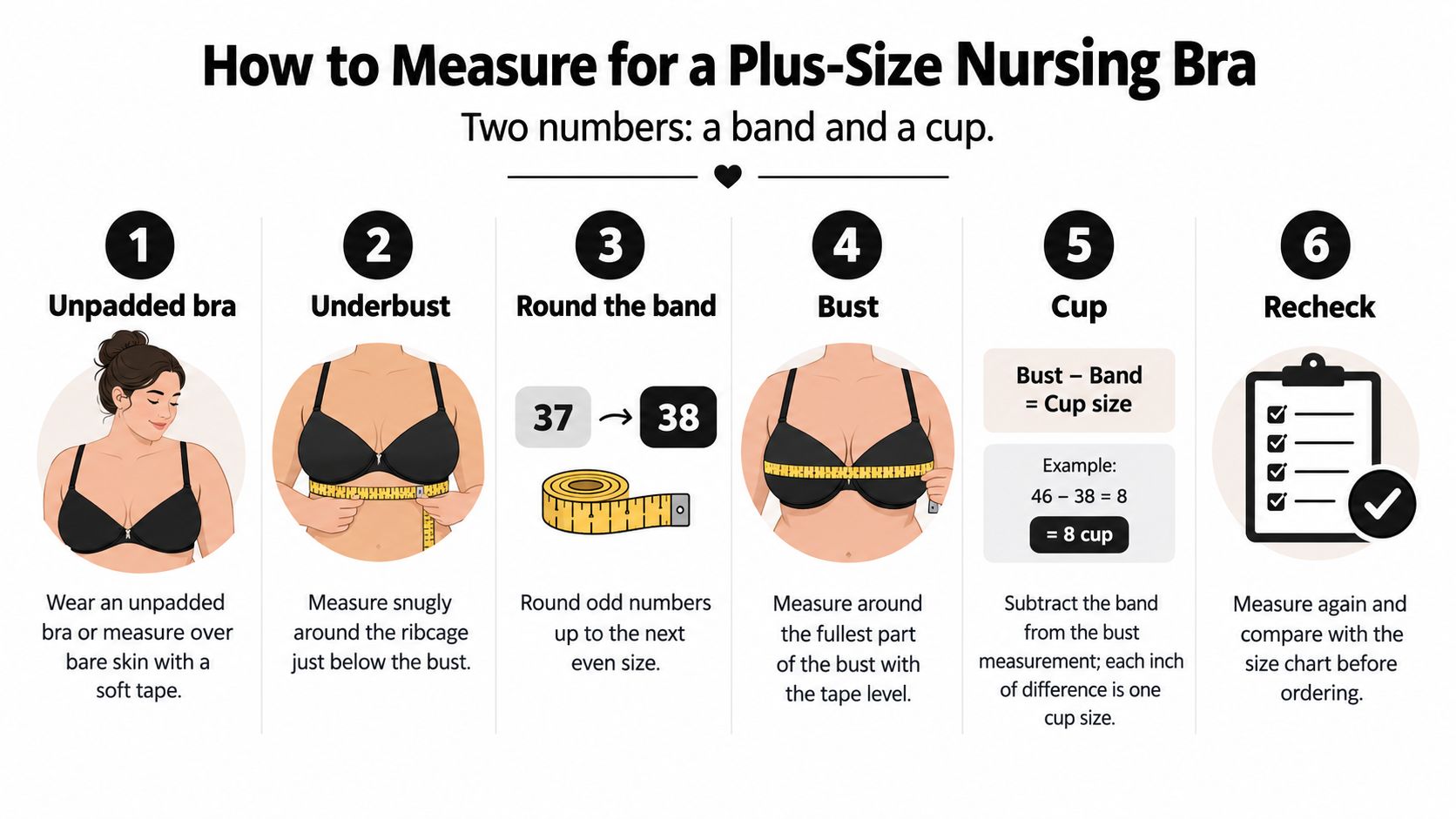
You need two measurements: underbust and full bust. Together, they give you a starting band-and-cup combination, but the brand's chart and the way the bra sits on your body decide the final size.
Use a soft dressmaker's tape and a mirror. If the tape twists behind your back, ask someone to check its position rather than pulling it tighter to compensate.
Take your measurements without guessing
- Start without padding. Wear an unpadded bra that doesn't compress your breasts, or measure over bare skin. Moulded padding adds volume that isn't yours.
- Measure your underbust. Place the tape directly beneath your breasts, level around your ribcage. Breathe out normally, keep it snug without digging, and record the measurement.
- Measure your full bust. Pass the tape around the fullest point, usually across the nipples. Keep your shoulders relaxed and the tape level, allowing it to touch rather than flatten the tissue.
- Calculate the difference. Subtract your underbust measurement from your full-bust measurement. Keep the original measurements as well as the result.
- Find a starting size. Compare your underbust with the brand's band chart, then use its cup system. If the chart uses even-numbered inch bands, follow its rounding instructions rather than adding an arbitrary allowance.
- Keep a fitting record. Write down your measurements, date, feeding stage, and whether you measured before or after a feed. Repeat when your fit changes.
Keep this measuring guide beside you while you check the tape placement.
Use cup letters as a starting point
The following is a common US-style fitting convention, not a universal conversion. Some charts calculate cup difference using the selected band rather than the raw underbust, and extended cup labels differ between brands.
Bust-minus-underbust difference to cup size
| Bust minus underbust (inches) | US cup letter |
|---|---|
| 1 inch | A |
| 2 inches | B |
| 3 inches | C |
| 4 inches | D |
| 5 inches | DD (E) |
| 6 inches | DDD (F) |
| 7 inches | G |
| 8 inches | H |
| 9 inches | I |
| 10 inches | J |
The band anchors the garment, while the cups contain breast volume. A fuller cup doesn't automatically mean you need a looser band, and the same cup letter doesn't represent the same volume across every band size.
Avoid measuring over padding, leaving the tape loose, or treating an unusually engorged measurement as permanent. Compare your results with the extended-size bra chart guidance, then check the chart for the actual bra you're ordering. Beyond the differences shown above, extended letters and DD-plus labels become especially brand-specific.
Fabric and Support Features That Carry Fuller Busts
Start with the underband, not the lace. If the foundation slides when you reach for a mug, tightening the shoulder straps won't turn it into dependable support.
Support is garment engineering. A review published by the American Physiological Society reports that a well-designed supportive bra can reduce vertical breast displacement by approximately 60% compared with no external support, and explains how transferring breast weight to the garment can reduce the mechanical load associated with forward torso bending.
Look beyond soft fabric
For a fuller bust, softness should sit alongside stable construction. You want the garment to distribute pressure, not just squeeze everything closer to your chest.
| Feature | What to check | Why it matters for fuller busts |
|---|---|---|
| Underband | Broad, firm, level, and comfortable during movement | Provides a stable foundation without relying on the shoulders |
| Hook positions | Several usable settings | Allows adjustment as your torso changes |
| Straps | Wide enough for comfort, with useful adjustment range | Spreads pressure and helps maintain cup position |
| Cup shape | Adequate depth and coverage without cutting in | Contains projected tissue instead of flattening it |
| Underwire | Follows the breast root without resting on tissue | Provides shaping without concentrated pressure |
| Back panel | Firm but nonrestrictive | Helps keep the garment anchored |
| Fabric | Accommodating lace with a soft, breathable lining | Balances flexibility with skin comfort |
| Nursing access | Easy to release and refasten, with a generous opening | Lets you feed without wrestling tissue past a tight edge |
A deep cup can matter more than a taller neckline. If your breast projects forward, adding fabric above it won't necessarily create the room you need at the fullest point.
Test the construction in motion
Stand naturally, lift your arms, then reach forward as though you're picking up your baby. The band should remain level, and the cup edge shouldn't slice into tissue as your shoulders move. Where the design permits, the centre panel should sit smoothly rather than tip outward.
More stretch isn't always more comfort. Fuller breasts need controlled lift as well as room to change.
Underwire is an option, not a requirement. A wire-free bra can work well when its band and cups provide enough structure; a wired bra needs enough cup space for the wire to sit around the breast, not on it.
Use the supportive nursing bra guide for large breasts to compare construction details. Then judge the garment on your moving body, not just its appearance on a hanger.
Common Fit Problems and How to Fix Them
You pull the back of your bra down, and it creeps up again before you've finished dressing. That usually points to a band that's too loose, although overtightened straps can contribute. Start there before changing the cups.
Fix the band first, then the cups, then the straps. Otherwise, you may keep adjusting the shoulders to compensate for an unstable foundation.
Fit symptoms, likely causes and fixes
| Symptom | Likely cause | First fix |
|---|---|---|
| Band rides up at the back | Band too loose, hooks too loose, or straps overtightened | Try a tighter hook and relax the straps; if needed, try a smaller band with the cup volume reassessed |
| Cups gape or wrinkle | Cup too large or the wrong shape | Try a smaller cup in the same band, or a shape better matched to your tissue |
| Tissue spills over the top | Cup too shallow or too small | Choose a deeper or full-coverage cup with adequate volume |
| Tissue spills under the band | Loose band, insufficient cup space, or narrow underband | Check band security and cup containment; consider a broader underband |
| Straps dig into shoulders | Band isn't providing enough support | Correct the band, then adjust or choose broader straps |
| Underwire presses or pokes | Wire rests on tissue or cup shape is unsuitable | Try more cup room, a better-matched wire shape, or a wire-free style |
| Band leaves uncomfortable red marks | Excessive tension, friction, or poor pressure distribution | Loosen the hooks; reassess band size and construction if discomfort continues |
| Soreness after feeds | Cup or wire pressure, or a problem unrelated to fit | Remove pressure and try a softer cup; seek clinical advice if soreness persists |
A broader underband and a larger band size aren't the same thing. Broader describes the fabric's width against your torso; larger describes the circumference. A riding band doesn't, by itself, mean your ribcage has grown.
Change the part that's actually wrong
Say the band feels comfortably snug, but breast tissue bulges above the neckline. Keep the band as your starting point and try more cup depth or volume. Increasing the band just to make the cup feel less tight can leave you with less support.
After each adjustment, run a movement check:
- Raise your arms. Watch for the band lifting or tissue escaping underneath.
- Bend forward. Check that your breasts remain contained without having to tuck them back in.
- Check after a feed. Notice whether the cup adapts comfortably when fullness changes.
Change one thing at a time. If the bra remains comfortable, wear it through ordinary activities before deciding, but don't persist through pain to complete a wear test.
Persistent pain, redness, warmth, fever, or a firm lump needs a healthcare provider, not another sizing experiment. Seek prompt advice if you feel unwell or symptoms are worsening.
Buying a Bra for the Stage You Are In
Say you're packing your hospital bag and want to buy every nursing bra you'll need at once. It feels efficient, but your current measurements can't guarantee how a structured garment will fit after birth.
A peer-reviewed review of pregnancy-related breast changes reports that enlargement becomes more pronounced after 28 weeks of gestation and describes a cited study in which the upper-breast measurement increased by an average of 6.5 cm by delivery, while the underbust increased by 10 cm. Those changes help explain why merely scaling up your old bra may miss both your new proportions and your need for adjustment.
Late pregnancy and the hospital bag
Consider a reader near the end of pregnancy whose usual bra has become restrictive by dinner. She chooses a soft-cup nursing style with several hook settings and straps that don't need to be tightened to their limit.
She checks that it fits now without assuming it will remain her everyday size indefinitely. Instead of buying a matching drawerful, she keeps the initial purchase modest and leaves room in her budget for a later fitting.
Her useful purchase isn't necessarily the prettiest or most structured one. It's the piece that accommodates her current shape and opens easily when she practises the nursing fastening.
Early fullness and later structure
Another reader is newly postpartum and finds that her breasts feel much firmer before a feed than afterwards. She had planned to buy a shaped underwire bra, but the fitting feels unpredictable.
She chooses a forgiving, adjustable option for now rather than forcing sensitive tissue into a fixed shape. She can revisit the structured style when she can assess its fit more comfortably.
Later, a reader returning to regular outings wants a defined silhouette under her shirts. Her fullness has become more predictable, so she tries a structured nursing bra in her current measured size and keeps a flexible alternative for days when she wants less shaping.
These are shopping scenarios, not milestones you must reach. You don't have to want underwire, lace, or a particular silhouette to be progressing through postpartum life.
Buying principle: Choose enough flexibility for your present needs, not enough extra space for every possible future body.
Make the purchase easy to reassess
- Name your present needs. Decide whether sensitivity, changing fullness, feeding access, or everyday shaping matters most.
- Record your measurements. Keep your underbust and full-bust figures beside the product chart.
- Start small. Order a limited selection before committing to duplicates.
- Read the terms before trying on. Check exchange eligibility, return conditions, tags, hygiene requirements, and whether wear or washing affects acceptance.
- Test within those conditions. During an eligible try-on, raise your arms, bend, and practise the fastening. Once you've decided to keep it, assess comfort through a feed and ordinary wear.
- Reassess when something changes. A new pressure point, persistent gaping, or shifting band is a reason to check fit again.
Keep receipts and packaging until you understand the policy. Exchange flexibility is part of fit management, especially when your body is still changing, but it only helps if you know what the retailer permits before wearing the bra.
Styling a Later-Postpartum Wardrobe That Feels Like You
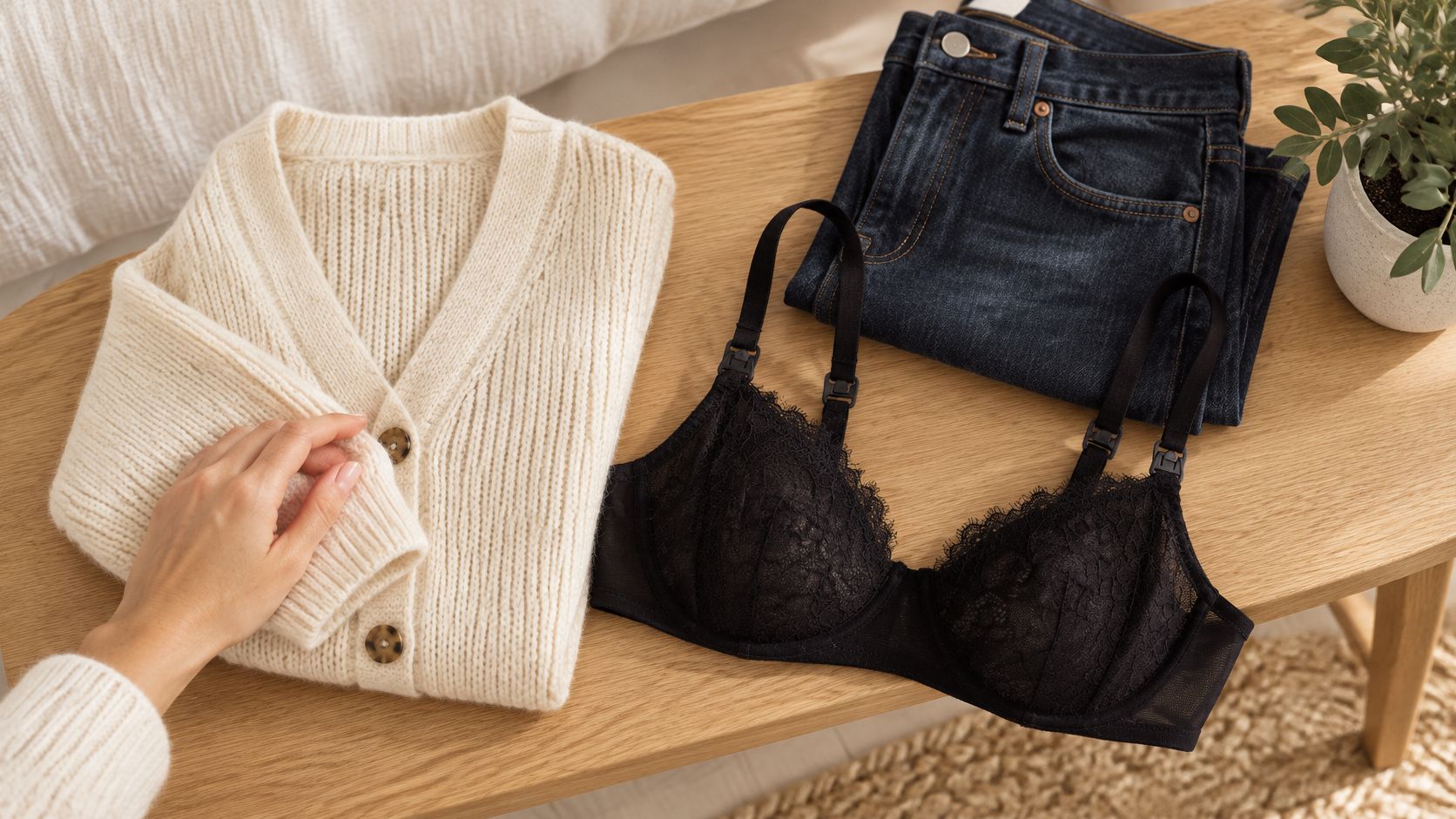
You're reaching for jeans and a favourite cardigan rather than whatever's closest to the feeding chair. Your dependable nursing bras still have a place, but you'd like something that feels more intentional underneath. That isn't vanity, and it doesn't mean you're finished needing comfort.
A premium nursing piece can add to your practical rotation, not replace it. Start with an outfit you already enjoy rather than buying a whole new wardrobe.
A familiar combination can make getting dressed feel easier.
Choose the structure your day needs
Milk&Lace's GAIA offers stretch lace, flexible support, and breastfeeding access. PETRA features ultra-soft stretch lace, gentle underwire, and one-hand nursing access. Both are options for later-postpartum dressing, with the choice guided by your preferred structure and current fit.
- For fine knits: Try a tone close to your skin when you want less contrast beneath light fabric.
- For a sheer blouse: Add a camisole that preserves nursing access and gives you the coverage you prefer.
- For intentional lace detail: Let ivory or blush show at a cardigan neckline if that feels like your style.
- For feeding away from home: Choose wrap dresses or open-neck shirts that don't require you to undress from the waist up.
Keep activity-appropriate support for workouts and a separate comfortable sleep option if you like wearing one. A lace nursing bra doesn't need to do every job.
For another styling reference, watch the video below.
Explore the stylish nursing wear guide for outfit ideas, and check each product page's size chart and current availability before ordering. The aim is a wardrobe you can feed in and feel yourself in.
Milk&Lace offers lace nursing lingerie for later-postpartum life, combining everyday support with practical breastfeeding access. Visit Milk&Lace with your current measurements to compare styles, check the size guidance, and review exchange terms before choosing your next bra.