

You pull on yesterday's favorite skirt, smooth your top over your belly, and sit down to put your shoes on. Suddenly, the waistband folds, the front hem lifts, and an outfit that looked effortless standing up feels like something you'll be adjusting all day.
Your body hasn't done anything wrong. The skirt needs a different kind of fit. Choosing long maternity skirts is less about finding extra fabric and more about putting softness, adjustment, and walking room in the right places.
Long Skirt Length and Waist Guide for Every Stage
A skirt that felt lovely earlier in pregnancy can start pulling across your belly before you're ready to put it away. You might loosen the waist and discover that the back now hangs too low, or pull it higher and lose the ankle coverage you wanted.
Waist position and hem length work together. Moving the waistband changes where the skirt finishes, so neither detail makes much sense on its own.
Women were making these adjustments long before dedicated maternity collections existed. Historical garment evidence described by the University of Technology Sydney shows ordinary clothing adapted with drawstrings, laces, released seams, and adjustable waists, including skirts lengthened at the front to accommodate pregnancy.
Waistline, hem length and fit check by stage
Use these combinations as starting points, not rules about what your pregnant body should wear.
| Stage | Waistline that works | Hem length to choose | Fit check |
|---|---|---|---|
| First trimester | Regular or low-rise waist with stretch panel | Midi to ankle | Waistband sits flat when seated |
| Second trimester | Over-belly panel or drawcord waist | Ankle length | Hem clears heels while walking |
| Third trimester | Full-panel or wrap waist | Ankle to just above the floor | Hem clears stairs and sitting |
| Postpartum | Soft wrap or drawcord waist | Ankle length | Waist adjusts as body volume changes |
Read down the waistline column to see how adjustment becomes more useful as your shape changes. Then read down the hem column: ankle length remains a practical anchor, while anything closer to the floor needs a more careful movement check.
The final column matters most. A waist that looks smooth but folds sharply when you sit isn't the right fit, and a beautiful long hem isn't useful if your shoe catches it.
Choose where you like support
You don't have to enjoy fabric over your belly. If you prefer an under-bump fit, the waist-position comparisons in our guide to low-rise maternity jeans can help you identify what feels comfortable before choosing a skirt.
For an above-bump waist, look for a broad, soft panel rather than a narrow elastic edge that does all the holding. With a below-bump waist, check that the skirt stays secure without tightening the band.
Practical rule: Buy for the stage you're in and the one you expect next, not just the size printed on the label.
That doesn't mean buying something oversized. It means choosing a skirt with adjustment left to use, enough room through the hips, and a hem you can walk in today.
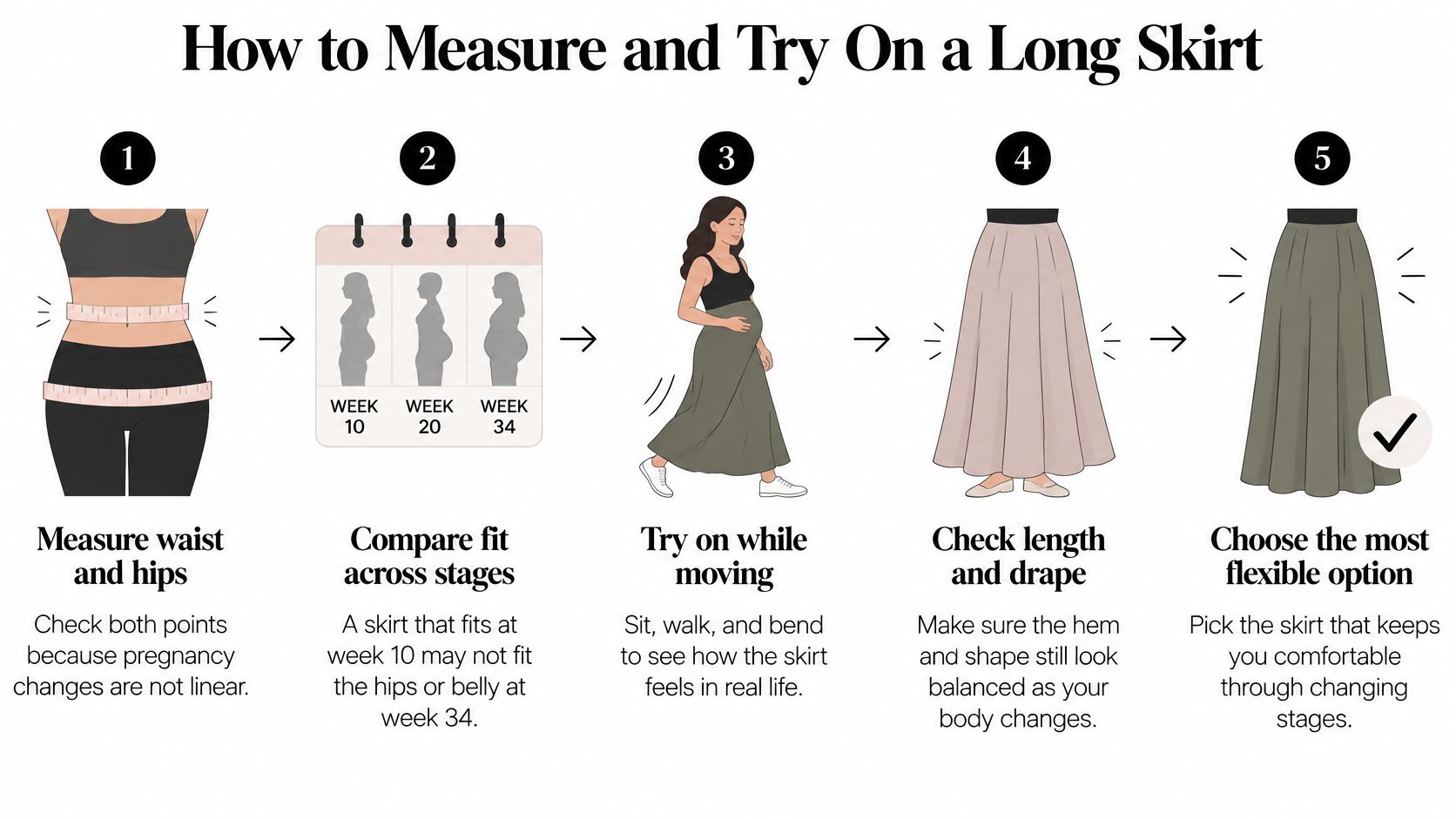
How to Measure and Try On a Long Skirt
Pregnancy doesn't change every measurement at the same pace. A skirt may still fit around your waist while feeling unexpectedly snug across your hips or the fullest part of your belly.
Brand charts aren't interchangeable, either. A longitudinal maternity-sizing study involving 600 pregnant women in Kenya documented variation in weight and girths and developed trimester-specific charts, a useful reminder to compare your current measurements with the actual brand guide rather than relying on your usual size.
A fitting routine you can use at home
- Measure your current shape. Use a flexible dressmaker's tape to record your bust, waist, fullest hip, and the largest circumference of your belly, keeping the tape level without pulling it tight. Your bust may not determine skirt size, but it's useful when comparing maternity size guides that combine several body measurements.
- Look beyond the waistband measurement. Choose adjustable accommodation, such as a stretch panel, drawcord, wrap, or concealed elastic, and check that the hip area has room to move. Sizing up can leave you with a loose waist and an awkwardly wide skirt without solving pressure across the abdomen.
- Try the hem with your real shoes. Put on the flats you wear for errands, then any heels you plan to wear with the skirt. A floor-skimming length chosen barefoot can become a nuisance when a shoe slips beneath it, so check both the front and back.
- Move as you would during your day. Sit in a chair, stand again, walk across the room, and use stairs with a handrail available. Take an ordinary stride rather than a careful fitting-room shuffle, and notice whether the fabric restricts your knees or catches beneath your foot.
- Check the waist while seated. Let your abdomen relax instead of holding yourself upright to make the skirt fit. Reject rigid seams pressing across the belly, elastic that rolls into a narrow band, or a panel you immediately want to pull away from your skin.
- Reassess during postpartum. Try the skirt again as your waist and hips change, especially before wearing it for a long outing. An adjustable fastening is useful only if it still holds the skirt securely without needing to be pulled tight.
Keep this visual checklist handy while comparing options.
Notice what you stop noticing
Good fit doesn't require you to stand perfectly still. The side seams should stay reasonably straight, the waist should remain where you placed it, and the hem should fall back into position after you sit.
A well-fitting skirt lets you think about your day instead of negotiating with your clothes.
If you keep smoothing, lifting, or loosening it during the try-on, treat that as useful information. You're looking for a garment that accommodates you, not a posture that accommodates the garment.
Fabrics and Waistlines That Stay Comfortable All Day
A jersey skirt that looks smooth on the hanger can sag at the seat by mid-morning. The waistband that felt soft at 8 a.m. may feel warmer and firmer by lunch, and a twisted lining turns every trip to the printer into a small adjustment.
Stretch, recovery, and breathability answer different questions. Stretch lets fabric expand; recovery helps it return to shape; breathability affects how the whole garment feels in warm rooms and during long car rides.
Maternity-clothing design guidance published by Springer treats movement, ergonomics, safety, and comfort as practical requirements, including attention to waistband pressure, fabric recovery, and hem clearance.
Fabric choices for long maternity skirts
Use the table as a comparison, then check the garment itself. Fiber blends, knit structure, lining, and fabric weight can change how an individual skirt behaves.
| Fabric | Stretch | Breathability | Best for | Watch for |
|---|---|---|---|---|
| Jersey cotton | High in stretch blends | High | Everyday wear and early pregnancy | Pilling over time |
| Modal or viscose blend | High with stretch fibers | Good, with fluid drape | Office and warm days | Shrinkage if dried hot |
| Ponte knit | Medium to high | Medium | Structured looks in cooler months | Heavy in summer |
| Linen blend | Low | Excellent in lightweight constructions | Summer days | Needs a stretch panel for changing fit |
| Lace overlay on stretch lining | Low to medium | Good in lightweight constructions | Occasions and events | Check that the lining feels soft |
| Crepe or rayon | Low in woven constructions | Medium | Dressy evenings | Catching on the hem |
A light stretch does not guarantee a smooth seat. Press a small area of fabric gently between your fingers, stretch it lightly, then release. If it remains rippled, don't assume it will look smooth after a day of sitting.
For lace, test both layers together. A stretchy lining can't compensate for an overlay that stops the skirt expanding.
Match the waist to your day
A stretch panel offers continuous coverage and moves with your belly. A drawcord allows small adjustments, but its casing should feel soft and its knot shouldn't press into you when seated.
A wrap adds room through the hip, provided the overlap stays generous when you walk and sit. For relaxed textures and flowing shapes, the boho maternity clothes guide shows how to build outfits without adding unnecessary bulk.
Choose controlled fullness, such as gores or softly released pleats, over volume for its own sake. A low-bulk skirt is often easier to manage, although pale or sheer fabrics may still need a suitable lining.
Ways to Style Long Skirts as Your Body Changes
A hip-length shirt and a full-panel skirt can look deliberate, but only if the shirt clears the waistband without bunching above it. A tunic that stops mid-panel reads as an accident, however good the fabric feels. Start with the skirt that feels comfortable sitting down, then build the outfit around where its waist sits.
These combinations show how changing top lengths make the same long silhouette feel intentional at different stages.
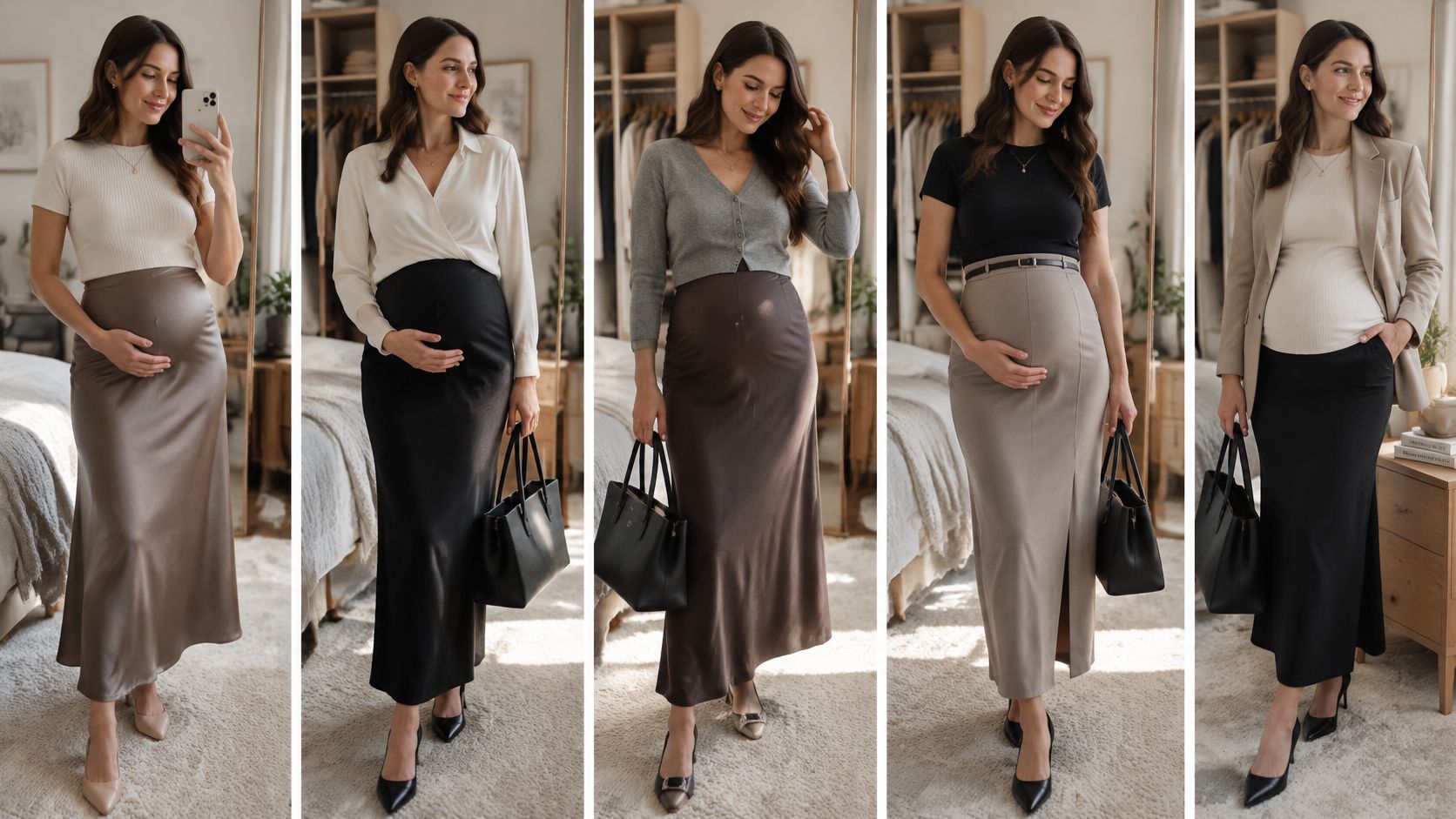
Early pregnancy and the middle months
- Jersey maxi with a fitted knit tee. Choose a tee ending around the upper hip and tuck only a little fabric at the front if that feels comfortable. An open cardigan falling below the hip and flat loafers create a clear outline without asking the waistband to hold a bulky tuck.
- Denim maxi with a relaxed shirt. Pick a maternity-friendly denim skirt with walking room, then leave a hip-length shirt open over a soft tank. Flat sneakers keep the outfit practical. A loose belt worn over the panel rather than tucked beneath it adds definition, so long as it stays decoration and the waistband does the holding.
- Wrap skirt with a soft bodysuit and blazer. A hip-length blazer gives meetings a finished feel, while flat pointed shoes keep the hem easy to judge. Choose a bodysuit with enough torso length that it doesn't pull downward, or substitute a stretch tank if fastening it feels inconvenient.
You don't need a belt, a necklace and a patterned layer all at once. When your waist feels sensitive, let a textured skirt or a favorite pair of earrings carry the outfit.
For more combinations built around ordinary days, browse our stylish maternity outfits guide.
Watch for the relationship between top length and skirt volume in this styling video.
Later pregnancy and postpartum
A full-panel skirt with an untucked tunic works when you want the waistband covered. Choose a tunic that reaches below the panel without gripping beneath your belly, add an open hip-length jacket, and finish with flat ankle boots or supportive flats.
For postpartum, try a drawcord skirt with a feeding-friendly top ending at the upper hip, a light cardigan, and flat walking shoes. Check that the top opens or lifts clear of the waistband rather than getting trapped beneath it.
A nursing-friendly base layer makes that outfit easier to manage on the days you're feeding away from home. Our GAIA nursing bra has soft stretch lace, flexible support, and breastfeeding access.
Keep the finishing touches simple. Let the visible change in your shape be part of the outfit, with a hem you can walk in and a waistband that stays where you put it.
Fixing Hem Drag, Waistband Pinch and Fading Fit
You lean forward to pick up your bag, and the front hem lands beneath your shoe. Or you stand straight and notice the opposite problem: the front has lifted while the back hangs low.
These symptoms need different adjustments. A growing belly can lift a conventional skirt at the front, while a slipping waistband, stretched fabric, or excess garment length can leave fabric dragging.
The United States Patent and Trademark Office describes U.S. Patent No. 2,141,814, granted in 1938, for a maternity ensemble whose skirt used an adjustable front window and drawstrings to accommodate expansion while keeping the hem parallel to the ground.
Match the fix to the symptom
- The front hem drags. First check whether the waistband has slipped down. An adjustable waist may let you lift the front into position, but if that creates pressure or distorts the side seams, the skirt needs a different length or alteration rather than tighter fastening.
- The front hem rises. Don't pull the whole skirt downward until the back trails behind you. Look for more abdominal accommodation, or ask an alterations specialist whether the existing hem allowance and construction permit rebalancing.
- The waistband pinches when seated. Try moving a soft panel above or below the sensitive area without folding it into a tight ridge. If there's still pressure, a wrap with more hip ease may suit you better than another adjustment to the same band.
- The skirt loses shape after washing. Check the care label before trying to correct it. For washable stretch knits, gentle cold washing and drying flat can be sensible options, but neither will restore permanently damaged elastic.
- The fabric pills or bags at the knees. Reduce rubbing against rough bags and surfaces, and allow the garment to rest between wears. Persistent bagging suggests poor recovery; removing surface pills won't fix that underlying problem.
Decide whether it's adjustable or finished
Test a simple position change at home before committing to an outing. Walk, sit, and check the garment from the side as well as the front; a level-looking hem can still catch behind your heel.
Re-hemming is worth considering when the waist and hips fit comfortably and excess length is the only problem. Have the hem marked while wearing the intended shoes and with the waistband in its normal position.
Stop adjusting when comfort requires a compromise: a tight waist, restricted stride, or hem you must keep lifting is a reason to choose another skirt.
Likewise, replace a skirt whose elastic won't hold or whose fabric stays stretched out. Your body doesn't need to wait for the garment to become comfortable again.
Choose Your First Long Skirt Before the Next Stage Begins
Say you're down to two long skirts on a Tuesday morning, one jersey and one ponte, and neither has a clear job yet. You don't need to replace the whole wardrobe in one trip. Start with a daily skirt you can wear for groceries, appointments, and an ordinary afternoon at home.
A stretch-knit skirt is a useful first choice. Jersey feels relaxed; ponte gives a neater outline for cooler days or work. Choose between them by handling the fabric, not just reading the name on the tag. Give the second skirt a separate purpose, such as a wrap or softly structured style for occasions and postpartum outfits. It should work with tops and shoes you already wear.
The waist, length, and fabric checks from earlier still apply, so run them once before you buy: sit in the band, walk in the footwear you'll reach for, and feel how the knit recovers after a stretch. What remains is deciding which skirt earns its place first. Pick the one that fits the body you have this month and has enough adjustment for the months ahead; then let the second skirt wait until you know what your days ask for.
A long maternity skirt is worth buying when it fits the body you have this month and offers room for the one you'll have next.
On a cooler morning, pair a fine-gauge knit skirt with a soft nursing bra; the smooth layer keeps the waistband from catching and keeps feeding access within reach. Milk&Lace offers maternity and nursing lingerie to wear beneath the outfits that help you feel like yourself. As you choose a long skirt, give your base layer the same attention to softness, fit, and everyday function. Visit Milk&Lace to explore nursing lingerie that brings breastfeeding access and personal style together.