

Yes, a well-fitting, supportive bra is generally fine to wear while breastfeeding, and the concern is fit rather than bra-wearing itself. Available observational evidence includes an adjusted odds ratio of 3.47 for tight-bra exposure and mastitis, while another study reported pressure from a tight bra among 37% of women with mastitis compared with 20% of control participants.
At three in the morning, the room is quiet except for your baby's small feeding sounds. You reach toward the nightstand for a nursing bra, then pause and wonder whether support will help or somehow interfere with breastfeeding. That uncertainty is common, especially when advice makes bras sound either essential or dangerous.
The more useful answer is practical. A bra can support your breasts, keep nursing pads in place, and make feeding access easier, but it shouldn't dig into breast tissue, leave lasting marks, or create pressure in one recurring spot. Your comfort may change from the early postpartum weeks to later months, so the right choice can change with it.
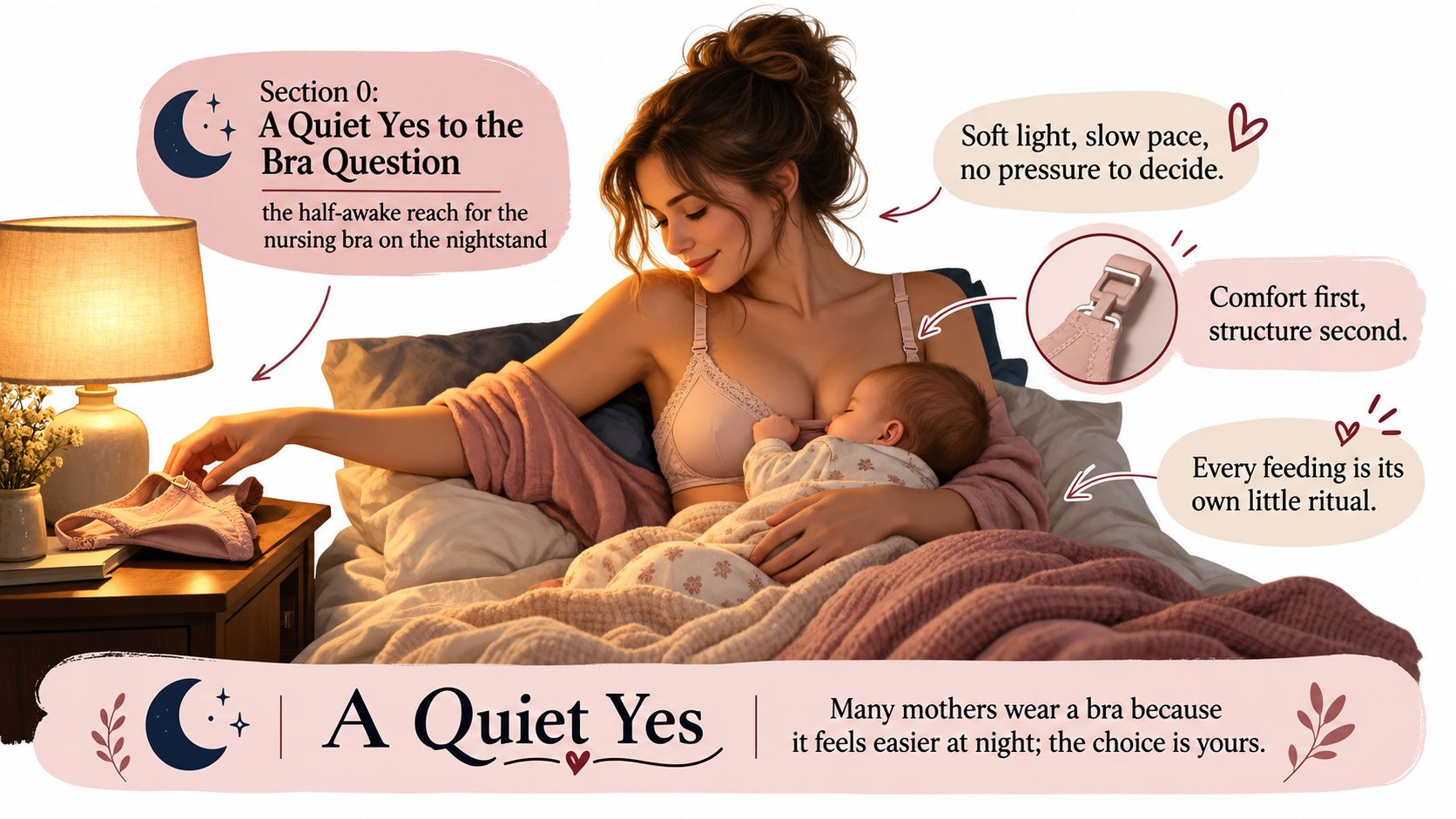
A Quiet Yes to the Bra Question
A supportive bra can be helpful during a night feed, a workday under a blouse, or a grocery trip with a hungry baby. It can also be unnecessary when you're resting at home and prefer the freedom of going braless. Both choices can be reasonable.
The Academy of Breastfeeding Medicine advises lactating women to wear an appropriately fitting, supportive bra because breastfeeding breasts are highly vascular and may benefit from support against dependent swelling. Support may also reduce strain on the back and neck. The guidance doesn't say that every breastfeeding mother must wear a bra, and it doesn't turn a particular style into a universal requirement.
Four questions make the decision easier
Rather than asking whether bras are good or bad, ask:
- Does the bra support without compressing? A firm but comfortable band can feel reassuring. A band that bites, rolls, or leaves a deep groove needs changing.
- Can your breast change shape? Fullness may vary before and after a feed, so rigid cups and inflexible seams can become uncomfortable quickly.
- Can you feed without a struggle? Drop-down cups, clips, and stretchy openings should make access easier, not force you to pull the bra sharply over sensitive tissue.
- How does your body respond? A bra that feels fine in the morning may feel restrictive later. Recheck it after movement, feeding, and periods of fullness.
The worry behind “is it good to wear bra while breastfeeding” usually isn't really about clothing. It's about milk flow, mastitis, pain, leaking, and whether your changing body can still feel like your own. The answer becomes calmer when you separate clinical guidance, everyday benefits, possible risks, and fit and fabric choices.
A bra isn't a breastfeeding rule to memorize. It's a comfort decision that can evolve as your breasts, routines, and sense of style evolve.
What Breastfeeding Guidelines Say About Bras
Clinical guidance focuses on appropriate fit, not on whether a bra is labeled nursing, wireless, or underwire. The Academy of Breastfeeding Medicine's mastitis protocol recommends support that fits properly and cautions against excessive compression. Two bras with the same design can feel very different, because breast shape, fullness, and sensitivity vary from person to person.
Pressure is the central concern. A band, wire, strap, or baby carrier can press on one part of the breast when it is too tight or sits poorly. Breast fullness also changes as milk is produced and removed, so a rigid wire may press against an area that becomes temporarily fuller between feeds. Flexible fabric may allow more room, but no material is automatically comfortable if it rests on breast tissue.
The practical principle: choose a bra that follows your breast shape instead of forcing your body into a fixed shape.
The evidence linking tight bras with mastitis needs careful interpretation. A systematic review found an association between tight bras and higher mastitis risk in the available observational research, including one study with an adjusted odds ratio of 3.47 and a 95% confidence interval of 1.30 to 9.22. A 2006 case-control study reported tight-bra pressure among 37% of women with mastitis and 20% of control participants. These results do not prove that a bra causes mastitis. Nipple damage, feeding difficulties, and milk stasis may also contribute. The Academy of Breastfeeding Medicine mastitis protocol therefore supports a properly fitting bra rather than restrictive compression.
What guidance does not promise
A nursing bra may improve feeding access and physical comfort. It doesn't increase milk production, guarantee protection from breast problems, or replace attention to latch, feeding frequency, nipple trauma, and inflammation. Clothing can support a feeding routine, but it cannot resolve an underlying breastfeeding difficulty.
WHO and UNICEF recommend exclusive breastfeeding for the first six months, followed by continued breastfeeding with complementary foods to two years or beyond. These recommendations address infant feeding, not whether a mother wears a bra. The WHO and UNICEF infant-feeding guidance reports that roughly 47% of infants aged zero to six months were exclusively breastfed across recent years. That estimate reflects varied experiences and circumstances among families rather than a clothing requirement.
A soft option such as GAIA combines stretch lace, flexible support, and breastfeeding access. Those features may suit someone who wants a more polished style while nursing. The same fit test still applies: if the bra presses, rubs, or creates a persistent tender area, choose a different size, style, or no bra for that phase.
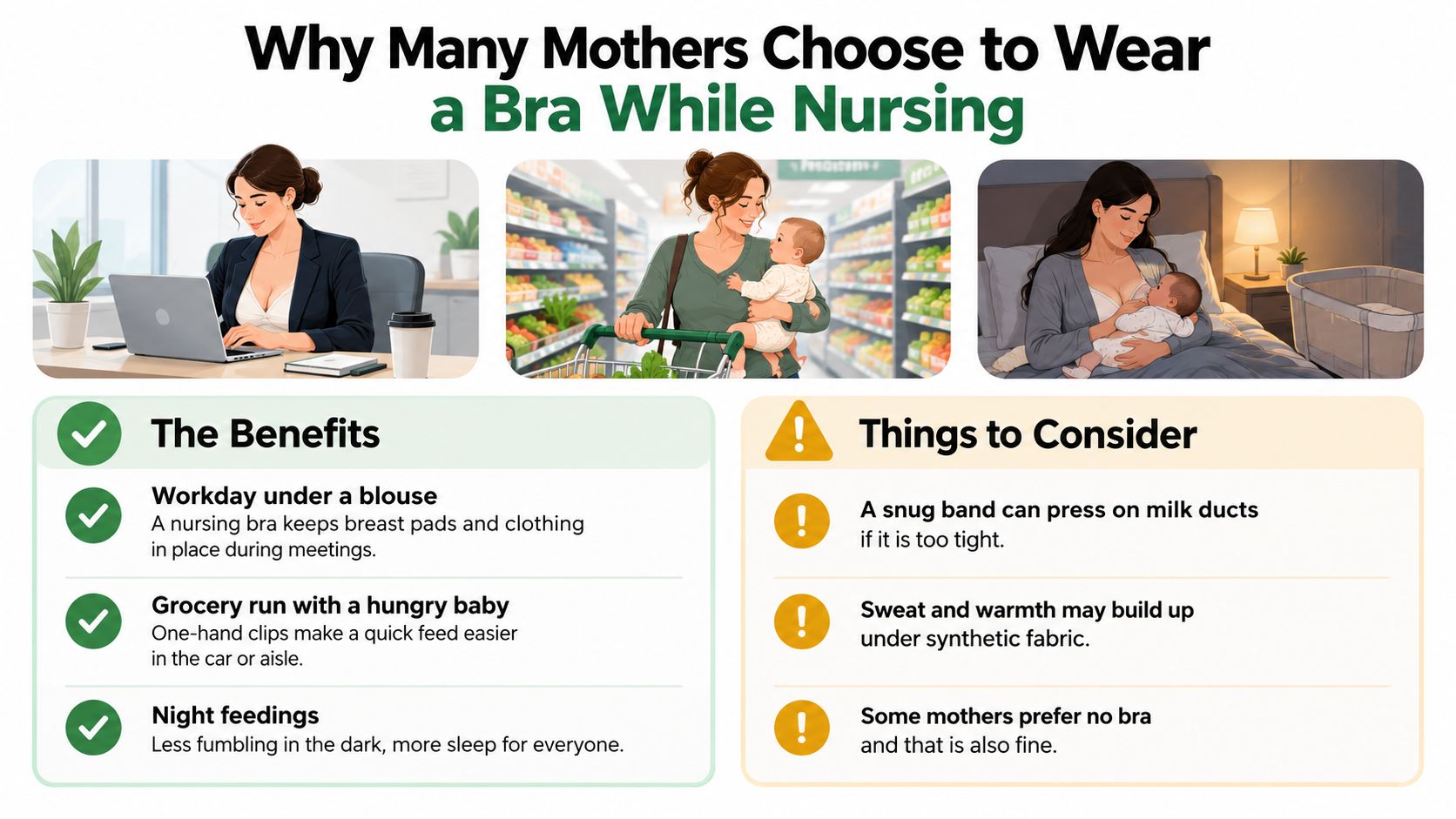
Why Many Mothers Choose to Wear a Bra While Nursing
By the time a work meeting runs long, a grocery bag digs into one shoulder, or a night feed begins in the dark, breast support can feel less like a style choice and more like a small practical aid. For some mothers, a bra gives nursing pads a place to stay, spreads breast weight across the torso, and keeps feeding access within reach. It can add order to a day that changes from one feed to the next.
Support during ordinary tasks
At work, a blouse can cling after a leak, nursing pads can shift, and fuller breasts can feel heavier as the hours pass. A comfortable band with wide straps may provide a steadier base without pressing into breast tissue. Support can also matter during longer upright stretches, such as a commute or a standing appointment, when breast weight gradually pulls on the shoulders.
During a grocery run, access may matter more than appearance. A clip-down or drop-down cup opens one side while the other remains covered. Since one arm may be holding your baby, a closure that works with one hand can reduce fumbling and repeated pulling.
At night, a soft nursing bra can keep pads in place and make the first movement toward a feed easier. Another mother may find that fabric, heat, or elastic interrupts sleep, making no bra the better choice. Night support is optional, not a test of commitment.
Comfort can be physical and emotional
Breastfeeding breasts may feel unfamiliar as fullness changes across the day. Gentle containment can make movement feel more settled, especially during a walk, an appointment, or time spent standing. As noted in the clinical guidance above, the useful question is whether the bra fits comfortably and avoids restrictive compression.
A nursing bra can also provide a little structure when your body, schedule, and clothing all feel in transition. That structure may support confidence as much as comfort. Later, when feeding routines become more familiar, you may want a different shape, firmer support, or a style that feels more like your usual wardrobe.
Use the bra as a situational tool:
- Wear one when movement, breast weight, or leaking makes support helpful.
- Skip it when fabric, heat, or pressure feels distracting or uncomfortable.
- Change styles when a bra works for one setting but feels wrong in another.
Your choice can change from morning to night and from the early postpartum weeks to later months. The goal is to make feeding and daily movement easier while letting comfort, fit, and personal style guide the decision.
When a Bra Can Work Against You
A bra may feel comfortable through one feed, then become restrictive as your breasts fill again. The issue is usually tight, prolonged, or localized pressure, not the simple presence of fabric around the breasts. A fit that feels fine in the morning may press by afternoon, when fullness and swelling have changed.
A small cup worn at peak fullness can press against the upper or outer breast. A rigid wire may rest on breast tissue instead of following the breast root. A sports bra can feel secure during exercise but become uncomfortable during let-down. Even a wireless bra may cause trouble if its elastic digs into one area.
Pressure matters more than the bra category
NHS guidance identifies pressure from a tight bra, bag strap, or tight clothing as a possible contributor to a blocked duct. The Academy of Breastfeeding Medicine mastitis guidance also advises avoiding deep breast massage, which can increase inflammation, swelling, and microvascular injury. Together, these points support a gentle response: remove the pressure, avoid forceful manipulation, and observe how your symptoms change.
The concern is not that every underwire bra causes mastitis. A wire that sits on breast tissue, a seam that rubs the same spot, or a band that becomes tighter as your breasts fill can create a problem. The discussion of underwire nursing bras is useful because it treats underwire as a fit question rather than an automatic rule.
A bra should support the breast around its shape, not press forcefully into it.
Signs the bra deserves suspicion
Look for a repeatable pattern instead of reacting to one moment of ordinary sensitivity. The bra may be contributing when:
- A tender area eases after you remove it.
- The same spot becomes uncomfortable in one particular style.
- The band or elastic leaves marks that remain after removal.
- A wire, strap, or seam presses directly on a sore area.
- Feeding hurts because the bra opening pulls, pinches, or rubs.
Stop wearing that fit and choose less restrictive support. In the early postpartum weeks, a soft, flexible option may suit changing fullness better than a structured style. Later, you can reassess as feeding patterns settle and your preferred shape or support changes.
Do not try to manage a worsening inflammatory problem by repeatedly buying different bras. A firm tender lump, increasing warmth, redness, fever, or flu-like symptoms needs medical attention. NHS guidance advises seeking care when symptoms are worsening or do not improve within 12 to 24 hours.
How to Judge Fit, Fabric, and Feel in the Fitting Room
The best fitting-room test is not standing still in front of a mirror. Your body moves, your breasts fill and soften, and a nursing bra has to work through all of those changes.
Start with the band. It should sit level around your body and stay in place when you lower your shoulders and gently move your arms. You should be able to slide two fingers beneath it without forcing them, but the band shouldn't feel loose enough to ride up. If the band feels fine before feeding but bites when you're full, try a more adjustable or flexible style.
Check each part separately
Straps should anchor the bra without digging into your shoulders. Adjust them so they provide stability, not lift through tension alone. If they keep falling, the band or cup may not be supporting correctly.
Cups should contain the breast without spillover at the top, sides, or underarm. Before feeding, the breast should fill the cup comfortably. After feeding, slight wrinkling can be normal, but there shouldn't be painful gaping, folding fabric over the nipple, or a hard edge pressing into the breast.
For an underwire, follow the shape of the breast root. The wire should sit around the breast, not on it, and it should not press into the upper outer breast or underarm area. If you feel a sharp point when you twist or lift your arm, treat that as a red flag even if the bra looks smooth beneath clothing.
Try the closure with one hand while the other arm is occupied. Open and close each nursing panel, then simulate bringing your baby to the breast. Access should be quick and calm, with no hard pull across sensitive skin.
Match fabric to the moment
Breathable cotton-modal blends can suit everyday wear. Stretch knits without seams may feel gentler for sleep or quiet days at home. Moisture-wicking fabrics can be useful in warm climates or when leaking and perspiration make the skin feel damp. Whatever the fiber, inspect the inside for rough seams, stiff elastic, or lace edges that rub.
Run the movement test:
- Raise both arms.
- Twist your torso from side to side.
- Sit down and stand up.
- Lean forward as if lifting your baby.
- Open the cup and imitate a feed.
Use the two-timing rule. Assess the bra once when your breasts are full and again after feeding. Your body may need more room at one point and more containment at another.
| What to Test | Pass | Red Flag |
|---|---|---|
| Band | Level, stable, and comfortable with two fingers underneath | Rolling, riding up, restricting, or leaving deep grooves |
| Straps | Anchored without digging | Sliding constantly or creating shoulder marks |
| Cups | Contain the breast at fullness without spillover | Cutting into tissue, gaping sharply, or rubbing |
| Wire or seams | Follow the breast root and avoid breast tissue | Pressing one area, pinching, or causing recurring soreness |
| Fabric | Breathable, soft, and comfortable when damp | Trapping heat, scratching, or holding moisture against skin |
| Nursing access | Opens smoothly with one hand | Pulling, snagging, or forcing the breast through a tight opening |
Postpartum sizing is temporary information, not a permanent verdict on your body. Recheck the bra as fullness and routines change. The guide to measuring for a nursing bra can help you take a fresh measurement, but your comfort during movement and feeding matters more than a number on a label.
Early Postpartum Versus Later Months
The bra that helps during the earliest days may not be the bra you want later. Early on, breasts can fluctuate quickly, sleep is interrupted, and feeding may feel like the central activity of the day. Gentle containment, stretch, and room for fullness usually matter more than a sculpted silhouette.
A soft sleep bra, bralette, or wire-free style can work well when you want nursing pads held in place without rigid structure. Choose enough room for your fullest point, and avoid assuming that a close fit is better just because it looks more supportive. If a bra feels comfortable only before feeding, it may not give your body enough flexibility.
As feeding settles into a more familiar rhythm, your needs may widen. You may want a bra that works under a blouse, offers a smoother shape beneath clothing, and still opens quickly for nursing. Support becomes connected to commuting, appointments, social plans, and time away from home, not just to breast fullness.
Later postpartum wear can include more structure when your body tolerates it. PETRA is described as featuring ultra-soft stretch lace, gentle underwire, and one-hand nursing access, making it an example of a more sculpted nursing silhouette for someone whose fit and comfort needs have changed. It shouldn't be treated as automatically suitable for every stage. The wire still needs to sit around the breast root, and any focal pressure is a reason to change the fit.
Style matters, too. A mother may begin with a bra chosen only for softness, then later want lace, shape, or a feeling of femininity again. That shift isn't vanity. It's part of reconnecting with a body that has been serving an enormous physical purpose.
The phase-based question is simple: what does your body need today, and what do you want your clothes to help you feel? The answer may change without meaning that anything has gone wrong.
Busting the Rigid Rules About Nursing Bras
Breastfeeding advice often gets repeated as a command, even when the underlying guidance is more nuanced. A better approach replaces absolute rules with observations you can make on your own body.
“Never wear underwire”
A more useful rule is to avoid any wire, seam, or strap edge that leaves a red line, presses a specific area, or reproduces pain between feeds. The evidence doesn't establish that every underwire bra causes mastitis. It does support avoiding excessive or localized pressure, particularly when breasts are full or sensitive.
“Never sleep in a bra”
Sleep in whatever leaves you more comfortable. If leaking, heaviness, or movement makes a soft sleep bra useful, choose a flexible style without constriction. If a bra interrupts rest or creates pressure, going braless is equally valid. Older guidance has differed, while newer clinical materials emphasize comfort and avoiding pressure rather than imposing one universal nighttime rule.
“One bra is enough”
A small rotation is more practical than relying on one bra for every feed, outing, leak, and wash cycle. A damp or sweaty bra can become uncomfortable, and repeated wear can make the fabric and elastic less forgiving. Keep options for sleep, everyday movement, and clothing that calls for a smoother shape.
“Tighter means more support”
Tightness isn't the same as stability. A wide, comfortable band and well-placed straps can distribute support more effectively than a squeezed fit. If you need to hold your breath, adjust the bra repeatedly, or remove it because one spot hurts, the bra is giving you information, not support.
The explanation of how nursing bras work is most helpful when you use it as a starting point. Let symptoms, movement, fullness, and feeding access guide the final decision.
Listening to Your Body and Your Future Self
Some discomfort is a cue to change the bra, not to push through it. Straps that slide, cups that gape after let-down, or elastic that leaves marks by evening usually mean the fit or construction is wrong for that stage. Remove it, check the fit when your breasts are full and again after feeding, then try a softer or less restrictive option if needed.
Other symptoms call for clinical advice. A tender red area that keeps its shape after feeding, repeated plugged ducts in the same place, nipple damage that keeps getting worse despite latch support, or a new breast lump should be assessed. Symptoms that spread beyond one area of the breast, or bring fever alongside a hard tender lump, need clinical attention rather than another fitting-room change, as the mastitis protocol cited earlier supports.
Your body can also tell you when a style has outlived its role. A bra that felt right in the early postpartum weeks may become too narrow as fullness patterns change. Another may feel too soft once longer days, more movement, or clothing that needs more shape return to your routine.
Breastfeeding changes identity as well as breast size. Early on, function may matter most. Later, elegance and confidence often matter again too. Wanting beautiful lingerie does not make you less focused on your baby, and choosing a soft bralette does not mean you have stopped caring about yourself.
Listen to the signal, not the rule. Change the bra when the fit changes, and bring in a qualified clinician or lactation professional when pain, inflammation, or a persistent lump goes beyond clothing.