

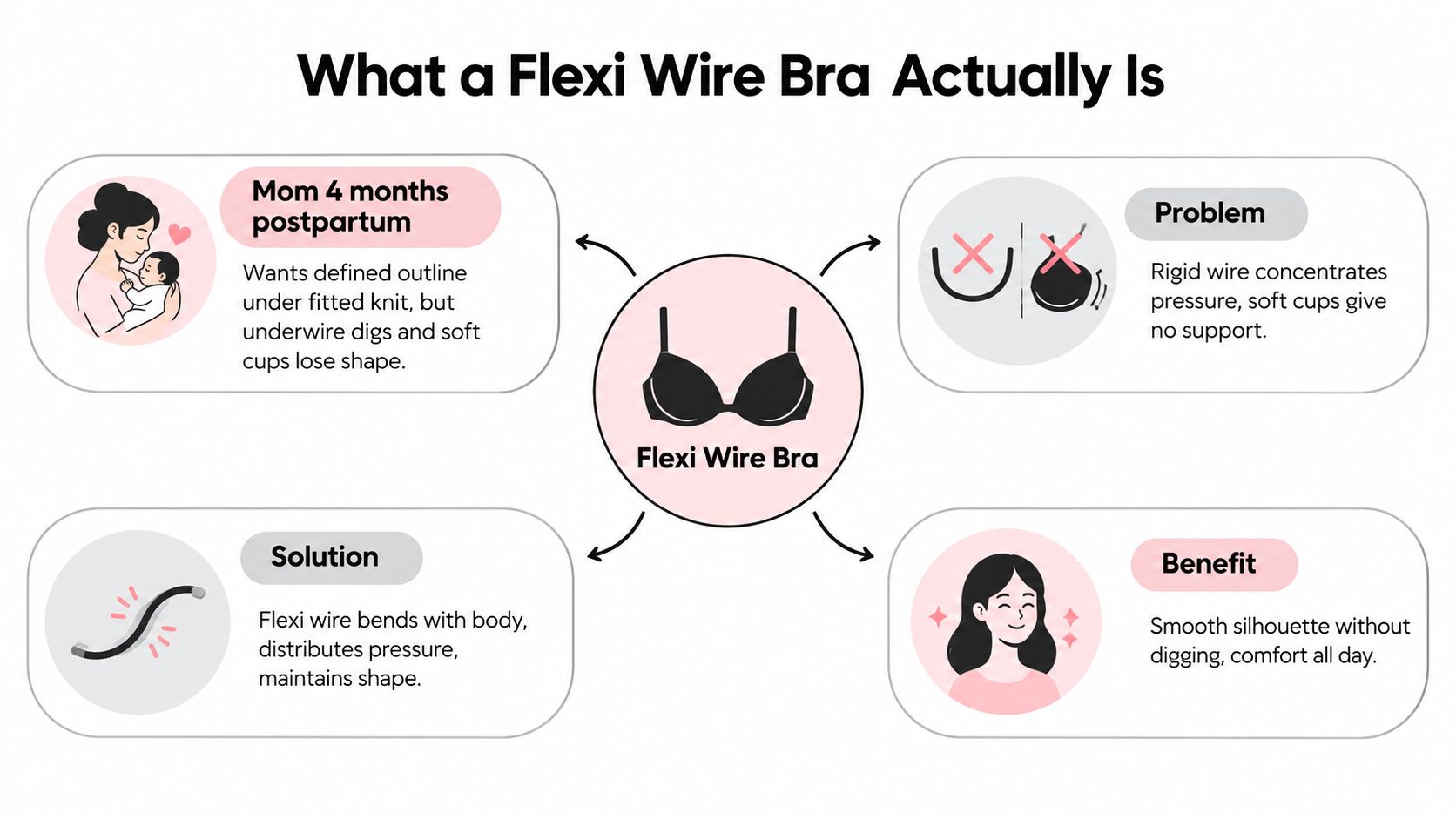
You're four months postpartum, standing in front of a fitted knit top, wanting your shape back without feeling trapped in your bra. Every rigid underwire digs into your ribs, while every soft cup feels comfortable but leaves you looking less supported than you'd like. That's exactly where a flexi wire bra can earn its place, but only if the timing and fit are right.
Flexi wire isn't a universal permission slip to wear structure at every stage of breastfeeding. It's a compromise between the defined lift of an underwire and the forgiving feel of a wireless nursing bra. The important questions are where the wire sits, how your body is changing, and whether your bra's band, cups, and straps work as a system.
What a Flexi Wire Bra Actually Is
A flexi wire bra is a nursing bra built with a flexible support element beneath each cup. The wire sits inside a sewn casing channel and follows the lower breast root, while its spring-tempered metal or coated composite construction allows more movement than a conventional rigid underwire. It's designed to bend with your body instead of forcing your body to conform to one fixed arc.
That distinction matters during breastfeeding. Breast volume can change between feeds, and your ribcage and breast shape may still feel unfamiliar after pregnancy. A rigid wire keeps its curve and can create a concentrated pressure point when the cup no longer matches your body. A flexi wire gives slightly, but it still creates an architectural frame beneath the cup.
The three support systems
Traditional underwire uses a firmer, fixed arc. It's excellent at creating lift and a clean outline, but its support comes from holding a stable shape. If the wire is too narrow, too short, or placed over breast tissue, it can dig in rather than support.
A wireless nursing bra has no structural wire. It relies on band tension, cup seams, stretch fabric, and sometimes inner slings to lift and contain the breast. That makes it the easier choice when your breasts feel tender, full, or unpredictable, though it generally creates a softer silhouette.
Flexi wire sits between those designs. It preserves directional lift from underneath, but the support arc has more give. The wire should rest behind the breast root on the chest wall, not on breast tissue. The casing needs to be secure, the ends should be capped or flattened, and the channel should prevent the wire from working its way through the fabric.
What flexi wire isn't
It isn't a posture device, and it isn't weightless. It also isn't the same as boning, memory foam, or a purely molded shaping panel. The wire supplies controlled support from below. It can improve outline and separation, but it can't compensate for a cup that's too small or a band that's riding up.
Fit rule: Flexible doesn't mean harmless when the bra is too small. A flexi wire sitting on breast tissue can create the same kind of pressure problem you're trying to avoid.
How Flexi Wire Got Here
The history of flexible nursing support starts with a basic design problem. Women wanted the breast to be lifted and shaped, but they also needed the support structure to move independently from the rest of the garment. In 1893, Marie Tucek patented a breast-supporting device with a rigid plate beneath the breasts, an early foundation for the underwire concepts used today. The modern underwire bra developed in the 1930s and became widely popular by the 1950s, according to the historical overview of underwire development in this account of the underwire bra's evolution.
Nursing introduced another constraint. In 1943, Albert A. Glasser received the first patent for a “nursing brassiere,” showing that designers were already working to combine structured support with breastfeeding access more than eighty years ago. A nursing cup couldn't function as one uninterrupted, fixed structure. It needed to open, drop, or move aside while still supporting the breast when closed.
Why the compromise became useful
Rigid underwire remained popular because it gives reliable lift and a polished outline. But breastfeeding bodies aren't static. A wire that feels acceptable when the breast is relatively soft may feel restrictive when the breast is fuller. That's why modern flexible-wire nursing bras use softer wire construction and more accommodating support layouts. The design goal isn't to remove structure. It's to make structure more responsive.
Market forecasts also show that underwire remains a substantial global category. One report valued the underwire bra market at USD 12.34 billion in 2024 and projected USD 15.67 billion by 2033, with a 4.2% CAGR from 2026 to 2033 in its forecast, while another estimated USD 14,500.75 million in 2024 and USD 25,200.45 million by 2032, implying a 6.42% CAGR from 2025 to 2032. These are projections from different market methodologies, not a guarantee about any individual product or postpartum shopper, but they help explain why manufacturers continue refining structured support. The market report outlines both underwire forecasts.
A soft, elegant nursing option such as GAIA reflects that direction through stretch lace, flexible support, and straightforward breastfeeding access.
Flexi Wire vs Underwire vs Wireless Nursing Bras
No support system wins every postpartum job. The right choice changes with breast sensitivity, feeding patterns, clothing, and how stable your size feels.
| Criterion | Traditional Underwire | Flexi Wire | Wireless Nursing |
|---|---|---|---|
| Support level | Strongest, with a fixed support arc | Structured support with more give | Gentle to moderate, based on band and cup construction |
| Comfort for daily nursing | Can feel restrictive if fit shifts | Usually the middle ground when correctly fitted | Most forgiving for tender or changing breasts |
| Shape under clothing | Most defined and lifted | Defined, with a softer feel than rigid wire | Softer outline and less projection |
| Ease of one-handed opening | Depends on clasp and cup design | Depends on clasp and cup design | Often simple, but varies by construction |
| Sensitive or engorged breasts | Lowest tolerance for fit errors | Better tolerance, but not risk-free | Usually the safest starting point for sensitivity |
Support and silhouette
Traditional underwire is the clear choice when maximum lift and a firm outline matter most. It can work well later in breastfeeding, but a fixed arc leaves little room for a changing breast shape. Flexi wire gives a more forgiving version of that same architecture. It's useful under fitted clothing when a wireless bra feels too relaxed, without pretending that flexibility eliminates fit requirements.
Wireless nursing bras win for softness and adaptability. Wide bands, seamed cups, and stretch fabrics can accommodate daily changes without a wire pressing into the lower breast. The trade-off is that they may offer less projection, separation, and definition.
Nursing access and real wear
Breastfeeding access doesn't depend on wire type alone. A rigid bra can have an excellent drop-down clasp, while a wireless bra can have an awkward opening. Test the clasp with one hand, because the other hand may be holding your baby or supporting the breast.
For early postpartum, choose the option that lets you feed, sleep, and recover without pressure. Later, a flexi wire becomes more useful when you want structure for work, outings, or fitted clothing. If you're comparing construction details, this guide to nursing bras with underwire can help you evaluate the difference between support and discomfort.
My verdict is simple. Wireless comes first for sensitivity. Flexi wire earns its place when your shape and comfort are steadier. Rigid underwire demands the most precise fit and gives you the least room for daily fluctuation.
Fit Engineering Behind Real Comfort
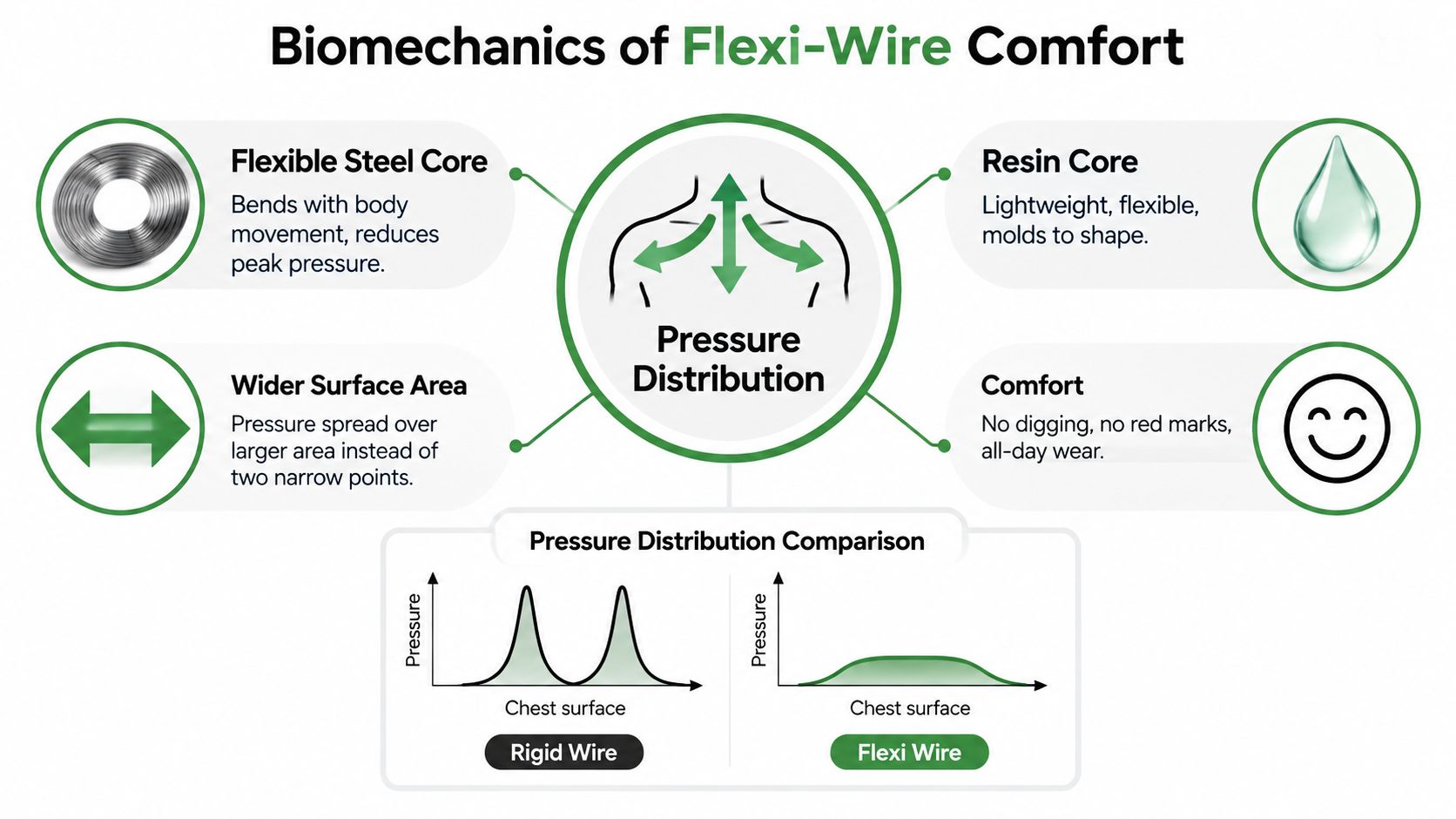
A flexible wire can reduce the feeling of a hard arc, but the wire is only one component of the bra. Pressure studies show that bands and straps can dominate the load profile, while material stiffness changes compression and tension across the garment. Research using a bra-manikin pressure system found pressure increased with rigid shoulder straps and bands, as well as with flexible cup material and underwire. Another study found that side-strap pressure changes with breathing and varies across body curves, especially during deeper breathing or after exercise. The ergonomic research explains why bra comfort must be engineered as a full system.
That means a flexi wire won't rescue a loose band, an over-tight strap, or a cup with the wrong depth. The wire needs to trace the breast root, but the band must anchor the bra and the straps must contribute support without carrying the entire load.
What to inspect in the mirror
Start with the band. It should feel firm on the loosest hook, sit level around your torso, and stay in place when you raise your arms. If it rides up, the band is too loose or the straps are doing too much work. If it rolls, cuts into your ribs, or makes breathing uncomfortable, the band may be too tight or too rigid.
Next, check the wire and cups:
- Wire placement: The wire should sit flat on the chest wall and follow the crease beneath the breast. It shouldn't rest on tissue, gap away from the body, or stab at the underarm.
- Cup projection: The breast should fill the cup without spilling at the top or leaving empty space near the apex. A shallow cup can push tissue outward even when the size label appears correct.
- Centre and side fit: The centre panel should lie close to the sternum, while the side wire should finish behind the breast tissue rather than on it.
- Strap behavior: If tightening the straps creates shoulder grooves but doesn't improve lift, the band or cup is carrying the wrong share of the support.
Independent bra-engineering research found that a customized underwire design produced significantly lower pressure at measured contact points and received higher comfort and support ratings than a conventional underwire. The reported results included p = 0.001 at the inner point, p = 0.009 at the upper-breast point, and p = 0.003 for total pressure, supporting the importance of wire geometry rather than relying on the label alone. The bra-engineering document reports these pressure and rating comparisons.
Your pre-purchase self-check
Wear the bra while sitting, standing, reaching, and simulating a nursing position. If the wire tips dig when you bend, if the band shifts when you lift your arms, or if the cups change shape when you lean forward, stop treating the discomfort as a break-in problem. Those are fit signals.
A good flexi wire should feel present but not aggressive. You should be able to identify its support without thinking about it every few minutes.
Right Time to Wear a Flexi Wire Nursing Bra
A flexi wire nursing bra can feel comfortable in the morning and restrictive after several feeds. Timing matters as much as wire type. Flexible construction reduces rigidity, but it cannot compensate for rapidly changing breast volume, an undersized cup, or pressure across the breast.
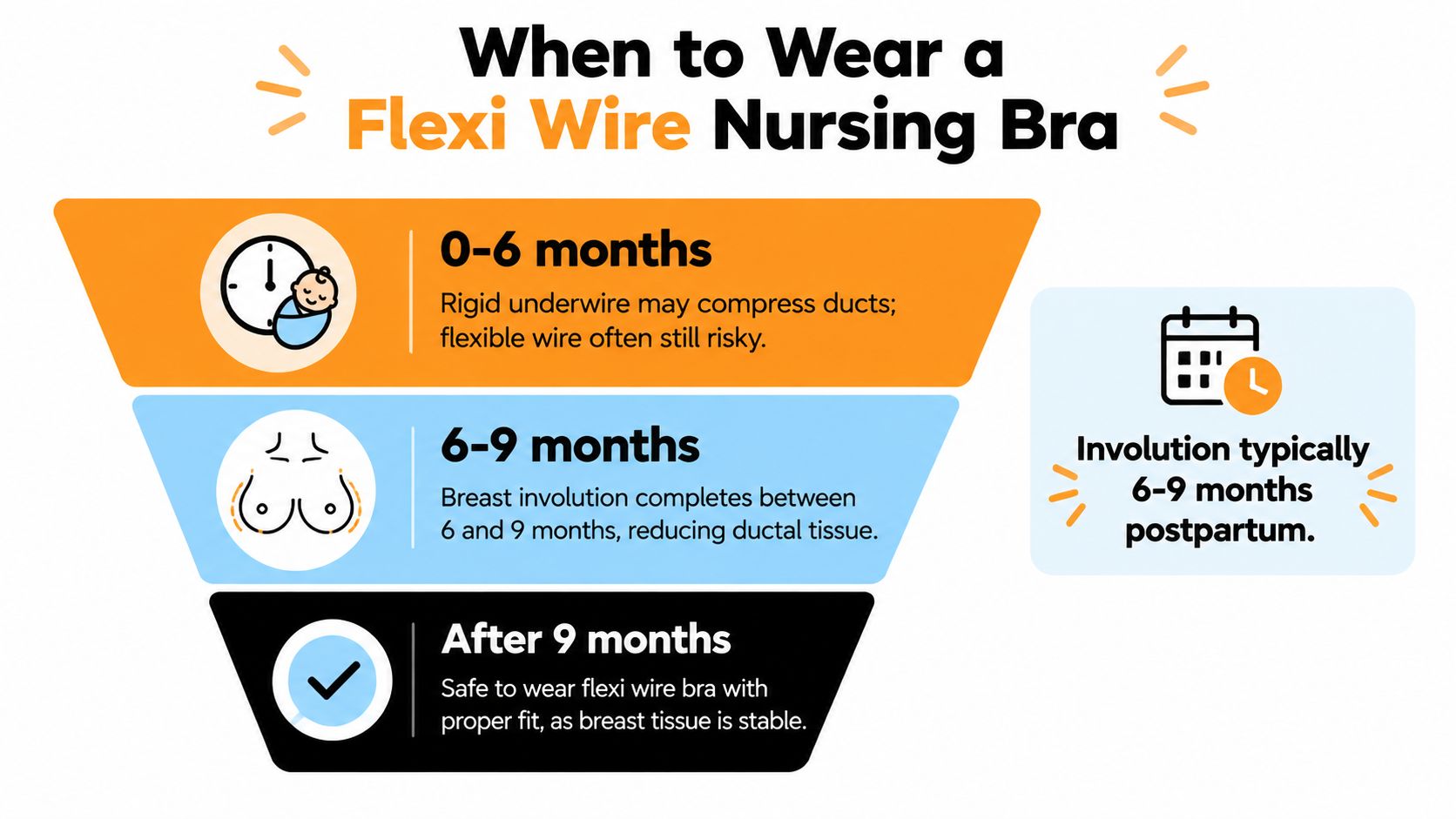
Early breastfeeding usually calls for a wireless or soft-cup style. Guidance varies, with some recommendations avoiding flexi wire during early pregnancy and the first 4 to 6 weeks postpartum, while others favor wire-free bras for the first 6 to 8 weeks. Another recommendation suggests non-flexi-wire styles in the week before delivery and for at least 2 to 3 weeks after birth. Treat these ranges as fitting guidance, not personal medical clearance. Your stage, feeding pattern, and fit determine the decision. The flexi-wire timing guidance highlights stage and fit as the central questions.
Use your body signals
Choose a wirefree nursing bra early postpartum if your breasts become full between feeds, your nipples are sore, or your size changes noticeably during the day. Frequent feeding and letdown can make a structured cup feel fine at one point and restrictive later. A soft cup gives changing tissue more room to move.
Trial flexi wire when your size is more predictable, fullness is easier to manage, and your current bra no longer provides enough lift for daily activity. Women with dense tissue or a larger bust may want structured support sooner. The answer is a well-shaped flexi-wire design fitted to the larger part of the day, not a rigid fashion bra that presses into the breast.
Later postpartum, breast involution is typically described as completing between 6 and 9 months postpartum, alongside more stable tissue and changing milk-production patterns. That can make flexible support easier to fit, though the bra still needs room for feed-related changes. The postpartum nursing-bra guide discusses this later transition and the need for flexible support.
Use this decision sequence:
- Early stage or active engorgement: Choose a soft cup or wireless bra.
- Changing size with improving comfort: Trial flexi wire for short periods, not a full day.
- Stable fit and predictable fullness: Wear it for work, outings, or fitted clothing.
- Pinching, red marks, lumps, or persistent soreness: Remove it and return to wireless while reassessing the fit.
“Flexible” on the label proves nothing by itself. Wear flexi wire when your body can tolerate its pressure, the cup fits at fullness, and the support improves your day rather than demanding constant adjustment.
Care Routine That Keeps the Wire Working
Flexible support depends on more than the wire's original shape. Repeated heat, twisting, and poor storage can strain the casing, elastane, and cup construction. Treat the bra as a fitted garment, not as ordinary laundry.
Before the first full day
Put the bra on and check the wire's curve against your inframammary fold. Don't force it into a new shape, but use warm hands to see whether the channel follows your body comfortably. Wear it for a short trial before committing to a full day, and test sitting, bending, reaching, and nursing access.
Wash by hand in lukewarm water with a pH-neutral detergent. Press water out with a towel rather than wringing the cups or twisting the wire channels. If machine washing is unavoidable, use a mesh laundry bag and a gentle cycle.
Dry and store carefully
Lay the bra flat on a towel, reshape the cups with your fingertips, and keep the wire channels straight. Air-dry it away from radiators and other direct heat. Heat can fatigue the wire's memory and degrade elastane, leaving you with less support even when the bra still looks intact.
For storage, nest the cups without folding one cup inside the other. Rotate between several bras so the elastic can recover between wears. With daily use, replace a bra when the band no longer anchors, the cups lose their shape, or the channel becomes uncomfortable. A product's useful life depends on wear and care, so don't treat a calendar as more important than the actual fit.
Troubleshooting: A poking tip often points to casing movement or shrinkage rather than a failed wire. Reshaping the channel under warm hands may help, but stop wearing the bra if the wire remains exposed or continues pressing into tissue.
Choosing a Flexi Wire Bra With Confidence
A flexi wire deserves a place in your later-postpartum wardrobe when it gives you shape without creating pressure hot spots. Don't buy it because “flexible” sounds reassuring. Buy it only after the bra passes a deliberate fit test.
Start by measuring your current body rather than relying on a pre-pregnancy size. This nursing bra measuring guide can help you establish a starting point, but postpartum bodies rarely fit neatly into one old measurement. Trial two nearby sizes whenever possible, especially if your ribcage and breast volume have changed at different rates.
The five checks I use
Band: Fasten it on the loosest hook. It should feel secure without restricting breathing or riding up when you move.
Wire: Trace the wire with your finger. It should follow the breast root on the chest wall, with no gap, pinch, or contact with breast tissue.
Cup: Simulate a feed, then let the cup return to position. Check for overflow, empty space, or breast tissue being pushed toward the underarm.
Straps: Adjust them so they stabilize the cup without digging into your shoulders. If the straps are doing all the lifting, reassess the band.
Clasp: Open and close the nursing clasp with one hand. If you need both hands and a mirror, the feature won't feel convenient during a real feed.
A good candidate should also have a protected wire channel, reinforced ends, a wrapped underband, and a cup interior that doesn't scrape sensitive skin. Stretch at the upper cup can accommodate ordinary changes, but it shouldn't replace structural support underneath.
Build a rotation, not a single solution
Use a soft wireless bra for sleep, early sensitivity, and days when your body feels unpredictable. Add a flexi-wire style for work or fitted clothing once your size and comfort are steadier. Choose a fuller-coverage option such as PETRA when you want stretch lace, gentle underwire, and one-hand nursing access in one structured nursing design.
The best flexi wire bra is the one you can wear without monitoring it. If you're adjusting the band every hour, checking for marks, or wondering whether a tender spot is connected to the wire, the bra hasn't earned a place in your rotation yet.
Milk&Lace offers structured nursing designs for the later postpartum stage, including flexible support, lace construction, and discreet breastfeeding access. Visit Milk&Lace to explore the collection and choose a bra that supports your current body instead of forcing it into an old fit.