

A crossover nursing bra is designed to keep your breasts supported while letting you pull the cup aside for feeding, pumping, or checking a nursing pad. The design makes particular sense as your body changes, since mean empty-breast volume declined from approximately 1.56 liters at 0.23 months postpartum to 1.28 liters at 11.82 months in a 2025 synthesis of postpartum measurements (Frontiers in Pharmacology).
By the third postpartum month, you may know exactly what you want from a bra, and still struggle to find it. The soft, bulky style that helped during the earliest feeds can start to feel more like equipment than lingerie, while a beautiful everyday bra may not offer the access you need. You want to breastfeed without wrestling with fabric, but you also want to look in the mirror and recognize yourself again.
A crossover nursing bra can bridge those needs. Its overlapping front panels create a pull-aside opening, often without a rigid clasp, while stretch fabric and a carefully built underband help maintain support. For later postpartum months, that balance matters. Convenience remains essential, but confidence, shape, and personal style begin to matter just as much.
Why Crossover Nursing Bras Matter After the Newborn Phase
At three months postpartum, Maya had stopped carrying every feeding essential from room to room. Her days had settled into a rhythm, at least compared with the earliest weeks. Yet her bras still belonged to that first stage: soft, high, practical, and designed around constant access. They worked, but they made her feel as though her wardrobe had been paused.
That feeling is common. Early nursing garments often prioritize softness, flexibility, and generous coverage because the body is changing quickly. Later, many women want a bra that can still support feeding and pumping while sitting naturally under a blouse, knit top, or dress. They aren't asking to leave motherhood behind. They're asking for clothing that recognizes the whole person wearing it.

A bridge between access and identity
A crossover front works through overlapping fabric rather than a full front opening. To nurse, you pull one side aside, creating access while the rest of the garment remains on your body. That differs from a front-clasp style, where a cup detaches from the strap, and from a pull-down style, where the entire upper cup moves below the breast.
The distinction becomes noticeable during a busy day. You can open the crossover with one hand, keep the opposite breast contained, and return the fabric when the feed ends. The design can feel less mechanical, especially when the front uses soft stretch lace or a smooth, recovery-oriented knit.
Milk&Lace positions its GAIA and PETRA nursing bras for this later postpartum need, combining lace with structured support and nursing access. The point isn't to replace softer early-stage bras. It's to offer another option when you want more shape and a more familiar lingerie feel without giving up practical access.
Practical rule: A nursing bra should serve the way you feed, move, and dress now, not only the way your body felt immediately after birth.
What later-stage shoppers should look for
A useful crossover bra needs more than a pretty overlapping neckline. Check for:
- Stable support: The underband should stay level instead of riding up when you walk or lift your baby.
- Controlled stretch: The fabric should open easily but recover rather than becoming loose after repeated use.
- Clear access: The panel should move far enough away for feeding without slipping back toward the latch.
- A wearable silhouette: The neckline and cup shape should work with the clothes you enjoy wearing.
This guide follows that progression, from the design's history and fit mechanics to the underwire question, style comparisons, and ways to wear a crossover nursing bra with confidence.
The Evolution and Engineering of Crossover Nursing Bras
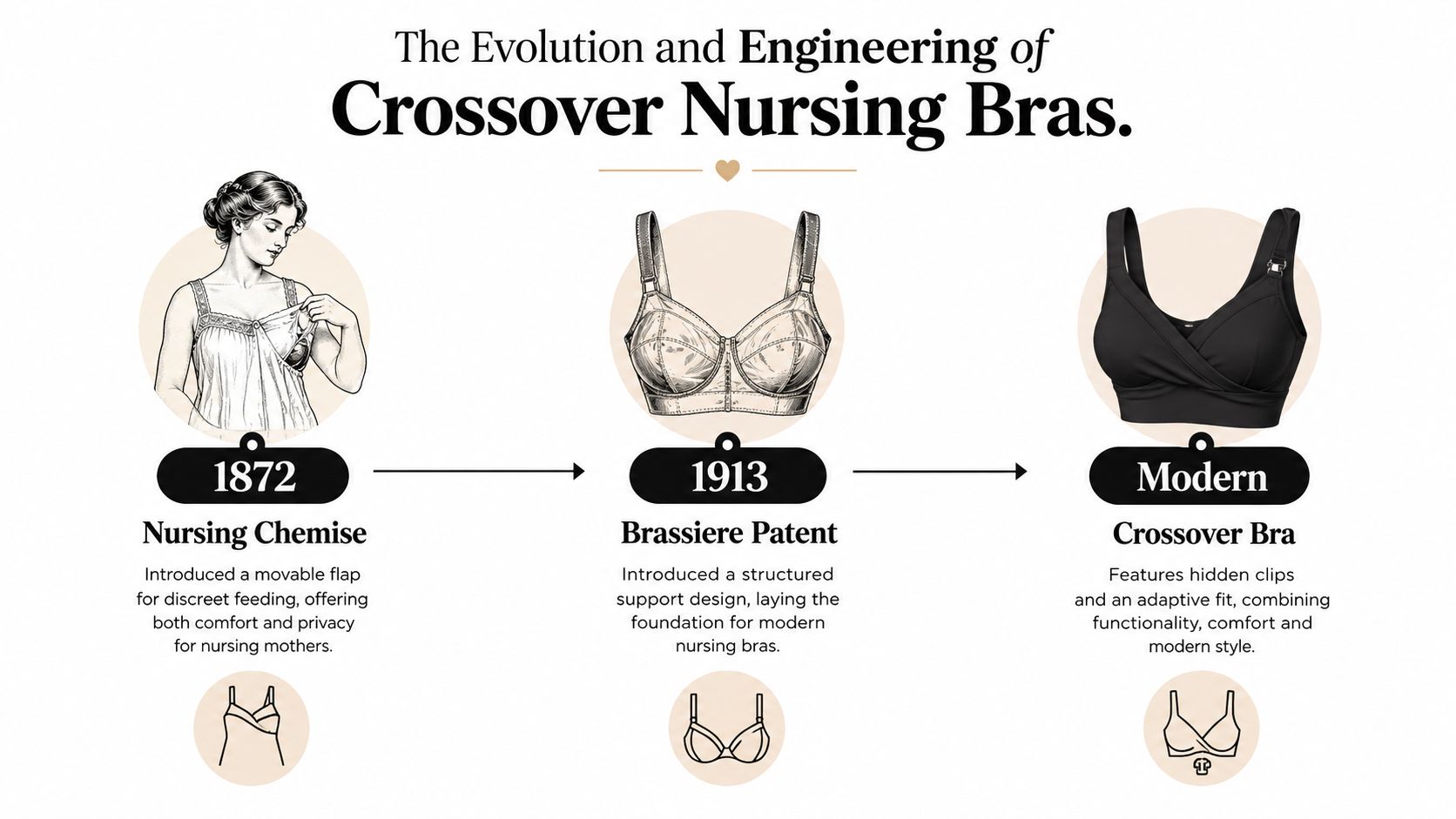
Nursing access in clothing predates the modern bra. Historical evidence records an 1872 nursing chemise with a movable flap, allowing a mother to expose the breast for feeding without removing the whole garment. That detail reveals a design problem that has remained consistent for generations: how can clothing protect modesty and preserve support while making feeding simple?
The modern brassiere's development began with Mary Phelps Jacob's 1913 U.S. patent, widely recognized as an important predecessor to today's bra. A dedicated device described as a “nursing brassiere” was patented in the United States by Albert A. Glasser in 1943. After World War II, the baby boom contributed to substantial expansion of the nursing-bra market, connecting demographic change with garment innovation. Later, Mary Sanchez received a 1991 patent for a fastening system intended to permit one-handed use and variable cup-size adjustment. These milestones are summarized in the history of the nursing bra.
The design principle stayed remarkably consistent
Those examples show that nursing garments haven't evolved by adding access as an afterthought. They developed around a central principle: maintain breast support while creating rapid, discreet access.
A modern crossover bra applies that principle through an overlapping front. The fabric crosses near the sternum, then lifts or pulls aside to expose one breast. A well-designed panel moves enough to clear the feeding area without dragging the entire cup sideways. That matters because the opposite breast can remain supported while you're nursing, pumping, or adjusting a nursing pad.
The mechanism also changes the experience of one-handed use. A clasp can be fast when it works smoothly, but it introduces hardware that must align and release. A crossover relies more heavily on fabric tension, seam placement, and recovery. If those elements are balanced, access feels immediate and the garment returns to its original position after feeding.
Engineering details you can feel
The most important construction features are easy to describe in practical terms:
- Stretch-lace or knit panels create movement without requiring a separate opening.
- A stable cradle and underband carry load around the torso instead of allowing the cups to collapse.
- Wide or padded straps distribute weight over the shoulders.
- A shaped side panel helps prevent breast tissue from escaping toward the underarm.
- Recovery-focused fibers help the garment return to shape after being pulled aside.
That combination explains why a crossover bra can suit active days. It isn't only a sleep garment, and it isn't a regular bra with a nursing label. Its construction treats access and support as connected mechanical requirements.
How Breast Volume Changes and What That Means for Fit
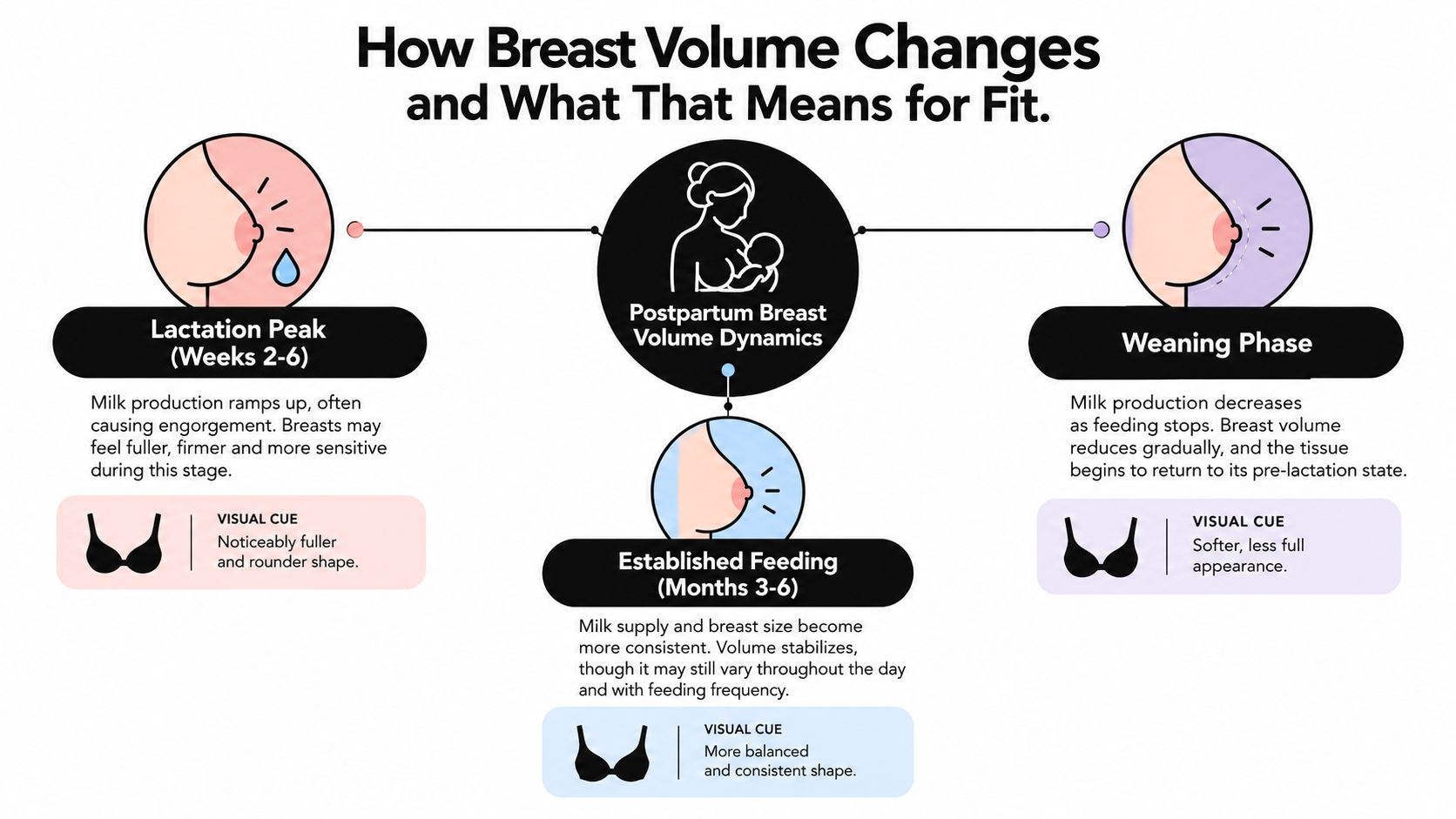
You may want a bra that looks polished again, not only one that works during the newborn phase. Yet a bra that feels right in the morning can fit differently after a feed, and a size chosen during early fullness may feel loose as lactation settles. Breast shape and volume keep changing, so fit depends on how the garment responds, not only on the label.
A 2025 synthesis of 36,689 measurements from 20,801 postpartum women found that mean empty-breast volume fell from approximately 1.56 liters at 0.23 months postpartum to 1.41 liters at 3.63 months, 1.38 liters at 5.83 months, and 1.28 liters at 11.82 months (the postpartum breast-volume synthesis). The authors described an approximately linear decrease over postpartum time. Individual bodies vary, but these time points explain why a pre-pregnancy size may stop predicting a comfortable fit, particularly in the later postpartum phase when you may want more shape and confidence from your clothing.
Read the bra, not only the size label
A crossover nursing bra needs to adjust like a garment with several working parts:
- The front needs stretch and recovery. It should move aside for feeding, then return without becoming slack.
- The straps should adjust. Changes in fullness and breast position affect lift, support, and neckline placement.
- The underband should provide more than one setting. A level, stable band forms the bra's foundation, while a shifting band can change the fit as you move.
- The crossover should open vertically or diagonally. If it pulls the cup too far sideways, breast tissue can lose containment and relatching may become awkward.
Measure before ordering instead of relying on an old size. Milk&Lace's guide to measuring for a nursing bra offers a systematic way to check your current measurements.
Fit check: With the bra fastened, the underband should feel firm without restricting you. Breast tissue should remain inside the cup or cradle, and the crossover should move aside without lifting the band.
Structure must remain gentle
Structured support can distribute weight more evenly when the bra has a broad cradle and stable side panels. Firmness should guide the breast rather than press into it. An underwire or firm lower edge should sit beneath the breast tissue, follow the inframammary fold, and leave the breast itself uncompressed.
Check the bra in more than one condition if possible. Try it after feeding, during ordinary movement, and when your breasts feel fuller. A flexible exchange policy helps because postpartum fit can change, and the most useful size is the one that supports you across those conditions, not merely the one that feels perfect at one moment.
The Underwire Debate - What the Evidence Says
Underwire is neither automatically appropriate nor automatically unsafe. The meaningful question is whether the wire and the rest of the bra fit without compressing breast tissue as your volume changes.
A systematic review found that lactational mastitis affects approximately one in four breastfeeding women during the first 26 weeks postpartum. Within the reviewed literature, tight-bra use was associated with increased mastitis risk in only three studies. That finding does not establish that underwire itself causes mastitis. The systematic review on lactational mastitis sits alongside guidance from the Academy of Breastfeeding Medicine recommending an appropriately fitting supportive bra, while our guide to underwire nursing bras explains the fit criteria in more detail.
When structure may make sense
After the newborn phase, some women want more lift, separation, or a smoother outline beneath clothing. A structured crossover bra may suit that stage when breast volume feels more predictable and a soft, wireless style no longer provides the desired support.
Timing still varies from person to person. During early milk establishment, fullness can change quickly. Later, fluctuations may continue, yet a carefully fitted structured bra may work well for selected parts of the day. The crossover front can also make feeding practical because access does not require removing the entire bra or leaving both breasts unsupported.
A practical wear test
Use this as a cautious garment-evaluation routine, not as medical advice or a guarantee:
- Start with short daytime wear. Choose a time when you can remove the bra easily if it feels uncomfortable.
- Check the lower edge. The wire or firm band should stay below the breast tissue and remain there during normal activity.
- Assess after feeding. Look for localized pressure, tenderness, persistent marks, or a cup pressing into a fuller area.
- Move naturally. Raise your arms, bend, and hold your baby. The wire should stay in place instead of shifting into the breast.
- Stop if symptoms persist. Remove the bra and seek qualified medical or lactation support if discomfort, tenderness, or other breast symptoms continue.
“Wire or no wire?” is less useful than asking, “Does this bra support me without compressing me as my body changes?”
A structured crossover nursing bra should earn its place through repeated comfort. Shape can support confidence and personal style, especially later postpartum, provided it does not bring pressure, restricted movement, or a band that stops following your body.
Crossover Versus Other Nursing Bra Styles
Every nursing-bra construction solves access differently. The best choice depends on whether your day involves frequent feeding, pumping, commuting, sleeping, or dressing in clothes that need a defined silhouette.
A front-clasp bra offers a clear release point. It can be quick when the clasp is easy to operate, but hardware adds another component to align and can feel noticeable if the shape or placement doesn't suit your body. A pullover style has fewer parts, yet pulling the fabric down may disturb the entire front of the garment.
A wireless tank gives softness and extra coverage. It can work well at home or under casual layers, but some women want more lift and separation than a long, flexible tank can provide. A crossover design sits between these options, using pull-aside access while retaining the possibility of a shaped cradle, adjustable straps, and a more lingerie-like neckline.
Nursing bra style comparison
| Style | Access Method | Support Level | One-Handed Use | Best For |
|---|---|---|---|---|
| Crossover | Pull fabric aside | Moderate to structured, depending on cradle and materials | Often easy when stretch and recovery are balanced | Later postpartum days that combine feeding, movement, and style |
| Front-clasp | Release cup from strap | Moderate to structured | Fast when the clasp is easy to align | Shoppers who prefer a defined opening |
| Pullover | Pull the cup or front panel down | Soft to moderate | Simple, but may move more fabric | Relaxed wear and uncomplicated routines |
| Wireless tank | Lower or pull aside the upper layer | Soft to moderate | Varies by opening design | Home wear, layering, and extra torso coverage |
Match the mechanism to the routine
For repeated one-handed feeds, crossover access can reduce fiddling because there isn't a clasp to locate. During pumping, the priority may shift toward a stable cup and a clean opening that doesn't collapse into the breast shield. For sleep, a softer pull-aside style may be more comfortable than a structured bra.
If you like a more traditional neckline and lifted shape, compare the crossover with a balconette nursing bra, since neckline geometry changes how a bra behaves under low-cut or fitted clothing. The important distinction is that no style is universally superior. The right design reduces the specific friction you encounter most often.
Styling and Confidence Beyond Function
A crossover nursing bra can change how an outfit feels before anyone else sees it. The difference may be subtle: a neckline that sits where you expect, lace that looks intentional, or support that lets a blouse fall smoothly instead of pulling across the bust.

For later postpartum dressing, start with the clothes you already reach for. A low-cut top can work with a crossover neckline that feels deliberately visible. A cardigan creates an easy layer for feeding access, while a close-fitting knit benefits from smooth cup edges and a band that doesn't fold. Color matters too. Black, beige, soft rose, or another shade you like can make the bra feel like part of your wardrobe rather than a temporary solution.
The GAIA and PETRA designs from Milk&Lace combine stretch lace with structured nursing construction for women who want a more lingerie-inspired option later in postpartum. Their purpose is practical, but their visual language belongs to everyday underwear, not only to hospital bags and the earliest weeks.
Let the bra support your self-image
Motherhood changes routines, bodies, and priorities. It doesn't erase the desire to feel attractive, composed, or expressive. Choosing a nursing bra with care can be a small way to acknowledge that your identity has expanded rather than disappeared.
Use the earlier fit checks before choosing a structured option. Confirm that the band stays level, the crossover opens cleanly, and the lower edge doesn't press into breast tissue. Then style it as you would any other favorite lingerie piece, with clothes that reflect your taste instead of hiding the fact that you're still breastfeeding.
This short visual offers another way to think about nursing lingerie as part of an active, changing wardrobe.
A well-chosen crossover nursing bra doesn't ask you to choose between access and elegance. It gives you room to feed your baby, move through your day, and reconnect with the parts of your style that still feel like home.
Milk&Lace offers the GAIA and PETRA nursing bras for later postpartum wear, with stretch lace, structured support, and discreet crossover-style access. Visit Milk&Lace to explore the collection and choose a nursing bra that supports both your changing body and the way you want to feel in your clothes.