

The first weeks of breastfeeding can make every clothing decision feel practical. You reach for the softest bra, the easiest clasp, and anything that tolerates a changing body without asking much of you. Then, one morning, your baby is content after a feed, you have a few quiet minutes, and you find yourself wanting something different. Not less comfortable, just more like you.
That's where a balconette nursing bra can fit into your wardrobe. It isn't usually the first bra a new mother needs during the most changeable days. It's a more considered option for the stage when feeding access still matters, but support, shape, and personal style matter too.
The Postpartum Moment When You Want to Feel Like Yourself Again
A mother might notice the change while getting dressed for a simple outing. She has a soft nursing tee, practical trousers, and a baby bag ready by the door. The essentials work, but she misses the small ritual of choosing lingerie because it makes her feel polished, feminine, or confident.
That feeling deserves attention. Postpartum dressing isn't only about hiding a changing body or solving feeding logistics. It can also be about reconnecting with the person who existed before the interrupted sleep, the leaking pads, and the constant calculations around the next feed. A beautiful bra won't solve the difficult parts of early motherhood, but it can give an ordinary morning a more personal starting point.

Why this stage calls for a different kind of bra
The earliest feeding period often brings noticeable fullness changes, sensitivity, and uncertainty about fit. Later, many women begin looking for a bra that can move beyond minimum utility while still offering straightforward nursing access. That's the space a balconette nursing bra is designed to occupy.
The category itself is no longer limited to purely functional basics. One market estimate places the global nursing bra market at about $3.2 billion in 2025, with a projection of $5.1 billion by 2034 and a projected 6.2% compound annual growth rate, according to Market Intelo's nursing bra market data. The same estimate identifies padded nursing bras as the largest share at 28.5%, while Asia Pacific accounts for 38.2% of revenue, suggesting that shoppers are already choosing among distinct levels of shaping, padding, and style.
You may be in this second-stage moment if you're ready to wear lower necklines again, want more definition under clothes, or miss seeing something elegant when you get dressed. The right choice still begins with comfort and fit. It just recognizes that comfort doesn't have to mean giving up beauty.
What Makes a Bra a Balconette in the First Place
A balconette cup sits lower and wider than a full-coverage cup, with straps set farther apart. This creates an open neckline and lift anchored in the lower cup and band. For postpartum dressing, that shape can feel like a later-stage option: less about getting through the earliest feeding changes, more about choosing a silhouette that suits your clothes and comfort now.
The main differences are easy to see:
- A full-coverage nursing bra rises higher over the breast and creates a more enclosed outline.
- A plunge bra angles sharply downward at the center, forming a deeper V shape.
- A balconette bra follows a broader, more horizontal line, leaving the upper bust visually open.
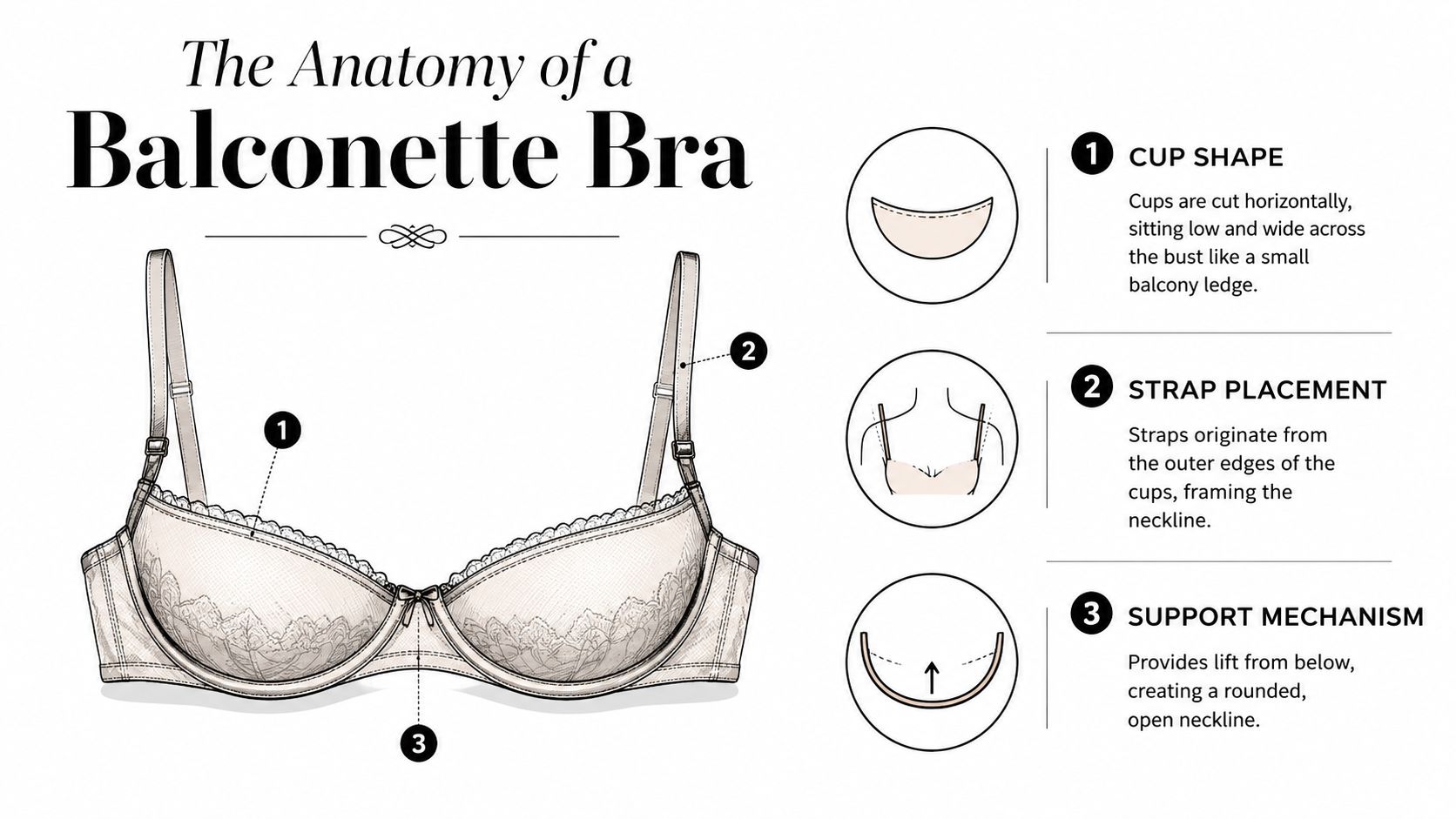
The parts that create the silhouette
The cups are lower and wider, framing the upper bust instead of covering it completely. In a nursing version, the cup or upper section still needs to move aside without making feeding awkward. A half-opening or drop-cup mechanism can preserve the balconette shape while keeping access practical.
The band circles the ribcage and supplies much of the steady support. It should stay level from front to back. If it rides upward, shortening the straps only masks the fit problem rather than correcting it.
The wire, when present, follows the breast root. It should surround the breast, not rest on breast tissue. Fit and timing matter here. A well-fitted underwire may feel different from an underwire that presses, shifts, or meets changing breast fullness at the wrong stage.
The straps sit farther apart than those on many full-coverage styles. That placement helps form the open neckline, but check that the straps remain comfortably on your shoulders as you reach, bend, and feed.
Finally, the nursing clip should release with one hand and lie flat when closed. A good clasp should not create a hard ridge beneath a thin top. If soft lace, stretch, and flexible support appeal to you, GAIA offers that gentler interpretation of nursing lingerie, with breastfeeding access built into the design.
Why Postpartum Mothers Choose This Silhouette
A balconette nursing bra can change an outfit's visual line before anyone notices the bra itself. Lower, wider cups open the neckline, while wide-set straps create more space across the upper chest. Beneath a V-neck or wrap top, that shape may look more intentional than the high, straight edge of a full-coverage style.
For many mothers, this makes the balconette a second-stage postpartum garment. Early feeding often calls for soft, flexible support that can accommodate frequent changes. Later, as feeding patterns and breast fullness become more predictable, a structured silhouette may help familiar clothes feel wearable again.
A fitted knit can follow the body more smoothly. A blazer may look more balanced when the bust has clear support underneath. Even a simple top with high-waisted jeans can feel styled rather than merely practical.
Small wardrobe wins add up
| Outfit | What the balconette shape contributes | What to check |
|---|---|---|
| Soft tee and high-waisted jeans | A clean, lifted line under a relaxed top | Look for cup edges that stay smooth |
| Wrap dress | An open neckline that works with the dress shape | Make sure the straps don't show when you move |
| Blazer and camisole | Definition beneath a more structured layer | Check that the nursing clasp lies flat |
| Fitted knit | A rounded outline without excess fabric at the upper bust | Confirm that the cups don't cut in |
These styling benefits are about giving clothes a supportive foundation while postpartum proportions continue to settle. They are not about making your body resemble its pre-pregnancy shape. Your body does not need correcting before it can look beautiful.
A useful style test: If the bra makes you want to wear more of the clothes already hanging in your wardrobe, it's doing more than providing support.
Comfort still sets the boundary. The Bump reports that 81% of survey respondents ranked comfort as the top feature in a nursing bra, as summarized in the research on maternity and nursing bra fit. That preference can sit alongside elegance. Soft materials, adaptable construction, and a flattering shape can serve the same purpose: helping the bra feel good through ordinary movement and feeding.
Lace and an open neckline are not frivolous postpartum choices. They can remind you that your identity has expanded rather than disappeared. You are still feeding your baby, while also dressing for a meal with friends, a return to work, a walk through town, or a quiet moment in the mirror that belongs only to you.
The Underwire Conversation Every Mother Deserves to Hear
Underwire safety is often presented as a simple yes-or-no question. The more useful question is whether the bra fits correctly, whether your breasts are still changing sharply throughout the day, and whether your personal history calls for extra caution.
Independent breastfeeding guidance notes that there's no scientific evidence directly linking underwire bras to breastfeeding problems, while also explaining why a poorly fitted wire can create pressure. The National Childbirth Trust's guidance on maternity and nursing bras stresses that the wire should sit flat around the breast and never press on breast tissue. Breasts can change size between feeds, so a rigid wire becomes more problematic when it has little room to accommodate fullness.
Timing changes the conversation
Many professionals advise avoiding underwire during the first six weeks postpartum, when engorgement and rapid size changes can make a structured fit difficult to maintain. That doesn't mean every mother must avoid structured bras indefinitely. Once feeding patterns and supply feel more stable, an underwire balconette can become a reasonable option if it remains comfortable and correctly positioned.
Your own history matters. If you've had clogged ducts, mastitis, significant tenderness, or recurring pressure points, discuss structured bras with a lactation professional or healthcare provider before making them part of your daily rotation. A bra that feels attractive but leaves a persistent mark isn't the right bra for that day.
Use this quick audit when trying one on:
- Wire position: It should encircle the breast and rest in the fold beneath it, not on breast tissue.
- Underarm edge: The wire shouldn't dig into the side of the breast or pinch toward the armpit.
- Center and cup: Gaping can signal a cup shape or size mismatch, while spillage suggests the cup is too small or too shallow.
- After-wear response: Remove the bra and notice whether pressure, soreness, or unusual tenderness remains.
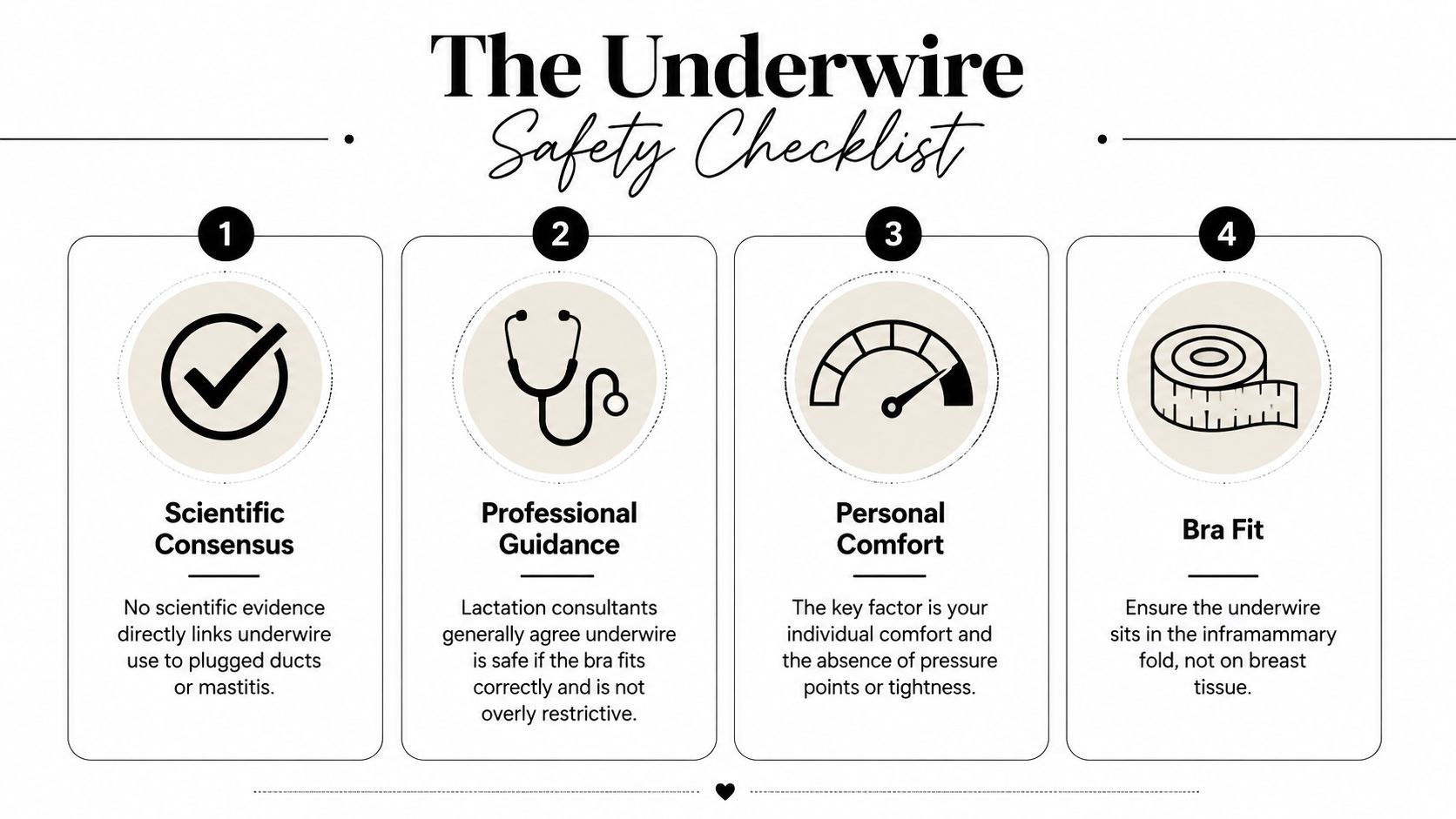
A structured nursing bra should support your routine, not ask you to ignore your body. For a focused discussion of construction and fit, read this guide to nursing bras with underwire.
This visual guide offers another way to review the basic checks:
How to Measure, Fit, and Self-Check at Home
Fit is easier when you treat it as a series of observations rather than a single number. Your body may continue to change after birth, and breastfeeding fullness can vary between feeds. Take measurements when you're reasonably comfortable, wear a lightly supportive bra if needed, and remember that the result is a starting point, not a verdict.
Begin with the band
Wrap a soft measuring tape snugly around your ribcage, directly beneath the breasts. Keep the tape level across your back, breathe normally, and avoid pulling so tightly that it compresses the skin. The band should feel secure when fastened on a comfortable setting, with enough room to adjust as the elastic relaxes.
Measure around the fullest part of your bust without flattening the tissue. If your fullness changes noticeably between feeds, make a note of that pattern. A bra that fits at one moment but becomes restrictive after feeding may not be flexible enough for your current stage.
For a detailed measuring walkthrough, use this guide to measuring for a nursing bra.
Read the bra, not just the tape
When you try on a balconette nursing bra, fasten the band on the loosest hook so you have adjustment room. Stand naturally, lift your arms, bend forward, and sit down. Each movement reveals a different part of the fit.
Look for these signs:
- A level band: The back should stay roughly parallel to the floor instead of creeping upward.
- A settled cup: The breast should fill the cup without spilling at the top, center, or sides.
- A clear wire path: The wire should follow the breast root and remain outside the tissue.
- Stable straps: Straps should stay in place without carrying the entire weight of the breasts or digging into the shoulders.
- Functional access: Release and close the nursing clip with one hand. You shouldn't need to twist your body or pull hard at the cup.
| What you notice | What it may mean | First adjustment |
|---|---|---|
| The back rides up | The band may be too loose | Try a firmer band or a smaller band with a roomier cup |
| Spillage at the center or top | The cup may be too small or shallow | Try a larger cup or a deeper cup shape |
| A side bulge near the wire | The wire may be too narrow | Look for a wider wire or different cup construction |
| Empty space at the top | The cup may be too tall or too open for your shape | Try a shorter cup or adjust the strap tension |
| Straps dig in | The band may not be providing enough support | Recheck the band before loosening the straps |
A mirror check helps, but your skin gives useful information too. Red marks that fade quickly can occur with close-fitting clothing. Persistent indentation, pain, or pressure on breast tissue deserves a different size, a different style, or a pause from underwire.
Styling the Balconette With the Clothes You Already Own
The easiest way to judge a balconette nursing bra is to place it inside real outfits. Start with a soft tee and high-waisted jeans. The bra's lower, horizontal cup line can create a cleaner foundation than a high-coverage style, while the tee softens the overall look for errands or a coffee run.
For dinner, try a silk-blend camisole or another fluid layer. Wide-set straps may show depending on the neckline, so treat them as part of the outfit only if that feels deliberate. If you want them hidden, choose a camisole with a wider shoulder line or layer a cardigan over it.
Four outfits, four practical checks
A wrap dress often works naturally with the balconette shape because both garments create an open neckline. Before leaving home, move your arms forward and sit down to make sure the straps and nursing clip remain covered.
For a workday, place the bra under a blouse and blazer. The blazer can provide visual structure, while the bra helps the blouse fall smoothly over the bust. Keep an eye on the center clasp if the blouse is thin or close-fitting.
A fitted knit is more revealing of cup edges than a loose sweater. Choose a smooth outer layer or test the garment in daylight before wearing it out. Lace can be beautiful beneath knitwear, but a textured edge may need a slightly heavier fabric above it.
Color also changes the experience. A skin-toned shade can disappear beneath pale clothing, while mauve, deep rose, or another muted color can become a private detail that lifts your mood even when no one else sees it. Lace doesn't have to mean delicate or impractical. Stretch lace can offer visual softness while the band, cup, and nursing mechanism handle the functional work.
The right styling question isn't whether the bra looks visible. It's whether its lines, color, and access points cooperate with the clothing you already enjoy wearing.
Caring for Lace, Elastic, and Shape Between Feeds
A nursing bra often works hard. It may be worn through feeds, naps, errands, and the occasional spill, so gentle care protects both comfort and shape.
Hand-washing is the safest option for delicate lace and elastic. If you use a washing machine, place the bra in a mesh laundry bag, choose a gentle cycle, and use cool water with a mild detergent. Fasten the nursing clasp before washing so it doesn't catch on lace or stretch the fabric.
Keep heat away from elastic
A dryer can weaken elastic and make lace lose its softness. Press water out gently rather than twisting the cups, then lay the bra flat on a towel to dry. Don't hang it by the straps while it's wet, since the weight can pull on the shoulder elastic and distort the shape.
A small rotation makes daily care easier. Two bras allow one to dry and recover while you wear the other, reducing the pressure to wash and dry the same garment repeatedly in a hurry.
Retire a bra when the band has lost its recovery, the cups no longer hold their original shape, or the underwire begins poking through its casing. A stretched-out bra can feel uncomfortable even when its original size was correct. A damaged casing also creates a pressure point that shouldn't be ignored, especially during breastfeeding.
Choosing Between GAIA and PETRA for Your Postpartum Stage
The choice between these two styles comes down to the kind of support and sensation you want today, not to a universal ranking. One mother may want fabric that adapts gently as her size continues to fluctuate. Another may be ready for a clearer, more sculpted balconette line during a busy day.
Start with three honest questions
Where are you in your postpartum journey? If your body still feels changeable and you want an easier, softer entry into structured nursing lingerie, GAIA's stretch lace and flexible support may feel more natural. If your shape has become more predictable and you're looking for a defined silhouette, PETRA's gentle underwire may better match that intention.
What does your day require? GAIA offers stretch and breastfeeding access for a softer everyday feel. PETRA features one-hand nursing access alongside its gentle underwire, which can be useful when you're feeding while carrying a baby, managing a bag, or moving through a crowded routine.
How do you want to feel when you see yourself? Choose the style that supports the emotional result you're seeking. GAIA leans toward breathable, adaptive comfort. PETRA leans toward structure and a classic balconette outline.
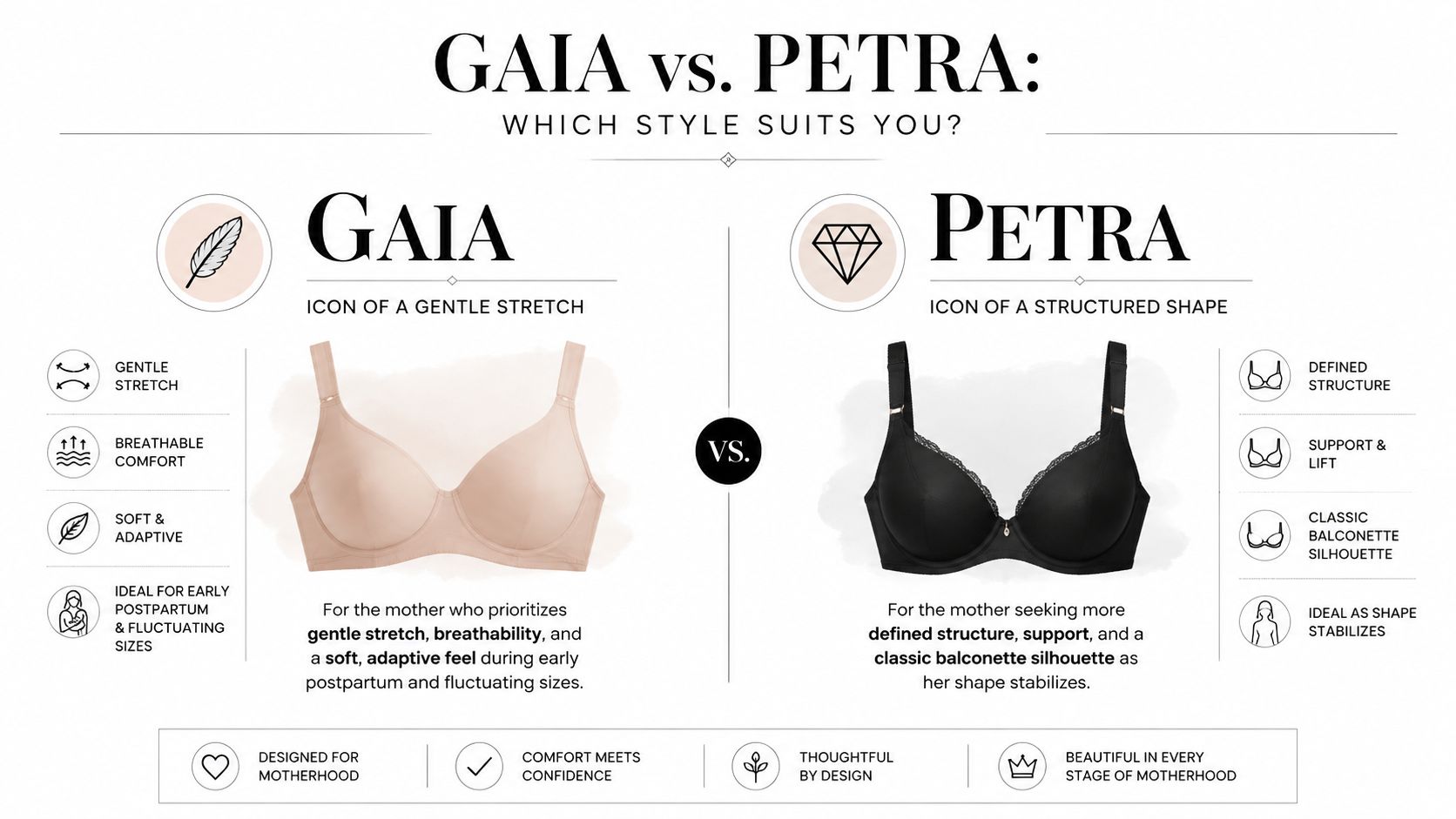
| Your priority | A natural starting point |
|---|---|
| Gentle stretch and an adaptive feel | GAIA |
| Flexible support with elegant lace | GAIA |
| More defined structure | PETRA |
| Gentle underwire and one-hand access | PETRA |
| A later-postpartum wardrobe refresh | Either, guided by fit and comfort |
The broader category shows why this choice matters. Market researchers use different definitions and methods, but their forecasts consistently describe sustained expansion, from a $530 million global market estimate in 2024 to $903.64 million by 2030, a separate estimate of $1.19 billion in 2024 rising to $1.66 billion by 2032, and a nursing and maternity bras estimate of $2.53 billion in 2024 reaching $5.50 billion by 2030, as reported in Deep Market Insights' nursing bras market overview. Those differing baselines shouldn't be combined as one measurement, but they do show a category broad enough to include comfort-led and style-led needs.
A balconette nursing bra doesn't replace the soft, uncomplicated bra that carried you through the earliest feeds. It marks a different chapter, one where supporting your baby and returning to yourself can happen in the same outfit.
Milk&Lace offers nursing lingerie that pairs breastfeeding access with soft lace, flexible support, and more structured silhouettes for later postpartum wear. Visit Milk&Lace to explore GAIA and PETRA, then choose the style that helps you feel comfortable, supported, and recognizably yourself again.