

You're dressed, the baby is fed, and you're already late. Then your bra starts digging into your ribs, the cups feel wrong, and the soft nursing bralette that worked beautifully during those first exhausting weeks makes your outfit look shapeless. You don't need another reminder to prioritize comfort. You need a bra for mom that supports the life you're returning to, including work, errands, movement, feeding, and the simple pleasure of feeling attractive again.
The right choice changes with your stage. Pregnancy, early postpartum, and later postpartum each ask something different from lingerie. A bra that accommodates tenderness and frequent feeding may not offer the lift you want under a blouse. A beautiful structured style may feel premature during the earliest weeks, but exactly right once your body and routine begin to settle.
Finding Your Moment in Motherhood and What Your Bra Should Do Now
You leave the house with a fed baby, a real outfit, and a schedule that no longer revolves around the next feed. Then your old nursing bra flattens your shape under a blouse, while a structured bra feels too rigid for your changing body. That is the later postpartum shift. You want reliable support, practical access, and a visible sense of yourself again.

Pregnancy often calls for flexible cups and a forgiving band. Early postpartum usually favors soft fabrics, stretch, and quick nursing access. Later, your bra should do more than accommodate change. It should hold your shape beneath everyday clothes, stay comfortable through errands or work, and let you feed without changing your whole outfit.
The market reflects how long this need lasts. The global nursing and maternity bras market is estimated at about USD 1.5 billion in 2026 and projected to reach USD 2.2 billion by 2035, with an estimated compound annual growth rate of around 4.5%, according to Business Research Insights' nursing and maternity bras market overview. Mothers need different bra functions as routines and bodies change, not one design for every stage.
The category also has a long practical history. Mary Phelps Jacob received the first U.S. bra patent in 1913, while Albert A. Glasser filed a patent specifically for a nursing brassiere in 1943, as documented in the history of the nursing bra. Today's useful designs bring those priorities together: access for feeding and styling that belongs in ordinary life.
Identify the chapter you're dressing for
Ask what your body and wardrobe require today. You may still need room for fluctuation and sensitivity. You may also want more lift, a cleaner silhouette, or a bra that feels attractive under your regular clothes.
The best bra for mom isn't the one that works forever. It's the one that works honestly for this chapter.
Comfort remains part of the standard, not the entire goal. Choose a bra for mom that supports feeding when needed, works with your daily clothes, and helps you feel like yourself as motherhood expands beyond the newborn phase.
How to Assess Your Stage Support Needs and Daily Life
Before you browse lace, clips, bands, or underwire, make a short needs profile. Your body and routine should choose the bra, not a generic recommendation.
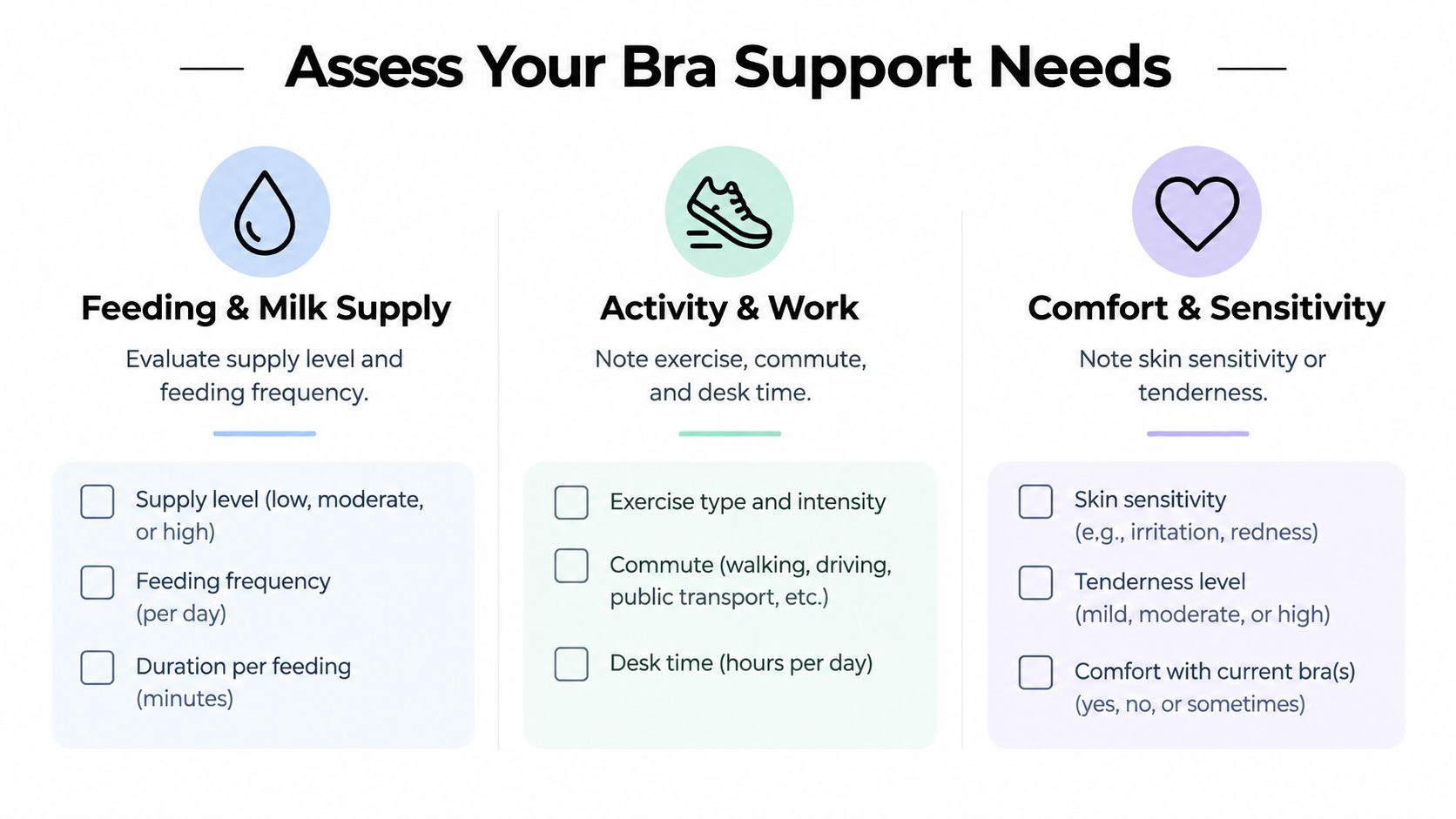
Start with feeding and fluctuation
Consider how often you're nursing, whether you're pumping, and whether your breasts change noticeably between feeds. Frequent feeding and significant fluctuation call for stretch, forgiving cups, and access you can operate with one hand. If feeding is less frequent or you're moving toward a mixed routine, you may want one flexible nursing style plus a more defined everyday bra.
Don't confuse stretch with a lack of support. Good stretch should accommodate movement and change while the band still anchors the bra against your torso. A bra that expands everywhere without recovering its shape may feel easy at first and unsatisfying later.
Add your real daily movement
Write down the activities that create pressure points. Desk work can expose a tight band or straps that slide. A commute can make rough lace or bulky hardware irritating. Walking, exercise, and active childcare require stability that a sleep bra won't provide.
A 2025 study on bra fit and breast support found that the average UK bra size increased by about one underband and two cup sizes across pregnancy and postpartum, while 85% of postpartum participants were physically active and 45% reduced their activity impact level compared with pre-pregnancy. The findings, reported through the study record on postpartum bra fit and activity, connect bra design with the practical challenge of returning to movement.
Use this quick sorting system:
- Full-time nursing access: Choose easy clips, flexible cups, and a band that remains comfortable across feeding changes.
- Hybrid wear: Pair nursing access with a smoother, more structured silhouette for work, errands, or social plans.
- Everyday confidence: Prioritize lift, shape, refined fabric, and discreet access if you still nurse but want your bra to look like lingerie.
Notice sensitivity before choosing structure
Tender skin, healing areas, pressure sensitivity, and rubbing can make an otherwise attractive bra unwearable. Check whether seams sit directly on sensitive areas and whether the band stays flat when you bend or sit. Stretch lace can be a practical choice when it lies smoothly and moves with the body.
For an example of this balance, GAIA is described as a soft nursing bra with stretch lace, flexible support, and breastfeeding access.
Here's a visual guide to the difference between support needs and common bra features:
Choosing Between Nursing Access and Everyday Wear Without Compromise
A nursing bra and an everyday mom bra solve different problems, but you don't need to treat them as opposing categories. The useful question is whether you need access, shape, or both in the same part of your day.
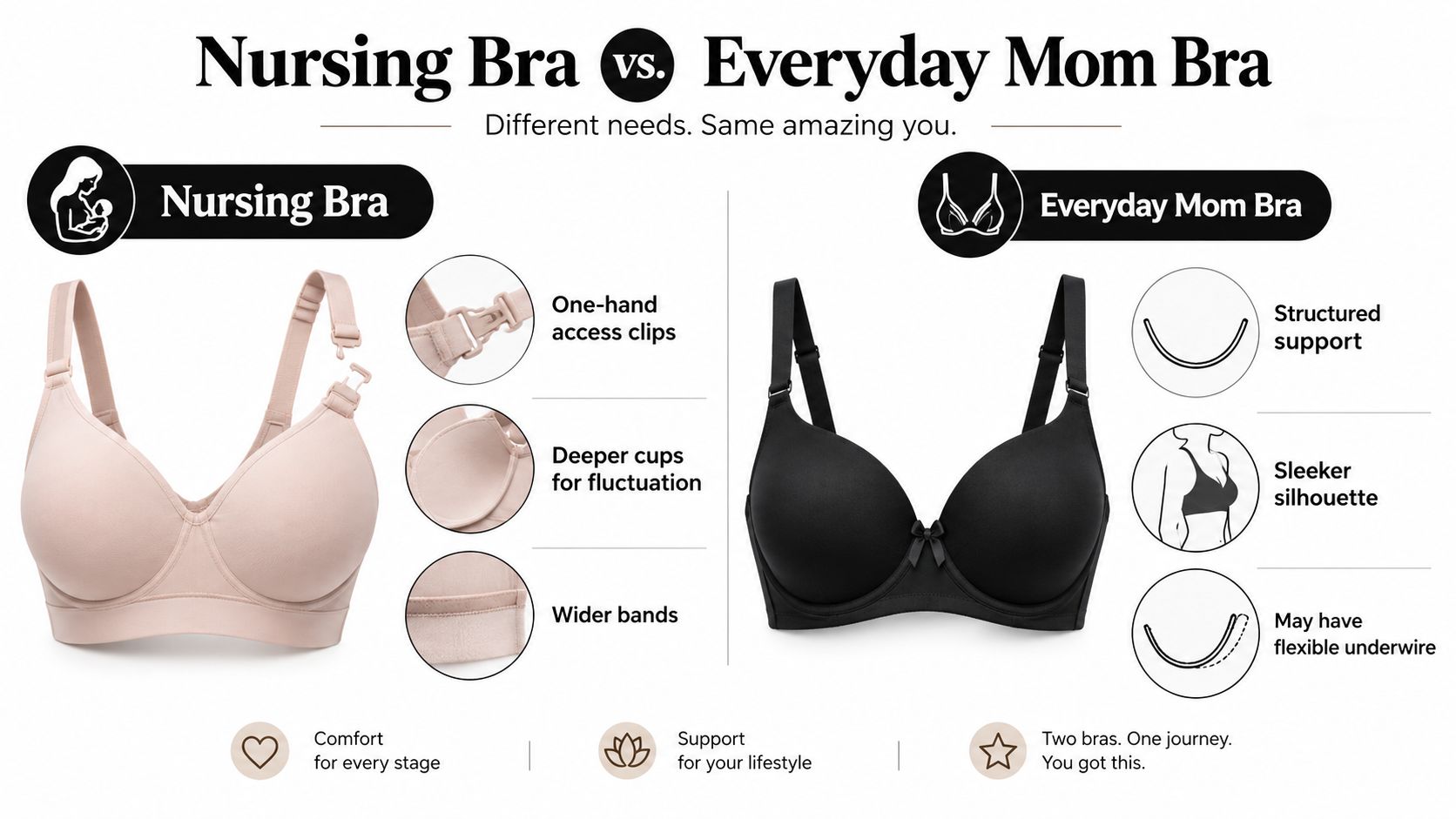
A nursing bra usually earns its place through one-hand access, adaptable cups, and a stable band. Clip-down cups work well when you're holding a baby, while wrap or pull-aside designs can feel simpler for quick feeds. Deeper cups and flexible fabric can help accommodate daily changes, but too much softness may not create the lifted shape you want under fitted clothing.
An everyday mom bra focuses more on silhouette. It may use molded cups, stronger side panels, or a flexible underwire to separate and lift. That doesn't make it unsuitable for breastfeeding. It means you should choose it for the moments when access is less frequent and appearance, stability, or clothing compatibility matters more.
Compare the features that affect your day
| Feature | Nursing Bra | Everyday Mom Bra |
|---|---|---|
| Access | One-hand clips or pull-aside openings | May have no nursing access |
| Cup design | Flexible cups for fluctuation | More defined shape and lift |
| Band | Often wider and adaptable | May be sleeker and more structured |
| Support | Fabric-based or lightly structured | Structured support, sometimes flexible underwire |
| Best use | Feeding, pumping, home, and changing routines | Work, outings, polished outfits, and later-stage wear |
The assumption that every nursing bra should be wireless is too narrow. The Bump's 2026 consumer survey found that 81% of respondents ranked comfort first, but its editorial coverage also includes structured and underwire options among notable picks. See The Bump's maternity bra guidance for that broader view of the category.
Underwire isn't automatically wrong. A rigid, poorly fitted wire is wrong. A gentle, correctly positioned underwire can give later postpartum outfits the shape a soft bralette can't.
Your rotation might include a flexible nursing bra for long home days, a pumping-compatible style if needed, and a structured nursing-access bra for office clothes or evenings out. For a deeper distinction between pregnancy support and feeding access, read this comparison of maternity bras and nursing bras.
Getting the Right Fit as Your Body Keeps Changing
Postpartum fit is a moving target, so don't judge a bra by the label alone. Measure close to the time you'll wear it, then test the bra through ordinary movements. Your body may feel different standing, sitting, bending, and feeding.

Check the band first
The band provides the foundation. It should sit level around your body rather than riding up between your shoulder blades. You should feel secure, but not squeezed. If you're constantly pulling the band down, loosening it to the final hook, or noticing deep marks that remain uncomfortable, the band may be too tight or the bra may be too small overall.
Try the bra on the loosest hook when it's new. That leaves room to adjust as the elastic settles. Raise your arms, rotate your shoulders, and sit down. If the band shifts dramatically, it isn't anchoring properly.
Then inspect each cup
Look for breast tissue spilling at the top, sides, or center. Spillage means you need more cup room or a different shape. Gaping can mean the cup is too large, the fabric is too rigid for your shape, or the bra needs adjustment after you settle the breast tissue inside the cup.
The center gore should lie comfortably between the breasts when the style is designed to sit there. If it presses painfully, floats away, or digs into sensitive tissue, don't force the fit. Nursing access should also open and close without pulling the cup out of position.
Use this home test:
- Stand naturally: Check the band, cup coverage, and strap position.
- Sit and bend: Look for riding, pinching, or cup collapse.
- Move your arms: Make sure straps stay put without excessive tension.
- Practice access: Open and close the nursing clasp with one hand.
- Wear it briefly: Notice heat, rubbing, pressure, and shifting before removing tags.
Treat exchange policies as part of fit
Flexible sizing and a clear exchange process matter because postpartum bodies don't follow a fixed timetable. Review the brand's measurements, compare them with your current body, and order only within a return policy you understand. For a more detailed measuring process, use this guide to measuring for a nursing bra.
Your bra should feel supportive at the beginning of the day and after normal movement. If you're adjusting it repeatedly, exchange it rather than trying to convince yourself that discomfort is part of motherhood.
Fabrics Silhouettes and Details That Feel Beautiful and Work Hard
A bra can support your body and still feel like your own style. In later postpartum life, that balance matters. You may need nursing access for part of the day, then want a clean shape under work clothes or something beautiful for an evening out.
Stretch lace earns its place when it moves with your body without losing structure. Paired with a stable band and supportive lining, it can feel close to the skin while accommodating normal changes. Poor-quality lace scratches, catches on clothing, or concentrates pressure at the seams. Review how fibers and construction affect comfort in this guide to bra fabric and material choices.
Match details to the problem
- Wide wings: Spread pressure across the sides and create a smoother line beneath clothing.
- Soft lining: Limits friction and makes longer wear more comfortable for sensitive skin.
- Gentle underwire: Adds separation and lift when it sits fully behind the breast tissue.
- Discreet nursing openings: Keep feeding practical without making the bra look purely utilitarian.
- Adjustable straps: Help refine lift and reduce slipping as your posture and outfits change.
The PETRA nursing bra brings together ultra-soft stretch lace, gentle underwire, and one-hand nursing access. It suits the later postpartum transition because it offers more than coverage. You can keep feeding access available while choosing a defined, feminine silhouette that feels closer to your pre-motherhood identity.
Beauty isn't a frivolous extra
Research involving 1,300 mothers found that many considered nursing bras unattractive and said they did not feel good wearing them. That response reflects a design gap, not a shallow preference. Comfort and function should not require you to give up the details that make lingerie feel personal.
Choose fabric that feels kind, construction that supports your actual routine, and a shape that works with your wardrobe. The right bra for mom can be breathable, supportive, practical, and feminine at the same time. When your body is still changing, that combination gives you room to care for yourself without dressing as though comfort is the only thing that matters.
Shopping Smart and Feeling Confident Again
Buy for your current routine, not for an imagined version of postpartum life. If you feed often, start with reliable access and adaptable cups. If you're returning to work or regular outings, add a structured option that works under your best clothes. If movement is becoming part of your week, look for support designed for activity rather than expecting a casual nursing bra to do everything.
A small collection works better than one supposedly perfect bra. Build around different moments:
- Home and recovery: Choose softness, flexibility, and minimal pressure.
- Work and errands: Look for a smooth silhouette, stable band, and discreet access.
- Exercise and active days: Prioritize breast support, secure straps, and movement control.
- Confidence moments: Choose lace, lift, and details that make you feel recognizably yourself.
Check the return, refund, shipping, and size-exchange terms before ordering. Try the bra at home while wearing the tops you own. Sit, stand, bend, feed, and move through a normal morning before deciding whether it earns a place in your drawer.
Secure checkout options can also make ordering easier. Milk&Lace lists Apple Pay, Google Pay, PayPal, Shop Pay, Venmo, and major credit cards among its checkout options, along with guidance for returns and size exchanges.
Choosing a beautiful bra after motherhood isn't a rejection of comfort or practicality. It's a recognition that your identity has expanded, and your lingerie can reflect more than one role. You're allowed to want support, access, softness, shape, and beauty in the same wardrobe.
Start with your stage, write down your daily needs, measure carefully, and choose the style that serves your actual life. Then let yourself enjoy the result.
Milk&Lace offers nursing lingerie that combines breastfeeding access with stretch lace, flexible support, and structured options for later postpartum wear. Visit Milk&Lace to explore bras designed for the moment you're ready to feel comfortable, supported, and like yourself again.