

You're pulling a top over a nursing bra that fit two weeks ago, and it doesn't fit now. The cups gape at the top, the band rides up while you're lifting your baby, and by afternoon you're adjusting straps that were fine at breakfast. That's not a sign you chose badly. It's a sign your stage has changed.
The best support bra after breastfeeding isn't a single winner you buy once. It's a staged decision. A soft bra that's right during frequent feeds can be wrong months later, and a structured bra that's wrong during engorgement can be exactly right once your size settles. Match the structure to today, confirm it with fit checks, then recheck when feeding changes again.
Quick Picks for Support After Breastfeeding
A bra that works during active feeding may feel too soft once your routine settles. Use the table to choose a style to try for your current needs, then let the fit checks decide whether it works.
| Need | Style to look for | Milk&Lace option | Main trade-off |
|---|---|---|---|
| Soft comfort during active feeding | Wire-free stretch nursing bra | Nursing bras are available from Milk&Lace | Less lift as breast fullness changes |
| Transition, feeding less often | Soft structure with adjustable fit | Petra Lace Nursing Bra | Adjustability fine-tunes fit but does not replace correct sizing |
| Later postpartum everyday support | Structured cups with gentle underwire | Gaia Lace Nursing Bra with Gentle Underwire | Underwire must sit outside breast tissue |
| High-impact exercise | Sports bra designed for impact control | Choose a sports bra suited to the activity | Nursing access may not be included |
How to Read Each Row
During active feeding, a wire-free stretch nursing bra can accommodate changes in fullness through the day. The trade-off is less lift and structure. If you are leaking while breastfeeding, Milk&Lace recommends pairing a nursing bra with your favorite nursing pads.
As feeds become less frequent, an adjustable fit can help you fine-tune comfort. The Petra Lace Nursing Bra has an adjustable fit, smooth design, ultra-stretch fabric, and flexible cups that provide nursing access. Adjustment can refine a close fit, but it cannot correct a cup or band that is the wrong size.
For everyday wear later postpartum, structured cups can provide more support under clothing. The Gaia Lace Nursing Bra has gentle underwire and flexible cups for nursing access. Its nursing clips can be unclipped and clasped back with one hand. Check that the wire follows your breast root rather than resting on breast tissue.
Exercise calls for a bra suited to the activity. A nursing bra may offer access for feeding, while a sports bra is designed to manage movement. Choose based on the support you need for that session.
Use the row as a starting point, then let the fit checks decide.
When to Switch From Nursing Bras to Structured Support
The week after the last feed, a structured cup can still fit poorly. Breast volume and shape may continue changing after weaning, so the right switch depends on whether your current size has settled, not on whether feeding has stopped.
A 2025 quantitative imaging study found that breast volume increased by 45% during lactation compared with prepregnancy levels. After weaning, breast volume decreased by 23.3% relative to lactation, while fibroglandular tissue volume fell by 52.8%. A cup shaped for lactation volume may gape, pucker, or lose containment as tissue volume changes, even if the bra itself hasn't stretched out.
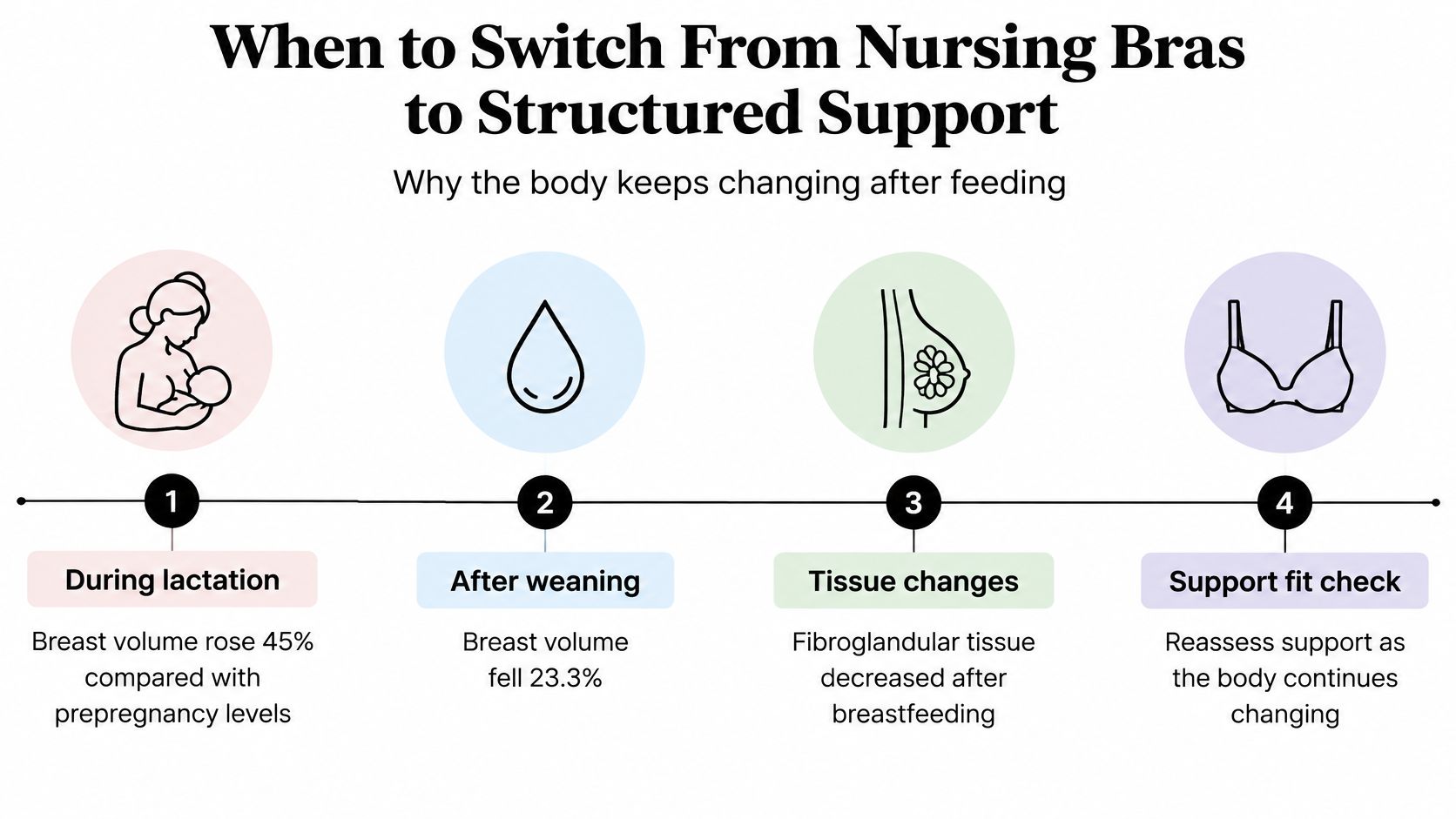
Pregnancy and weight changes can also affect breast shape. Give your body time to settle before choosing a structured bra; buying one as soon as feeding stops can mean fitting a size that is still changing.
Signals You're Ready to Assess the Switch
- Feeding has dropped and stayed dropped. Sessions are fewer and predictable, and engorgement between them has eased.
- Your nursing bra feels loose in the wrong places. The band rides up at the back, or you tighten the straps to compensate for a band that no longer anchors.
- Cups gape or spill differently than before. Gaping at the top can indicate lost volume. New spill at the side can mean tissue is sitting differently, not necessarily that your breasts are larger.
- Comfort changes during the day. If the bra feels supportive in the morning but not by evening, reassess its fit before choosing a different style.
A Short Sequence That Works
- Confirm stability. Wait until feeding frequency has been stable for several weeks.
- Check the band on your current bra. If it no longer sits level, don't assume the same size will work in a structured style.
- Wait or bridge. Allow roughly one to two months after the last feed for your size and shape to settle, or use a soft transitional bra in the meantime.
The switch is working when support feels steady without pressure, the band stays put as you move, and comfort holds through the day. If you keep adjusting the bra, reassess the fit.
How to Check Fit After Weaning
Measure first, then check in the order you'd put the bra on. Don't reuse a pre-pregnancy size and hope.
Measure at Your Current Stage
Wrap a tape snugly around your rib cage directly under your bust for your band measurement. Then measure around the fullest point of your bust without compressing tissue. Guidance from the NCT on maternity and nursing bras supports re-measuring after weaning because breast volume and shape may continue changing for roughly three months after complete weaning.
Use those numbers to choose a starting size. Then let the checkpoints below overrule the chart. If you want a step by step walkthrough before you measure, our bra fitting guide lays out the tape placement in detail.
| Checkpoint | Right fit | Warning sign |
|---|---|---|
| Band | Level front and back, about 5 cm of stretch away from the body | Rides up at the back or digs in |
| Cups | Full containment with no spill over the top or under the arm | Gaping, spill or puckering |
| Underwire | Lies flat around the breast root without pressing tissue | Pressure, tenderness or wire resting on tissue |
| Center gore | Lies flat against the sternum | Lifts away from the chest |
| Straps | Stabilize without carrying breast weight | Shoulder grooves or slipping |
| Re-measure | Bust and band re-checked after full weaning | Reusing a pre-pregnancy size |
Work Through the Bra in Order
Start with the band, because it carries the load. It should sit horizontally at the same height front and back and allow approximately 5 cm of stretch away from the body. If it rides up, it's too loose or the cups are too small and pushing it out of place. Tightening straps won't fix either problem.
Check containment next. Lean forward as you put the bra on, settle all tissue into the cups, then stand up. You want full containment with no spill at the top edge or under the arm, and no gaping when you move. Puckering fabric means the cup shape doesn't match your current volume, even if the letter size looks right on paper.
Place the wire and gore. An underwire should lie flat around the breast root without pressing on tissue, following the fold where breast meets chest wall. The center gore should lie flat against your sternum. If the gore lifts away, the cups are usually too small or too shallow for your shape.
Set straps last. Straps stabilize the garment. They don't lift the breast. Adjust them so they stay in place without shoulder grooves or slipping. If your shoulders ache, your band is asking your straps to do its job.
Test It Like Real Life
Raise your arms overhead, bend forward, and walk around for a minute. The band should stay level and the cups should keep containing tissue. Check fit at two different times of day if you can, since a fit that works at breakfast may loosen by evening as fullness changes.
Judge a structured style like GAIA only once milk production and breast size feel relatively stable. During highly variable weeks, even a correct size will feel wrong half the day.
Underwire or Wire-Free Without Losing Comfort
After weaning, the same bra that felt comfortable during active feeding may no longer give enough lift. Choose by stage and fit: wire-free styles accommodate changing fullness, while a correctly fitted underwire can offer more shape once breast size has settled.
The Academy of Breastfeeding Medicine protocol on the mastitis spectrum recommends an appropriately fitting supportive bra, based on consensus rather than high-quality clinical trials. Guidance from the Australian Breastfeeding Association cautions against rigid underwires when breasts are changing rapidly, since pressure on a full area may contribute to inflammation, and notes that flexible, low-gauge wires may be less problematic.
Both positions are right under different conditions. Consider the stage of feeding, how stable your size is, whether the bra presses on full or tender areas, and how flexible the wire feels.
Four Structures, Four Jobs
- Wire-free stretch nursing bra: A practical choice in early lactation, when size can swing between feeds. It accommodates fluctuation, though it may offer less lift as breasts settle and tissue sits lower.
- Flexible low-gauge wire: A middle ground when you want more shape but fullness still changes. The wire should flex rather than force a fixed shape.
- Structured underwire: Often suits later postpartum wear once size is stable. It offers clearer lift and separation, but a rigid wire pressing on breast tissue can cause discomfort.
- Adjustable band with structured cups: Offers some room as your body settles. Adjustment helps with band fit, but it cannot make an incorrectly sized cup fit.
The Gaia Lace Nursing Bra from Milk&Lace has gentle underwire. Appalachian Reviews describes it as providing “real support without digging in or feeling restrictive.” The wire still needs to sit around the breast root without pressing on tissue.
Warning Signs That Mean Stop and Reassess
Take the bra off and reassess if you notice localized pressure, tenderness, redness, or a wire resting on breast tissue. Don't wait for the wire to “break in.” If it presses on tissue, the fit or structure is wrong for you.
Lace and support can coexist: a soft-feeling lace bra can offer a more feminine look, while underwire can provide the shape some people prefer in fitted clothes. The underwire versus no-underwire comparison explains the trade-offs between the two structures.
Reassess your choice as feeding frequency falls. A bra that felt comfortable during frequent feeds may press differently as fullness changes.
Matching Support to Daily Life and Activity
A bra that passes a mirror check can still fail your actual day. Test support against the routines you repeat, not the ones you imagine.

Errands, Commuting, and Standing
Say your day is school drop-off, a commute, groceries, and an evening on your feet cooking. You need a band that stays level under movement and cups that hold their shape from morning to evening without you thinking about them. Structured everyday support earns its place here. As Danielle says, "It's supportive enough for my larger cup size but still soft and comfortable." That combination, hold without hardness, is what a long day requires.
Pumping and Feeding Days
Now say you're pumping at work and nursing at home. Speed matters more than silhouette. You need cups that open quickly without unhooking everything, one-hand access while you hold your baby or a pump flange, and fabric that tolerates frequent washing without losing recovery. One reviewer, B, describes it as "Feminine, flirty lace yet durable and functional for nursing and pumping. Best of both worlds!" The practical test is simpler. Can you open, feed, and close the bra one-handed in under a minute, every time?
Exercise
Exercise asks for something else entirely. A 2025 study of 323 pregnant, recently postpartum, or breastfeeding women found self-reported UK bra size increased by an average of one underband and two cup sizes from before pregnancy through pregnancy and after pregnancy, and breast pain during physical activity was highest among pregnant and breastfeeding participants. Focus-group participants reported reducing or changing physical activity because suitable supportive bras were difficult to find.
That last finding matters. If your everyday nursing bra hurts during a workout, the answer isn't to exercise less. It's to use a dedicated sports bra built for impact. Our guide to choosing a supportive nursing sports bra explains what to look for if you need feeding access around workouts.
A very tight bra can feel secure while creating pressure points. A loose cup or unstable band increases movement and pain. Support sits between those two failures.
Keep everyday support and exercise support separate, and re-test both after any size change. Your sports bra size and your everyday size may not move together.
GAIA and PETRA Side by Side
After weaning, a bra that worked during active feeding may no longer suit your preferred level of structure. Compare these two options against your current fit needs: GAIA has gentle underwire, while PETRA offers an adjustable fit in ultra-stretch fabric.
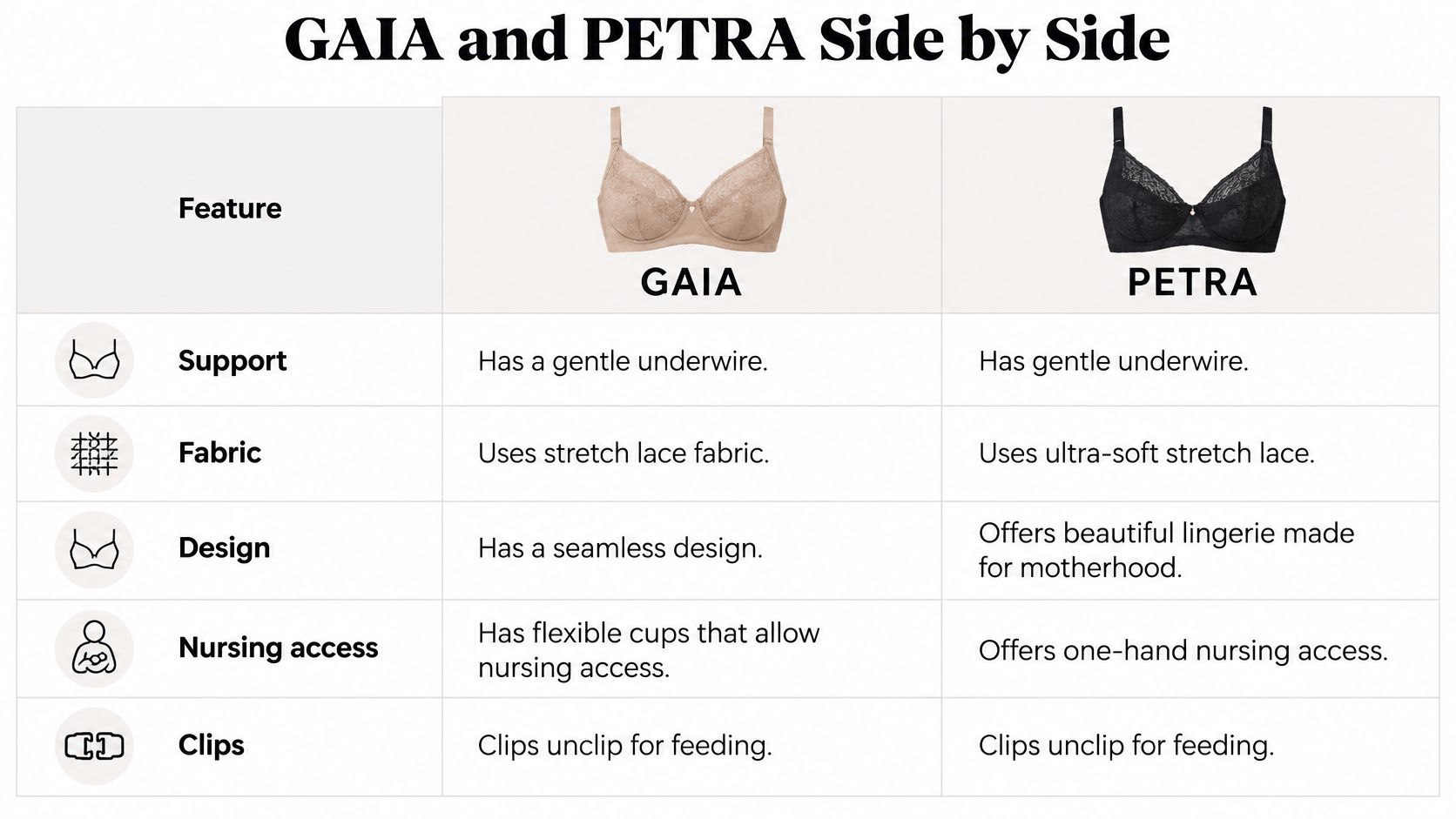
| Feature | GAIA Lace Nursing Bra | PETRA Lace Nursing Bra |
|---|---|---|
| Structure | Gentle underwire | Flexible cups |
| Fabric | Lace | Ultra-stretch fabric |
| Construction | Smooth design | Smooth design |
| Nursing access | Flexible cups; clips open and clasp back with one hand | Flexible cups provide nursing access |
| Fit adjustment | Sized by band and cup range | Adjustable fit |
| Size range | S (30-34 band, A-C), M (34-36, B-D), L (36-38, C-DD), XL (38-40, D-DDD) | Adjustable fit |
| Price | Price shown at checkout | $65.00 |
| Reviews | 28 reviews | Not specified |
GAIA combines gentle underwire with flexible cups for nursing access. The clips can be opened and clasped back with one hand. Its listed sizes run from S (30-34 band, A-C cups) to XL (38-40 band, D-DDD cups), so compare the range with your current measurements rather than relying on your pre-pregnancy size.
PETRA uses ultra-stretch fabric, flexible cups and an adjustable fit. The Petra Lace Nursing Bra costs $65.00.
The practical distinction is structure versus adjustability. If your measurements have settled and you want underwire support, GAIA may suit your everyday needs. If your fit is still changing, PETRA's adjustability may offer more room to adapt. Neither feature replaces a fresh fit check.
Prices are set when the order is placed and listed in the order confirmation email. Unless otherwise stated, posted prices exclude taxes, shipping, handling, customs and import charges.
Care and Longevity That Keeps Support Working
Elastic loses recovery when you treat it roughly, and a stretched band undoes every fit check you passed. Care is how you protect support, not just fabric.
A Care Routine That Preserves Fit
- Wash cold and gentle. Use cold water on a gentle cycle, inside a mesh bag, so straps and lace don't twist around other garments.
- Air dry, never tumble dry. Dry flat or hang the bra to dry. Heat weakens elastic faster than wear does.
- Rotate at least two bras. Alternating bras gives elastic time to recover between wears instead of staying stretched day after day.
- Protect lace and hooks. Hand-wash lace when you can, and fasten hook closures before washing so they don't snag other pieces.
When to Replace Instead of Adjust
Replace the bra when the band no longer sits level even on a tighter hook, when cups lose shape or gape after you've confirmed your size hasn't changed, or when a wire shifts out of position or pokes through fabric. A poking wire is a retirement signal, not a repair project.
Keep a soft transitional bra in rotation for days when your body is still settling, and replace your structured bra first when its band fails. The band carries most of the load, so its failure matters more than faded lace.
After several washes, repeat the band and cup checks on your body. Fit can drift before fabric looks worn, and you'll feel that drift as extra movement long before you see damage.
Choose Your Bra and Confirm the Fit Before You Buy
Make the decision in order. Skipping steps is how the wrong bra ends up feeling like the wrong body.
Your Decision Sequence
- Confirm your stage. Use your feeding pattern and symptoms to place yourself in early nursing, transition, or later postpartum.
- Re-measure band and bust. Measure after weaning rather than ordering your pre-pregnancy size from memory.
- Choose structure by stage. Match wire-free, adjustable, or structured support to how stable your size is right now.
- Run the fit checkpoints on your body. Test band, cups, wire, gore, and straps under movement, at two times of day if possible. A size chart starts the process. Your body finishes it.
GAIA suits you if your size has stabilized and you want structured lace with gentle underwire for everyday wear. PETRA suits you if your size is still changing and adjustability matters more than maximum structure today. Keep a soft transitional bra for unsettled days either way, and add a dedicated sports bra if you're returning to high-impact exercise.
Before you order, note that the price charged is the price in effect when the order is placed, set out in your order confirmation email, and unless otherwise expressly stated, posted prices don't include taxes, shipping, handling, customs, or import charges. Review the return and exchange guidelines before ordering, so a size swap is a simple step rather than a surprise.
If your fit checks pass, order the option that matches your stage. Then wear it through a full normal day before you judge it.
If you're ready for structured lace support that still allows nursing access, explore GAIA and PETRA at Milk&Lace and match your fresh measurements to the size range before you order. Choose GAIA for gentle underwire shape once your size is stable, or PETRA for adjustable fit while you're still settling, and use the fit checkpoints above to confirm the band, cups, and wire on your body.