

You're standing in front of the mirror with one hand holding your baby and the other pulling a riding band back into place. The cups spill when you're full, then gape after a feed. Your old size makes no sense, and every size chart seems to assume your ribcage and your bust grew together. They didn't, and that's exactly why finding the best nursing bra small band large cup fit starts with your numbers, not a label.
Why a Small Band and Large Cup Needs a Different Bra
You buttoned your pre pregnancy jeans at the waist, but your nursing bra cuts in, lifts up, and spills over at the top. The band rides, the cups pull, and a 34C from the mall fits nowhere that counts. Pick a different fit logic for this body.
Pregnancy shows why standard grading fails you. A 2026 longitudinal study in Scientific Reports found average breast volume rose from 1,165.9 cm³ in early pregnancy to 1,482.9 cm³ later in pregnancy, a 27.2% increase, with ranges around 543.6 to 3,500.4 cm³ at the start and 688.8 to 3,729.9 cm³ at the end, and with only 35 to 67% of breast volume classifications matching body fat classifications by trimester. Body size does not predict cup need. The mismatch is a pattern problem in how bras are graded.
So check the map before you trust a letter. A size marked S can still stop at a C cup while your underbust measures 31 inches and your fullness needs far more room. That combination needs a firm, level underband for support plus cups that contain without pressing flat.

Three jobs your bra has to do
- Carry weight from the band: Keep a firm, level underband doing the work, not your shoulders.
- Contain without compressing: Hold all breast tissue inside the cup without pressing it flat.
- Leave room to change: Allow for fullness that rises and falls between feeds.
A larger cup is never a reason to buy a larger band. Measure first, check where a size map stops, rank the features that create support, fix the symptom you feel now, and match the style to your postpartum stage. If the first size fails that test, exchange it rather than enduring it.
How to Measure Band and Cup for Your Fit
The usual shop method fails this body in a predictable direction. A breast-support research program from the University of Lancashire reported that traditional fitting methods overestimated band size for 76% of participants and underestimated cup size for 84%. That's the sister-size trap in numbers. You're given too much band and too little cup, then told to tighten the straps.
Don't do that. Follow our step-by-step guide to measuring for a nursing bra and use these six steps on the day you order.
This visual lays out the order, band first and cup second.
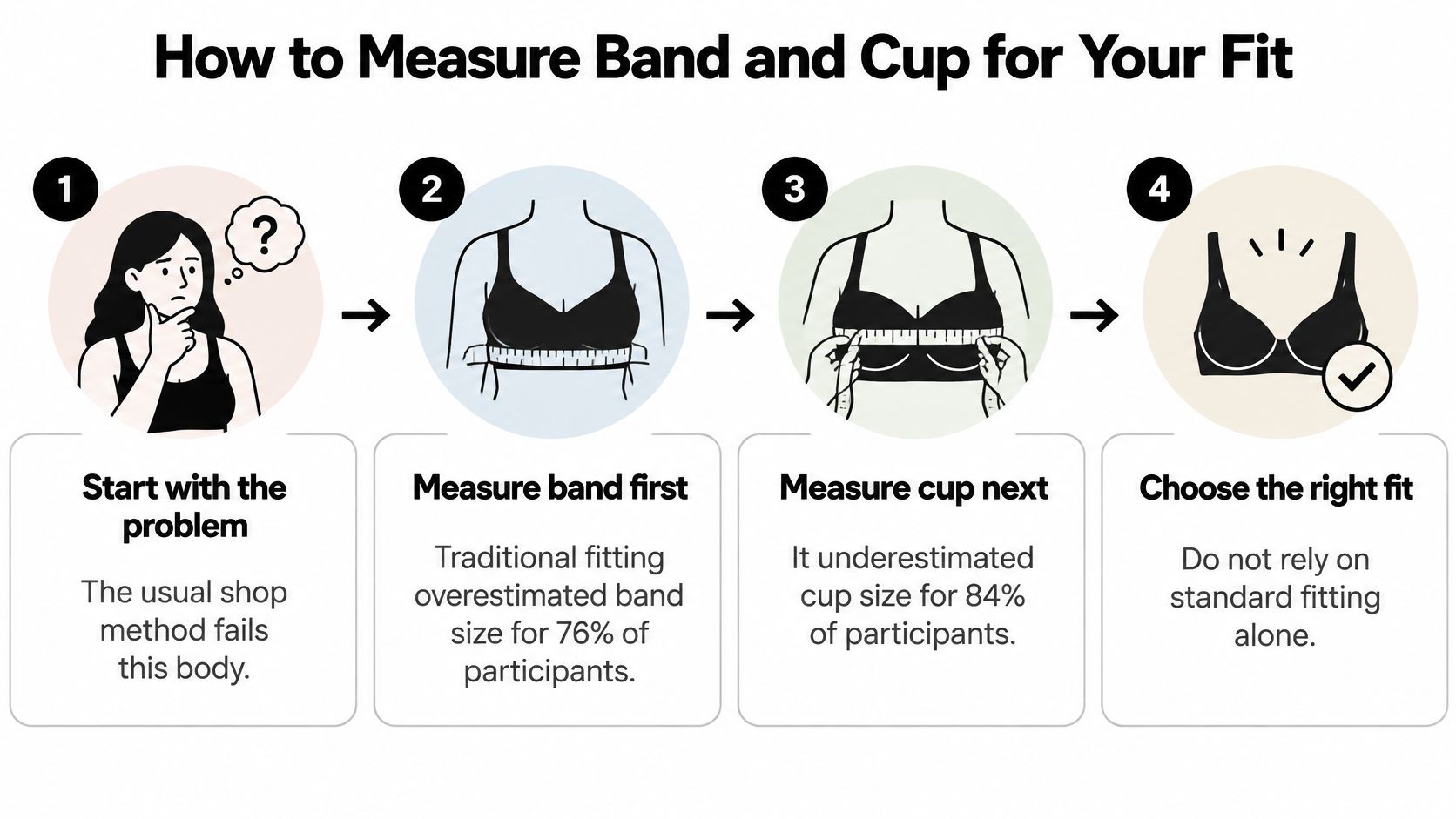
Measure in this order
- Measure your underbust snugly: Wrap the tape directly under your breasts, level all around. Round to the nearest even number for your band.
- Measure your fullest bust: Wear an unpadded bra, keep the tape level over your nipples, and don't pull it tight enough to compress tissue.
- Subtract band from bust: Use the difference to estimate cup volume. A bigger difference means you need more cup depth, not a looser band.
- Compare the pair with the brand map: Our sizes map to US bands and cups as S 30-34 A-C, M 34-36 B-D, L 36-38 C-DD, and XL 38-40 D-DDD. Reject any size whose cup range can't hold your estimate.
- Use a sister size carefully: One band up means one cup letter down. One band down means one cup letter up. Only use it when both parts exist on that pattern.
- Remeasure the same day you order: Fullness changes between feeds and across postpartum months, so an old measurement isn't a fit.
Watch the tape placement here before you trust your result.
Then check the bra on your body. The band stays horizontal and doesn't ride up. All tissue sits inside the cup without bulging at the top or underarm. The gore sits flat when the construction allows it, and any wire stays off breast tissue.
Practical rule: If you need more cup room, keep the band that fits and change the cup or the style. Sizing up the band trades support for space you don't need around your ribs.
Quick Picks for Small Band and Large Cup
Read this table as a coverage check, not a trophy list. We list one US map for both of our featured styles, and I'll be candid about its ceiling. A 30 or 32 band never pairs with D or above on that map, and DDD only appears from a 38 band. If you're a true 30G or 32F, neither style below is your size today, no matter how much you love the lace.
| Option | Band and cup coverage | Support approach | Nursing access | Best for | Price |
|---|---|---|---|---|---|
| Milk&Lace GAIA | S 30-34 A-C; M 34-36 B-D; L 36-38 C-DD; XL 38-40 D-DDD; no 30/32 band with D+ | Gentle underwire, stretch lace | Cups open for feeding | Later postpartum only if your size is inside the map | Price shown in your order confirmation |
| Milk&Lace PETRA | Same map; no 30/32 band with D+ | Seamless ultra-stretch, adjustable fit | One-hand nursing clips | Volume shifts only inside the listed cups | $65.00 before tax and shipping |
| Soft-cup wireless nursing bra | Check each brand map for your exact band and cup pair | Stretch fabric, minimal structure | Pull-aside or clip-down cups | First weeks when comfort beats lift | Set by the brand's size and style |
| Full-coverage molded-cup nursing bra | Only choose a brand that grades your cup on your small band | Molded cups, firmer band | Clip-down cups | Higher cup volume if that brand grades it on a small band | Set by the brand's size and style |
GAIA is a soft, elegant nursing bra with stretch lace, flexible support, and effortless breastfeeding access, available in sizes S, M, L and XL. It's the later postpartum choice when you want shape back under clothes and your measured pair sits inside those letters.
PETRA is crafted from ultra-stretch fabric with a smooth design and flexible cups that provide nursing access. Pick it when your numbers fit the map and your volume still moves through the day, because the adjustable fit gives you some room to reset after a feed.
Match the pick to your stage
In the first weeks, choose the soft-cup wireless row. Your size is moving too fast for structure to be the priority, and comfort wins. Later, when feeding is established and you want lift again, an underwired style makes sense, but only inside its map.
Use the measurement you just took as the gatekeeper. If your bust estimate sits above a row's cup letters, don't order that size and hope stretch will save it. Stretch can't create cup depth that isn't in the pattern.
Features That Decide Support and Comfort
Take a 32G reader whose wireless bra rides up every time she sits to feed. She tightens the straps, her shoulders ache by noon, and the band still climbs. Her problem isn't effort. Her bra has the support ranking backwards. Our guide to supportive nursing bras for large breasts goes deeper, but these five features decide her day.
The Australian Breastfeeding Association guide to choosing a maternity bra recommends a firm band that remains level front-to-back, wide straps, full-coverage cups, and structured or seamed construction when greater support is needed. For an underwired style, the wire should follow the inframammary fold, lie flat, avoid breast tissue, and keep the center front close to the sternum.
This ranking puts those features in the order our 32G reader should check them.
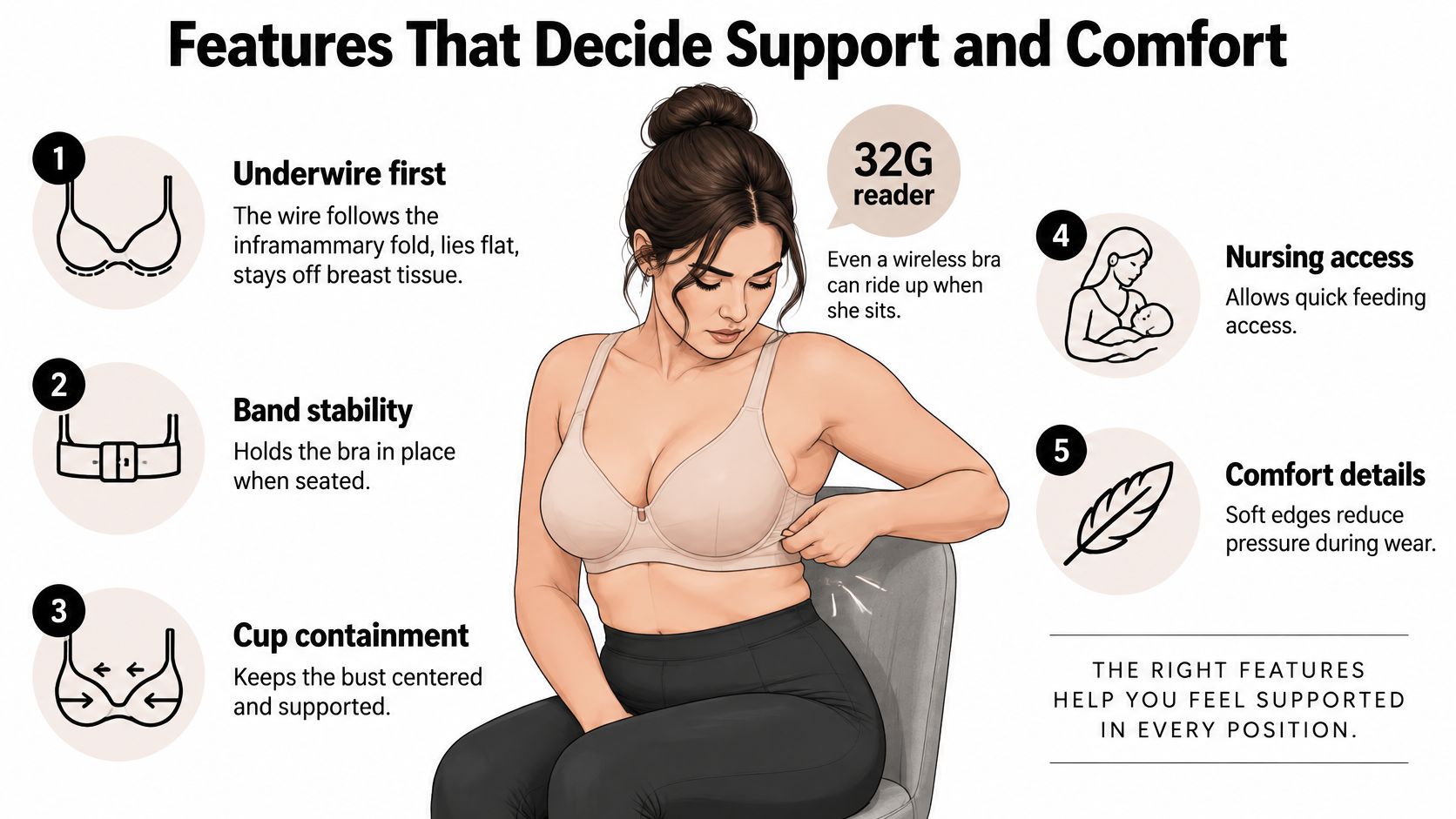
The five features in order
1. Underwire placement. The wire traces the fold under your breast, lies flat against your torso, and clears tissue at the side. GAIA has gentle underwire, and one reviewer said that gentle underwire supports without digging in. That only helps our 32G reader if her size exists on the map. For her, it doesn't, so she needs a brand that grades a G cup on a 32 band.
2. Cup construction. She needs full coverage, controlled stretch, and enough depth for a feed-to-feed swell. A highly elastic, unstructured cup feels soft at 9 a.m. and lets her breast drop, spill sideways, and load her shoulders once milk comes in.
3. Band and wings. The band is the load-bearing piece. For this reader, a firmer 32 band with wide wings and several back hooks beats another notch on the straps. Her band rides up because it's too loose to anchor the weight in front.
The last two are adjustments you'll use daily. Straps need several settings so you can reset them as volume drops after a feed, and our bra has shoulder bands that can be adjusted to different settings. Nursing access needs clips you can unclip and clasp back with one hand, because your other hand is holding your baby.
| Feature | What to look for | Red flag |
|---|---|---|
| Underwire | Wire follows the underbust, lies flat, clears breast tissue | Wire sits on breast tissue or lifts from the chest |
| Cup construction | Full coverage, controlled stretch, depth for volume changes | Gaping at the top or side spill |
| Band and wings | Firm, level band with wide wings and multiple back hooks | Band rides up or tightens only through the straps |
| Adjustable straps | Several shoulder settings and straps that stay in place | Fixed straps that dig in on the shoulder |
| Nursing access | One-hand clips and cups that open without lifting the bra | Full removal needed to nurse |
Common Fit Problems and How to Fix Them
A wire that sits on breast tissue will tell you fast. Pain, pressure, or a red mark after a feed means the fit is wrong for your current size, not that all support is off limits for a large cup.
A physician breastfeeding resource on bra myths states there is no scientific evidence that a tight-fitting bra itself causes mastitis or plugging, although comfort and pressure still matter. General lactation guidance points the same way. Wear a supportive bra that fits without compression, and switch to a softer style during engorgement or while a plugged area is tender. If you develop a red, hot, painful area or a fever, contact a clinician promptly.
Work through the symptom you feel
| Symptom | Likely cause | Fix |
|---|---|---|
| Wire presses on breast tissue | Wire too wide or cup too shallow | Stop wearing it and try a sister size or a softer style |
| Band rides up at the back | Band too loose or too large | Move to the next firmer band size or add a back hook setting |
| Straps dig into shoulders | Shoulders carry the load | Widen the straps and tighten the band instead |
| Gaping at the top of the cup | Cup too large for the bust | Try the sister size with a smaller cup letter |
| Spill at the side or underarm | Cup too small or wire sitting too high | Try the sister size with a larger cup letter |
| Leaking while nursing | Let-down or fullness, not fit | Add nursing pads and keep the fit check in place |
Test one bra in a fixed order. Check the wire first. It is a stop sign, not a break-in period.
Then check the band. A level band that stays put will clear up half the strap complaints on its own. Digging straps usually mean the band is not carrying its share, so firm the band before you loosen anything. Leave gaping and spill for last, since both read differently once the band sits level after a feed.
Leaking is different. We recommend pairing the bra with your favorite nursing pads if you are leaking while breastfeeding. Keep the fit you measured. Do not buy a looser bra to solve a pad problem.
Choosing a Bra for Your Postpartum Stage
A small band and large cup isn't one fixed body type across your first year. It's a moving target, and your bra wardrobe should admit that. Our guidance on when to buy nursing bras can help you time a purchase, but your stage decides the construction.
A 2025 study of 323 pregnant and postpartum women found self-reported bra size increased by an average of one underband size and two cup sizes from before pregnancy to during and after pregnancy. In that study, 81% reported a cup size of at least D during pregnancy, compared with 53% before pregnancy.
Change doesn't only go one way. In a cohort drawn from 5,991 women who gave birth between 1996 and 1999, 559 respondents reported postpartum breast changes. Among them, 35.1% reported an increase in breast size, 21.8% reported a decrease, and 66.4% reported reduced breast stiffness compared with 5% who reported increased stiffness.
Three stages and what each one needs
- Early weeks: Choose soft, stretchy styles with minimal structure. Volume and let-down shift most now, so expect to remeasure often and don't stock up.
- Early lactation: Measure every few weeks and watch for gaping or spill after feeds. Asymmetry is normal, so fit the fuller side and adjust the other strap.
- Later postpartum: Choose a structured style when routines return and shape matters again. This is the stage our lace underwire designs are made for.
A single pre-pregnancy measurement is not permanent, so treat each size as a starting point to be tested on your body.
That two-way change is why an exchange plan matters more than extra stretch. We offer a flexible size-exchange policy, so keep your order confirmation and check the exchange window before you wear a bra for long periods. Plan for a size up and a size down, not growth only.
Confirm Your Size and Order the Right Bra
Here's my verdict, and it depends entirely on whether your measured pair sits inside the map. Don't let a pretty style talk you out of your own tape measure.
If your band is 34 or above and your cup sits inside the map, and you're past the early weeks wanting lace with flexible support, order GAIA. You'll get the shape and lift that soft early bras can't give you.
If those same numbers fit and your volume still shifts, order PETRA for its adjustable support and one-hand clips. It costs $65.00, with tax and shipping added at checkout. Its published split is 41 reviews, 61% five-star, 34% four-star, 5% three-star, and none at two stars or below. Read that as satisfaction among women the map fits, not proof it fits a 30G. As Danielle put it, "It's supportive enough for my larger cup size but still soft and comfortable."
If your underbust is 30 or 32 and your cup is D or larger, don't force these styles. Buy a soft wireless bra now or a brand that grades your cup on your band, then revisit a structured style only if a later measurement lands inside this map. Forcing a size creates the wire pressure and ride-up you're trying to escape.
Take one action. Order a single candidate, wear it through several feeds, sit, reach, and settle your baby in it, then exchange it if the wire sits on tissue, the band rides up, or the cup gapes. One honest test beats a drawer of almosts.
You deserve a nursing bra that supports your actual band and cup while letting you feel like yourself again, and we design our lace styles for that later postpartum moment when comfort alone isn't enough. Measure today, check your pair against our map, and visit Milk&Lace to order the style that contains you or exchange it for the sister size that does.