

At 6:45 a.m., the baby gate clicks open, your coffee is still sitting untouched, and your 13-month-old is already halfway down the hallway. Yesterday, breakfast went smoothly, both naps happened, and bedtime felt almost easy. Today, your toddler wants to walk, refuses the high chair, asks to nurse, then cries when the second nap appears on the horizon.
That's why a 13 month old schedule feels different from the routines you used earlier in the first year. Your child is becoming more mobile, more opinionated, and more interested in doing things independently. A useful schedule still matters, but it needs to organize the day without pretending that every day will unfold neatly.
Why the 13 Month Schedule Question Feels Different Now
At this age, the morning often starts with movement instead of stillness. Your toddler may cruise along furniture, walk independently, scribble, turn pages, point to body parts, or help push an arm through a sleeve. Some children are still working toward independent walking, and that can be completely typical, since pediatric milestone references place independent walking across a broad range from 9 to 15 months. The 13-month milestone guide from Huckleberry also describes language and self-feeding as developing across a wide range, rather than arriving on one exact birthday.
The schedule question matters more now because your toddler's day has become less newborn-centered. Feeding, dressing, play, naps, and getting out of the house all require more coordination when a child is crawling quickly, standing in the crib, reaching for the spoon, or protesting the activity you planned. A routine that once revolved around milk and sleep now has to make room for family meals, active play, cup practice, and changing levels of independence.
Use milestones as context, not a checklist
A 13-month-old might use a few understandable words, begin scribbling, stack blocks, or follow simple directions. Another child may be focused almost entirely on walking and show less interest in talking. These differences don't automatically mean the schedule is wrong, and they don't create a requirement to push a nap transition.
Practical perspective: The routine should support your toddler's development, not turn development into a series of deadlines.
The most helpful framework starts with anchors rather than a perfect chart. Wake time, nap spacing, meals, milk, and bedtime give the day a recognizable shape. Within that shape, you can shorten an outing, offer a calmer afternoon after a rough night, or move bedtime when sleep falls apart.
A flexible schedule also reduces decision fatigue. You won't need to ask what happens next after every unexpected wake-up. You'll know which part of the day you're protecting, which part can move, and when an earlier bedtime is more sensible than trying to rescue a missed nap.
The Building Blocks of a 13 Month Old Day
Before choosing clock times, establish the architecture. A workable routine depends on total sleep, wake windows, and nap count, in that order.
Most expert sleep guidance places a 13-month-old's total sleep need at about 11 to 14 hours in 24 hours, with many schedules landing near 13.25 hours. That commonly includes roughly 10 to 12 hours overnight and 2 to 3 hours during the day, according to Huckleberry's 13-month sleep schedule guidance. These figures are planning benchmarks, not a promise that your child will sleep for the same duration every day.
A wake window is the time your toddler can comfortably stay awake between sleep periods. At this age, wake windows commonly fall around 3 to 4 hours, and the first one is often shorter than the final stretch before bed. Taking Cara Babies describes the typical sequence as about 3 hours before the first nap, about 3 to 3.5 hours between naps, and about 3.5 to 4 hours before bedtime.
Build from the morning outward
Start with the time your toddler usually wakes. Place the first nap after an appropriate morning wake window, then calculate the next sleep period from when that nap ends. Don't force Nap 2 to happen at a fixed clock time if Nap 1 was unusually short or unusually long.
The two-nap structure remains the common starting point. It generally provides enough daytime rest without pushing bedtime too late, while leaving room for active morning and afternoon periods.
Your own comfort matters inside this active routine, too. If breastfeeding continues, a nursing bra such as PETRA combines ultra-soft stretch lace, gentle underwire, and one-hand nursing access.
Keep the anchors stronger than the details
Protect the morning start, the first nap opportunity, the family dinner rhythm, and the bedtime sequence. Breakfast may shift because your toddler refuses the spoon. A walk may replace indoor play. Those changes don't necessarily matter if the overall sleep pressure and feeding pattern remain coherent.
A clock-based schedule tells you what time to act. Wake windows tell you why that time may need to change.
Two Naps or One How to Read Your Toddler
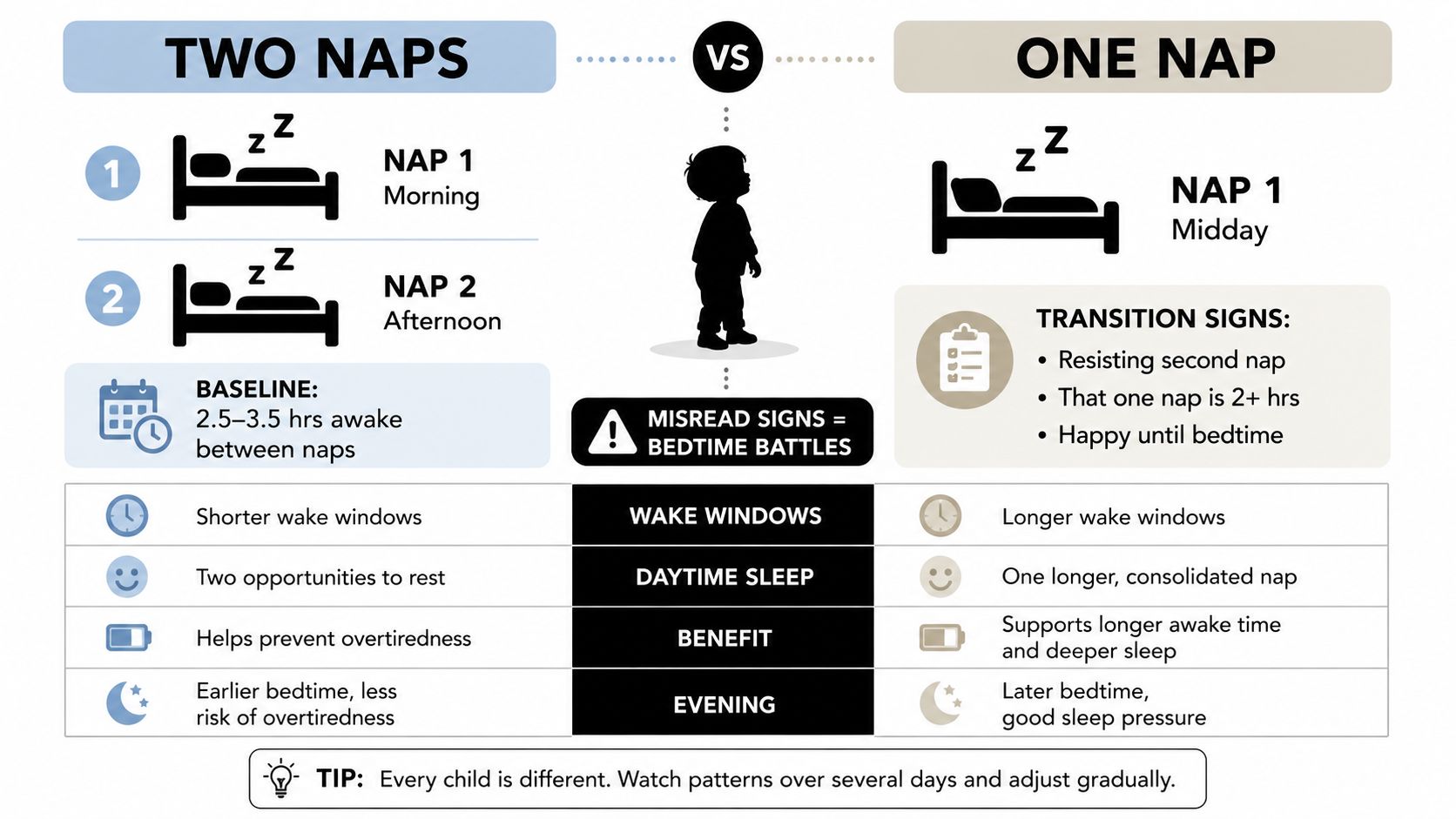
Most 13-month-olds still function best with two naps. The usual two-nap pattern includes about 2.5 to 3 hours of daytime sleep, wake windows around 3 to 4 hours, and bedtime commonly between 7:00 and 8:00 p.m., as outlined by Taking Cara Babies. A brief refusal of one nap doesn't automatically mean your toddler is ready for one.
Compare the patterns
| Element | Two-Nap Day | One-Nap Day |
|---|---|---|
| Morning | Active play followed by a morning nap | Longer morning stretch before one central nap |
| Daytime sleep | Two restorative sleep periods | One consolidated midday sleep period |
| Afternoon | A second wake window followed by Nap 2 | A longer afternoon stretch leading to bedtime |
| Best fit | A toddler who still becomes tired between activities | A toddler who consistently manages the longer day without falling apart |
| Main risk | Nap resistance from changing sleep needs | Overtiredness if the transition happens too soon |
A one-nap transition deserves evidence from repeated behavior, not a difficult Tuesday. Look for a consistent pattern in which settling for naps takes longer, a previously reliable nap becomes short, late-afternoon wakefulness becomes manageable, and night sleep remains stable. If your toddler is cheerful after refusing a nap but melts down before bedtime, the problem may be an awkward day rather than readiness.
Night disruption is another important clue. A child who begins waking more often after daytime sleep is reduced may be carrying too much fatigue. In that situation, restoring the two-nap structure can work better than stretching wake windows further.
One nap can be appropriate for some children, especially when the pattern is stable rather than occasional. But a 13-month-old who refuses the morning nap for a few days may be walking more, teething, overstimulated, or testing a new boundary.
Here's a useful decision filter:
- Nap resistance: Is your toddler taking much longer to settle repeatedly, rather than just once?
- Late-day stamina: Can they reach bedtime contentedly, without frantic behavior or a crash?
- Night sleep: Has reducing daytime sleep preserved, rather than disrupted, overnight rest?
- Nap quality: Is the remaining nap long and restorative, rather than a brief replacement for two naps?
The sample 13-month sleep schedules from Taking Cara Babies show both two-nap and one-nap formats, but the practical lesson is more important than copying either clock. Choose the structure that matches your child's repeated sleep behavior.
A Sample 13 Month Old Schedule You Can Actually Follow
Use this as a handoff schedule for a caregiver, not as a test your toddler can pass or fail. It combines sleep with food, milk, movement, and quiet time so the day doesn't become a sequence of naps with meals squeezed into the gaps.
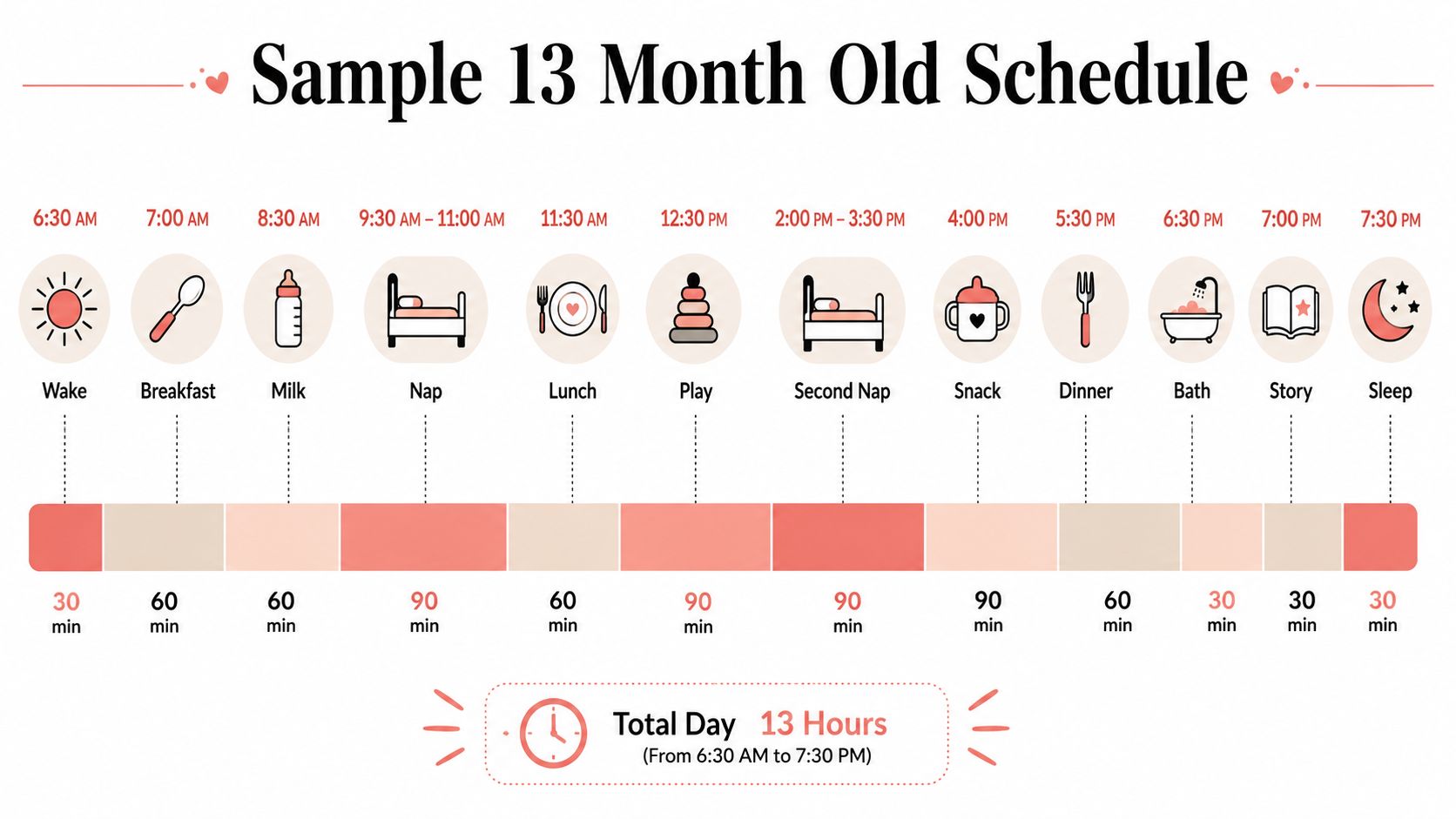
A practical two-nap framework
- 6:30 a.m. Wake, diaper change, and milk or breastfeeding if that fits your family's pattern.
- 7:00 a.m. Breakfast with family foods and water.
- 7:30 to 9:15 a.m. Active play, getting dressed, outdoor time, or daycare activities.
- 9:30 a.m. Nap 1 opportunity, placed about 3 hours after waking.
- 11:00 a.m. Lunch after waking, followed by active play.
- 1:30 p.m. Nap 2 opportunity, generally about 3 to 3.5 hours after Nap 1 ends.
- 3:00 to 5:30 p.m. Snack, outdoor movement, errands, or calmer play depending on energy.
- 5:30 p.m. Dinner with the family.
- 6:30 p.m. Bath or wipe-down, pajamas, books, and a final feed or cuddle.
- 7:15 p.m. Bedtime, adjusted according to when Nap 2 ended.
The key calculation is simple. Anchor wake time first, offer Nap 1 around 3 hours later, place Nap 2 about 3 to 3.5 hours after Nap 1 ends, then allow about 3.5 to 4 hours before bedtime. This approach follows the practical timing described in Huckleberry's schedule guidance.
If your toddler wakes earlier, move the whole rhythm earlier rather than forcing the original clock times. If the morning starts later, shift meals and naps forward while protecting enough time before bedtime for your child to build sleep pressure.
The schedule is a set of relationships, not a set of appointments.
Daycare may offer naps at times you can't control. On those days, keep meal order and bedtime cues familiar, then use the actual nap ending to decide how long the final wake window should be.
Weaving Milk and Solids Into the Day
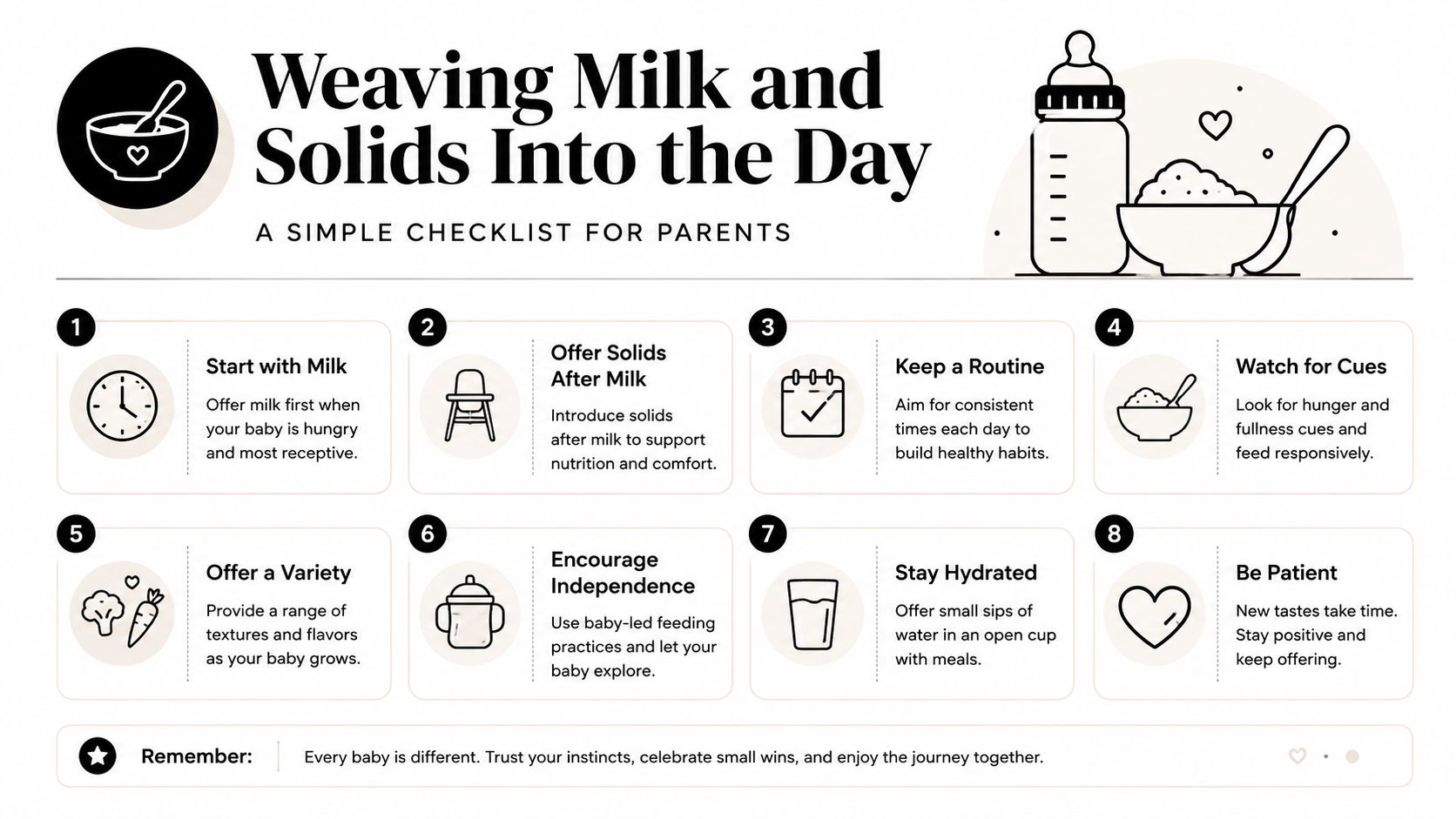
Feeding often causes more schedule stress than sleep. A toddler may drink eagerly in the morning, reject lunch, nurse before every nap, and then ask for food immediately after bedtime. Appetite can vary, but the offering pattern can remain predictable.
Public-health guidance emphasizes that, around 12 months, toddlers should move toward family foods and that milk shouldn't crowd out iron-rich meals. The Baby Sleep Site's discussion of the 13-month schedule highlights this feeding transition as an important part of the daily routine, rather than treating the schedule as a nap chart alone.
Put food in the driver's seat
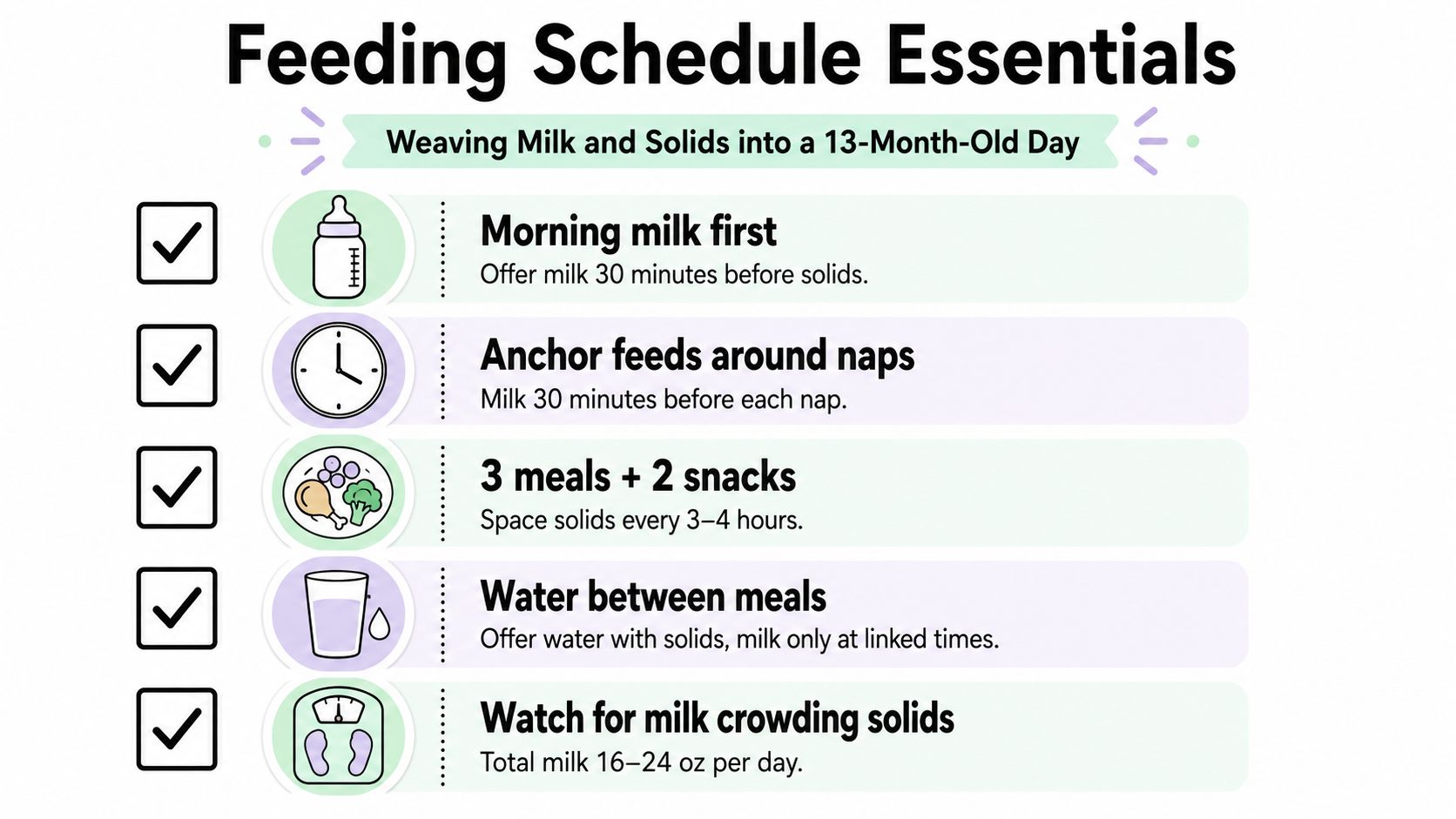
Offer breakfast, lunch, and dinner as the main eating opportunities. Add snacks when needed, especially between meals, but don't automatically replace a refused meal with a large milk feed. That can create a cycle in which your toddler arrives at the next meal without enough appetite for food.
A practical sequence might look like this:
- Morning: Offer breakfast and family foods, then milk according to your child's established feeding pattern.
- Before Nap 1: Use a small feed or nursing session if it helps your child settle, while keeping the meal separate from the entire sleep routine.
- Midday: Serve an iron-rich food alongside other family foods after the first nap.
- Afternoon: Offer a snack and water, then milk if your child needs it.
- Evening: Serve dinner early enough that hunger doesn't collide with the bedtime wind-down.
Breastfeeding doesn't have to stop at 13 months. Some families continue nursing around naps or at waking, while others gradually move toward cups and family meals. The right arrangement depends on your child's growth, your feeding goals, and advice from your pediatrician.
For families pumping or warming expressed milk, review safe handling details in this guide to warmed breast milk so feeding decisions don't add unnecessary uncertainty.
Make the routine portable
Daycare caregivers need the order more than they need a perfect time. Send a simple plan: breakfast or first meal, milk pattern, nap opportunities, lunch, snack, and the bedtime target. At home, weekends can follow the same sequence even when the clock shifts.
Water belongs naturally with solid foods, while milk and breastfeeding can remain connected to waking, naps, or family preferences. If your toddler repeatedly fills up on milk and barely touches iron-rich foods, discuss the pattern with your pediatrician rather than trying to correct it through pressure at the table.
Building a Bedtime Routine That Actually Sticks
Bedtime works best as a sequence your toddler recognizes, not as a number you defend. Begin the wind-down about 30 to 45 minutes before sleep, then repeat the same broad order even when the afternoon nap ends at an inconvenient time.
Keep the ritual predictable
A workable routine might include:
- Diaper change and pajamas.
- Bath or a quick wipe-down.
- Low lights and a quieter room.
- One or two books.
- Final breastfeeding, bottle, or cuddle if that remains part of your family's routine.
- Sleep phrase, song, and crib.
A dark, calm room can reduce stimulation, and a sound machine may help create a consistent sleep cue. If you're choosing one, compare practical features in this guide to the best noise machines for babies.
The routine should stay recognizable when naps shift. If Nap 2 ends late, shorten the wind-down rather than removing every cue. If the nap is missed, move bedtime earlier while keeping pajamas, books, and the final connection intact.
When your toddler stands and calls
Standing in the crib can turn bedtime into a negotiation. Respond calmly, use the same brief phrase, and return your toddler to a safe resting position if needed. Avoid creating a new, lengthy interaction each time your child stands, because the extra attention can become more stimulating than reassuring.
You may need several consistent responses before the new boundary feels familiar. Comfort is appropriate, but the response should remain boring enough to preserve the message that bedtime is still bedtime.
When the Schedule Breaks and What to Do Next
A missed nap doesn't erase the routine. A daycare nap reversal, teething, illness, travel, daylight saving, or a burst of walking can make a familiar day look completely different.
Use the disruption to choose the next sensible anchor:
- Short nap: Offer the next sleep opportunity based on the shorter wake window your toddler can manage.
- Skipped nap: Bring bedtime earlier instead of forcing an exhausted child to stay awake.
- Illness or teething: Prioritize comfort and recovery, then return to familiar cues when your child feels better.
- Travel or daycare changes: Keep meals and the bedtime ritual recognizable, even if naps move.
- Daylight saving: Shift gradually through the routine while keeping the sequence stable.
A broken day isn't proof that the schedule failed. It's a reason to use the schedule's underlying logic.
The target is not a perfect chart on the refrigerator. It's a toddler who gets reasonable opportunities to sleep, eats without constant pressure, and has enough flexibility to handle an active life. If your return to work is changing who handles naps, feeds, or bedtime, this guide to returning to work after baby can help you think through the practical transition.
If sleep disruption persists, feeding concerns arise, or your child seems unwell, contact your pediatrician. A routine is a support system, not a substitute for individualized medical guidance.
Milk&Lace offers nursing lingerie designed for later postpartum routines, including supportive pieces with breastfeeding access and elegant materials. Visit Milk&Lace to explore options that can make feeding access feel more practical while you move through this increasingly mobile stage of motherhood.