

You're standing in a dark nursery at 3:07 a.m., one hand on a bottle or breast pump, the other trying to keep your phone from lighting up the room. The baby finally dozes, then the dog barks, a door clicks, and your partner rolls over after a too-short stretch of sleep. That's where a noise machine earns its keep, not as a cute baby gadget, but as the thing that protects everyone's rest when your whole house feels fragile.
| What matters most | What to look for | Why it matters in real life |
|---|---|---|
| Safety | Controlled volume, proper placement | Protects baby's ears and keeps the room usable overnight |
| Continuous sound | No auto-off if possible | Prevents wakeups when the room suddenly goes silent |
| Portability | Rechargeable, clip, light weight | Helps with naps in the stroller, car, or travel crib |
| Sound variety | White, pink, brown noise | Lets you match the sound to your house and your baby |
Why Sound Matters More Than You Think
At 3 a.m., the room doesn't need silence. It needs predictability. Newborns are already adjusting to life outside the womb, and the household around them is full of sudden noises, siblings, vents, pets, pipes, and the partner who's trying very hard to get one more hour of sleep before work.
A good noise machine gives the room one steady backdrop. That matters because the baby isn't only hearing the machine, the whole family is benefiting from a more consistent sound environment. It also changes how night feeds feel for you, because the tiny sounds that normally make you tense up, a floorboard, a cough, a chair scrape, don't land as sharply.
The case for white noise has old roots. In a small 1990 study of newborns aged 2 to 7 days, 80% of babies exposed to white noise fell asleep within 5 minutes, compared with 25% in the control group, and when white noise was then turned on for the control group, 70% of the previously awake babies fell asleep too, a short-term soothing effect that parenting and sleep resources still cite today (ParentData).
Practical rule: if the sound machine helps the room feel boring, you're using it correctly.
That “boring” room is what makes night feeds less chaotic. It's also what helps a resting partner stay asleep, which sounds small until you've lived through the second week home with a newborn and realized that one interrupted sleeper can destabilize the whole house. The best noise machine for baby is the one that makes your nights feel less reactive and more repeatable.
Understanding White, Pink, and Brown Noise
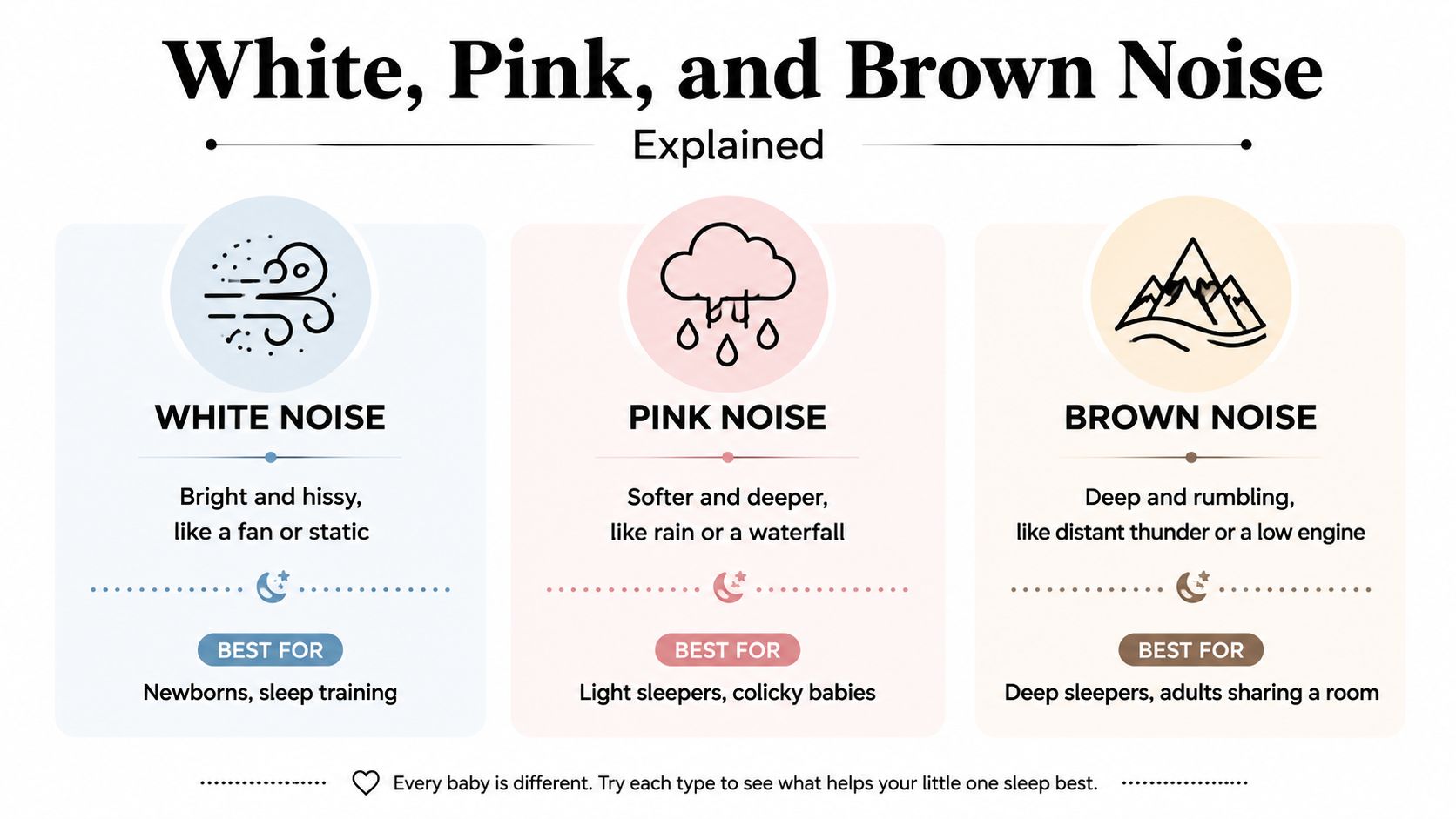
White noise is the bright, hissy one. Think static, a fan, or the sharper part of a shower running in the next room. It's good at masking sudden household sounds because it spreads across the frequency range in a way that covers voices, traffic, and random clatter.
Pink noise sounds softer and more balanced. Rainfall is the easiest mental image, and that's why a lot of parents find it easier to live with all night. Brown noise is deeper and more rumbly, closer to distant thunder or a low engine, and some families prefer it when they want the room to feel less harsh.
Which one works best
If you live with traffic, hallway noise, or a partner who still wants to watch TV in the next room, white noise usually does the most obvious masking work. If your baby seems startled by harsh sound, pink or brown can feel gentler in the nursery.
Here's the honest truth. Most families do better by choosing the sound they can tolerate for hours, not the one that sounds clever in a product description. A machine that annoys you at 2 a.m. won't stay in use, and consistency matters more than chasing the perfect audio profile.
A useful way to think about it is this, white noise for sharper disruption, pink noise for a softer middle ground, brown noise for deeper hush. That's also why some parents switch as the baby grows, not because the baby is suddenly “choosing” a color, but because the household changes, the baby becomes more aware of sound, and your own tolerance for harsh hiss may drop fast.
For a postpartum mom, the best sound is often the one that doesn't make you feel like you're living inside a machine. That's one reason a soft, well-made nursing piece like GAIA can feel like part of the same practical philosophy, comfort first, with enough structure to make long nights easier to move through.
Key Features Worth Prioritizing
Continuous playback beats fancy extras
Most parents do not need ten lullabies or blinking lights. They need the sound to keep going. If a machine shuts off in the middle of a sleep cycle, the room changes right when the baby is most likely to stir, and no app feature fixes that.
The portable market makes that trade-off easy to see. The Momcozy WN06 is listed at about 10 hours of continuous runtime and includes a clip for stroller, car seat, or bag use, which fits families who move through naps on the go (Bebé Seguro). The Easy@Home unit is described as 170 g, with 26 sounds, USB-C charging, and a 1,500 mAh battery, while another compact rechargeable model is listed at 88 g with 19 sounds. Those specs tell you whether a machine is meant for travel, all-night use, or bedside convenience.
A lot of feature lists are just noise around the real question, will this machine stay on, stay quiet enough, and stay easy to use when you are half asleep?
Compare features by age
| Feature | Newborn 0 to 3 months | Infant 4 to 12 months | Toddler 1 to 3 years |
|---|---|---|---|
| Continuous sound | Required | Required | Still useful |
| Precise volume control | Required | Required | Useful |
| Portability | Useful for naps and travel | Very useful | Useful |
| Sound variety | Optional | Useful | More relevant |
| Timer control | Usually skip it | Sometimes useful | More useful |
| App control | Nice, not needed | Nice, not needed | Helpful for routines |
The main verdict is simple. For newborns, continuous sound and safe volume matter most. For older babies and toddlers, portability, app control, and sound variety start to matter more because sleep routines get layered with travel, transitions, and daycare naps.
Bluetooth-heavy options can be tempting, but they are usually a lifestyle choice, not a sleep requirement. If you want one machine that disappears into daily life, a basic, reliable model usually wins. If you want a machine that also helps with routines later on, app control starts to earn its place.
Safe Placement and Volume Guidelines
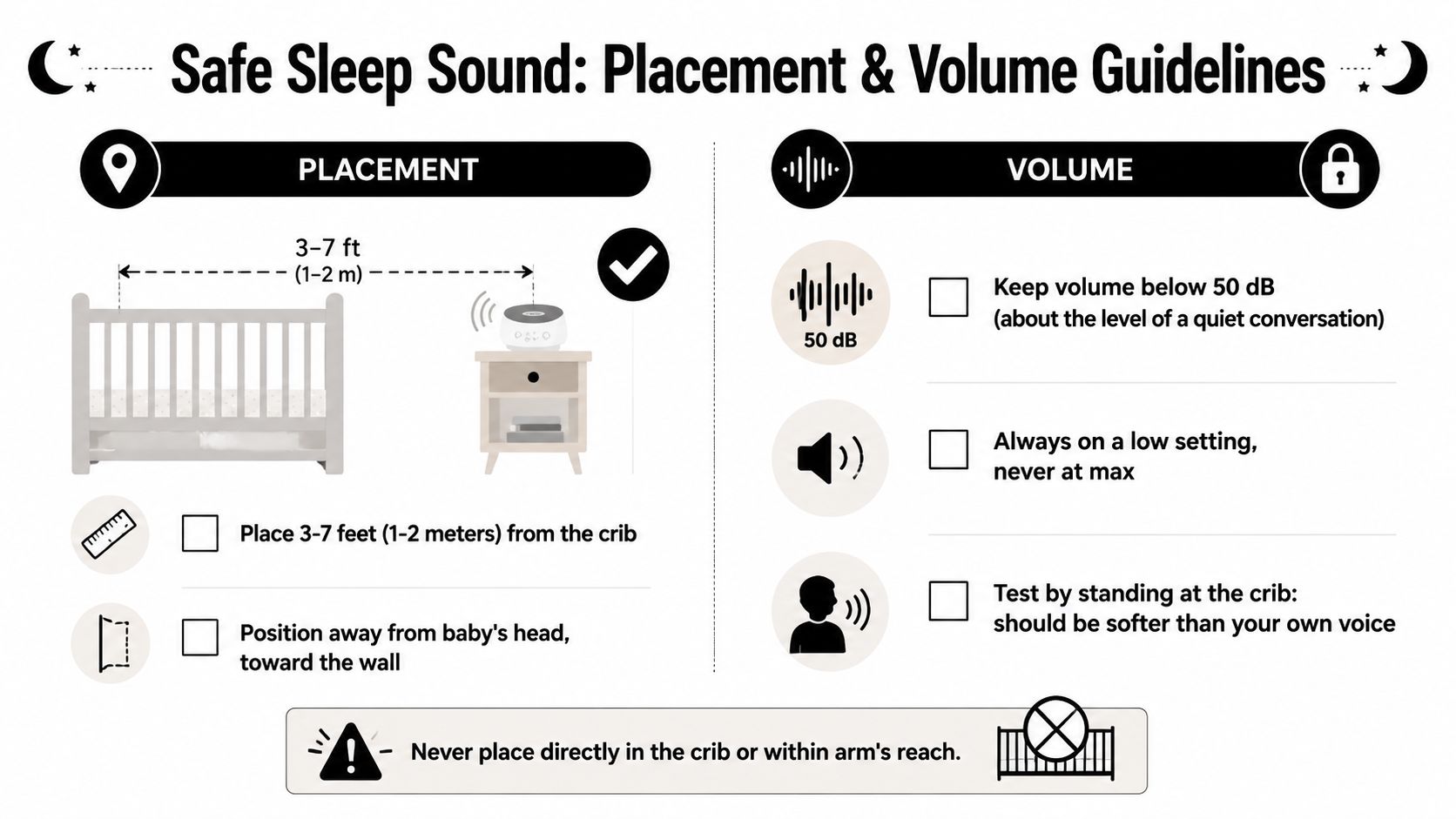
Placement matters more than the machine's biggest volume setting. The goal is to mask noise, not create a new one. Parenting and review guidance commonly points parents toward a range of 55 to 70 decibels, with some allowing 70 to 75 decibels, and recommends putting the device away from the crib instead of next to the baby (BabyGearLab).
A separate safety guide says a technically strong target is 50 dB or lower measured at the baby's head in the crib, and it also notes that in one review of 14 tested machines, 3 units exceeded 85 dB (Momcozy safety guide). That's a big reminder that not every product handles volume responsibly.
The setup I'd use tonight
Put the machine 3 to 7 feet from the crib, or roughly 1 to 2 meters, and keep it pointed away from the baby's head, ideally toward the wall. Never place it in the crib or within arm's reach. One source recommends keeping it at least 7 feet from the baby's head and using the lowest effective volume, while another general safety discussion says the output should stay closer to the sound of a shower or normal conversation rather than something loud and obvious (Taking Cara Babies).
Here's the practical test. Stand at the crib and listen. If you can clearly hear the machine over your own voice, it's too loud. If it softens the room and blurs random household sounds, you're in the right zone.
As the baby gets older and more mobile, the setup still shouldn't change into a louder, closer, “stronger” version. Keep the same safe placement and adjust only what's needed to maintain a gentle buffer. Loud is not more effective, it's just riskier.
Choosing Based on Your Household Reality
The right machine depends on what your nights sound like. An apartment with thin walls needs different masking than a quiet suburban nursery. A home with older siblings needs a sound profile that can absorb door slams, footsteps, and hallway chatter without making the room feel aggressive.
If you're back at work soon and juggling a pumped bottle, partner shifts, and a baby who still wakes often, consistency becomes the priority. You don't need a gadget that does everything. You need one that works the same way at 1 a.m., 4 a.m., and during a stroller nap at noon, which is the same kind of grounded decision-making that helps when you're reading practical postpartum planning guides like returning to work after baby.
Match the machine to the house
In a noisy urban home, white noise usually earns its place because it masks sharper interruptions. In a quieter room where the baby seems bothered by harsher sound, pink or brown may be easier to live with. If you share a room, a lower-profile unit matters because the machine will be part of your own sleep, not just the baby's.
Travel changes the equation again. Portability becomes the feature that saves your night, because a compact rechargeable machine is easier to pack than a full nursery unit. If you move between crib, bassinet, car seat, and hotel room, the machine should feel like a sleep anchor, not one more bulky thing to manage.
That's also why aesthetics matter more than people admit. If the machine sits in your bedroom, looks at you all night, and reminds you of plastic baby gear, you may resent it. A more designed room can help you feel a little more like yourself, which is one reason thoughtful postpartum basics matter, including products that support feeding routines without shouting for attention.
Scenario-Based Recommendations for Postpartum Moms
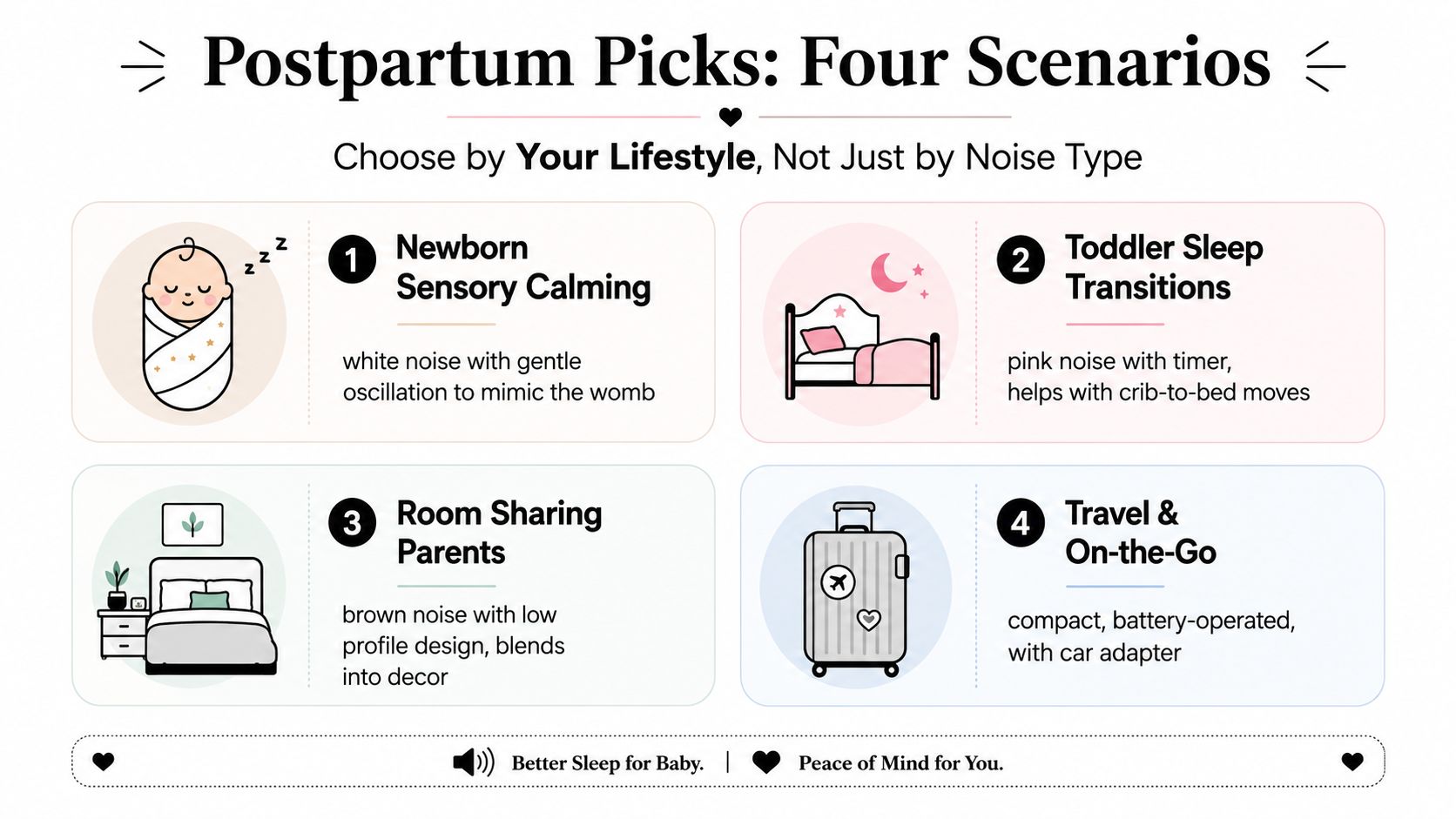
The first-time mom in a small apartment should keep it simple. Choose a machine with continuous playback, clear volume control, and a sound that does not feel harsh after long stretches of use. White noise is the safest default here because it handles neighbor noise, hallway interruptions, and the random apartment sounds newborns seem to notice at the worst possible moment.
The mom managing multiple kids needs a machine that disappears into chaos. Sibling noise, bathroom doors, and a partner leaving before dawn all call for stronger masking and a device that does not need babysitting. In that setup, brown noise can be easier on the adult nervous system, especially when the machine is running in shared space and you are trying to stay calm while someone else's day is already starting.
The traveling family should prioritize rechargeable power, a clip, and easy packing. As noted earlier, compact models in the 88 g to 170 g range work well for travel, because that is the kind of portability that gets used. A travel machine does not need the biggest sound library, it needs to survive diaper bag life and be easy to start in the dark.
The mom who wants the nursery to still feel like her room should choose a machine that looks calm, not clinical. If the room already has a considered design, a low-profile unit with a softer finish will fit better than a bright plastic tower. That matters more in the postpartum months than most shopping guides admit, because the room should support both sleep and identity.
Buying for a fantasy nursery instead of the life you are living is a common error. If you are up twice a night, feeding in the dark, and passing the baby back and forth with your partner, the machine needs to be easy, quiet in use, and forgiving when you are exhausted. That is the postpartum test.
If breastfeeding is part of that picture, do not overlook what you wear during those hours. A bra like Petra can matter because it is built for one-hand nursing access and a soft feel against sensitive skin, which is exactly the kind of practical comfort that helps the night feel less punishing. If you are also dealing with feeding tension or a baby who cries at the breast, this newborn breastfeeding crying guide is a useful place to start.
Your Prioritized Shopping Checklist
Start with the essentials. Safety, volume control, and continuous playback come first, because a machine that cuts out, runs too loud, or sits too close to the crib solves one problem by creating another. If you are still packing for the hospital, keep your maternity bag checklist nearby while you sort the rest of your newborn setup. A timer can help later, but for newborn sleep, continuous sound is the safer default.
The next tier is about fit. Portability, power source, and sound variety matter once your life stretches beyond the nursery. If you travel, want a stroller clip, or need a machine that works in more than one room, rechargeable power stops being a nice extra and becomes part of daily life.
Screenshot this before you shop
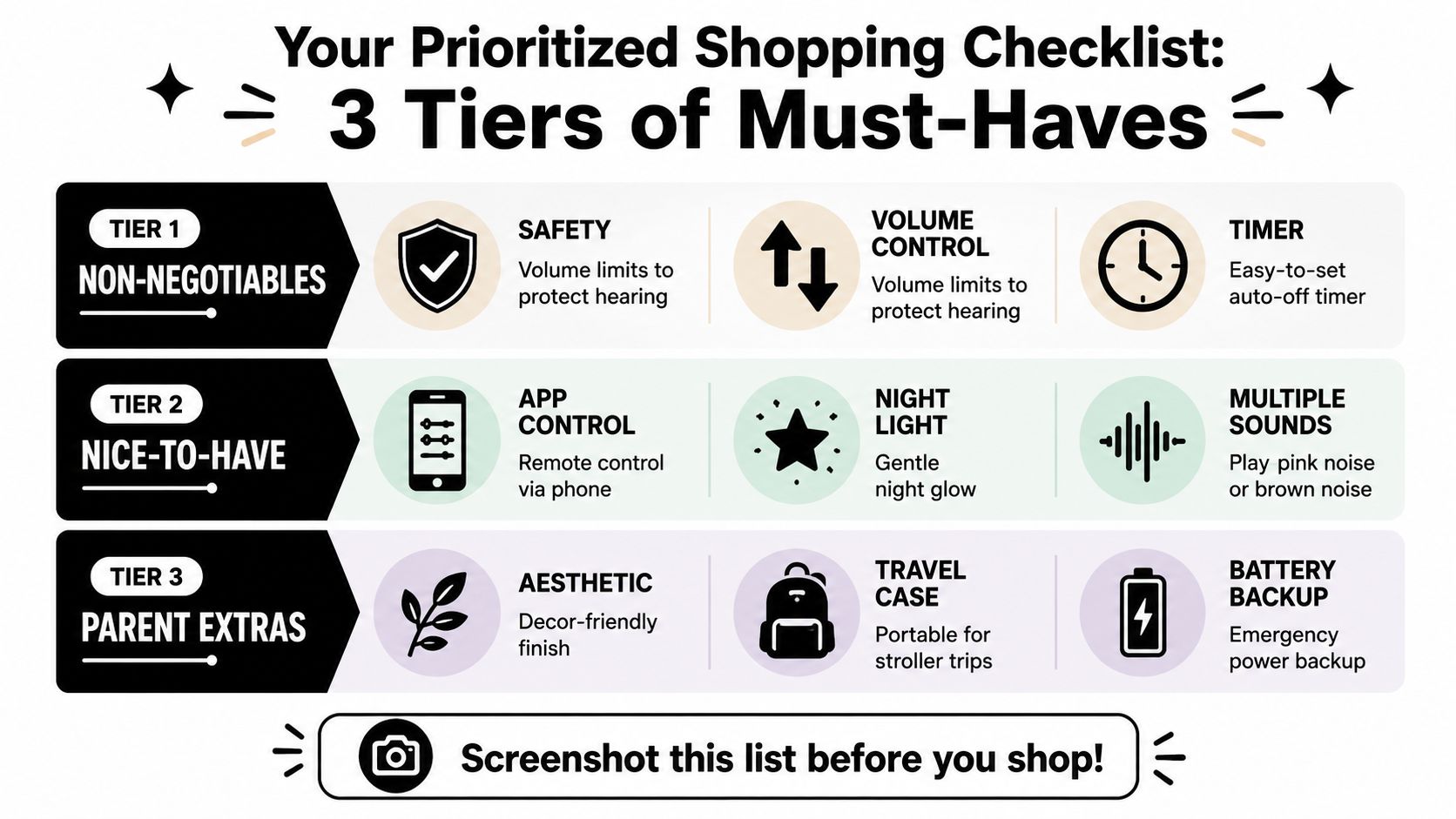
Use this filter before you buy. If a machine lacks safe volume control, skip it. If it has smart features but no easy physical controls, think hard about whether you will use it at 2 a.m. If it looks beautiful but cannot stay on when you need it, that is decoration, not function.
- Required: safe output, stable placement, continuous playback.
- Important considerations: battery life, clip or travel case, white and brown or pink options.
- Nice-to-haves: app control, night light, decor-friendly design.
If you want one clear rule, use this. Buy the machine that makes your nights quieter without making your life harder. Set it up low, keep it away from the crib, and use it consistently.
For mothers rebuilding their routines after birth, that kind of calm can be part of the whole reset, from the sound in the room to the clothes on your body. If you want pieces that support your nights and still feel like you, visit Milk&Lace and explore maternity and nursing essentials for real postpartum life.