

The baby is fed, dressed, and finally asleep. You have 40 minutes before the pediatrician appointment, and your closet has become a puzzle. Your pre-pregnancy jeans won't button, your maternity leggings feel too loose in the wrong places, and the only nursing-friendly bra you own is stretched from sleeping in it.
That confusion isn't a personal failure. What to wear postpartum changes because your body, recovery, feeding routine, and sense of self are changing at the same time. The answer isn't one miraculous outfit. It's a wardrobe that moves through stages, from healing and softness to access, support, and eventually the return of personal style.
The Postpartum Wardrobe Problem Nobody Talks About
Postpartum clothing has to solve three problems at once. It must respect a recovering body, make feeding or pumping straightforward, and help you feel like a person rather than a walking medical appointment. Those demands rarely line up neatly.
Your waistband may need to accommodate swelling, tenderness, an incision, or a pad. Your breasts may change throughout the day. A top that looked practical at home may become frustrating in public if nursing requires removing three layers and wrestling with a fixed neckline. Meanwhile, the clothes that feel physically kind can sometimes make you feel shapeless or disconnected from the woman you were before birth.
That's why a single “postpartum outfit” isn't enough. The first days call for uncomplicated, forgiving pieces. Later, you'll want garments that still allow feeding but have more shape, detail, and personality. A useful wardrobe has to absorb those shifts instead of demanding that your body settle on a schedule.
Start with three wardrobe questions
Before buying anything, ask:
- Can I move comfortably? Look for fabrics and closures that tolerate sitting, standing, bending, and carrying a baby without cutting into your abdomen or pelvis.
- Can I feed without undressing? Test whether the garment lifts, wraps, or opens easily while holding a baby with one arm.
- Do I recognize myself in it? Practicality matters, but so does color, texture, lace, silhouette, and the feeling that you chose the garment on purpose.
The postpartum undergarments guide is a useful starting point for building that first layer, but don't treat early postpartum dressing as a permanent identity. It's a temporary system designed to give your body room while your life finds its rhythm.
The right question isn't “What size am I now?” It's “What does my body need this week?”
A staged approach also protects your budget. Buy fewer early pieces with flexible fits, then reassess as your breasts, torso, energy, and daily routine become more predictable. You don't need to replace your whole wardrobe immediately. You need the right layer for the chapter you're in.
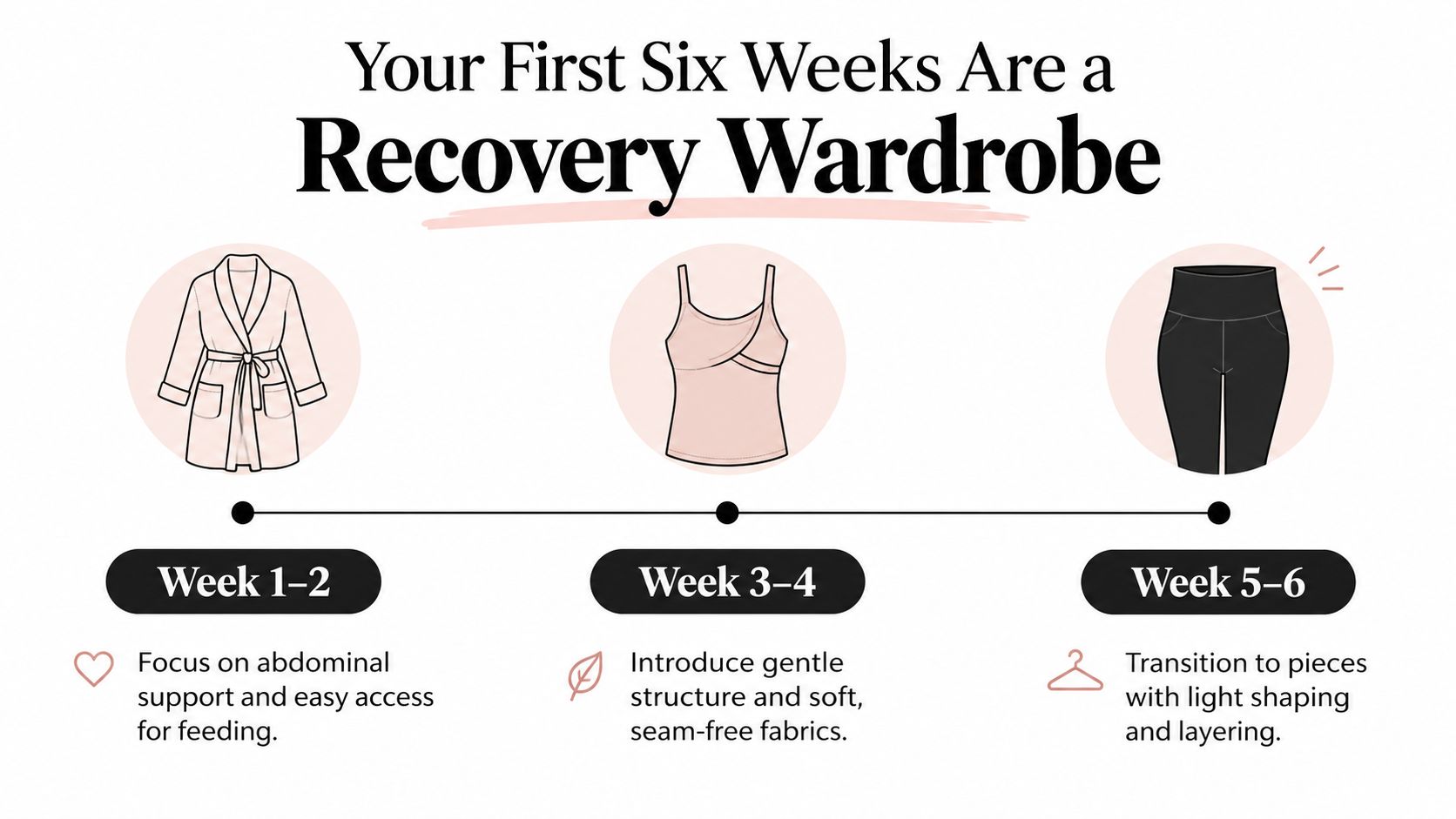
Your First Six Weeks Are a Recovery Wardrobe
The first six to eight weeks deserve their own clothing rules. The postpartum period begins immediately after childbirth and generally lasts about 6–8 weeks, although recovery varies and some physical changes continue for several months. Bleeding is typically heaviest during the first 3–4 days and can continue for up to 6 weeks, while the uterus usually moves toward its original size within about 6 weeks (Cleveland Clinic's postpartum overview).
That timeline explains why your first wardrobe should prioritize flexibility over polish. You may leave the hospital while dealing with sweating, swelling, tenderness, bleeding, or healing tissue. A rigid waistband is not a symbol of progress. It's just an unnecessary source of pressure.
Build around soft adjustability
Choose garments that make room for your actual recovery:
- Waistbands should yield. Wide, soft elastic and pull-on rises are kinder than narrow bands that roll or press into the abdomen.
- Rises should be adaptable. High-rise underwear can feel reassuring, but it shouldn't rub against a healing incision or trap heat.
- Layers should open easily. Wrap tops, loose cardigans, and lift-up nursing tanks reduce the need to pull clothing over your head.
- Fabrics should breathe. Cotton knits, modal, and other soft blends can help with sweating and make long periods of wear less distracting.
- Coverage should be practical. Leave enough room for postpartum protection, an ice pack, or temporary swelling without forcing the garment into a compression role.
During the first two weeks, favor a soft robe, loose sleepwear, nursing tanks, and flexible bras. In the next stretch, you can add gentle structure through a wrap top or a smooth, seam-light layer. By the later part of this window, light shaping may feel appealing, but only if it supports rather than squeezes.
A soft, elegant nursing bra such as GAIA uses stretch lace, flexible support, and breastfeeding access. Whether that type of bra works for you depends on your tenderness, breast changes, and fit on the day.
Your early wardrobe isn't supposed to make you look “back to normal.” It should let you heal, feed, rest, and leave the house without negotiating with every seam.
How a Postpartum Bra Should Actually Fit
A postpartum bra should manage pressure, not win a contest for maximum compression. During the first 2–6 weeks of breastfeeding, breast volume can change substantially with engorgement and feeding intervals, so adjustable, non-binding support matters more than rigid shaping (University of Washington Medicine's engorgement guidance).
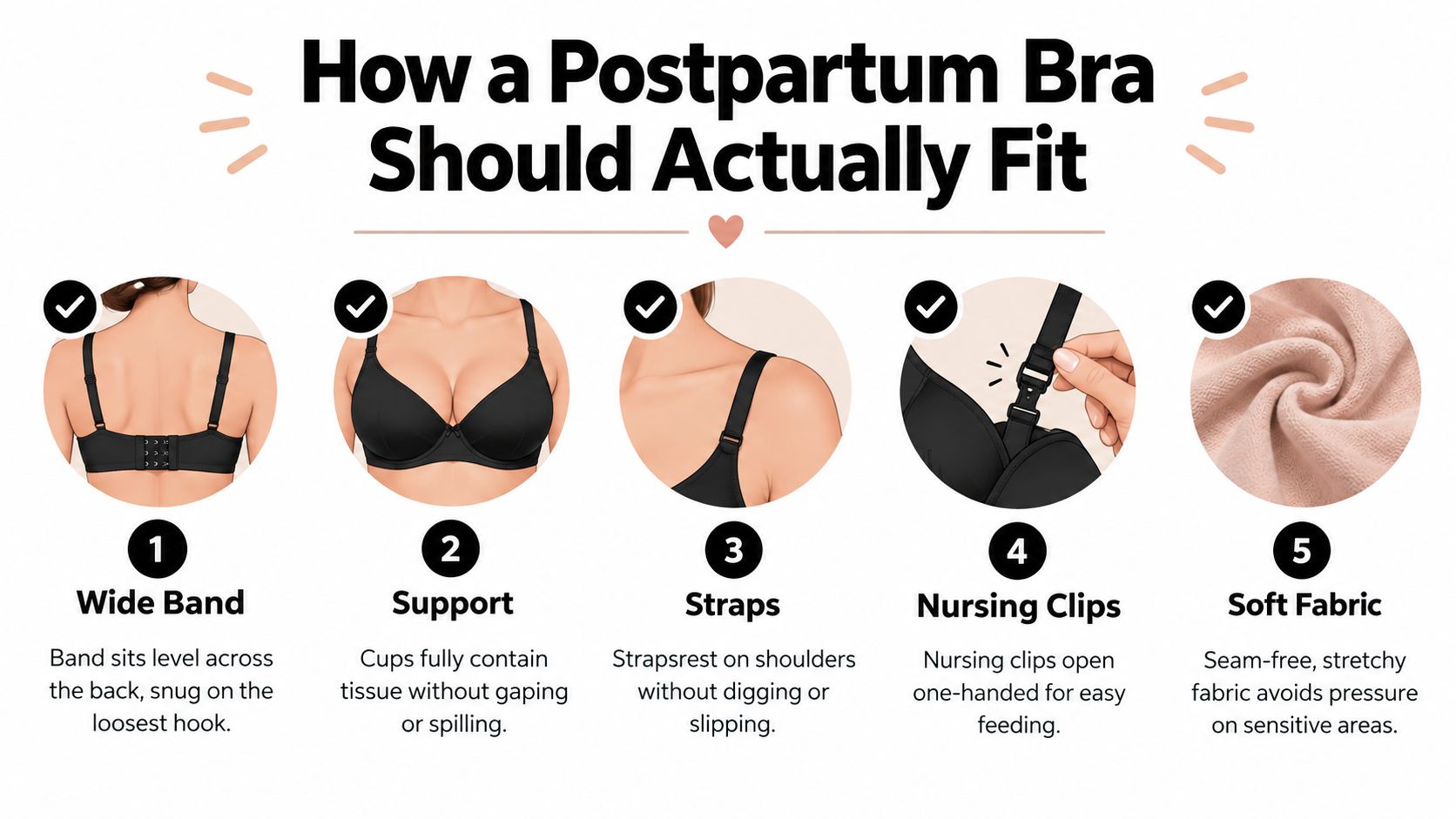
Start with the band. It should sit level across your back, feel stable when you move, and avoid cutting into your ribs. The cups should contain your breast tissue without squeezing it into a narrow shape. If you see persistent red marks, feel soreness near the nipple or outer breast, or notice one concentrated pressure point, the bra is giving you information. Change it.
Test the bra like you'll use it
A fitting-room check should include more than standing still:
- Raise both arms. The band shouldn't climb, and the cups shouldn't shift away from the breast.
- Sit down. Check whether the underband becomes a hard line across your ribs or abdomen.
- Lean forward. Breast tissue should remain supported without spilling over the cup edge.
- Open the nursing clip one-handed. If you need both hands or the cup pulls sharply inward, feeding will be frustrating.
- Close it again. Hardware should return the cup to position without dragging the breast into a fold.
The nursing bra fit guide can help you evaluate those details before you commit to a style. Prioritize adjustable straps, multiple closure positions, adequate cup depth, smooth seams, and a nursing mechanism that opens cleanly.
A bra that feels perfect before feeding may feel different afterward. Check the fit at different points in the day, especially while your breasts are still unpredictable. Early on, flexible support is the sensible default. Later, you can consider more structure when it stays pressure-free, doesn't mark your skin, and doesn't cause soreness.
If you develop focal pain, redness, fever, or flu-like symptoms, don't try to solve the problem with a different bra alone. Seek medical advice.
Choosing Fabrics That Work With a Healing Body
Fabric is the part of a garment your skin has to tolerate for hours. After birth, that interface matters more because sweating, tenderness, leaking, and frequent feeding can make small irritations feel enormous.
Cotton knits are breathable and familiar, making them dependable for sleepwear, tanks, and underwear. They can feel slightly heavier when damp, so they're not always the most discreet choice beneath fitted clothing. Modal and micromodal usually offer a smoother, lighter feel and work well for garments worn close to the skin, especially when you want a second-skin sensation without a rough seam.
Stretch lace deserves a fair assessment. Lace isn't automatically scratchy or decorative-only. A soft stretch lace with a smooth lining can provide flexibility and visual detail, while a stiff lace or raised seam can become irritating quickly. Judge the actual construction, not the fabric label.
| Option | Best For | Watch Out For |
|---|---|---|
| Cotton knit | Sleepwear, tanks, and breathable everyday layers | Dampness that lingers against skin |
| Modal or micromodal | Smooth close-to-skin comfort and lightweight layering | Thin fabrics that lack enough support on their own |
| Soft stretch lace | Nursing lingerie with flexibility and intentional style | Scratchy edges, rigid panels, or rough internal seams |
| Seam-free stretch fabric | Tender breasts and long wear periods | Weak support if the band and straps lack stability |
| Structured fabric with gentle support | Later postpartum dressing when fit is predictable | Any underwire or panel that presses into breast tissue |
Match construction to the stage
During early breastfeeding, avoid firm underwire and rigid structure when breasts are variable or tender. Breastfeeding-focused guidance recommends minimizing prolonged, concentrated pressure across breast tissue, particularly around the nipple and outer breast, while still providing enough support for comfortable movement (lactation complications guidance).
The bra fabric and material guide can help you compare materials, but your body remains the final test. A forgiving fabric with smooth seams is often the right early choice. Once fullness becomes more predictable, a structured style can work, provided it doesn't dig in or leave indentations.
Beyond the Bra Building a Wearable Postpartum Closet
A workable postpartum closet is not one soft outfit repeated until it falls apart. It is a small rotation built around three standards: adjustable, accessible, and forgiving. If a piece misses two of those, it usually ends up at the back of the drawer, even if it looked perfect on a model.
Start with tops you can open, lift, or shift with one hand. Wrap styles, crossover knits, relaxed V-necks, and lift-up nursing tops do the job better than stiff button fronts that gape at the chest or make feeding feel like a project. Choose shapes that give access without making you feel locked into a temporary category of clothes. The best postpartum tops still look like your style, just easier.
Choose bottoms that cooperate
Your waist, hips, ribs, and lower belly can keep changing long after the early recovery stage. A pair of pants that feels fine at six weeks may feel sloppy later, or strangely tight by afternoon. Plan for a transition, not a finish line.
That is why stretch-woven trousers, pull-on pants, and high-rise leggings with a wide waistband earn their place. They move with bloating, healing, sitting, lifting, and the general reality of being in your body all day. If you want jeans, buy the pair with some give. Skip any waistband that presses into a tender scar, digs into your abdomen, or turns getting dressed into a small act of punishment.
Do not use tight denim as a recovery test.
A useful closet usually includes:
- Two or three nursing-friendly tops that lift or wrap without exposing your whole torso.
- Soft trousers or leggings with wide waistbands that stay put instead of rolling.
- One easy dress with a wrap or lift-up front for appointments, visits, or days when separates feel annoying.
- A cardigan or overshirt for warmth, light coverage, and an easy layer if you leak.
- Shoes you can put on easily, especially while swelling, fatigue, or bending still feels like a lot.
- Real pockets, big enough for a phone, keys, or a burp cloth.
One more opinion. Do not build every outfit around hiding yourself. Extra length can feel good, and there is nothing wrong with wanting coverage. But postpartum style gets better when you also choose color, texture, earrings, a strong neckline, or a clean silhouette on purpose. Your body is changing for months, sometimes well into the first year. Your clothes should make room for that without asking you to disappear.
Three Outfits for the Three Lives You Are Living
Postpartum life rarely follows one dress code. You may spend the morning walking through a park, the afternoon meeting a friend, and the evening planning how to pump or feed during a workday. The same principles can look completely different depending on the setting.
The week-three park walk
Start with a soft, flexible bra under an easy-access wrap top. Add high-rise leggings with a wide waistband and a cardigan that can provide warmth, privacy, or an improvised feeding layer. This outfit works because every piece can move with you, and nothing depends on a precise waist measurement.
Choose sneakers that still feel good if your feet remain swollen. Add a crossbody bag or a coat with usable pockets so you're not carrying your phone and keys in one hand while handling the stroller or baby.
The month-four coffee meeting
At this point, you may want more shape without giving up nursing access. Try a nursing-friendly camisole under a relaxed blazer, flexible-waist jeans, and a low-profile lace bra that feels considered rather than purely functional.
The blazer creates structure without squeezing your torso. The camisole handles access, while the bra gives the outfit a finished base. If you're worried about leaking, choose a darker or patterned layer that doesn't make you spend the meeting monitoring your clothing.
This is also the stage when fabric and proportion begin doing more style work. A clean neckline, a favorite color, or a familiar piece of jewelry can make the outfit feel like yours again.
The video below offers another visual reference for nursing-friendly dressing and bra access.
The month-seven return to work
Build around a more structured nursing bra, a feeding-friendly knit dress, and a layer that can stay on during a pumping break. A cardigan, cropped jacket, or relaxed blazer can make the dress feel professional while keeping the nursing access discreet.
The point isn't to force your old work wardrobe to fit immediately. Choose pieces that let you sit, reach, pump, and carry a bag without constant adjustment. Your clothes should support the logistics of the day while still reflecting the professional and personal identity you're bringing back into the room.
Why Postpartum Style Is Really About Identity
You get dressed for a coffee run or your first day back in the office, catch your reflection, and realize the actual problem is not the jeans or the bra. It is the disconnect. Your body is still shifting, your days are full, and the clothes that technically fit can still make you feel like a placeholder in your own life.
That tension is common after birth. A qualitative BMC Pregnancy and Childbirth research summary describes lower self-image after childbirth in connection with body changes, unrealistic expectations about recovery, and clothing that no longer fits well. That matters because postpartum style is not only about softness or access. It is also about recognition. You want to look like yourself, even while your shape, routine, and priorities keep changing through the first year.

Stop treating concealment as the default
A lot of postpartum advice pushes one message: hide. Hide the stomach. Hide the bra. Hide the fact that your body has not settled yet. That approach usually makes women feel worse, not better.
Concealment is not the same as comfort. You can want one-hand nursing access and still want shape. You can need flexibility at the waist and still want your outfit to look intentional. You can be grateful for your baby and still reject clothes that make you feel erased.
Dress for the body you have now, and leave room for the body you may have at month six, nine, or twelve. That is the smarter way to build a postpartum wardrobe. It accepts change instead of treating your current body as a short delay before the “real” one returns.
Use details that reconnect you to your style instead of defaulting to camouflage:
- A lace texture that makes a nursing bra feel personal, not purely functional
- A wrap or tie shape that adjusts with you and still gives definition
- A structured jacket that adds polish without squeezing your middle
- A favorite color that feels familiar on a tired day
- A soft, skin-friendly fabric that lets a beautiful piece stay wearable for hours
A beautiful nursing bra is not frivolous. A flattering knit dress is not vanity. Clothes can support recovery and still reflect taste, sexuality, professionalism, and personality. Early on, you may want softness above all else. Later, you may want sharper lines, better shape, or pieces that feel more like the woman leaving the house again. Both stages count.
Your Postpartum Wardrobe Checklist and the Next Right Step
Start with what you reach for at 6 a.m., half awake, sore, and already needed by someone else. Your postpartum wardrobe should make that moment easier. It should also still make sense months later, when the baby is bigger, your schedule is fuller, and your body is still shifting.
Use this checklist as a filter. Do not buy everything at once. Postpartum dressing works better in stages, because the first few weeks and the 6 to 12 month stretch ask for different things.
Early recovery essentials
Choose pieces that protect healing, save time, and give easy feeding access:
- Soft bras with flexible support and adjustable closures
- Nursing tops that lift, wrap, or open with one hand
- Wide-waist leggings or pull-on trousers
- High-rise underwear that does not rub sensitive areas
- Breathable sleepwear and a robe
- A cardigan or overshirt for warmth and light coverage
- Shoes that fit comfortably and do not need fiddly fastening
Later transition pieces
Once your feeding rhythm is more predictable and your breast size is less volatile across the day, start adding shape back in:
- A structured nursing bra you can wear for hours without wanting to rip off
- A knit dress with discreet feeding access
- Flexible-waist jeans or well-cut trousers
- A blazer, jacket, or polished overshirt
- Lace, color, and accessories that feel like you
Keep one standard at every stage: no persistent marks, no sharp pressure, no painful seams, and no garment that makes feeding harder than it needs to be. If getting dressed means tolerating digging bands, awkward access, or a waistband you notice all day, that piece is wrong for this season.
Style still matters here. As noted earlier, many women do not want clothes that reduce them to pregnancy or early motherhood. They want clothes that support recovery and still leave room for taste, shape, work, and self-recognition.
The right time to move beyond pure recovery clothes is simple. It is the point when a garment supports your body, works for feeding if needed, and lets you get through the day without adjusting, tugging, or planning around discomfort.
Milk&Lace offers nursing lingerie that combines breastfeeding access with soft lace and flexible support for the later postpartum transition. Visit Milk&Lace to explore pieces designed for the stage when you still need function but are ready to feel like yourself again.