

You're standing in front of an open drawer, one hand holding a nursing bra and the other trying to rescue a pad that has folded into a triangle after the wash. In the early days, you probably tolerated it because feeding access, leaks, and getting dressed quickly mattered more than anything else. But as your routine steadies, you may want a bra that feels less like emergency equipment and more like part of your wardrobe.
That's where nursing bras without removable pads become especially useful. A fixed cup or intentionally unpadded design can simplify daily wear, preserve a consistent silhouette, and help you move from survival-mode breastfeeding toward comfort that also feels personal. The right choice still depends on your breast changes, support needs, skin sensitivity, and whether you nurse, pump, or do both.
Why Nursing Bras Without Removable Pads Matter Now
At first, a nursing bra earns its place by making the next feeding easier. You need a clip you can release while holding your baby, a band that doesn't feel punishing, and enough coverage to get through a night feed without searching for extra layers. Style can wait.
Later, the priorities often widen. You're leaving the house more, returning to work or social plans, wearing fitted tops again, or wanting to look in the mirror and recognize your taste. A loose insert that shifts every time you drop the cup can make even a well-designed bra feel unfinished. A sewn-in cup keeps the internal shape where the designer intended it, and an unpadded style removes that extra layer altogether.
The broader category reflects how persistent this need is. One market estimate values nursing and maternity bras at about USD 1.5 billion in 2026, with a projection of USD 2.2 billion by 2035 at roughly a 4.5% CAGR in the nursing and maternity bras market overview. Another report estimates the category at USD 3.27 billion in 2026, projecting USD 7.30 billion by 2032 at a 14.15% CAGR, using a broader market definition in its nursing and maternity bras market forecast.
Comfort becomes more intentional
The appeal isn't “less padding.” It's less daily friction. You don't have to straighten an insert after nursing, search for a missing pad in the laundry, or decide whether a warped cup will show beneath a shirt. Fixed construction can support a more predictable morning routine.
Breastfeeding remains common across very different stages of postpartum life. The same market report cites breastfeeding initiation by about 83% of new mothers in the United States, while the World Health Organization figure cited there places exclusive breastfeeding worldwide at 41% of infants aged 0 to 5 months. Those figures establish why nursing access and practical comfort matter, but they don't mean every mother needs the same bra. Your best design may change as your body and confidence change.
A no-removable-pad bra can be the bridge between the softest early postpartum bralette and the more polished lingerie you want later. It doesn't replace a gentle, flexible option for every stage. It gives you another tool when function and identity need to coexist.
What Makes Nursing Bras Without Removable Pads Different
A removable-pad nursing bra has a separate insert that sits inside a fabric pocket. That insert can add opacity, smooth the nipple area, create a rounded outline, or offer a little visual symmetry. The weakness is that the insert isn't anchored to the cup. It can twist, fold, migrate during feeding, or come out in the wash.
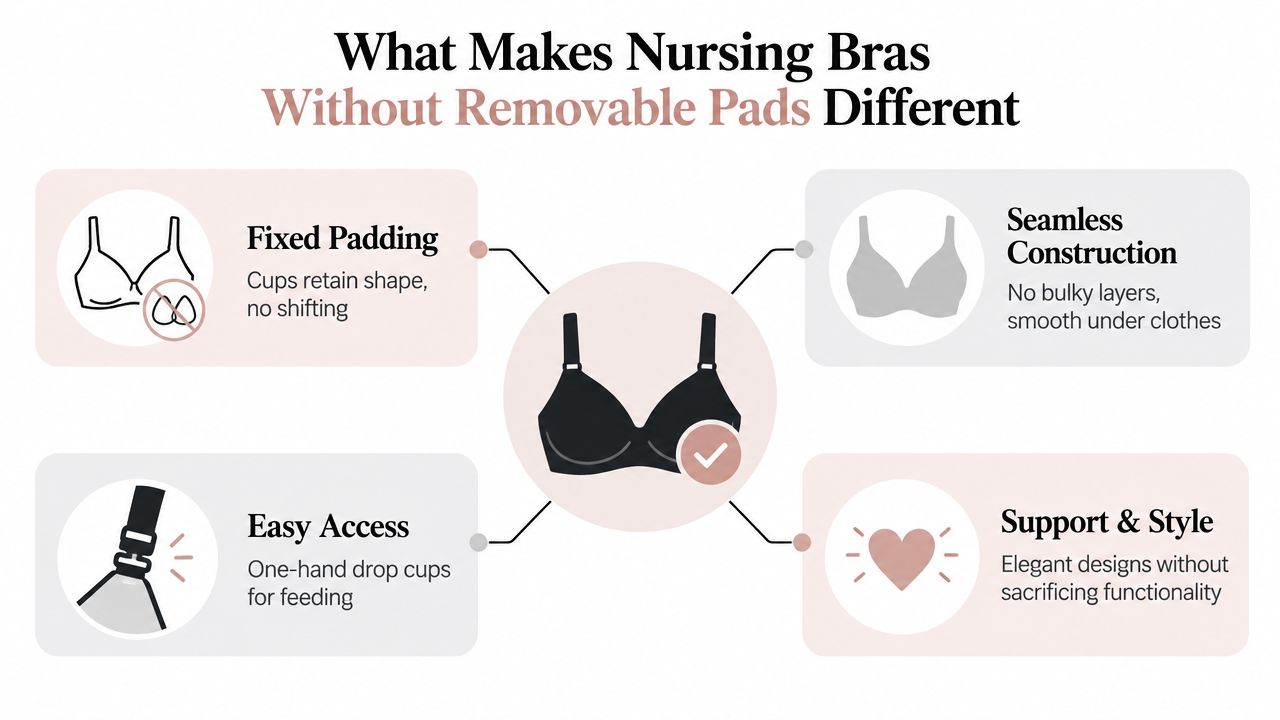
A bra without removable pads uses a different strategy. It may have sewn-in padding, a molded or fixed cup, bonded layers, or a single unpadded fabric layer. These constructions don't all perform alike. Fixed padding gives more consistent coverage and shape, while an unpadded cup feels lighter but may reveal more texture beneath thin clothing.
Fixed shape reduces small daily annoyances
Sewn-in padding stays attached to the bra, so it doesn't disappear into the laundry or require repositioning after every feed. A product example describes sewn-in pads as staying intact and preventing pads from getting lost in the wash, a practical advantage documented in this technical product and patent reference. The design also keeps the cup's outline more consistent when the nursing section opens and closes.
That stability is particularly relevant to one-handed feeding. When a drop cup releases, the fabric moves. A loose insert can move with it or catch against the opening. A fixed layer avoids one variable in an action you're already performing while supporting your baby.
Construction that reduces visible edges beneath T-shirts and close-fitting clothing is helpful. However, that term describes the construction, not necessarily the padding. A bra described this way may still contain removable inserts, so check the product details for sewn-in, fixed, built-in, or non-removable cups rather than relying on the label alone.
Access and support still determine success
A no-pad cup won't compensate for a poor nursing mechanism. Look for a clip that releases smoothly with one hand, a strap that remains connected to the cup, and a neckline that doesn't collapse into your baby's face. The bra should return to its original position without forcing you to rebuild the cup after every session.
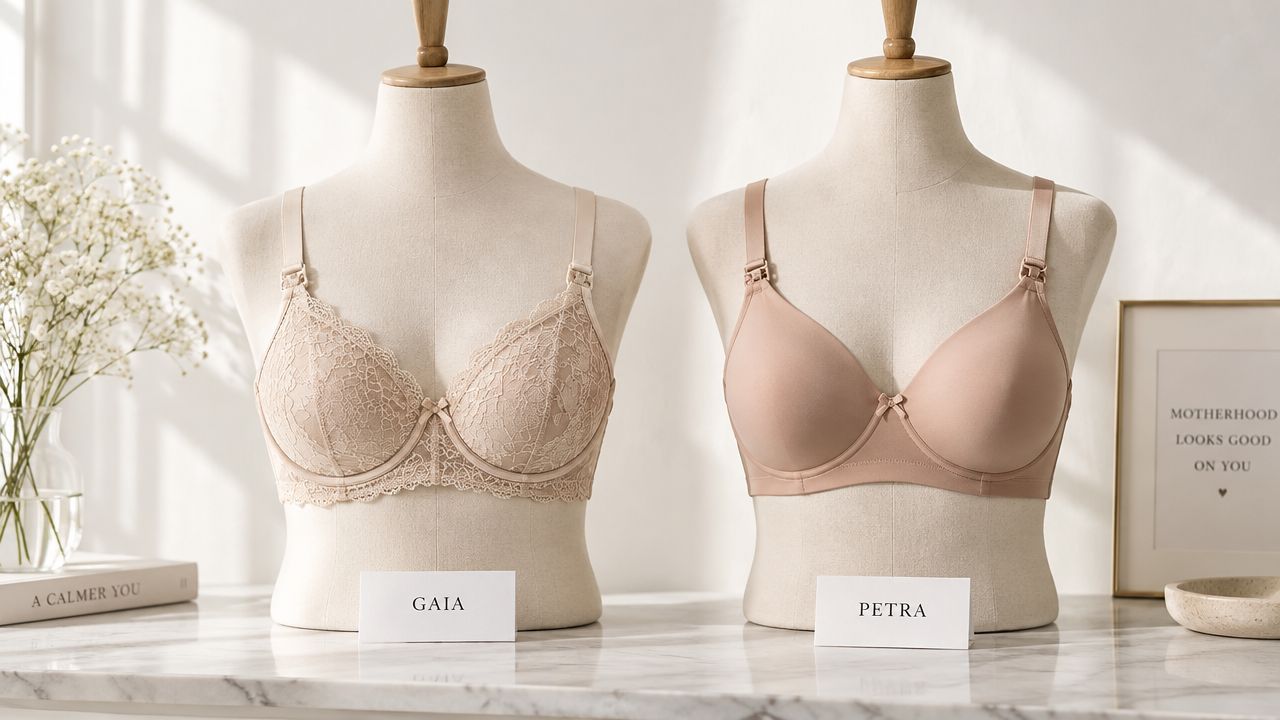
GAIA is one example of a soft, elegant nursing bra with stretch lace, flexible support, and breastfeeding access, illustrating how a nursing design can move beyond purely utilitarian styling.
Benefits and Trade-offs Versus Removable-Pad Styles
The practical question is not whether fixed cups are always better. It is which inconvenience fits your current routine. A non-removable cup reduces pad maintenance and keeps its internal layer in place. A removable insert gives you more control over coverage, shape, and breast-volume changes. The better choice may shift from early feeding to later breastfeeding, pumping, or mixed routines, especially as you move from survival-mode dressing back toward clothes that reflect your personal style.
| Feature | Without Removable Pads | With Removable Pads |
|---|---|---|
| Cup position | Fixed construction keeps the internal layer in place | Inserts may shift, fold, or need adjustment |
| Coverage | Consistent when the cup is designed well, especially with sewn-in padding | Coverage can be customized, replaced, or removed |
| Shape | More predictable from one wear to the next | Adjustable, but the outline may change when inserts move |
| Laundry | No separate pads to remove or replace | Inserts may need to be taken out before washing |
| Changing breast volume | Less adaptable if the cup is rigid or closely molded | Inserts can be removed, repositioned, or swapped |
| Under-clothing appearance | Smooth fixed cups can reduce uneven outlines | Inserts may create a rounded profile, but can bunch |
| Leak management | Depends on the bra's built-in absorbent or layered design | Often depends on adding separate nursing pads |
| Lightness | Unpadded versions can feel less bulky | Removable padding adds an optional layer |
Where no-pad designs work well
A sewn-in cup suits someone who dislikes laundry adjustments, wants dependable opacity, or wears fitted clothing. In the later-postpartum phase, it can also help restore a clean line beneath a knit top or blouse while keeping nursing access available. That combination matters when a bra needs to function as feeding equipment without making every outfit feel temporary.
Non-padded designs are an established part of the category. One market report estimates that non-padded bras held 22.1% market share in 2025 and projects growth at a 5.9% CAGR through 2034, as described in this nursing bra market analysis. That segmentation figure does not show that every unpadded bra will fit well, provide enough coverage, or suit your changing body.
Where removable inserts remain useful
Removable pads help when breast volume changes noticeably, coverage needs vary, or a temporary fit problem needs a quick adjustment. Remove an insert for a lighter feel at home, add it beneath a thin top, or replace it after it loses its shape.
The cost is attention. A loose insert can bunch, shift, or create an uneven outline, turning flexibility into another task during an already demanding day. A fixed cup may feel restrictive if your body is still changing, particularly when its foam or molded layer has little give. Choose according to how often you adjust your bra, what you wear most, and whether reclaiming a more polished personal style matters alongside feeding access.
How to Choose the Right Fit, Closure, and Material
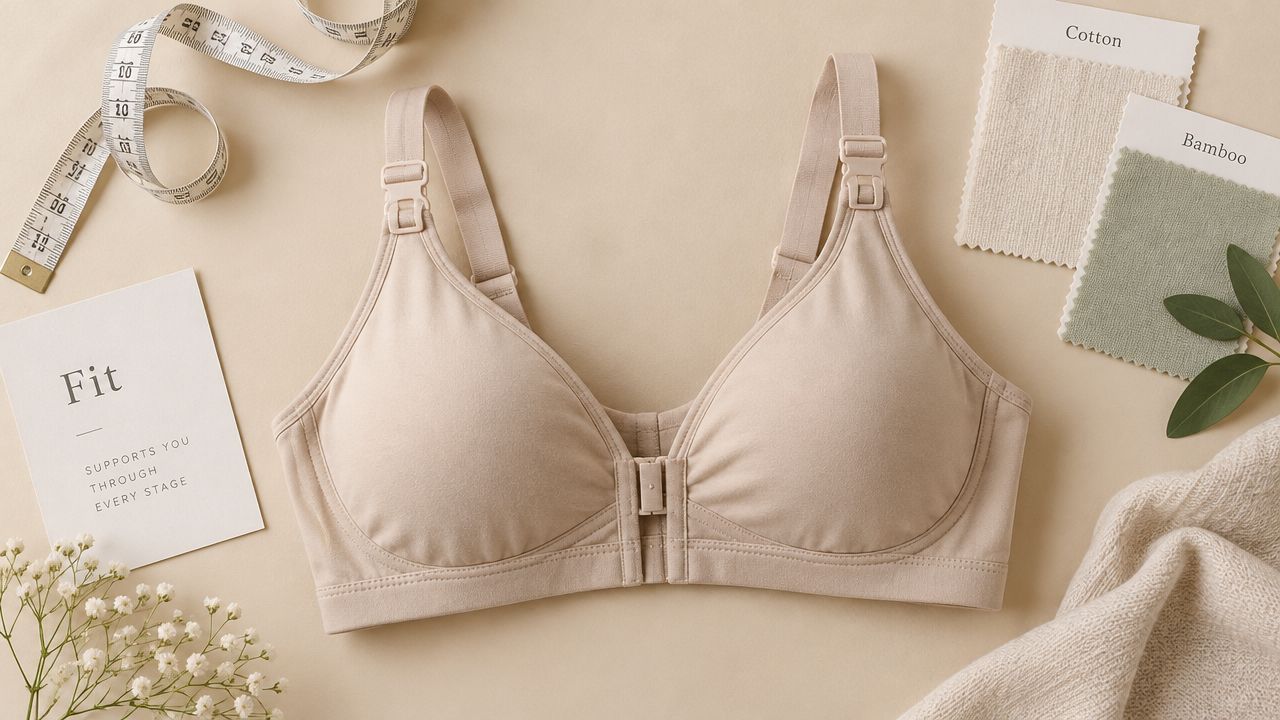
Start with your body, not the size you wore before pregnancy. Measure around your ribcage while wearing a lightly supportive bra, then measure the fullest part of your bust without compressing the tissue. Use the brand's chart, and check whether the design expects you to select by band and cup, underbust and bust, or a general size range. The nursing bra measuring guide can help you take those measurements consistently.
Check the fit in a few deliberate movements
Try the bra while standing, bending, lifting your arms, and simulating a nursing release. The band should sit level around your torso without riding upward. You should be able to slide a finger beneath it, but the band shouldn't drift when you move.
Look at the cup from the side and above. Spillage near the neckline or underarm means the cup is too small or too shallow. Wrinkling, gaping, or a visibly collapsed top edge can mean the cup is too large, too deep, or not shaped for your breast. With fixed padding, don't expect the cup to mold around every fluctuation. A little flexibility is helpful, but hard pressure is not.
Fit check: A nursing bra should feel secure before you fasten the cup. The nursing clip should provide access, not create the support.
Decide between wireless and underwire thoughtfully
Wireless designs usually rely on the band, lower cup, side panels, and straps to distribute weight. They're often the easier choice when your breasts are tender, changing quickly, or uncomfortable with pressure. Technical guidance for maternity bras recommends minimal stretch in the lower cup and more stretch near the top, because the lower section acts as a load-bearing platform. The same guidance cautions that underwire may contribute to blocked milk ducts early in breastfeeding, so it favors wirefree or carefully flexible structures during sensitive stages in this maternity nursing bra guidance.
Underwire can make sense later if it sits completely outside breast tissue and feels comfortable throughout the day. Never accept digging, pinching, redness, or pressure as the price of structure. If you notice a painful area or feeding concerns, stop wearing that bra and seek qualified lactation or medical guidance.
See how the bra opens, supports, and behaves in motion before committing to a wardrobe rotation.
Choose the fabric for the hours you'll wear it
Look for breathable, skin-friendly materials with enough recovery to hold the bust without feeling stiff. Stretch lace can offer softness and visual delicacy, while smooth microfiber or knits may disappear more easily under clothing. Check the inside for rough seams, scratchy elastic, coarse labels, and edges that cross the nipple or breast crease.
A no-pad bra should also match your coverage needs. If you're sensitive to nipple visibility, choose a fixed, opaque layer rather than assuming every “non-removable-pad” bra offers the same discretion. If you need pumping support, verify that the bra is specifically designed for your pump setup. Nursing access alone doesn't guarantee hands-free pumping compatibility.
Care, Laundering, and Styling for Everyday Confidence
Fixed cups simplify laundry, but they still need thoughtful handling. Close the nursing clips before washing so they don't catch on lace or stretch fabric. Use a lingerie bag, cool water, and a gentle detergent, then reshape the cups while the bra is damp. Avoid twisting the garment to remove water because twisting can distort the band and cup relationship.
Air-drying is the safer default for elastic and delicate lace. Lay the bra flat or hang it from the center gore rather than stretching wet cups from the straps. The right bra fabric and material guide can help you compare how different textiles feel against sensitive skin and behave in regular wear.
Build a small rotation around your life
Keep one soft option for sleep or slow mornings, one everyday bra for repeated nursing, and one more structured design for work or going out. You don't need every bra to perform every job. Separating roles helps you avoid wearing a firm, polished style during a tender day or relying on a light bralette beneath an outfit that needs more lift.
For clothing, match the bra's finish to the fabric. Smooth fixed cups work well under fitted jersey, fine knits, and tucked-in shirts. Stretch lace can become part of the outfit beneath an open cardigan, low neckline, or relaxed button-down. A high-waisted skirt, soft trousers, or a blazer can make the whole look feel intentional without pretending postpartum life is perfectly tidy.
Let confidence return at your pace
The later postpartum phase deserves more than a compromise between comfort and beauty. You may still be nursing frequently, but you can also want color, texture, shape, and lingerie that feels chosen rather than assigned. That desire isn't frivolous. It's one way of reconnecting with the person you were before motherhood while making room for who you are now.
Real Examples and Product Guidance From Milk&Lace
A useful no-removable-pad design should solve a real problem without looking like a medical accessory. The most promising examples combine stable construction, gentle contact with the skin, and access that works when one hand is occupied.
PETRA uses ultra-soft stretch lace, gentle underwire, and one-hand nursing access. That combination suits the later postpartum shopper who wants more definition than a sleep bralette but still needs a straightforward feeding mechanism. The underwire should be assessed carefully against your own stage and sensitivity, especially if your breasts remain prone to tenderness or pressure.
Read the design through your routine
If you're dressing mostly at home, softness and easy access may matter more than a sculpted outline. If you're returning to work, attending events, or wearing close-fitting clothes, a stable cup and a clean finish may carry more weight. If you still experience substantial changes in fullness, prioritize stretch and adjustability over a rigid molded shape.
Milk&Lace's GAIA and PETRA examples reflect a broader shift toward lingerie that treats breastfeeding as one part of a woman's life, not her entire visual identity. Use them as design references, not as a reason to ignore your body's feedback. The best bra is the one that supports your current needs without asking you to disappear inside it.
Common Questions and Clear Answers for New Mothers
Do nursing bras without removable pads prevent leaks?
Not automatically. Padding and leak protection are different functions. A fixed cup can improve opacity and preserve shape, but absorbency requires a built-in leak-management layer or a separate nursing pad. Check the product construction instead of assuming “padded” means absorbent or “unpadded” means unprotected.
Will a no-pad bra fit changing breasts?
It can, if the fabric and cup allow measured flexibility. Fixed, rigid cups offer less room for daily fluctuations than stretch cups, so early postpartum wear may call for a softer wireless design. As your shape becomes more predictable, a structured fixed cup can feel more polished and stable.
Is unpadded better for sensitive skin?
Sometimes, but not by definition. Removing a loose insert may reduce bulk and shifting, yet an unpadded bra can expose you to seams, lace texture, or less cushioning. Choose smooth, breathable fabric and inspect the inside of the bra before wearing it for a full day.
Can I use any nursing bra for pumping?
No. Nursing access and hands-free pumping are separate features. If you pump, confirm that the bra is designed to hold your flanges securely and suit your equipment.
Is this style only for early postpartum?
No. It can be especially valuable later, when you want easier care, reliable coverage, and a silhouette that feels closer to your usual wardrobe. Your bra collection can evolve as feeding, body changes, and personal style evolve.
Milk&Lace offers elegant nursing lingerie such as GAIA and PETRA, with soft lace, flexible or structured support, and discreet breastfeeding access for women ready to combine function with personal style. Visit Milk&Lace to explore nursing bras without removable pads and choose a design that fits the postpartum life you're living now.