

You're settling your baby against your chest when you notice the bra again. Not the color or the shape, just the edge pressing into a tender spot that didn't bother you earlier. If you've been searching for “nursing bra no underwire,” you're probably trying to solve a very immediate problem: how to feel supported without feeling squeezed.
A wire-free nursing bra can be a useful starting point. But choosing well means looking beyond the missing wire to the way the whole garment fits, and recognizing that what works now doesn't have to become your permanent rule.
Why the Bra Question Hits Hard in the Early Weeks
It's the middle of the night. Your baby is ready to feed, you're arranging pillows with your free hand, and a seam beneath your breast suddenly feels sharp. You shift your shoulder, loosen a strap, then wonder whether you bought the wrong size or whether every nursing bra is supposed to feel this awkward.
That's an illustrative scene, not a test you've failed. When you're learning to feed a baby while recovering from birth, even a small clothing problem can become another task you don't have room for.
The everyday setting matters more than a perfectly styled fitting-room photo.

Start with the moment that feels wrong
Rather than deciding that the entire bra is uncomfortable, notice where and when you feel it. Is the problem a seam against your nipple, a cup edge across the side of your breast, or a band that becomes unpleasant when you sit down?
Those observations give you something concrete to change. A strap adjustment won't solve a cup that's too shallow, and softer fabric won't necessarily solve an underband that squeezes.
You don't need to endure discomfort to prove that you're adapting to motherhood.
A useful starting point: Treat a comfort failure as information about the garment, not a criticism of your body.
Separate feeding access from comfortable wear
A bra can open easily for breastfeeding and still fit poorly once the cup is closed. Try judging those jobs separately: can you uncover your breast without wrestling with the garment, and can you wear it comfortably between feeds?
- During feeding: Notice whether folded fabric gathers beneath your breast or pulls against sensitive skin.
- After fastening: Check whether the cup returns to its position without trapping tissue at the edge.
- While resting: Pay attention to how the bra feels sitting, reclining, and reaching for your baby.
The aim isn't to find a garment you never notice under any circumstances. It's to remove avoidable interruptions so you can focus on feeding, resting, and getting through the day with a little more ease.
What a No-Underwire Nursing Bra Actually Is
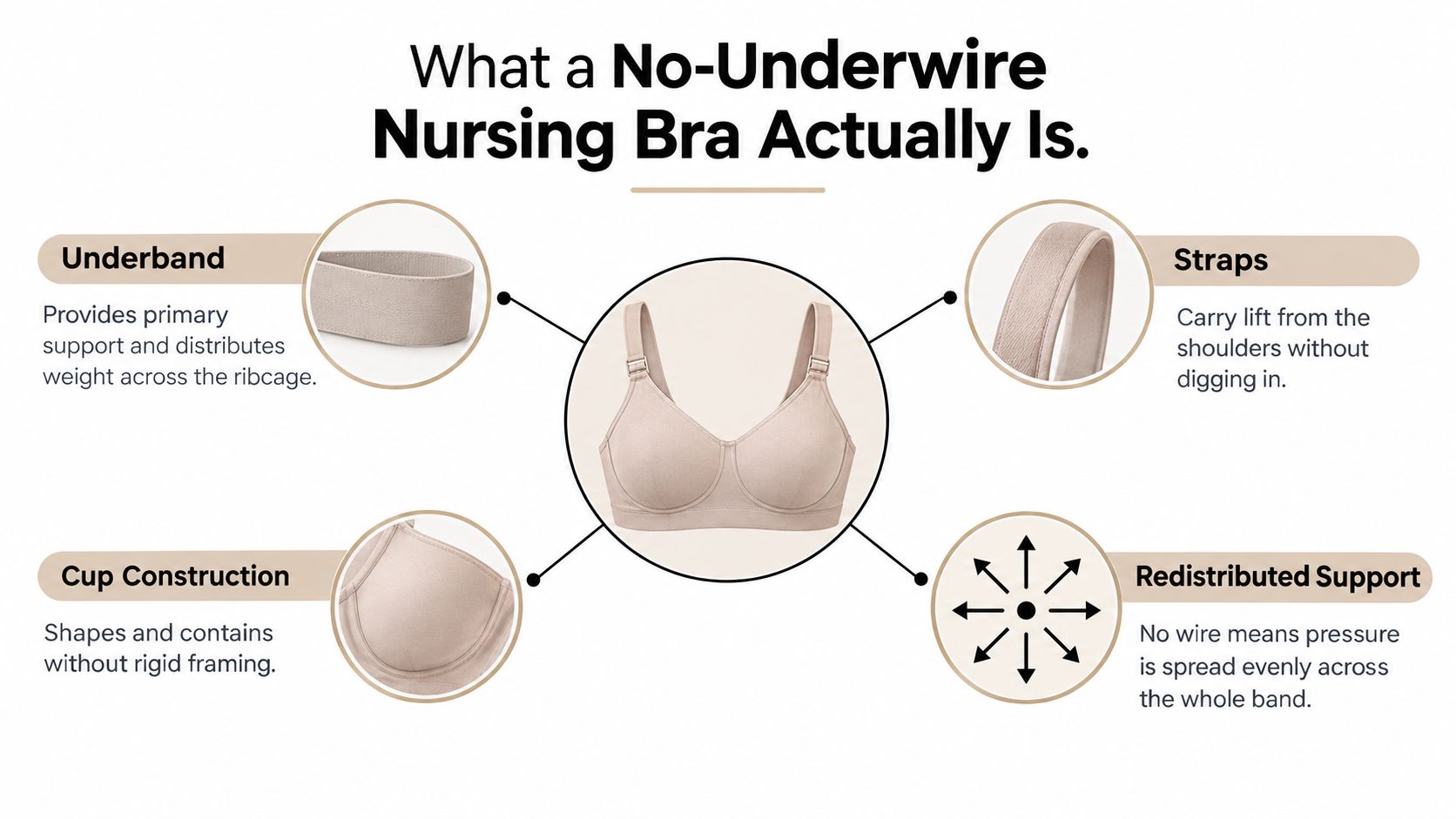
A no-underwire nursing bra is a nursing garment without the rigid curved wire traditionally placed beneath each breast. Removing that component doesn't remove the need for support. Instead, the designer has to provide it through the underband, straps, cup construction, and fabric.
Think of a well-made hammock: the fabric can feel flexible because its shape and attachment points work together. A loose sheet suspended carelessly wouldn't give the same support. Wireless bras follow a similar principle, although the comparison is about construction, not medical protection.
This concept map identifies the parts to inspect rather than treating softness as the whole answer.
Where the support comes from
Look at how the components cooperate. A broad band with cups that collapse under the breast won't behave like a bra with a stable band and properly shaped cups.
- Underband: Look for a wide, stable foundation that stays in place rather than a narrow elastic edge doing all the work.
- Straps: Adjustable straps let you refine the fit, but they shouldn't have to compensate for an unsuitable band or cup.
- Cups: Coverage and shaping help contain breast tissue without depending on a rigid frame.
- Fabric: Controlled stretch allows some give while resisting excessive movement.
These are practical selection criteria, not promises that every wireless design distributes pressure evenly. You still need to try the garment on your own body.
Softness has a limit
A peer-reviewed study of breast support during lactation found that non-wire bras were easier to move in and less constricting than wire bras, while also noting that greater breast movement could increase nipple-to-fabric rubbing and irritation. That distinction matters when an exceptionally stretchy bralette feels lovely standing still but less comfortable as you move.
The research also describes the extra load associated with milk accumulation. For fuller breasts, choosing the least structured garment isn't automatically the most comfortable approach.
Wire-free doesn't mean structure-free. A wireless bra can use shaped cups, supportive panels, and a substantial underband, while another may offer only light containment.
Keep the category flexible in your mind. It can provide an early-postpartum foundation, a resting option, or an everyday choice later on. Its usefulness comes from matching the construction to your current needs, not from winning a permanent contest against underwire.
Comfort, Support, and Safety Trade-Offs in Plain Language
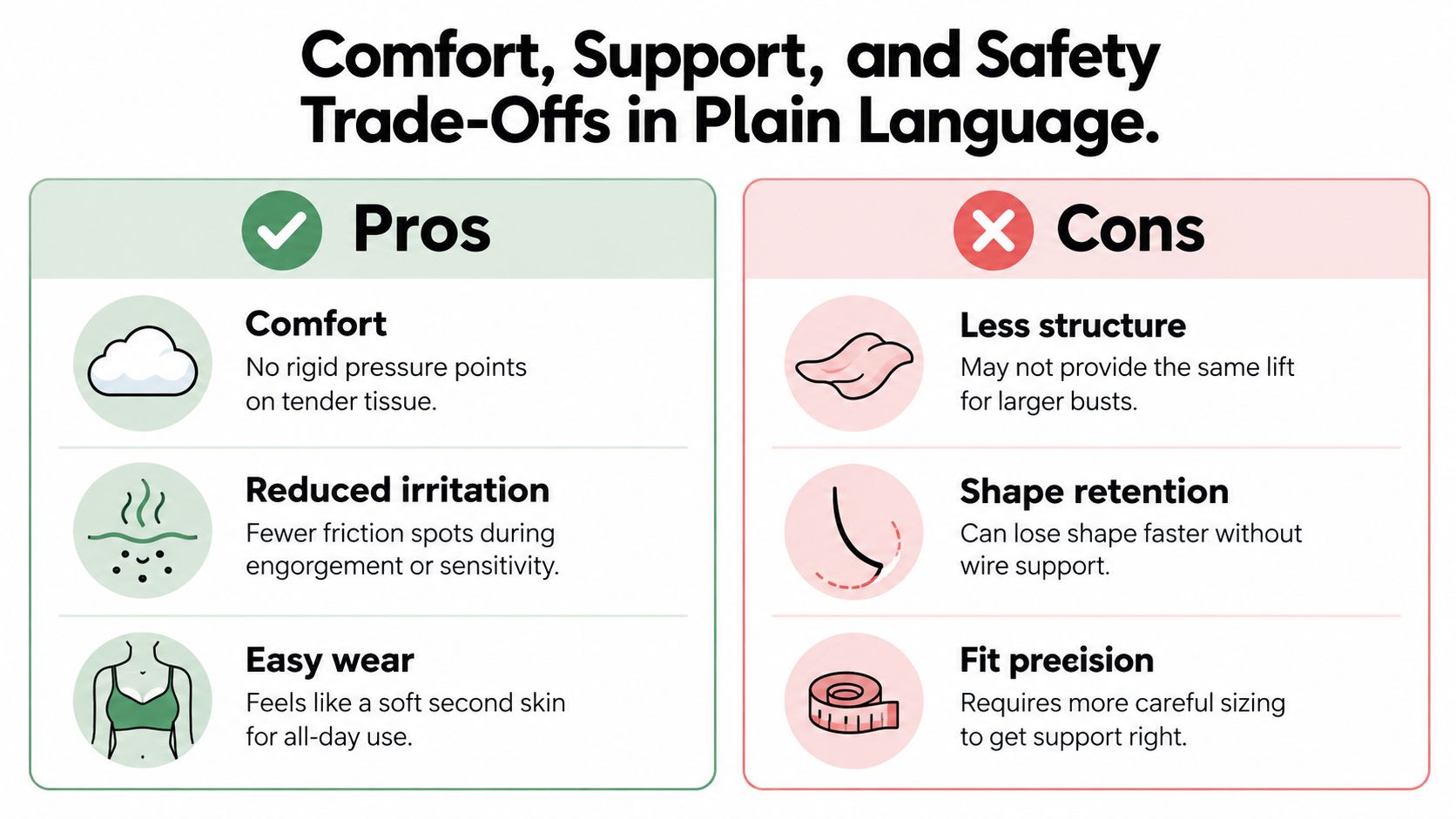
The clearest benefit of removing a wire is straightforward: there's no rigid wire edge to press against you. The less straightforward question is whether the remaining fabric, elastic, and seams fit comfortably.
Reduced rigid pressure and adequate support are separate requirements. You can have a soft garment that compresses too much, or a roomy garment that leaves you wanting more containment.
Use this comparison as a prompt for evaluating your own experience, not as a guarantee about every wireless bra.
Comfort isn't the same as absence of structure
The movement trade-off described in the breast-support research matters in daily life. If you're comfortable resting but uncomfortable walking across the house, you may need a different construction rather than tighter straps.
Similarly, smooth fabric deserves attention alongside stretch. If a seam rubs whenever you reach forward, more room alone may not resolve the irritation.
Try separating your priorities:
- Tenderness: Favor surfaces and edges that don't create focal pressure.
- Movement: Seek containment that feels steady during the activities you perform.
- Shoulder comfort: Don't keep tightening the straps to make an otherwise unsuitable bra feel supportive.
- Appearance: Treat preferred lift or shape as a legitimate preference, but not a reason to accept pain.
No-underwire construction also doesn't, by itself, establish how long a garment will retain its shape. Assess its construction and care instructions rather than assuming wires determine durability.
What the safety advice actually says
The National Childbirth Trust's maternity and nursing bra guidance explains that an underwire should sit flat, follow the breast's perimeter, and avoid gaping, digging, or pressing on breast tissue. It notes that avoiding wires can be preferable during the early months when breast dimensions change frequently.
That supports a cautious, stage-based choice. It doesn't establish that every underwire bra causes mastitis, or that a wireless label guarantees safety.
Choose the garment that supports you without creating a concentrated pressure point. The label can help narrow your search, but it can't finish the fitting.
If you're experiencing tenderness or inflammation, don't use a bra change as a substitute for clinical advice. Reduce avoidable pressure and seek help if symptoms persist or worsen.
If you prefer a video format alongside written guidance, this is another viewing option.
You don't have to choose between being supported and being comfortable. The practical challenge is finding enough structure in the right places, without concentrating force where your breast feels sensitive.
Fit and Sizing Checks You Can Run at Home
Put on the bra as you'd normally wear it, including nursing pads if you use them. Fasten it, settle your breast tissue into the cups gently, and stand in front of a mirror without pulling your shoulders back into an artificial posture.
Use your current measurements as a starting point, not a verdict. A guide to measuring for a nursing bra can help you identify sizes to try, but the garment still has to pass a wearing test.
Check the band and cups first
Look around your torso. The underband should stay level rather than climbing up your back, rolling into a narrow strip, or digging underneath your breasts. Sit down and take a comfortable breath; a fit that only works while you stand still isn't useful.
Next, inspect the cups from the front and side. Look for tissue spilling over the top, escaping near the underarm, or being pressed by an edge that crosses the breast.
Retest when your breasts feel fuller, then again after feeding. You're checking whether the fit remains workable across your own changes, not trying to make your breasts look identical at every check.
Test straps, seams, and feeding access
Adjust the straps enough to position the cups without hauling the band upward. Reach forward, bend gently, and return to sitting; notice whether you feel supported or whether you're bracing against the garment.
Open and close the nursing access as well. After feeding, make sure the cup is properly repositioned and that folded fabric or a displaced pad hasn't created a new pressure point.
Inspect your skin after wearing the bra through a feed cycle. Persistent indentations, soreness, or a focal red mark deserve attention, especially when they match an area that felt compressed.
Fitting Red Flags and What They Usually Mean
| Symptom | Likely Cause | What to Try |
|---|---|---|
| Band rides up at the back | Band may be too loose, or straps overtightened | Recheck band fit and ease strap tension |
| Tissue spills above or beside the cup | Insufficient cup room or an unsuitable cup shape | Try greater cup capacity or fuller coverage |
| Band rolls or digs in | Excess tension or an unsuitable band construction | Try another adjustment or a broader band |
| Straps leave sore grooves | Support may be relying too heavily on straps | Reassess the band and cup structure |
| A seam leaves a persistent focal mark | Localized pressure or poorly placed stitching | Try a smoother interior or different cup design |
These are starting hypotheses, not diagnoses. Don't automatically increase every part of the size when only the cup or band needs changing.
The Breastfeeding Network's mastitis guidance identifies tight-fitting clothing, including bras, as a factor associated with mastitis risk and advises avoiding restrictive pressure that may restrict milk flow or aggravate inflammation. If discomfort continues after removing or adjusting the garment, seek clinical advice rather than repeatedly buying another size.
Underwire or Not at Every Postpartum Stage
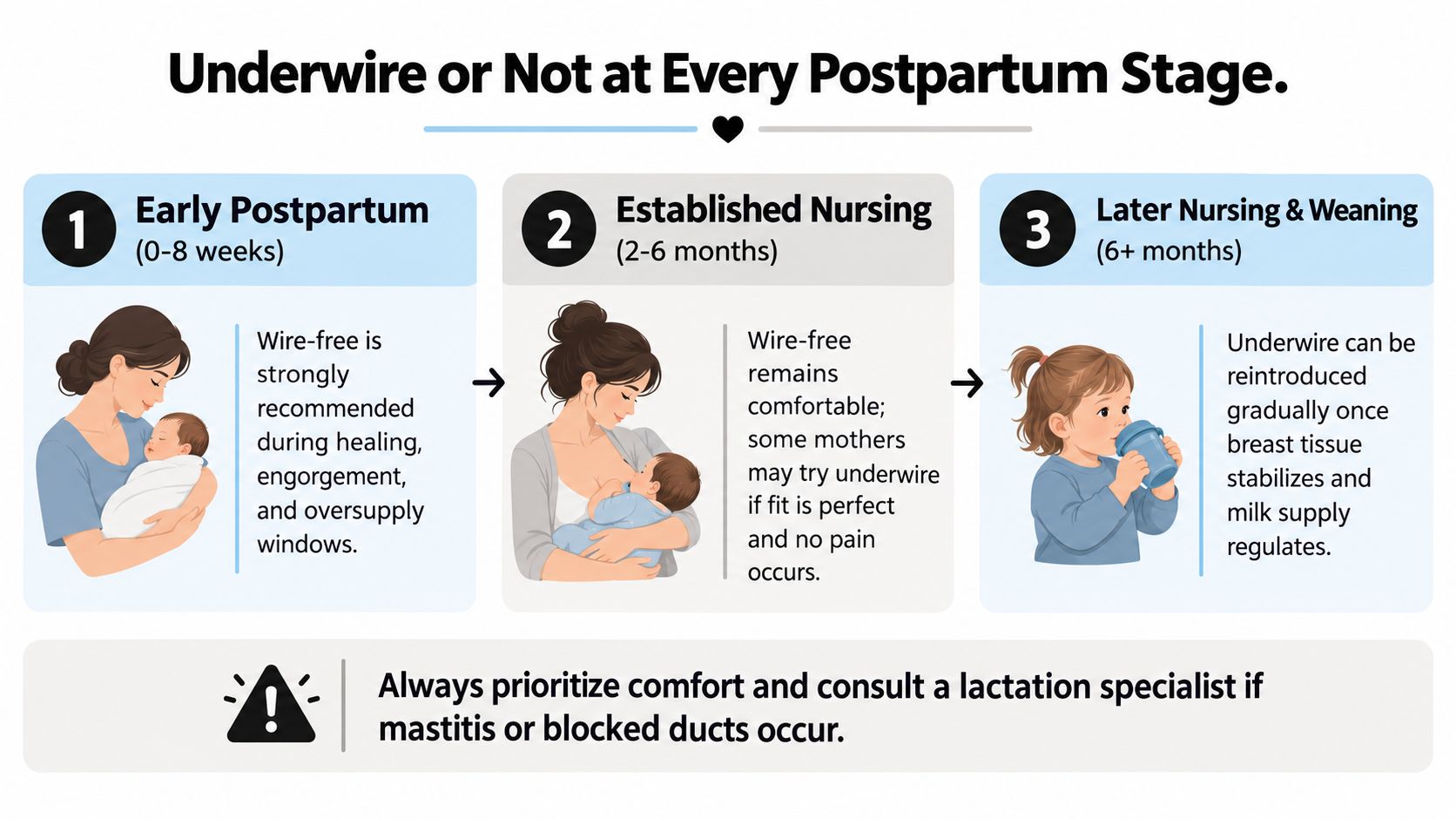
Your postpartum stage is more useful than a blanket rule, but it's not a deadline. There's no calendar date when you must stop wearing wireless bras or start wearing underwire.
Nursing can remain part of daily life beyond the immediate recovery period. The 2023 WHO and UNICEF Global Breastfeeding Scorecard reported that 48% of infants younger than six months were exclusively breastfed worldwide, a 10-percentage-point increase over the preceding decade.
That population statistic doesn't tell you which bra to buy. It does reinforce why nursing clothing should accommodate an evolving routine rather than only the first days after birth.
Read the stages in this graphic as broad orientation, not medical clearance based on age alone.
Early postpartum favors adaptability
When fullness and sensitivity feel unpredictable, a well-fitted wireless bra is a sensible starting option. The early-month guidance discussed earlier supports avoiding a rigid component that may become uncomfortable as fit changes.
During engorgement, tenderness, or an inflammatory episode, prioritize the least compressive supportive setting you can comfortably wear. Oversupply or pumping may also make it useful to revisit fit more often, rather than assuming your usual garment still works.
Later choices can depend on the task
Once your fit feels more predictable, you can consider wireless and structured options side by side.
| Current priority | Wireless option | Underwire option |
|---|---|---|
| Resting or sensitive days | Useful if gentle and adequately supportive | Less appealing if any edge feels intrusive |
| More defined shape | Shaped wireless cups may meet the need | May suit your preference if fitted without pressure |
| Fuller-bust containment | Look for substantial cup and band construction | Consider only if the frame follows your breast perimeter |
| Changing fullness | Recheck available room and adjustability | Pay particular attention to the wire's position |
For a closer look at that alternative, the guide to nursing bras with underwire addresses the structured category.
You might keep wireless for resting and choose another style for a meeting or an outing. You might prefer wireless throughout nursing. Neither choice is a measure of recovery, confidence, or how well you're breastfeeding.
Returning to Structure When Your Body Is Ready
Wanting a more defined silhouette doesn't mean you're neglecting comfort. Equally, keeping your wireless bras doesn't mean you haven't moved forward.
The assumption worth challenging is that a wire alone determines whether a bra is suitable. A systematic review of mastitis risk factors found an association between tight bra wear and mastitis in three studies, including an adjusted odds ratio of 4.05 among first-time breastfeeding women in one study, while noting substantial variation in the evidence.
That figure describes an association, not proof of causation or an individual prediction. It doesn't establish that every underwire bra causes mastitis.
Test a structured bra without committing to it
Choose a calm day when you can change clothes easily. Don't make the first trial an outing where you'll feel obliged to keep wearing it.
Apply the earlier fitting checks, then pay special attention to the frame. Does it follow the perimeter beneath and beside your breast, or does part of it sit on breast tissue?
Inspect the wire channel and nearby seams with your fingers before wearing it. You're looking for smooth finishing, not assuming that lace, a flexible wire, or a particular shape automatically makes the garment suitable.
- Start with ordinary movement: Sit, reach, and walk around before deciding how it feels.
- Test nursing access: Check that opening and replacing the cup doesn't leave the frame displaced.
- Keep an alternative nearby: Change back if you notice focal pressure or discomfort.
Make room for preference without making promises
A structured wireless bra remains an option if you want more shape without a wire. For readers exploring later-stage nursing lingerie, GAIA by Milk&Lace is described as a nursing bra with stretch lace, flexible support, and breastfeeding access.
Those features describe the garment, not a guarantee about your fit or a treatment for breast symptoms.
Permission to change your mind: A trial that ends with you returning to wireless is still useful. You've learned what feels workable today.
You're allowed to enjoy lingerie again, and you're allowed to postpone that decision. Neither requires an explanation.
Building Your Own Nursing Bra Plan
Build your rotation around the situations you encounter, not a fixed shopping quantity. Start with what fits now, identify what's missing, and add only when you can name the job the next garment needs to do.
For example, your resting bra might be comfortable but unsuitable under a particular work outfit. That's a reason to explore another option, not evidence that your resting bra was a bad purchase.
Use a personal decision order
Keep your priorities in a sequence that prevents appearance from overriding discomfort.
- Stage: Are you navigating unpredictable fullness, or does your fit feel relatively consistent?
- Sensitivity: Which edges, fabrics, or levels of pressure feel uncomfortable today?
- Support need: What happens when you move, sit for a long stretch, or carry on with your routine?
- Style: Once the fit works, which shape and finish help you feel like yourself?
Style belongs in the decision. It comes after the garment has shown that it can do its practical job.
Include the things you wear inside the bra
If you use nursing pads, test them with the garment rather than treating them as a separate purchase. Check whether they sit smoothly or make an otherwise workable cup feel crowded.
The guide to choosing nursing pads can help you consider that part of your feeding wardrobe. Keep noticing the full combination: bra, pad, clothing, and the position you spend time in.
Your plan can be as simple as a comfortable wireless foundation and another option when a different need arises. Reassess when the fit or your routine changes, rather than replacing everything because you've reached a particular stage.
The goal is a wardrobe you can use without arguing with your body. You can protect your comfort, ask for support, and make room for personal style at the same time. Motherhood doesn't require you to settle on one version of yourself, or one kind of bra.
Milk&Lace offers lace nursing lingerie with breastfeeding access for women exploring options beyond their early-postpartum essentials. Visit Milk&Lace to review the designs and fit information, keeping your current comfort and support needs at the center of your choice.