

You stand in front of the mirror a few weeks after birth, one hand adjusting a soft nursing bra that once felt like a small miracle. It still makes feeding easy, but the cups look shapeless beneath your shirt, the band shifts during the day, and the woman looking back at you feels more complex than “comfortable enough.”
That moment doesn't mean you're ungrateful for the bra that carried you through the early weeks. It means your needs are changing. A motherhood nursing bra can belong to a different stage, one where breastfeeding access still matters but shape, support, fabric, and personal style matter too.
The right choice isn't always one perfect bra that lasts through pregnancy, engorgement, regulated supply, outings, work, and recovery. It's often a small wardrobe plan that follows your body. Fit is a moving measurement, and comfort is partly an engineering problem involving cup geometry, band stability, wire placement, stretch, and pressure distribution. A nursing bra fit study found that an anatomical model was significantly more suitable for ergonomic physical and psycho-aesthetic comfort than a comparison model, with a highly significant logistic regression result, p < 0.0001 (read the nursing bra fit study).
The Moment Your Bra Stops Matching Who You Are
The first soft nursing bra often earns its place quickly. It may be the bra you wear home from the hospital, sleep in, reach for during long feeds, and wash whenever you get a quiet moment. Its job is simple: reduce pressure, accommodate fluctuation, and keep nursing access close at hand.
Then your routine expands. You leave the house more often. You wear a button-down shirt, a fitted knit, or a dress that needs a defined silhouette. The bra that once felt reassuring may now flatten your shape, show through clothing, or make you feel as though your wardrobe has been paused indefinitely.
A useful question: Is your current bra still supporting your present life, or is it only preserving an earlier postpartum stage?
Comfort can change meaning
Softness matters, especially when your breasts feel tender or change throughout the day. Yet fabric softness alone can't correct a band that rides up, cups that allow side spillage, or straps carrying more weight than they should. The researchers behind the anatomical-model study linked comfort with the relationship between body shape and bra construction, not with the feel of the textile.
That distinction helps explain why a bra can feel gentle but still leave you tired. If the band isn't anchored, the straps compensate. If the cups don't contain the breast fully, the fabric stretches in the wrong places. If the nursing clip is difficult to open, every feed becomes a small physical task.
Your wardrobe deserves a new question
Instead of asking, “Which nursing bra should I buy?” ask, “Which postpartum stage am I dressing for?”
An early bra may be ideal for sleep and unpredictable fullness. A later bra may need a more stable band, a shaped cup, and support that works under everyday clothing. Both can be nursing bras. They solve different problems.
This guide treats your bra drawer as a stage-specific system. You'll learn how to recognize when function has outgrown your first bra, how to reassess fit as your body settles, and how structured support and lace can re-enter your wardrobe without making breastfeeding harder.
What a Motherhood Nursing Bra Really Is
A motherhood nursing bra is designed for the period when breastfeeding remains part of daily life, but your needs have moved beyond immediate postpartum survival. It supports changing breasts, provides practical nursing access, and offers enough structure to work beneath real clothes.
That makes it different from a pregnancy bra, which primarily accommodates breast and ribcage changes before birth. It's also different from an early-postpartum bra, which usually prioritizes softness, flexibility, and room for rapid changes in fullness. The distinction isn't about a strict calendar. It's about what your body and routine require.
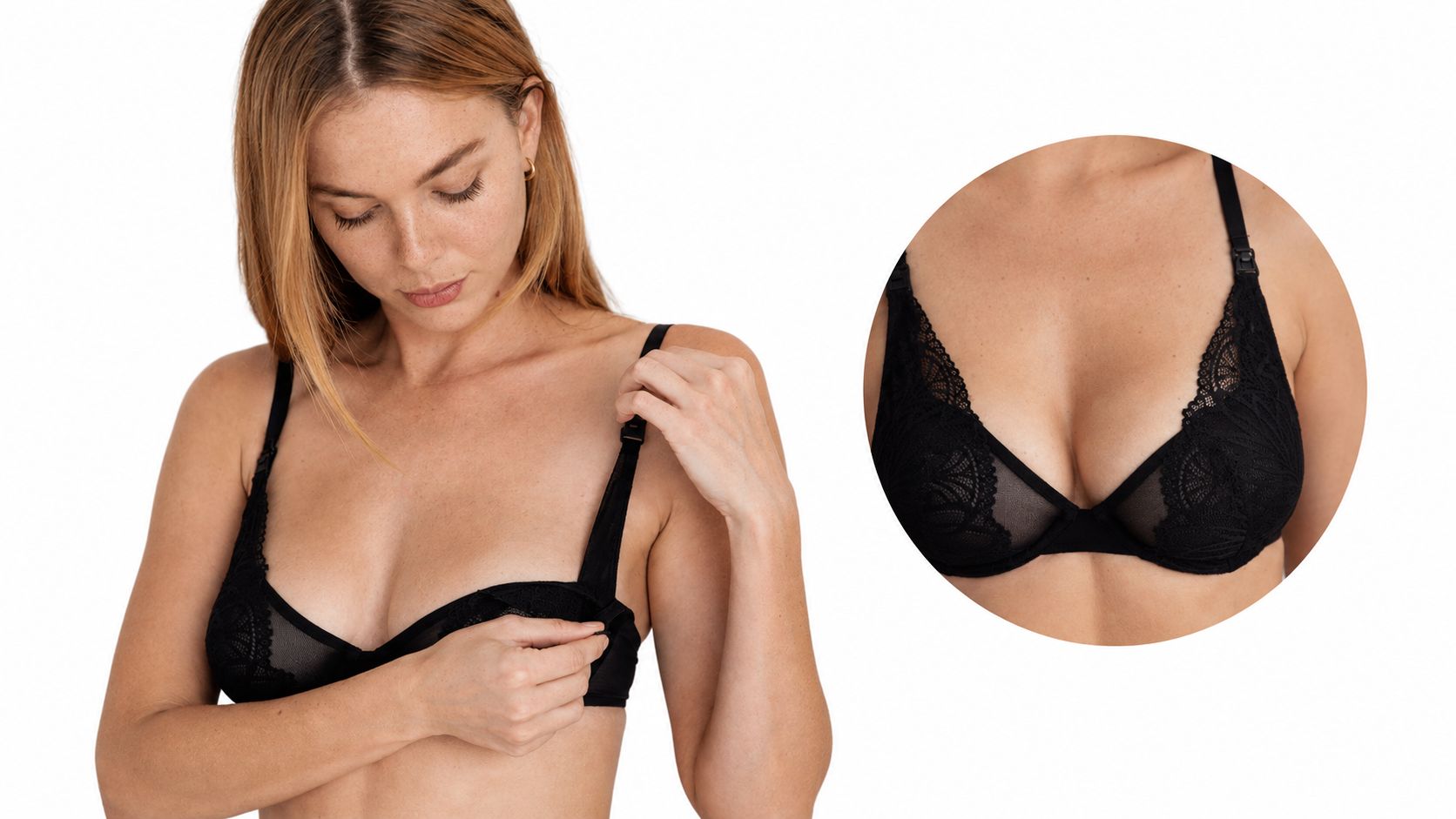
Three features define the later-stage workhorse
First, the bra needs usable nursing access. A drop-down cup or clip should open with one hand while you're holding your baby with the other. Crossover and pull-aside designs can work too, provided they don't require excessive stretching or rearranging.
Second, the material needs both stretch and recovery. Stretch allows the cup to adapt during a feed or a normal daily fluctuation. Recovery helps the band and cup return to their intended shape instead of becoming loose after repeated wear.
Third, the bra needs enough construction for clothing. That may mean a shaped cup, a firm lower section, a supportive side panel, or gentle underwire. A bra can remain nursing-friendly while giving the bust a clearer outline beneath a shirt or dress.
The PETRA nursing bra is described by Milk&Lace as featuring ultra-soft stretch lace, gentle underwire, and one-hand nursing access.
Postpartum bra types compared
| Feature | Pregnancy Bra | Early-Postpartum Bra | Motherhood Nursing Bra |
|---|---|---|---|
| Main purpose | Accommodate growth before birth | Handle tenderness and fluctuating fullness | Support established nursing and everyday dressing |
| Typical structure | Flexible, expandable, often lightly shaped | Soft, wireless, highly adaptable | Shaped, supportive, and nursing-accessible |
| Fabric priority | Stretch and room to grow | Breathability and low pressure | Recovery, comfort, and a polished finish |
| Best wardrobe role | Pregnancy and transition wear | Sleep, home, and early recovery | Daily outfits, work, errands, and occasions |
| Nursing access | May be included or absent | Usually simple and fast | Designed for one-handed, repeat use |
The first soft bra isn't a failed purchase when it stops meeting every need. It has completed an important phase. The mistake is expecting one design to provide maximum flexibility during engorgement and a defined, confident silhouette months later.
Choosing the Right Style, Fit, and Support
Choosing a nursing bra becomes easier when you separate appearance from construction. Four decisions do most of the work: fit, fabric, support, and access. A beautiful bra that fails one of these can become uncomfortable quickly, while a plain-looking bra with the right architecture may serve you well.
Start with the band
The band should sit level across your back and feel firm without restricting breathing or pressing painfully into your ribs. It provides the foundation for support, so don't judge the size from the cup alone. If the band rides upward, the straps may be compensating. If it digs sharply, the band may be too tight or the design may distribute pressure poorly.
Check the side of the cup as well as the center. Breast tissue should remain contained without spilling toward the armpit. A smooth cup edge doesn't necessarily mean a good fit if the wire or seam is resting on breast tissue.
Match fabric to the stage
Breathable knits and fabrics without seams make sense when fluctuation and sensitivity dominate. Lace can work beautifully later, especially when it has meaningful stretch and a soft finish rather than a rigid, scratchy texture. The key question is whether the material moves with you and recovers afterward.
Support also changes by body and stage. Light support may suit rest. Medium support can work for everyday movement. Structured support may be more appropriate when you want lift, clearer separation, or a stable shape under clothing. No category is universally correct. Your breast density, current fullness, activity, and clothing should guide the choice.
Test nursing access before you buy
Hold a bag, cushion, or folded garment with one arm and operate the clip with the other. The cup should open without twisting the band or forcing you to pull the bra away from your body. If the mechanism catches during a calm fitting, it'll probably frustrate you during a tired feed.
| Bra Style | Fit | Fabric | Support Level | Nursing Access |
|---|---|---|---|---|
| T-shirt | Smooth, close, cup-specific | Seamless or molded knit | Medium | Usually drop-down |
| Bralette | Flexible and forgiving | Stretch knit or lace | Light to medium | Crossover or pull-aside |
| Balconette | Defined neckline and cup shape | Lace, mesh, or structured textile | Medium to structured | Often clip-down |
| Full-cup structured | Full containment and stable band | Shaped fabric with recovery | Structured | Drop-down or clip-down |
A UK study of maternity and nursing sports bra purchasers found that support was very important or absolutely essential to 94% of respondents, while comfort received that rating from 98%. Yet only 15% found exactly what they wanted (review the UK maternity and nursing sports bra study). Those findings point to a practical gap. Shoppers aren't asking for decoration instead of performance. They're looking for both.
The right bra should disappear into your day while still delivering a shape you recognize as yours.
Sizing Across the Postpartum Arc
Postpartum sizing is not one appointment with a measuring tape. Your breasts can feel different across the day, and the fit that works during early fullness may become loose or restrictive as feeding patterns settle. Several guides disagree about the ideal time to remeasure, with recommendations ranging from 4 to 6 weeks postpartum to 6 to 8 weeks, according to a review of nursing-bra sizing guidance (compare nursing bra measurement guidance).
That disagreement is useful information. It tells you to treat sizing as a sequence of check-ins rather than a permanent answer.
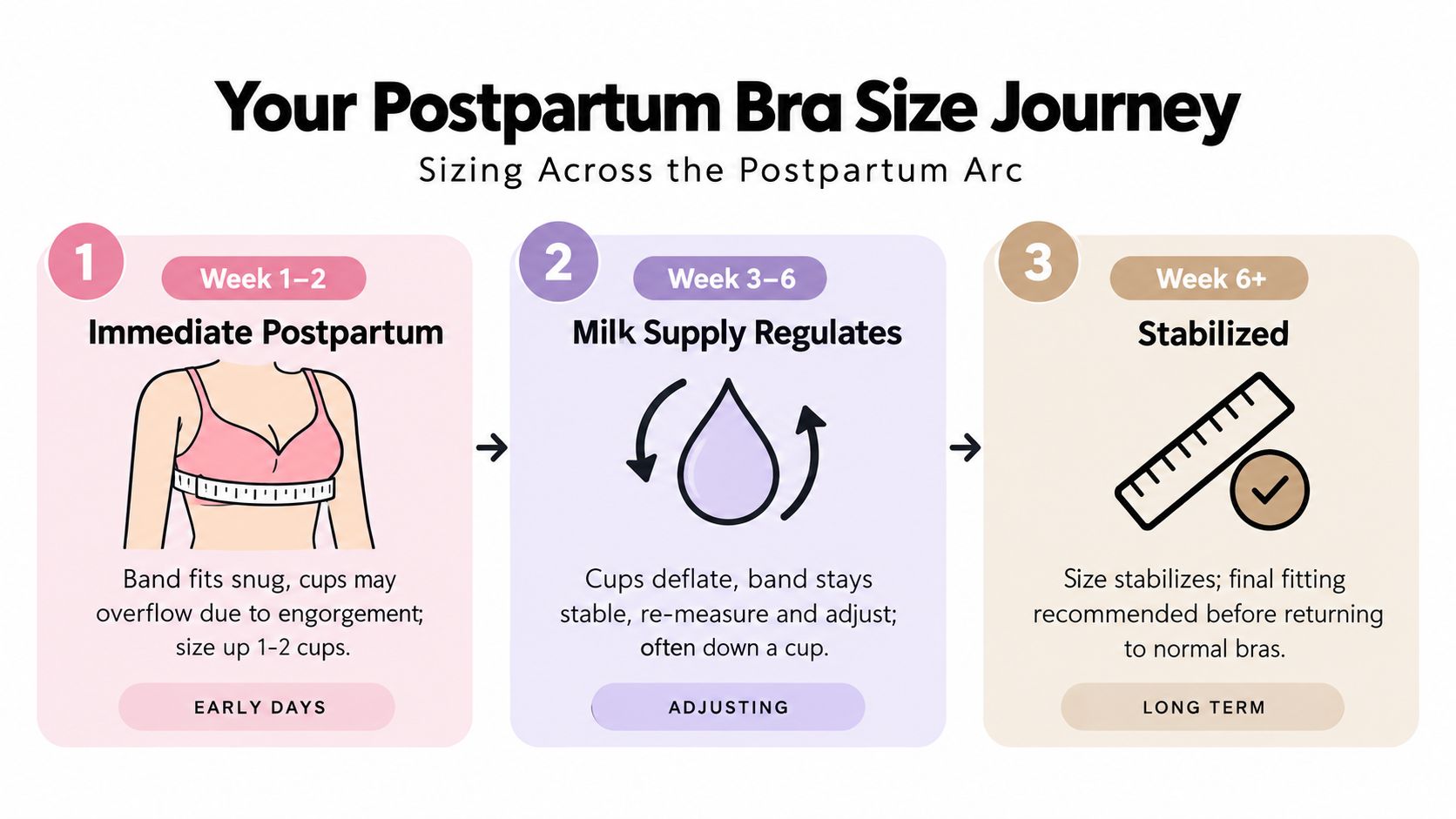
Read the fit in stages
In the first days, fullness may be unpredictable. Choose flexibility and avoid compression. You're looking for a level band, complete but not forced containment, and enough cup room for normal changes.
As feeding becomes more predictable, assess what has changed. Perhaps the band still feels right, but the cups wrinkle. Perhaps the cups fit in the morning and feel loose after feeding. Those signals don't necessarily mean you need to return to a pre-pregnancy size. They mean you need a current measurement and a style with appropriate adaptability.
At a later checkpoint, measure the snug underbust and the fullest part of the bust while wearing a non-padded bra or no bra. Use the brand's current size chart rather than relying on memory. Different manufacturers interpret cup volume and band tension differently, so your label can change even when the physical fit improves.
Fit rule: Replace the bra when your body or your daily use changes, not only when the fabric looks worn.
Build a re-fit habit
Keep a brief note beside your feeding or pumping log. Record whether straps dig, cups gape, the underband shifts, or your breast fullness changes dramatically between feeds. These observations are more useful than guessing from a past label.
For a detailed measuring walkthrough, use this guide to measuring for a nursing bra.
A later postpartum bra may solve a different problem than an early one. The first protects flexibility during change. The later choice can prioritize stable support, clothing compatibility, and the confidence to dress with intention.
Underwire Safety and the Later Postpartum Phase
“Never wear underwire while breastfeeding” is too blunt to guide every stage. The concern has a practical origin: a poorly fitted or rigid wire can press against breast tissue, especially when breasts are swollen or changing quickly. That's why early postpartum guidance often favors wireless designs while fullness is unpredictable.
The more useful question is when structured support becomes appropriate for your body. Editorial nursing-bra guidance commonly separates the early fluctuating period from the later stage when breast size and milk production have settled. One review discusses flexible-wire nursing bras as a later option once early changes have stabilized, while emphasizing that the wire must rest on the chest wall rather than breast tissue (read guidance on nursing bras with underwire).
Geometry matters more than the label
A structured bra should pass several tests:
- The wire sits in the fold: It follows the curve beneath the breast and stays on the ribcage.
- The cup contains fully: No breast tissue is trapped beneath, beside, or above the wire.
- The band remains anchored: It doesn't ride up when you lift your arms or feed.
- The skin recovers normally: Remove the bra and check for persistent red marks, soreness, or pressure points.
- The cup allows movement: Stretch at the upper cup can accommodate ordinary fullness without compression.
Underwire isn't automatically comfortable because it's flexible. Flexibility helps, but the wire still needs the correct width, depth, and placement for your shape.
Choose structure for a reason
A later-stage underwire nursing bra can provide lift and a clearer silhouette beneath clothing. It may also help you feel more upright during long periods of holding, feeding, and carrying. That doesn't make it a replacement for a soft sleep bra. It gives you another tool for the part of motherhood when you want support and presentation to coexist.
A lace overlay can add softness without making the bra shapeless. A structured lower cup can stabilize the base while a stretch upper cup accommodates change. The best choice is neither “wireless forever” nor “return to any old underwire.” It's a carefully fitted design matched to a settled stage.
Care, Styling, and Everyday Confidence
Premium lace and structured fabrics need a gentler routine than a quick wash-and-dry cycle. Hand-wash the bra in cool water with mild detergent, then press water out without twisting. Fabric softener can weaken elastic, and direct heat can distort recovery fibers.
Roll the bra in a clean towel, reshape the cups with your hands, and air-dry it flat away from strong heat. Store molded cups nested carefully, with tissue between delicate lace if needed, so hooks and trims don't create snags.
Give each bra recovery time
Rotating between three bras allows one to be worn, one to be washed, and one to rest in the drawer. The point isn't to create a rigid rule. It's to reduce the constant stress placed on one band, one set of straps, and one pair of cups.
Look for changes in the elastic before the lace shows obvious wear. A bra can look attractive while losing the recovery that keeps the band stable.
Style the bra with the outfit
A motherhood nursing bra should support the clothes you wear. These combinations keep access practical without making the bra the visible center of the outfit.
| Bra Style | Outfit | Occasion | Nursing Access |
|---|---|---|---|
| Structured lace | Relaxed white shirt with high-waisted jeans | Weekend errands | Drop-down cup or clip |
| Seamless T-shirt | Draped knit dress | Back-to-work dinner | Discreet drop-down access |
| Balconette | Square-neck top | Lunch, gathering, or evening out | Clip-down access with contained straps |
Under a relaxed shirt, lace can feel intentional rather than hidden. Beneath a draped dress, a smooth cup protects the line of the fabric. A balconette can work with a square neckline when the straps and hardware stay inside the garment's shape.
For more ideas on combining nursing function with personal style, explore this guide to stylish nursing wear.
Your bra also changes how you stand and move. When the band supports the bust and the straps aren't digging into your shoulders, you can focus less on adjusting your clothing. That small reduction in physical distraction can make getting dressed feel like participation in your life again.
A Simple Confidence-First Bra Checklist
Before buying, pause for a fit check that takes only a few focused minutes. You don't need to solve every future size change in one purchase. You need to choose a bra that matches your current stage and understand what signal will tell you it's time to reassess.
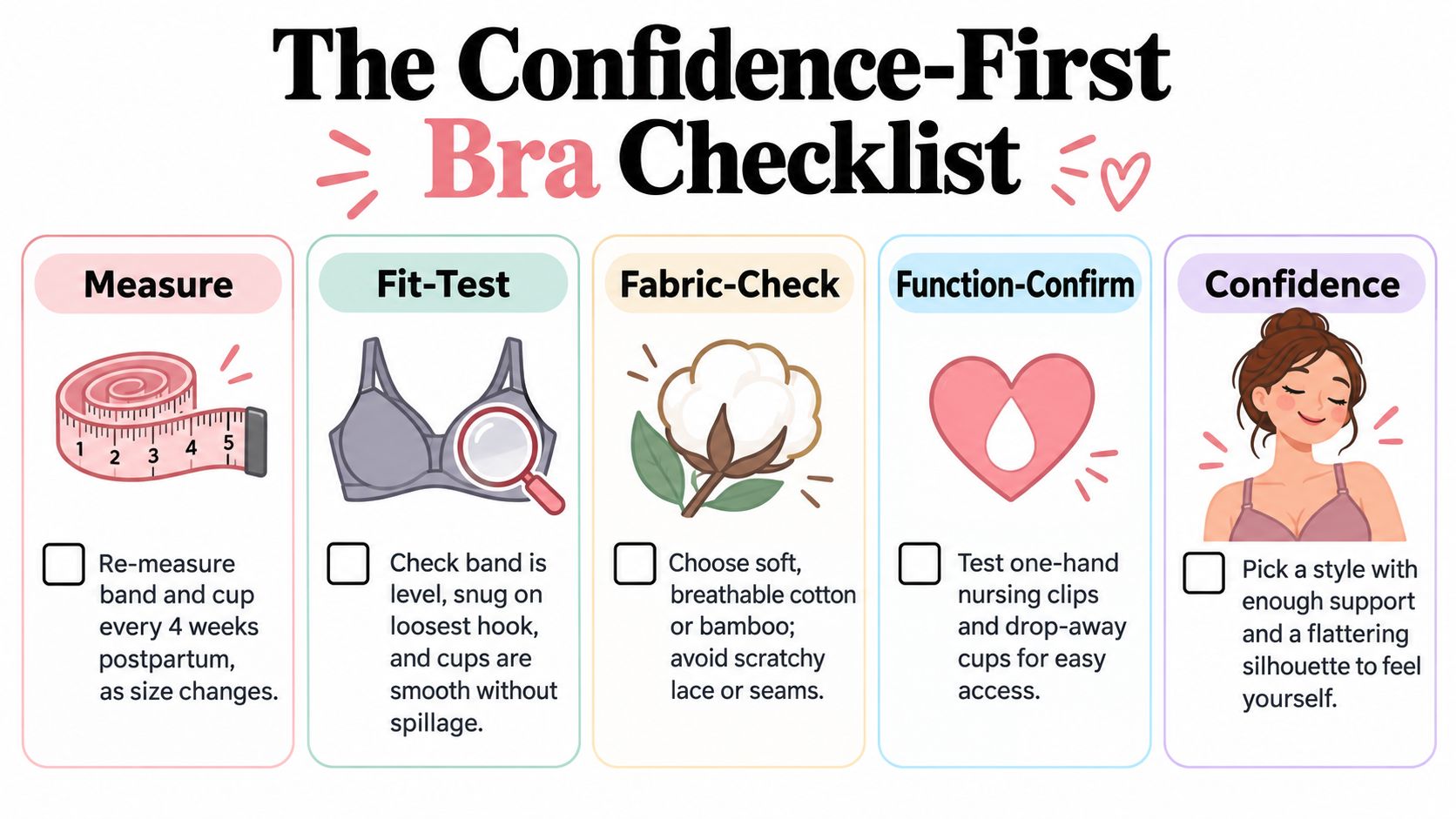
Measure
Use your current body, not your pre-pregnancy label. Measure the underbust snugly and assess the fullest bust area. If your body is still changing quickly, favor a style with enough stretch to accommodate normal fluctuation and plan to reassess.
Fit-test
Stand naturally, raise your arms, bend forward, and turn from side to side.
- Check the band: It should stay level and secure.
- Check the cups: They should contain the breast without spilling or gaping.
- Check the wire: If present, it should sit on the ribcage, not breast tissue.
- Check the straps: They should support without carrying the entire load.
- Check the shape: The bra should create a silhouette that feels familiar and intentional.
Fabric-check
Run your fingers over seams, lace, elastic, and closures. Softness is important, but so are breathability and recovery. A delicate fabric that scratches or stretches out quickly won't serve you because it looks pretty.
Function-confirm
Operate every nursing mechanism with one hand. Try it while holding a bag or folded coat. The cup should open smoothly, remain attached where intended, and close without forcing the breast back into place.
Confidence-verify
Look under the clothing you expect to wear. Does the bra give you the coverage, lift, and outline you want? If you feel more like yourself in it, that response belongs in the decision. Confidence isn't a frivolous extra. It's part of whether a garment earns regular wear.
Your commitment: Choose the bra for the postpartum stage you're living now, then give yourself permission to replace it when your body, feeding pattern, or wardrobe asks for something different.
A stage-specific approach also prevents an unnecessary either-or choice. You can keep a soft early bra for rest and sensitive days while adding a structured motherhood nursing bra for the moments when you want shape, support, and easy access together.
Milk&Lace offers nursing lingerie designed for later postpartum months, including the GAIA and PETRA styles with lace, structured support, and breastfeeding access. Visit Milk&Lace to explore a motherhood nursing bra that supports your current stage while helping you feel connected to your own style.