

You're standing in front of the mirror, tugging at the band of the bra you trusted before pregnancy. The cups cut across your fuller breasts, the straps leave marks, and the hooks seem to have moved closer together overnight. You may be tempted to buy the next regular size and carry on, but your body is asking for more than a temporary adjustment.
The core question in a maternity bra vs regular bra decision is not which one looks more attractive on a hanger. It's whether the bra can support changing breast tissue and an expanding ribcage without restricting you, and whether it gives you practical access if you're breastfeeding.
| Feature | Regular bra | Maternity or nursing bra |
|---|---|---|
| Main purpose | Support and shape breasts at a relatively stable size | Adapt to changing breast and ribcage dimensions |
| Band construction | Usually fixed and less forgiving | Often stretch-based, adjustable, or designed with additional flexibility |
| Cup fit | Built around a specific volume | More tolerant of fluctuation and changing fullness |
| Breastfeeding access | Usually requires removing or repositioning clothing | May include drop-down cups, clips, zips, or pull-down panels |
| Early postpartum suitability | Can become restrictive during fullness changes | Soft, flexible designs are generally more suitable during early fluctuations |
| Later postpartum option | Can work if it fits perfectly | Structured nursing styles can combine support, access, and personal style |
Recognizing When Your Regular Bra Stops Working
You notice it first while getting dressed. Your favorite bra still looks fine in the drawer, but the band feels tight before breakfast. By afternoon, the cups are cutting into the top or sides of your breasts, and you're pulling the straps away from your shoulders for relief. Nothing about this means you've done anything wrong. The garment no longer matches your measurements.
Pregnancy and postpartum changes can make a fixed-size bra less suitable. A riding band, cup spillage, pinching, or shoulder strain are practical signs that your current bra has reached its limit. A band that creeps upward at the back is especially important because it usually means the band isn't providing stable support, leaving the straps to carry more of the load.

Read the discomfort as information
Don't wait until a bra feels unbearable. Check it while standing, sitting, bending, and taking a full breath. Your breasts should remain contained, the band should stay level, and the straps should feel secure without digging into your skin.
- Cup overflow: Tissue rising above the cup or escaping at the sides means the cup is too small or too shallow.
- Band pressure: A tight, rigid band can become uncomfortable as your ribcage changes.
- Shoulder marks: Deep strap marks often indicate that the band isn't doing enough of the supporting work.
- Wire discomfort: A wire that sits on breast tissue rather than around it is a fit problem, not a sign you need to tolerate more discomfort.
A regular bra may still work during part of pregnancy if it fits correctly and feels comfortable. You don't need to replace every bra the moment your body begins changing. You do need to stop treating discomfort as something you should just endure.
Fitting reminder: Your body hasn't failed the bra. The bra has reached the edge of its design.
That emotional distinction matters. A changing bust can make familiar clothes feel like evidence that your old identity is disappearing. In reality, choosing adaptable lingerie is a way to acknowledge your body with care while keeping your sense of taste and self-respect intact.
The Anatomy of Pregnancy and Postpartum Fit Changes
A regular bra often assumes that your band and cup measurements will remain relatively stable. Pregnancy challenges both assumptions at once. Breast tissue changes, the ribcage expands, and postpartum milk-volume fluctuations can make the same garment feel supportive at one moment and restrictive at another.
A 2025 UK study of pregnant and postpartum participants found that self-reported bra size increased by an average of one underband size and two cup sizes from before pregnancy to pregnancy and the postpartum period, as reported in the study on pregnancy-related breast and ribcage changes. In the same study, the proportion reporting a cup size of at least D rose from 53% before pregnancy to 81% during pregnancy, then measured 70% postpartum. Those figures describe averages, not a schedule every woman must follow.
Two measurements move together
Anatomical research cited in the same source found that after 28 weeks of gestation, upper breast circumference increased by an average of 6.5 centimetres, while underbust measurement increased by 10 centimetres by the time of birth. That combination explains why sizing up a regular bra can be frustrating. A larger cup may contain more tissue, but a rigid band can still feel tight around the ribcage.
The breast changes also affect how support feels. As volume increases, the cup needs enough depth and stretch to contain tissue without creating pressure at the top or sides. The band needs to remain stable while allowing expansion, and the straps should steady the garment rather than compensate for an underperforming band.
Postpartum fit keeps evolving
Birth doesn't instantly return your body to its earlier measurements. Breast fullness can vary as milk is produced and removed, while the ribcage and breast shape continue to settle. That's why a bra bought during pregnancy may be useful postpartum only if it has enough flexibility and adjustment capacity.
A maternity design responds to this season with stretch fabric, adjustable fastening positions, and more forgiving cup construction. A soft, elegant option such as GAIA uses stretch lace, flexible support, and breastfeeding access as part of that adaptable approach.
The practical conclusion is simple. Your measurements are changing because your anatomy is changing. You're not “outgrowing” clothing through carelessness, and you don't need to force your body into an old size to prove that you're still yourself.
Structural Differences Between Maternity and Regular Bras
The clearest way to understand maternity bra vs regular bra construction is to separate support from adaptability. A regular bra can provide excellent lift when it fits well, but its band and cups are generally built around a more stable body. A maternity bra is designed to accommodate movement in both breast volume and ribcage dimensions.
A nursing bra adds another function, breastfeeding access. It may use a drop-down cup, clip, zip, or pull-down panel so you can expose the breast while leaving much of the band in place. That's different from a maternity bra, which may be designed primarily for pregnancy support and comfort without nursing hardware.
| Feature | Regular bra | Maternity or nursing bra |
|---|---|---|
| Band | Firm, comparatively fixed structure | Stretch panels, multiple fastening positions, or adaptable construction |
| Cups | Specific volume and shape | Stretch lace, flexible fabric, or cup sections that tolerate fluctuation |
| Underwire | May be rigid and less forgiving | Often wire-free early on, or flexible and carefully positioned later |
| Straps | Designed to stabilize a settled fit | Built to work with a changing band and cup |
| Breastfeeding function | No dedicated access | Drop-down, pull-aside, zip, or clip access |
| Daily experience | Shape and support | Support, pressure management, adjustability, and access |
Maternity and nursing aren't identical
A maternity bra can be useful before birth even if you don't plan to breastfeed. Its value comes from the adaptable construction. A nursing bra becomes especially useful when feeding access matters, because you don't have to remove the entire garment or wrestle clothing out of the way.
The difference between maternity and nursing bras is therefore functional rather than purely stylistic. You may wear one garment during pregnancy and another after birth, or choose a nursing style that also accommodates pregnancy changes.
Look beyond the label
The word “maternity” doesn't guarantee a comfortable fit, and “regular” doesn't automatically mean unsuitable. Judge the garment by its performance:
- Band stability: It should sit level from front to back and provide the primary support.
- Cup containment: Breast tissue should remain fully inside the cup without top or side spillover.
- Pressure distribution: The bra should support without creating concentrated compression.
- Adjustment capacity: Multiple hook positions and stretch sections give you room to respond to changing measurements.
- Access: Nursing hardware should open smoothly and allow practical feeding without shifting the whole garment.
A well-fitted regular bra may still be right for a particular day or outfit. But if you're pregnant or breastfeeding, adaptability gives you a larger margin for comfort, which is exactly what your wardrobe should provide.
Protecting Breast Health and Managing Engorgement
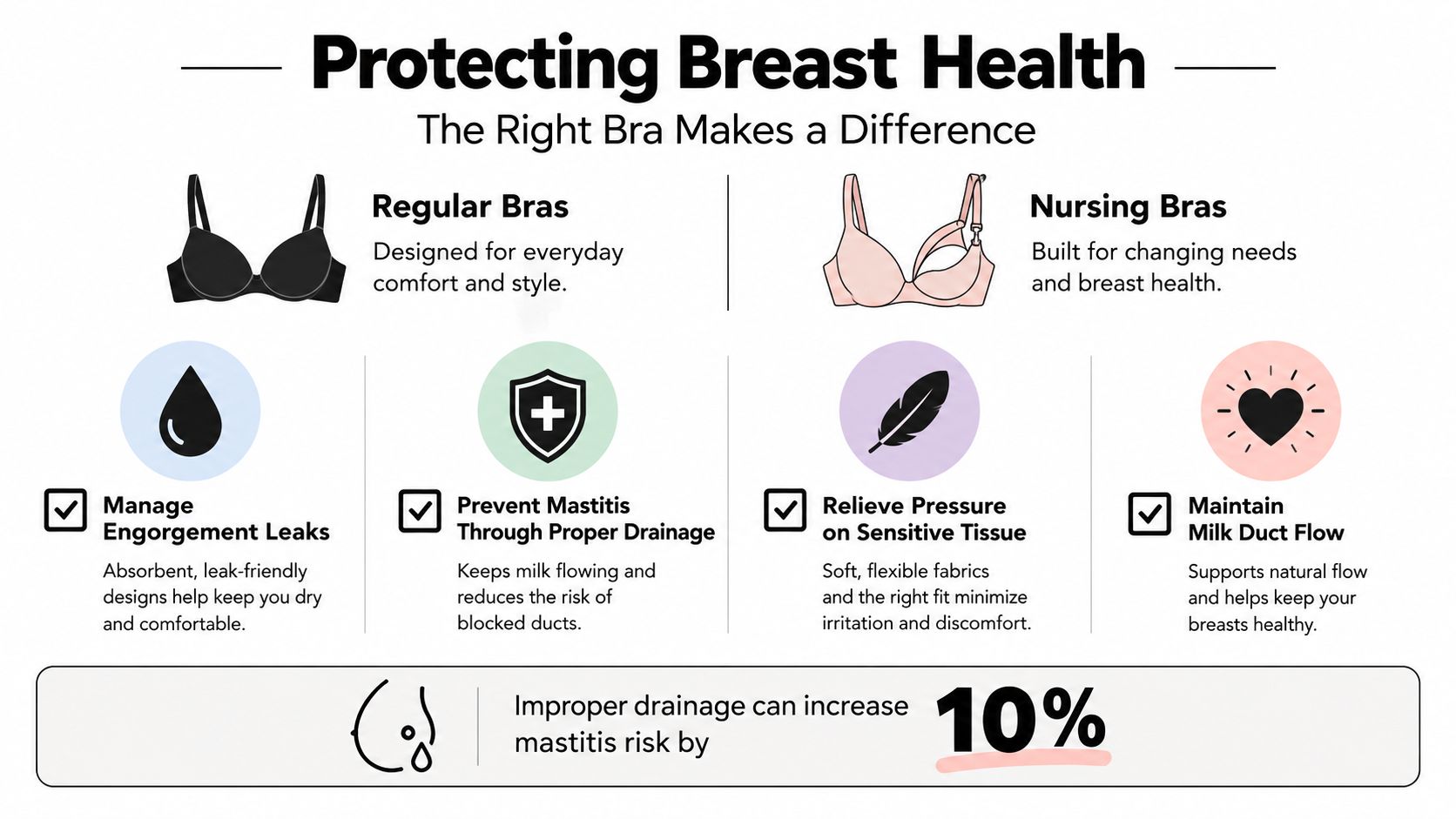
A beautiful bra is never worth persistent pressure on a changing breast. During lactation, fullness can rise and fall as milk is produced and removed. A rigid underwire or overly tight band can press on a fuller area, potentially contributing to inflammation and increasing the risk of plugged ducts or mastitis, as explained in guidance from the Australian Breastfeeding Association on choosing a maternity bra.
Choose softness when fullness is unpredictable
Early postpartum is the time to prioritize flexibility, gentle containment, and easy adjustment. Soft wireless or unstructured nursing bras can accommodate changes without forcing the breast into a rigid shape. That doesn't mean you should accept a loose, unsupportive garment. The band should still feel secure, and the cup should hold your tissue without squeezing it.
Use this check when trying on a bra:
- Assess both states. Notice how the bra feels when your breasts are fuller and after feeding or pumping.
- Inspect the wire, if present. It must sit completely around the breast on the chest wall, never on breast tissue.
- Check for compression. Look for digging, hard pressure, gaping, or a cup edge that leaves a pronounced indentation.
- Test access. Open the cup with one hand and confirm that the band and cup stay in position.
- Respond to pain. Persistent tenderness, a localized hard area, redness, or flu-like symptoms warrants professional medical advice.
The guide to breast engorgement can help you understand why breast fullness affects bra comfort and daily routines. A bra can support feeding, but it can't diagnose or treat a breast-health problem.
A later-postpartum nursing bra may include more structure if your size has become steadier and the wire fits precisely. The decision isn't “underwire or no underwire” in isolation. The correct question is whether the garment supports your breast without digging into tissue at either its fuller or emptier state.
Here's a visual demonstration of how nursing access and construction can affect everyday use:
Reclaiming Confidence with Elevated Nursing Lingerie
The first postpartum bra often serves a survival role. It needs to be soft enough for sensitive breasts, flexible enough for unpredictable fullness, and easy enough to operate while you're tired. That role matters, but it shouldn't define your entire nursing wardrobe.
As your body settles, you may want more shape, more lift, and more visual connection to the woman you were before pregnancy. You haven't stopped being sensual, stylish, or particular about what touches your skin. You've become a mother, and you're allowed to want lingerie that reflects the whole of you.

Function can look feminine
Refined nursing lingerie makes sense when comfort no longer needs to mean visual compromise. Stretch lace can move with the body, while a carefully fitted structure can create a more familiar silhouette. Nursing access remains important, but it doesn't have to announce itself through a purely utilitarian design.
PETRA combines ultra-soft stretch lace, gentle underwire, and one-hand nursing access. It belongs to the later-postpartum conversation, when a woman wants reliable support and practical feeding functionality without abandoning her preference for elegant lingerie.
Make the transition deliberately
Don't rush into a structured underwire because you're tired of soft bras. First, confirm that your breast size is becoming more predictable and that the wire can sit fully around the breast on the chest wall. Try the bra at a fuller state, move your arms, sit down, and open the nursing clasp with one hand.
Then judge the emotional fit as seriously as the physical fit. Does the silhouette feel like something you chose, rather than something you settled for? Does the fabric make you feel cared for? Does the access work without making you feel as though you're wearing medical equipment?
You don't need to earn the right to feel beautiful again. You can choose beauty that works with your life now.
Your identity hasn't gone anywhere. Nursing lingerie doesn't erase the practical realities of breastfeeding. It gives them a place inside a wardrobe that still belongs to you.
Practical Fitting Tips and Lingerie Care
Start with the garment, not the size printed on the label. Brands grade differently, and your measurements may not match your pre-pregnancy size. A useful guide to measuring for a maternity bra can help you take a fresh underbust and bust measurement before comparing the result with a brand's chart.
Use this fitting checklist
- Measure the underbust snugly. Keep the tape level around your body without pulling it painfully tight. This measurement helps you assess whether the band can sit securely without restricting your breathing.
- Check the band horizontally. Fasten a new bra on its loosest setting. The band should remain level rather than riding up.
- Scoop and settle the tissue. Gently bring breast tissue forward into the cups, then check for overflow at the top and sides.
- Inspect the centre and wires. The centre section should sit comfortably, while any wire should rest around the breast, not on it.
- Adjust the straps last. Straps should stabilize the bra, not pull the cups upward or carry the main weight.
- Test nursing access. Use the clip or panel with one hand. If opening it dislodges the band, the design or fit isn't working for your routine.
- Leave room for change. Choose stretch, adjustment positions, or flexible cup construction rather than a rigid fit with no tolerance.
A bra that fits on the tightest hook on its first wear has no useful adjustment room. Start looser and move inward as the band relaxes or your measurements change.
Protect the fabric and hardware
Treat stretch lace and nursing mechanisms gently. Follow the care label, use a mild detergent, and avoid harsh heat that can weaken elastic. Fasten hooks before washing so they don't catch lace, and place delicate lingerie in a wash bag if the care instructions permit machine washing.
Air-dry the bra rather than twisting it or placing it against direct heat. Store nursing bras with the cups supported and the clips closed. Inspect the elastic, seams, and hardware regularly. A bra that has lost recovery or no longer contains your tissue safely should be replaced, even if the lace still looks attractive.
Common Questions About Maternity and Nursing Bras
When should I buy a maternity bra?
Buy one when your regular bra becomes uncomfortable, not because a calendar says you must. Early signs include a tight band, cup spillover, tender pressure points, or straps doing too much work. If the bra feels comfortable and contains your breasts properly, you can continue wearing it while monitoring the fit.
Do I need a nursing bra during pregnancy?
Not necessarily. A maternity bra addresses changing measurements and comfort, while a nursing bra adds feeding access. If you want one garment to serve both purposes, choose a nursing design with enough stretch and adjustment for your current stage, but don't sacrifice fit just to gain future functionality.
Can I wear an underwire while breastfeeding?
You can consider structured support later, provided the wire sits fully around the breast on the chest wall and doesn't dig, gape, or compress tissue. During periods of rapid fullness change, soft or flexible designs are the safer practical choice. If an underwire creates localized pressure, stop wearing it and reassess the fit.
How many sizes should I buy?
Don't buy according to a predicted number of sizes. Buy for your current measurements, then prioritize stretch, adjustment, and a clear exchange policy. Your body may not follow someone else's pregnancy or postpartum pattern.
Is a maternity bra medically required?
No. A maternity or nursing bra is a functional clothing choice, not a medical mandate. Breastfeeding guidance describes a well-fitted supportive bra as recommended, while noting that the recommendation is based on consensus-level evidence rather than high-quality clinical trials, as summarized by Breastfeeding Support's discussion of nursing bra guidance.
The best choice changes with your body. Early on, select softness and flexibility. Later, if your fit has stabilized, choose the structure, lace, lift, and access that help you feel recognizable to yourself again.
Milk&Lace offers nursing lingerie that pairs breastfeeding access with stretch lace and structured support for later postpartum wear. Explore the collection when you're ready to move beyond purely utilitarian comfort and choose a bra that supports both your changing body and your personal style at Milk&Lace.