

A postpartum shopper lands on your product page after a long day. She sees the lace, the silhouette, and a confident model moving through a bright studio. She likes the bra, but one question stops her at checkout: How does the nursing clasp work when one hand is occupied? She scrubs through the video, finds no answer, and leaves.
That hesitation is where many maternity bra videos lose the sale. The footage can look polished and still fail to show whether the band stays level, whether the cup contains changing fullness, or whether the bra sits smoothly under clothing. A useful video treats those questions as the product story, not as details to hide behind attractive styling.
Breastfeeding education matters as context, but it shouldn't become a promise that a garment determines breastfeeding duration or success. A World Health Organization evidence review of antenatal breastfeeding education found no clear overall difference in breastfeeding initiation, breastfeeding at three or six months, or duration when additional antenatal education was compared with standard care. The practical implication is clear: show what the bra does, and don't attach medical outcomes to it.
Why Most Maternity Bra Videos Fall Flat at Checkout
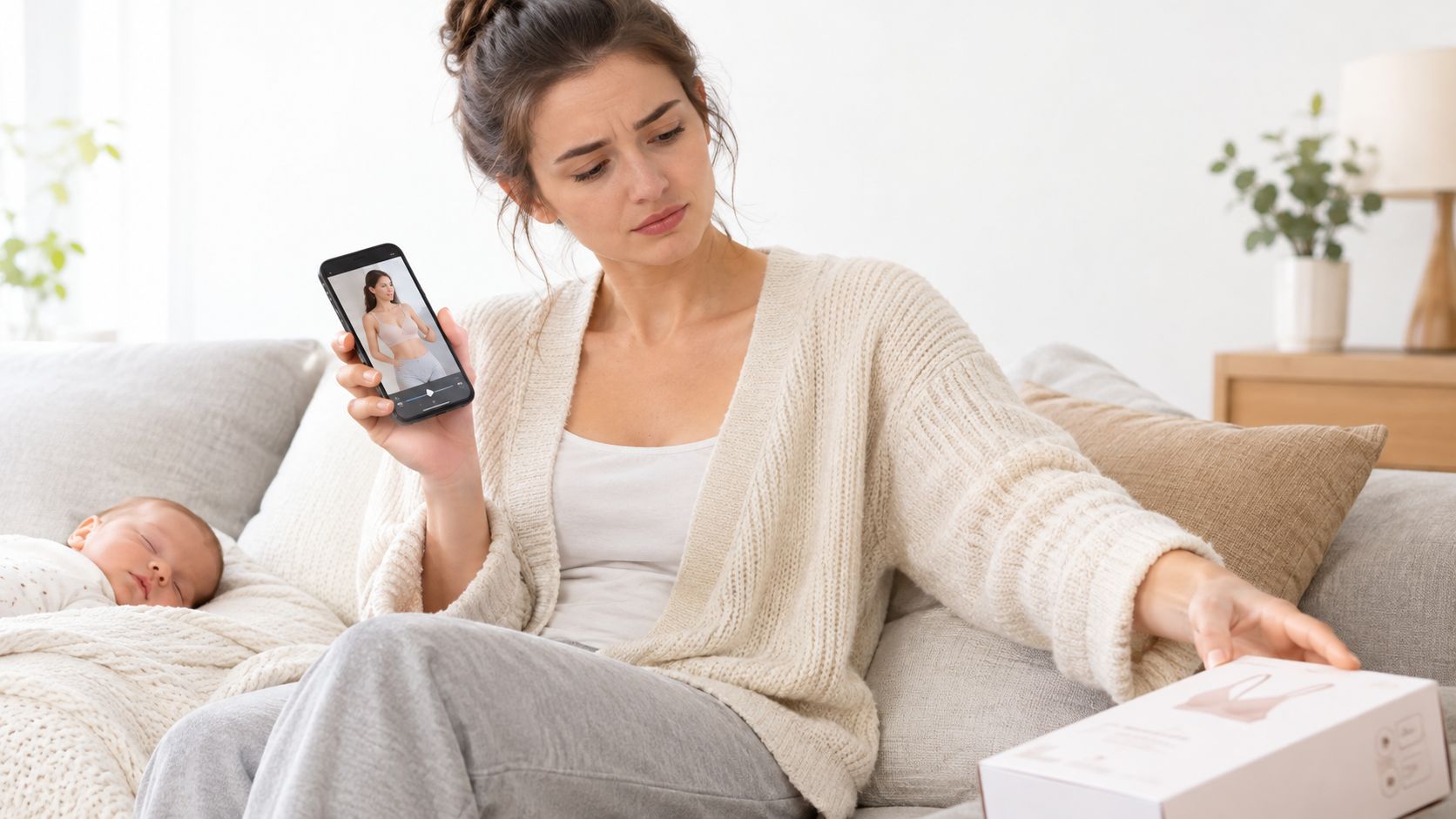
Aesthetic footage creates interest. Functional footage creates confidence. The difference often appears in the final moments before purchase, when a viewer stops admiring the product and starts imagining it during an actual feed, an errand, a workday, or a change in body shape.
A lace close-up can't answer whether the nursing clip opens with one hand. A slow-motion turn can't show whether the strap adjustment holds. A front-facing pose won't tell a later-postpartum shopper whether the underband remains stable beneath a favorite top. Those omissions force the buyer to guess, and apparel buyers usually treat uncertainty as a reason to delay.
The conversion question is simple: what would a skeptical postpartum shopper need to see before she trusts the fit and mechanics?
A strong maternity bra video resolves four practical jobs:
- Choosing a bra: Clarify the intended stage, support structure, access design, and the limits of a single size recommendation.
- Fitting the bra: Show the band, cup containment, strap adjustment, and how the garment behaves under clothing.
- Using the bra: Demonstrate nursing access slowly enough that the clasp and cup movement are unmistakable.
- Evaluating the purchase: Make sizing guidance, exchange information, and the next shopping step visible before the viewer leaves.
This is also where a product page should connect visual education with written guidance. A carefully placed link to what a maternity bra is can answer broader questions without forcing the video to carry every explanation.
The audience is diverse. WHO and UNICEF reported that exclusive breastfeeding reached 48% globally in 2023, while the global target for 2030 is 70%, as described in their regional breastfeeding update from the WHO Western Pacific Region. A video shouldn't imply that every viewer will breastfeed exclusively, follow the same timeline, or need the garment for identical reasons.
The best creative choice is therefore not to make the product look universally remarkable. It is to make the product understandable. Show the access, fit, construction, and daily use plainly. Beauty still matters, especially for a brand serving women who want to reconnect with personal style, but beauty should support the proof rather than replace it.
Choosing and Fitting a Maternity Bra Before You Ever Hit Record
A shopper may pause a video because the bra looks polished, then leave because she cannot tell whether it will stay comfortable through pregnancy, feeding, and ordinary movement. Fit guidance should shape the storyboard before the camera starts. A finished silhouette alone cannot answer the practical questions that determine confidence at checkout.
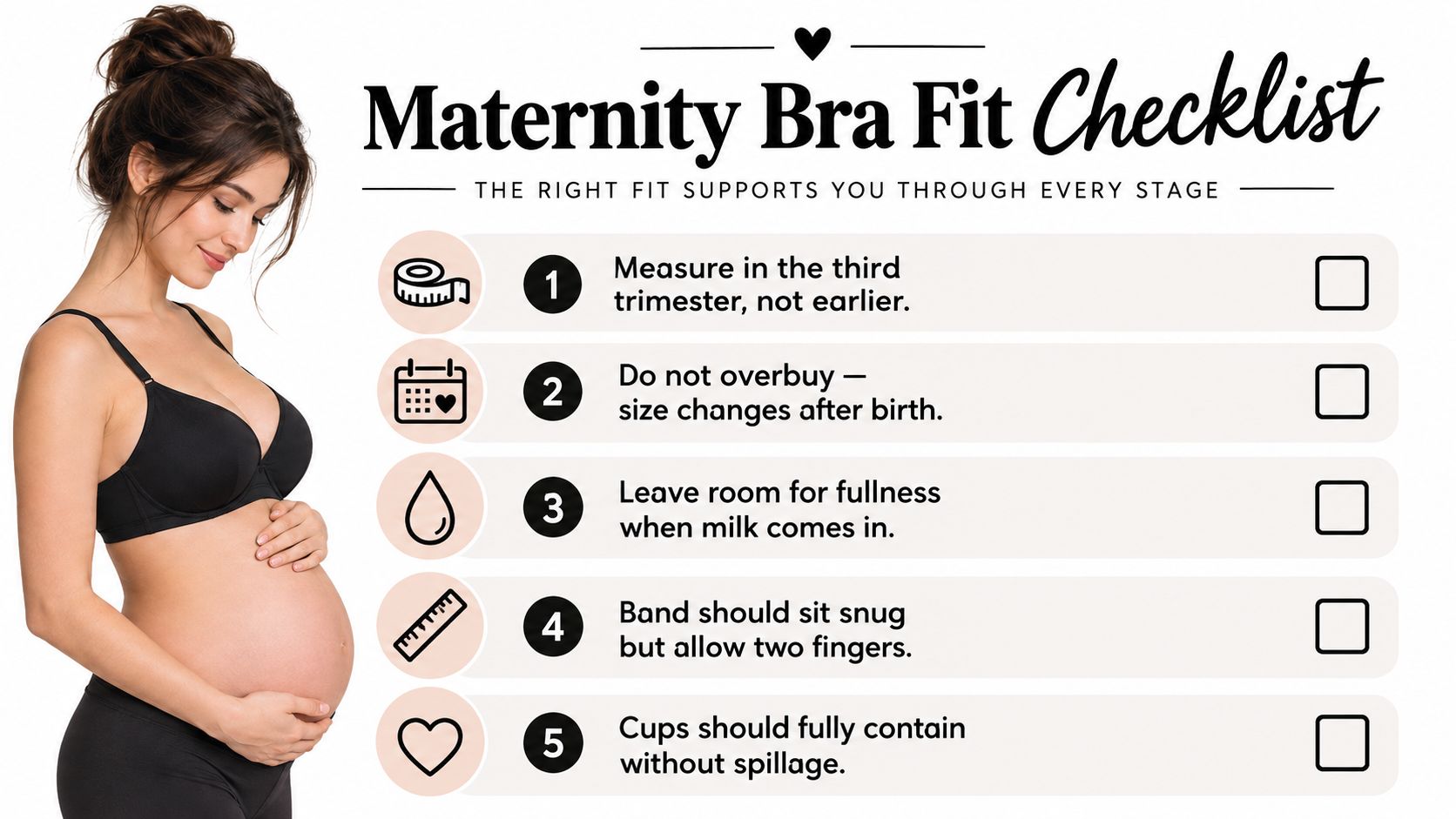
Use a staged approach to sizing. Someone late in pregnancy may want a nursing style for comfort, while buying several bras before birth can create unnecessary uncertainty. Leave practical room for fullness after milk comes in, then reassess when the body and feeding routine become more stable. An exchange policy helps when the band rides up, the cup overflows, or the wearer compensates with overly tight straps. Before you storyboard, send shoppers to a full guide on maternity bra fitting so the written advice and video present the same fit steps.
A 2025 University of Leicester study involving 323 pregnant, postpartum, and breastfeeding women reported an average self-reported change of one underband size and two cup sizes from before pregnancy to during and after pregnancy, as documented in the study record on changes in physical activity and breast-related factors during and after pregnancy. The result does not prescribe one progression for every shopper. It does show why a pre-pregnancy measurement should remain a starting point rather than a permanent fit instruction.
Turn fit decisions into visible footage
A tape measure gives you a starting point, while the camera captures details measurements cannot fully show:
- Band stability: Film side and back views while the model moves naturally. The band should appear level instead of climbing toward the shoulder blades.
- Cup containment: Use an angle that shows whether tissue spills near the neckline or underarm.
- Adjustability: Capture strap movement and hook-and-eye settings in close-up, then show the finished fit under a fitted top.
- Fabric behavior: Show stretch lace, breathable materials, and flexible support while the model moves, not only while she stands still.
- Daily wear: A bra can look elegant alone yet create lines or shift under clothing. Include the layer a shopper is likely to wear.
For a soft option with stretch lace, flexible support, and breastfeeding access, GAIA gives creators a concrete proof sequence. Film the model moving in the bra, show the lace and silhouette, then open the one-handed clasp and lower the cup in one continuous shot. That sequence puts comfort, appearance, and access in the same frame.
Use careful language around discomfort. Temporary fullness can occur as the body changes, while persistent pain, redness, or concerning breast changes should not be framed as a sizing issue for the video to solve. The garment can demonstrate construction and convenience. It is not medical treatment, so the script should claim only what the product visibly supports.
Teach viewers to reassess the band, cup, underarm coverage, and overall comfort as their bodies change, instead of telling them to buy a size up. That guidance respects postpartum variation and gives shoppers a practical way to judge fit at each stage.
Filming the Product Demo Shot by Shot
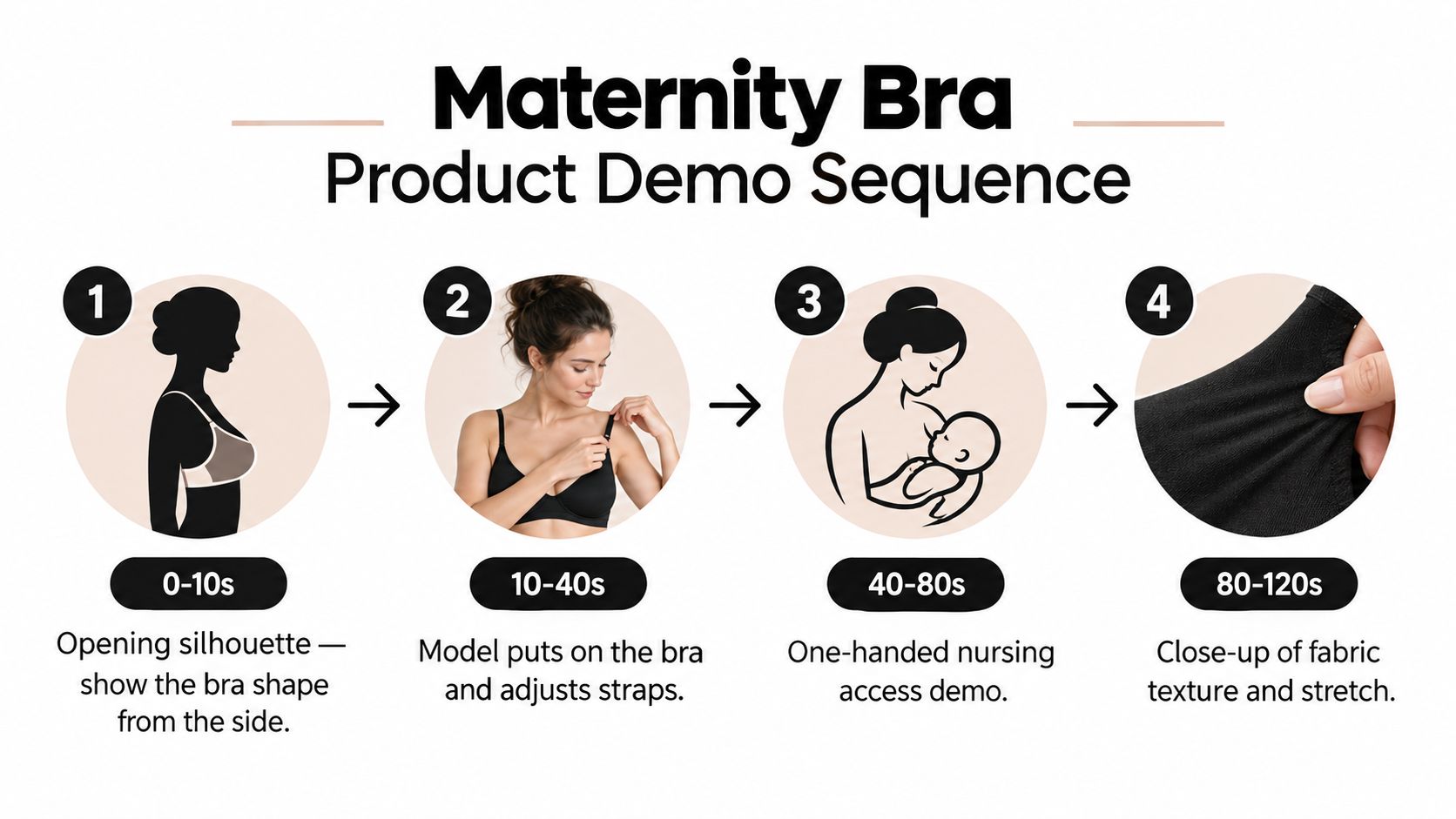
A product demo needs a clear beginning, middle, and end. For a maternity bra, a practical runtime is 30 to 120 seconds, a range identified as most effective by 71% of surveyed video marketers in the Google Merchant Center product video guidance. The exact duration matters less than whether each second answers a purchase question.
Open with the use case and finished silhouette. Show the bra from the front, side, and a natural three-quarter angle. The first frame should communicate who might use it and how it sits on the body, rather than beginning with a logo animation or an abstract lace detail.
Build the sequence around proof
Use this production order:
- Opening silhouette: Establish the finished shape and show how the bra looks under a simple top. Keep the background clean so the band, neckline, and straps remain legible.
- Putting on and adjusting: Film the model fastening the garment, setting the straps, and checking the band. Don't cut away before the adjustment is complete.
- Nursing access: Show the clasp opening with one hand at normal speed. Then repeat the action in a close-up where the viewer can see the mechanism, cup movement, and re-fastening.
- Construction details: Cut to the underwire, lace, breathable fabric, strap hardware, and hook-and-eye closure. Use slow camera movement or stable close-ups instead of rapid transitions.
- Under-clothing fit: Show the bra beneath a top or dress. A product can be attractive on its own and still create a distracting edge in real use.
- Closing guidance: End with the size guide, exchange policy, and a direct purchase prompt. Keep the information on screen long enough to read.
The two most valuable shots are the real-time access demonstration and the uninterrupted clasp close-up. If either is missing, the viewer has to infer the most important function. That inference is especially risky for first-time mothers and gift buyers who may not know what the mechanism should feel like.
Production rule: Never let lace carry the entire demonstration. Lace communicates identity, but mechanics resolve objections.
Google's product guidance favors product-specific videos, coherent structure, high-quality lighting, smooth camera movement, and footage that shows the item in use. Avoid black bars, cluttered backgrounds, and lighting that washes out the lace or hides the clasp. The viewer shouldn't need to pause the video to understand what happened.
For strap movement and fit mechanics, supporting written education can sit beside the video. A link to how to adjust bra straps gives the shopper a deeper reference while the footage remains focused.
Keep the model's movement ordinary. Reaching, turning, lifting an arm, and layering a top reveal more than a static pose. The production should feel controlled, but the use case should feel lived in.
Mobile-First Editing So the Video Survives Sound-Off
A maternity bra video is often watched in a feed, on a product page, or during a distracted pause. Design the master composition for vertical 9:16 social placements, then protect a clean 1:1 or 4:5 crop for commerce feeds. Keep the product centered and leave safe space around the clasp, neckline, and captions.
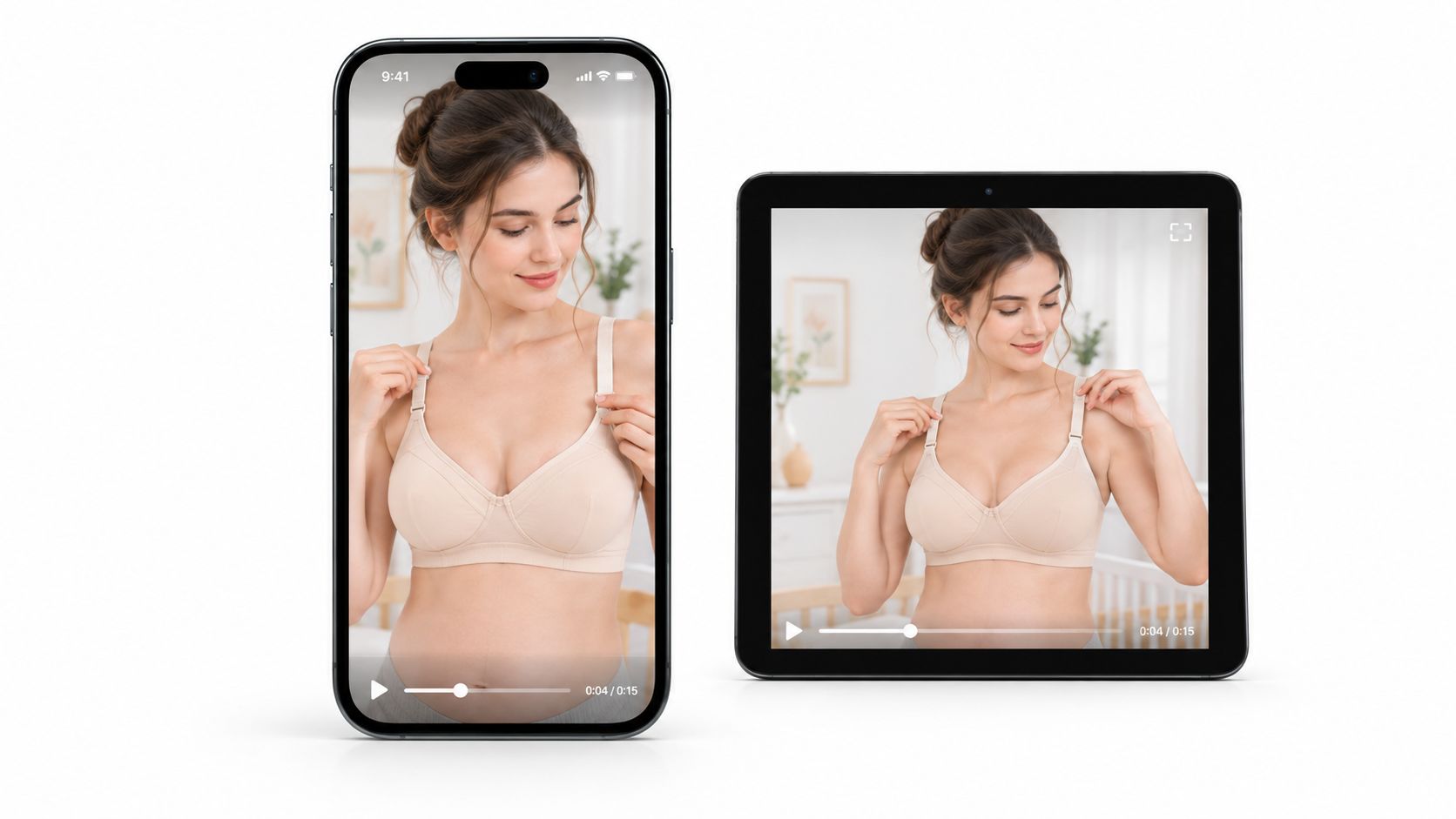
Sound-off design starts with the hook. Put the postpartum use case in large on-screen text, then repeat critical information visually. If the voiceover says “one-handed nursing access,” the clasp action should appear at the same moment, with a caption that remains readable without audio.
Place captions in open negative space rather than over the nursing mechanism. A caption covering the fastening point defeats the purpose of the close-up. Use a second line or a later frame for size and exchange information, and check the final export on a real phone instead of relying only on a desktop preview.
Slow the proof, accelerate the transitions
The access demonstration deserves two versions. First, show it at normal speed so the viewer understands the action as it would happen during a feed. Then repeat it in a closer crop, still slowly enough to show the clasp and cup movement. Transitions, logo cards, and secondary fabric shots can move faster because they aren't carrying the same functional burden.
Before publishing, check that the edit includes:
- A captioned opening: The viewer understands the postpartum use case immediately.
- A visible fit callout: Band, cup, strap, or sizing guidance appears on screen.
- A readable policy prompt: Exchange or return information isn't buried in tiny type.
- A supported product claim: The footage proves access and construction without promising medical support, milk supply, or universal fit.
- A clean crop: The nursing clasp remains visible in each planned placement.
The video should inform rather than pressure. Breastfeeding outcomes depend on clinical, social, and personal factors, so a garment video should focus on access, support features, fit adjustment, and everyday confidence. That restraint makes the content more credible, especially when the shopper is already evaluating how the garment may work through changing routines.
Measuring What Actually Moves Sales on the Product Page
Views tell you that a video started. They don't tell you whether the viewer understood the fit, trusted the clasp, or decided to buy. For a maternity bra product page, measurement should connect attention to intent and then to post-purchase fit.
Start with a controlled comparison. Publish a baseline page without the video, then create an otherwise identical version with the video. Keep the price, surrounding creative, product information, and traffic conditions constant as far as practical. Randomize traffic where possible and run the comparison through at least one complete purchase cycle.
Track the path rather than a single headline number. A viewer may complete the video but never click the size guide. Another may watch only the access demonstration, add the bra to the cart, and purchase later. Returns by fit reason can reveal whether the video helped the shopper choose correctly or increased impulse interest.
| Metric | What it measures | Why it matters for maternity bras |
|---|---|---|
| 3-second view-through rate | Whether the opening earns immediate attention | Tests whether the postpartum use case appears before the viewer scrolls |
| 25% view-through rate | Whether viewers reach the early product proof | Shows if the edit holds attention long enough to establish fit or access |
| Completion rate | Whether viewers watch through the closing guidance | Indicates whether sizing and exchange information are being seen |
| Nursing-access interaction clicks | Engagement with the functional demonstration or related content | Separates curiosity about style from interest in how the bra works |
| Size-guide engagement | Interaction with fit support | Helps identify whether shoppers need more staged guidance |
| Add-to-cart rate | Product interest after viewing | Connects the video with a meaningful shopping action |
| Checkout conversion | Completed purchase behavior | Shows whether the product page resolves enough uncertainty |
| Returns by fit reason | Post-purchase fit friction | Reveals whether the video sets accurate expectations |
| Assisted revenue | Purchases influenced by the video without a direct last click | Captures the role of video in a longer decision |
Video marketers most commonly quantify performance through views at 67%, engagement at 63%, leads or clicks at 52%, customer engagement or retention at 40%, and bottom-line sales at 32%, according to Wyzowl's video marketing statistics. Those figures describe survey benchmarks, not guaranteed results for a nursing apparel page.
Segment the results by first-time mothers, later-postpartum shoppers, and gift buyers. Their questions differ. A first-time mother may need mechanics explained. A later-postpartum shopper may care more about support, silhouette, and changing fit. A gift buyer may watch the full product story but still need a clear exchange path.
The strongest test is not the video with the highest view count. It is the version that produces engaged shopping behavior while reducing avoidable fit-related returns.
Pre-Publish Checklist and Brand Fit Examples
Before the video goes live, review it as both a producer and a postpartum shopper. The final cut should make the product attractive without asking the viewer to fill in missing information.
Confirm the product proof
- Claim accuracy: Every benefit shown on screen is supported by what the garment visibly does.
- Access clarity: The clasp opens and closes with one hand, shown at normal speed and in close-up.
- Fit visibility: The model demonstrates band placement, cup containment, strap adjustment, and the garment under clothing.
- Mobile readability: Captions remain large, high contrast, and clear in vertical, square, and four-by-five crops.
- Policy visibility: Sizing, exchange, and purchase guidance appear before the final frame.
- Medical restraint: The script doesn't promise milk supply, breastfeeding duration, treatment, or a universal fit.
- Body respect: The model's changing postpartum experience is presented without implying that one shape or feeding journey is the standard.
A soft stretch-lace bra with effortless access can serve a later-postpartum confidence story when the footage shows both the delicate construction and the practical clasp. A structured piece with breathable fabric and adjustable support calls for a different emphasis, with close-ups that explain stability and fit rather than relying on silhouette alone. In both cases, the product should be filmed as it will be used, not only as it looks in a campaign pose.
The broader principle is worth keeping beside the edit timeline:
A maternity bra video converts when it respects the buyer's body, time, and skepticism at the same time.
That respect is practical. It means showing the mechanism without rushing, explaining fit without pretending bodies stay fixed, and measuring completed shopping actions instead of celebrating attention that never reaches the cart. It also means acknowledging that breastfeeding education can provide context without turning a garment into a promise about health or outcomes.
Milk&Lace offers nursing lingerie that combines lace, structured support, and discreet breastfeeding access for women moving through later postpartum routines. Visit Milk&Lace to explore the collection and use the same fit-first questions from this guide before choosing your next product video or bra.