

You've made it through the first exhausting stretch of feeding, broken sleep, and bras chosen purely because they're soft. Now you're standing in front of your dresser with a drawer full of basic nursing bras, wondering when you're allowed to want something prettier. A lace underwire nursing bra can be the answer, but only when your body, milk supply, and fit are ready for a more structured design.
This isn't about abandoning comfort or treating nursing like an obstacle to personal style. It's about finding a second-stage bra that offers support, practical feeding access, and a sense of femininity that may have been missing from the early postpartum wardrobe.
Rediscovering Yourself Beyond the Early Postpartum Months
Several months after giving birth, Maya stood in front of her dresser holding three nursing bras that looked almost identical. They were soft, stretchy, and easy to pull down. They had also become symbols of a phase she was beginning to outgrow. She still loved nursing her baby, but she no longer wanted every part of her wardrobe to look as though it had been selected only for survival.
Her milk production had become more predictable, her breasts weren't changing dramatically from one feed to the next, and she was starting to return to familiar routines. A fitted top for coffee with a friend, a wrap dress for dinner, or a blouse for work suddenly felt appealing again. The question wasn't whether she needed nursing functionality. She did. She wanted that functionality packaged in something that looked and felt like lingerie.
That's where a lace underwire nursing bra can serve as a second-stage garment. It bridges the gap between the soft wireless bra that carried you through the earliest weeks and the everyday lingerie you wore before pregnancy. The lace brings visual softness and personality, while the structured cup and underwire can create a more defined shape beneath clothing.
Comfort can include beauty
Early postpartum weeks often call for flexibility. Breast volume may fluctuate sharply, tissue can feel tender, and a wireless bra makes it easier to accommodate feeding, engorgement, and long periods of rest. That choice isn't a failure of style. It's a practical response to a body that's still adjusting.
Later, some mothers find that their breasts hold a more consistent shape and that they're ready to reassess structured support. Expert guidance notes that underwire is generally better tolerated after the first 4–6 weeks postpartum, once milk production has stabilized and breast volume changes are less extreme. The timing isn't a rule for every body, but it explains why a bra that felt wrong immediately after birth may become workable later. San Diego Family's guidance on underwire nursing bras also emphasizes that correct fit matters more than the decorative fabric.
Wanting to feel attractive again isn't shallow. It can be a small, private way to recognize the person who still exists alongside the role of mother. The right lace underwire nursing bra doesn't ask you to choose between those identities.
What a Lace Underwire Nursing Bra Is
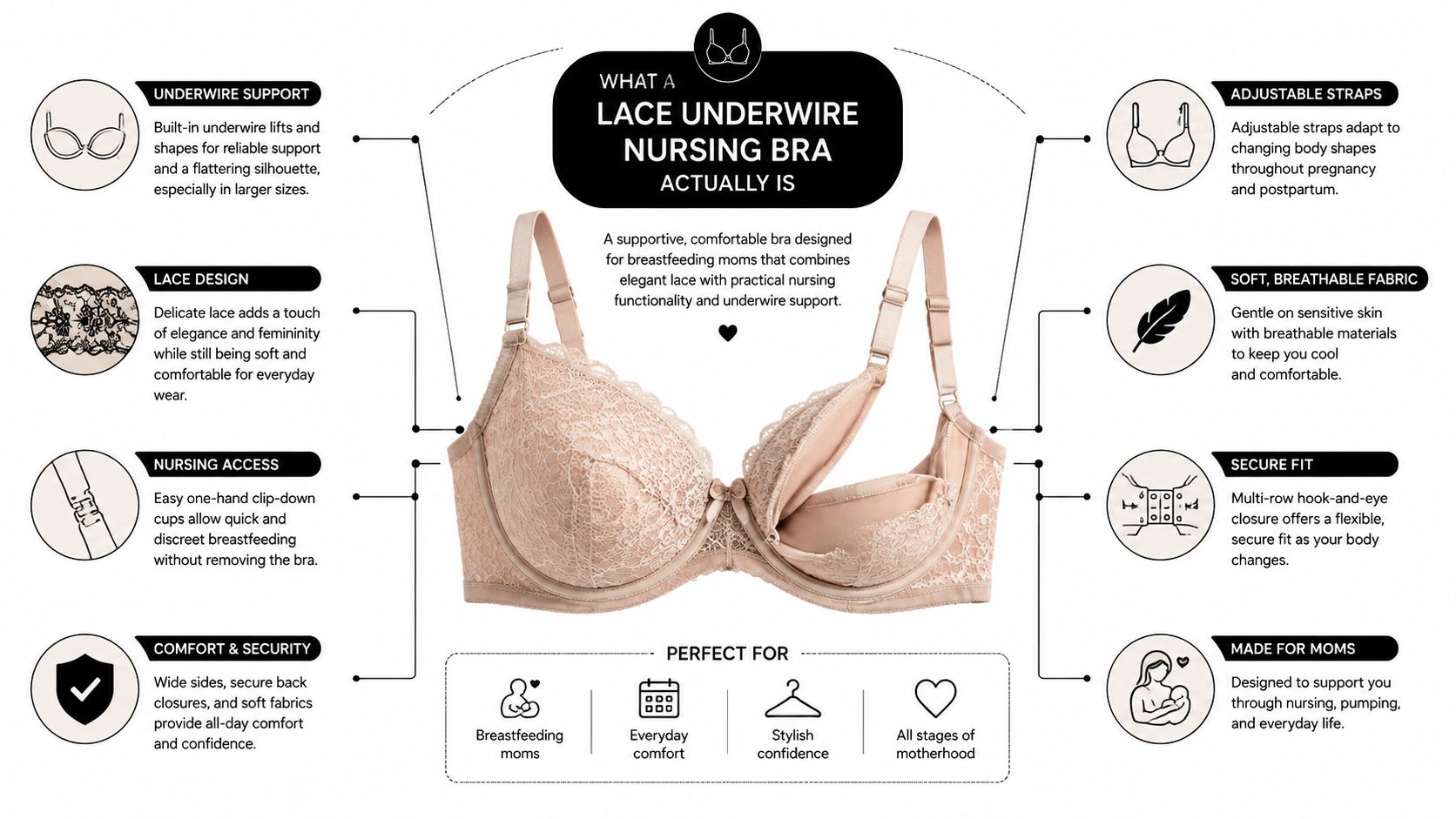
A lace underwire nursing bra combines two design goals: a delicate appearance and reliable support. Its lace creates visual softness, while the lining, cups, band, wire, straps, and nursing clasp determine how well it fits and functions. Understanding each part makes it easier to judge whether the bra suits your current body and feeding routine.
The visible and structural layers
Lace overlay: Lace usually sits over a supportive lining rather than touching the breast as the only layer. Stretch lace can follow changing contours and add texture without making the bra look purely utilitarian. Check the inside for smooth seams and a soft lining, particularly if your nipples or breast skin remain sensitive.
Underwire: The underwire is a curved support piece sewn into a channel beneath the cup. Traditional wires are relatively rigid. Flexi-wire designs use a more yielding construction that can move slightly with the body. Either style should support the breast from underneath, with the wire resting around the breast rather than on breast tissue.
Nursing clasp: A release at the strap and cup junction lets you lower the cup for feeding. It should be manageable with one hand, since your other hand may be holding your baby. The cup also needs to lower far enough to create a clear feeding area, rather than leaving fabric crowded around the nipple.
Cup shape: Full-cup designs provide more coverage. Balcony cups can create a lifted, open neckline while retaining structure. Plunge cups suit lower necklines, although they may offer less upper-breast coverage for some postpartum shapes.
Why the details matter
Lace is the finishing layer, not the source of support. The cup lining, band, wire shape, strap placement, and clasp must work together. If one part presses, shifts, or restricts access, an attractive surface cannot correct the fit.
For a closer examination of structure and nursing access, read this guide to nursing bras with underwire. A style such as GAIA combines stretch lace, flexible support, and breastfeeding access in a soft design. The practical test is whether its construction feels comfortable, keeps breast tissue clear of the wire, and matches how you feed each day.
Lace Underwire Versus Wireless Nursing Bras
Neither style wins for every mother or every day. A wireless nursing bra usually adapts more easily to early postpartum changes, sleep, lounging, and sensitive breasts. A lace underwire nursing bra offers more architecture, which can help create lift and a defined outline beneath fitted clothing.
Wireless doesn't mean unsupportive. Its support comes from the band, fabric tension, cup construction, and sometimes internal panels rather than a rigid wire. Underwire shifts more of the support into the lower cup and wire channel, so the design can feel more lifted, particularly for fuller breasts. That structure also makes accurate sizing more important.
| Factor | Lace Underwire | Wireless |
|---|---|---|
| Lift and shaping | Creates a more defined silhouette through the wire, cup seams, and band. | Gives softer shaping and adaptable support without a rigid lower edge. |
| All-day comfort | Can feel secure when correctly fitted, but pressure points appear quickly if the wire is misplaced. | Often feels forgiving during tenderness, fluctuation, and relaxed activities. |
| Discretion under clothing | Lace and structured cups can look polished under fitted tops, depending on the fabric and neckline. | Seamless and smooth versions tend to disappear beneath casual layers. |
| Style versatility | Works well with dresses, blouses, and outfits where lingerie becomes part of the look. | Suits sleepwear, loungewear, soft knits, and days when flexibility matters most. |
| Postpartum timing | Usually makes more sense once breast volume is steadier and the fit can be checked reliably. | Useful during early postpartum weeks and ongoing changes in breast size. |
A practical wardrobe often contains both. You might choose wireless support for a long feeding day at home, then wear a lace underwire style under a fitted dress when you want a smoother, more intentional shape. That rotation respects the fact that your body and comfort needs can change throughout the week.
The lace option becomes a natural upgrade when your supply has stabilized and your breasts no longer feel unpredictably full between feeds. It shouldn't replace a comfortable wireless bra if your body is still asking for flexibility.
Safety and Fit Considerations for Postpartum Bodies
A lace underwire nursing bra often belongs in the second stage of postpartum dressing, after your breasts feel less unpredictable and you want a defined, feminine shape again. Underwire itself is not automatically unsafe during breastfeeding. The concern is pressure on breast tissue and milk ducts, usually from a wire that is too small, poorly shaped, or positioned incorrectly.
A properly fitted wire should rest flat on the ribcage and trace the breast root, like a supportive frame around the tissue rather than across it. Independent Breastfeeding Support's nursing bra guidance explains that an underwire can work when it stays fully behind the breast, does not dig in, and is checked as breast volume changes between feeds. Flexible or flexi-wire designs can offer shape with less rigidity than traditional wires.
Run a fit check before a full day
Start with our nursing bra measuring guide, then put the bra on after feeding. Repeat the check when your breasts feel fuller, since a fit that seems correct at one point in the day may become restrictive later.
The wire should:
- Rest on the ribcage: It should sit beneath and around the breast, never on breast tissue.
- Follow the breast root: The outer end should curve around the breast without digging sharply toward the armpit.
- Stay flat: The center bridge should remain close to the chest without pressing tissue inward.
- Move with you: Flexi-wire should allow controlled movement without collapsing or twisting during ordinary activity.
Persistent redness, sharp pressure, a tender spot beneath the wire, or breast tissue spilling at the sides means you should remove the bra and reassess the fit. A band that rides up may be too loose, while cups that are too small can force the straps to provide support they cannot comfortably supply.
If you have recurrent mastitis, blocked ducts, ongoing breast pain, or unusually sensitive tissue, speak with a lactation professional before making underwire your regular choice. The right timing is the point at which the bra supports your shape without making feeding and recovery less comfortable.
Key Features That Define a Quality Lace Underwire Nursing Bra
A beautiful lace surface tells you very little about how the bra will perform. Look inside the garment and assess the parts that control pressure, movement, access, and moisture.
Start with the wire and cup architecture
The wire needs to match your breast root rather than feel firm. A shallow breast shape may suit a flatter wire, while a more projected shape may need a deeper curve. Rigidity also matters. Biomechanical research has found that greater underwire rigidity reduces vertical breast displacement and perceived motion, with a measurable exponential relationship between rigidity and displacement in a quantitative study. The North Carolina State University apparel engineering research also reports that customized underwires improved comfort and support performance compared with conventional designs, highlighting the importance of curvature and pressure distribution.
For a postpartum body, the most rigid option isn't automatically the best option. A flexi-wire may provide enough stabilization while allowing modest movement as breast volume changes.
Check the nursing mechanism
Open the clasp with one hand. The cup should release smoothly and drop away without pulling the underwire off your ribcage. A full drop cup generally gives a clearer feeding area than a small pull-aside opening, which may leave fabric gathered across the breast.
Then examine the inside:
- Breathable lining: Open-knit lace and a breathable cup lining can feel less clammy during long wear.
- Soft inner panels: The fabric nearest the nipple should be smooth and non-irritating.
- Stable band: A broad back band and multiple fastening positions help accommodate daily changes around the ribcage.
- Reinforced stress points: Stitching around the clasp, strap attachment, and wire channel should feel secure.
- Skin-sensitive hardware: Nickel-free clips and tagless interiors can reduce irritation for sensitive skin.
A brand's exchange policy is part of the buying experience, not an afterthought. Postpartum sizing can be difficult to predict, so clear size exchanges or a fit guarantee can make it easier to test the bra without treating a near miss as a permanent compromise.
How to Choose the Right Size and Fit
Measure with the goal of understanding your current body, not forcing it into a pre-pregnancy number. A professional fitting can be useful once your breast volume has become more predictable. If you're measuring at home, take your time and compare the result with the brand's own size chart.
Take two measurements
First, measure your underbust snugly with a soft tape, keeping it level around your ribcage. Taking this measurement after a feed may give you a less full starting point, but remember that your body can still change during the day.
Next, measure around the fullest part of your bust while leaning forward slightly. This helps capture breast projection that a standing measurement can miss. Use both measurements as guidance rather than treating a calculator as the final authority, because wire shape and cup construction vary by brand.
Try the bra through a feeding movement:
- Fasten the band on a comfortable setting.
- Lean forward and gently settle the breast tissue into the cups.
- Check that the wire remains beneath the breast root.
- Release each nursing clasp with one hand.
- Confirm that the cup opens enough for feeding.
- Refasten and inspect the neckline, side edge, and back band.

Quad-boob, cup gaping, side spillage, or a back band that rides upward all point to a fit problem. Don't tighten the straps to solve a loose band, and don't accept digging just because the cup looks attractive. The nursing bra fit guide can help you assess the relationship between the band, cup, straps, and wire.
During active breastfeeding, reassess your size whenever the bra begins to feel different. A good fit today can change as feeding patterns, breast fullness, and your body continue to evolve.
Care Instructions and Everyday Styling
A lace underwire nursing bra earns its place in your wardrobe when it remains comfortable after repeated wear. Treat it more like delicate lingerie than a basic cotton bra, especially if the lace has stretch and the bra contains a shaped wire channel.
Wash it by hand in cool water with a lingerie-safe detergent. Press water out gently, reshape the cups, and lay the bra flat on a towel or drying rack away from radiators and direct heat. Tumble-drying can damage elastic and distort the channel around the wire.
A mesh laundry bag can work for a structured bra when hand-washing isn't practical, but use a gentle cycle and avoid crowding it with heavier garments. Rotate between several bras rather than wearing the same one every day. The elastic and lace need time to recover between uses, and rotation also gives you a clean option when feeding brings spills or leaks.
Let the lace participate in your style
Black lace can add a subtle edge beneath a V-neck knit, while a champagne or neutral shade can sit discreetly under a draped blouse. A wrap dress makes practical sense for nursing access, and the bra's neckline can provide a polished foundation without showing more than you intend.
For summer clothing, choose a close skin-tone match beneath sheer or lightweight fabric. For a return-to-work outfit, pair the bra with a smooth blouse and high-waisted trousers, keeping the rest of the look clean and polished. A matching brief can make a date night feel considered without requiring a complicated outfit.
Care rule: Preserve the bra's shape by drying it flat and away from heat. The same structure that creates lift needs gentle handling to keep its form.
Style should never override comfort. If lace rubs, the wire shifts, or the band feels tight by midday, the answer isn't to endure it for the sake of appearance. A well-made bra should support the way you live, not turn getting dressed into another task.
A Confidence-First Approach to Nursing Lingerie
Postpartum confidence rarely arrives as one dramatic transformation. It often begins with small choices, such as replacing a stretched-out basic, wearing a color you love, or selecting lingerie that acknowledges your changing body instead of hiding it.
For the later-postpartum mother, a lace underwire nursing bra can mark a meaningful shift. You may look in the mirror and recognize the effects of pregnancy, birth, feeding, and interrupted sleep before you recognize yourself. That reflection deserves care, not criticism. Choosing flexible support, breathable materials, reliable nursing access, and a carefully checked fit lets you reclaim a sense of identity without treating motherhood as something to disguise.
The safety principles remain central. Wait until your body is ready for more structure, keep the wire behind the breast tissue, and switch styles if you notice pressure or discomfort. Flexi-wire construction can be a considered alternative when you want shaping with more adaptability. Honest sizing matters just as much as lace quality, because the prettiest bra can't compensate for a band or cup that doesn't match your current proportions.
For thoughtful gift shoppers
A nursing bra is personal, so avoid guessing based only on clothing size. Check the recipient's current band and cup size if possible, look for adjustable fastening positions, and choose a design with flexible support if she's still experiencing changes. A gift receipt or clear exchange option is especially useful because postpartum fit can be difficult to predict.
Add a handwritten note that gives her permission to choose what feels right. The message doesn't need to suggest that she should look a certain way. It can recognize that she deserves comfort, beauty, and practical support at the same time.
Nursing lingerie can be functional and feminine. It can help you feed your baby while also giving you a private reminder that your body belongs to you. Choosing a lace underwire nursing bra thoughtfully isn't indulgent. It's an act of self-recognition.
Milk&Lace offers later-postpartum nursing lingerie that combines elegant lace, structured or flexible support, and discreet breastfeeding access, including the GAIA and PETRA styles. Explore the collection at Milk&Lace to find a nursing bra that supports both your daily routine and the woman you're reconnecting with.