

Breastfeeding doesn't ruin your breasts. That popular warning confuses the visible changes of pregnancy, breast growth, weight fluctuation, and post-weaning volume loss with breastfeeding itself. If you want to know how to prevent sagging after breastfeeding, focus less on avoiding nursing and more on reducing repeated mechanical strain, supporting your breasts during movement, keeping weight changes steady, and weaning at a pace your body can manage.
You can't control genetics, age, breast size, or every change brought by pregnancy. You can control smoking, support, posture, exercise progression, engorgement management, and the way you approach weight loss. Those are the habits worth your attention.
The Truth About Breastfeeding and Sagging
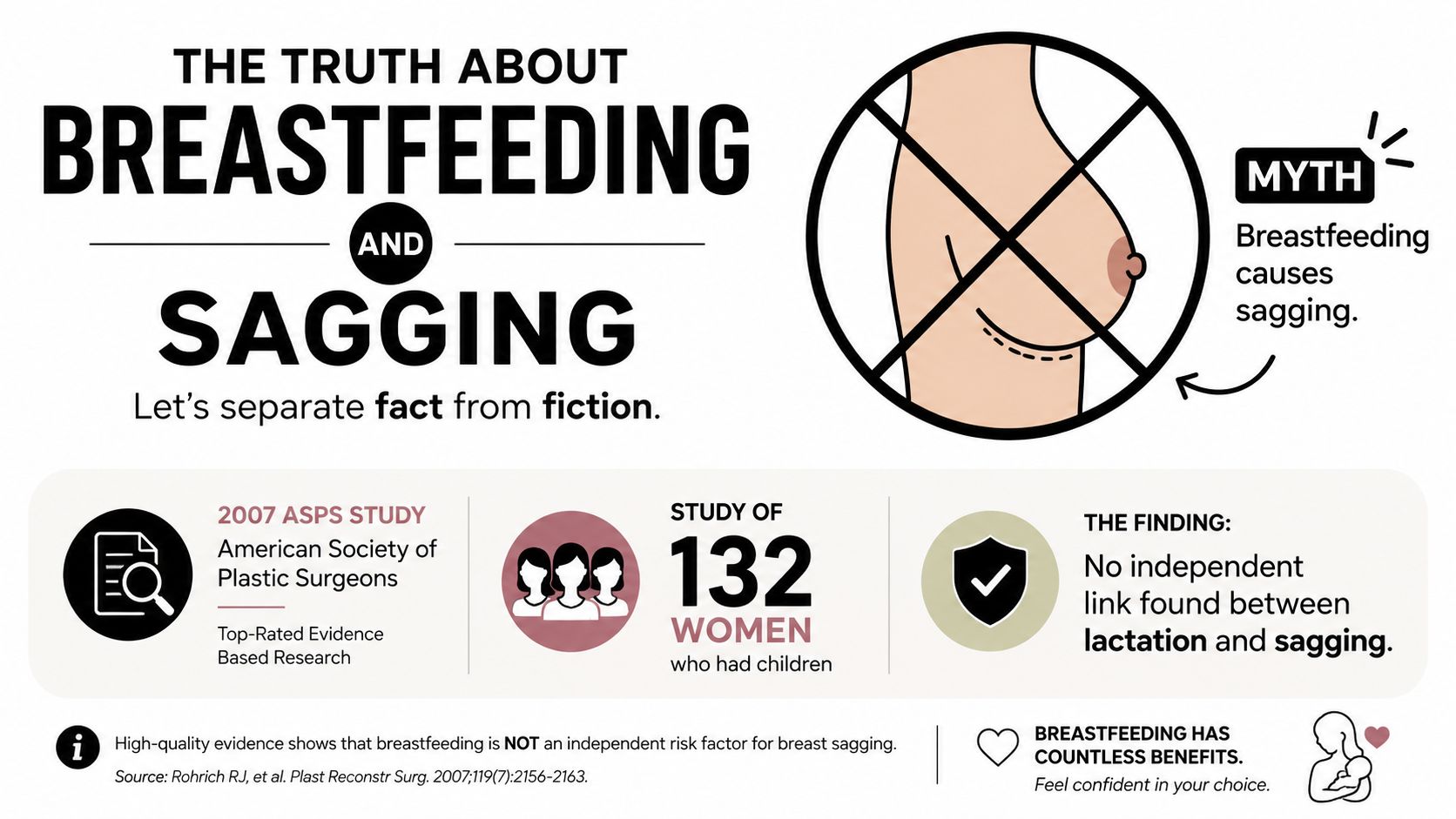
The belief that breastfeeding alone causes sagging doesn't hold up well. A 2007 prospective study summarized by the American Society of Plastic Surgeons followed women after pregnancy and found that breastfeeding wasn't an independent risk factor for breast ptosis, or sagging. The significant predictors included age, body mass index, number of pregnancies, larger pre-pregnancy bra size, and smoking history. Women who breastfed didn't have a higher degree of sagging than women who didn't breastfeed, and the authors concluded that ptosis increased mainly with additional pregnancies rather than lactation itself. Read the published study record for the full medical context.
That doesn't mean breastfeeding has no physical effect. Breast tissue expands and contracts, and a fuller breast places more load on the skin and supporting structures. Cooper's ligaments, dermal collagen, and the surrounding skin absorb that changing weight, but the strain comes as part of a broader pregnancy and postpartum process, not from a single cause.
Why the evidence isn't perfectly uniform
A 2017 prospective cohort study reached a different conclusion. It found that breastfeeding for more than six months was an independent predictive factor for more severe ptosis. Breastfeeding for 7 to 12 months was associated with about a four-fold higher risk, while 13 months or more was associated with about a six-fold higher risk, compared with no breastfeeding. The same study identified post-menopausal status and BMI at or above about 24.7 kg/m² as additional risk factors. You can review the full PLOS ONE study.
The sensible conclusion is not to frighten mothers away from breastfeeding. It's to stop treating sagging as a simple yes-or-no consequence of nursing. The evidence is mixed, while the practical levers are clear: avoid smoking, minimize large weight swings, use appropriate support, manage engorgement, protect posture, and taper feeds instead of stopping abruptly.
The useful question isn't “Should I breastfeed?” It's “How can I reduce repeated stretching while my breasts change?”
Feed With Better Technique to Limit Tissue Stretch
Good feeding technique won't guarantee a particular breast shape, but it can reduce the cycles of painful fullness, uneven drainage, and sudden volume change that make nursing harder on your body. The priority is comfortable milk transfer, not aggressively emptying the breast.
Start with the latch
A deep asymmetric latch gives the baby more areola in the mouth below the nipple than above it. This position can support more even milk transfer and reduce the need for prolonged pulling at the nipple. If latch pain continues, clicking sounds occur, or the breast remains lumpy after feeds, ask a lactation professional to watch a full feed rather than trying to correct everything from written instructions.
The breastfeeding tips for first-time mothers can help you review positioning basics, but persistent pain or poor transfer deserves individual assessment.
Keep fullness from becoming the routine
In the early months, many babies feed frequently. The American Academy of Pediatrics source summarized in the clinical review on breastfeeding support describes 8 to 12 sessions per 24 hours as a common early pattern, but your baby's needs and your clinician's advice matter more than forcing a schedule. The mechanical goal is simple: don't routinely wait until your breasts are painfully overfull.
Try these adjustments:
- Alternate the starting breast. Begin the next feed on the side that finished second, unless your clinician has advised a different plan.
- Change positions. Rotate cradle, cross-cradle, and laid-back positions so the same area isn't repeatedly compressed or drained in exactly the same way.
- Relieve, don't over-empty. If a breast feels comfortable after nursing, don't automatically pump until it feels completely empty. Extra stimulation can encourage more production and create another cycle of fullness.
- Use brief comfort measures. Cold compresses between feeds may ease swelling. Ask your healthcare provider whether ibuprofen is appropriate for you.
- Hand-express when necessary. Express only enough milk to soften an uncomfortable area. The aim is relief without creating sustained mechanical pulling or unnecessary extra production.
These steps are about comfort and tissue management, not cosmetic perfection. A deep latch, responsive feeding, and sensible relief are more useful than rigid pumping rules.
Choosing and Wearing the Right Supportive Bra
A bra should redistribute breast weight across the torso. It shouldn't leave your shoulders carrying the load while the band rides upward and the cups allow movement.
For everyday wear, choose a structured nursing bra with a stable bottom band, broad side panels, and enough cup coverage to contain the breast without compression. A soft sleep bra has a different job. It can reduce movement and discomfort overnight, but it shouldn't be expected to provide the same support as a daytime bra.
For exercise, use a sports bra designed for the activity. Fit the band first, then evaluate cup containment, because a familiar cup size can be misleading as your ribcage and breast volume change. The research and guidance summarized by UPMC on post-pregnancy breast changes emphasize support, weight stability, and upper-body strength over cosmetic quick fixes.
| Bra Type | When to Wear | Key Support Feature | Fit Cues | Watch Out For |
|---|---|---|---|---|
| Structured wire-free nursing bra | Daily wear and errands | Firm lower band and broad side support | Band stays level, cups contain tissue, nursing clasp opens easily | Thin fabric that depends on shoulder straps |
| Activity sports bra | Walking, fitness, and higher-impact movement | Secure encapsulation or firm compression suited to the activity | Breasts stay contained without pain or restricted breathing | Stretching, bouncing, or chafing |
| Soft sleep bra | Overnight comfort | Gentle containment with flexible fabric | No digging, rolling, or pressure on tender areas | Wearing a tight bra that worsens discomfort or blocked areas |
| Later-postpartum nursing lingerie | Weaning and everyday confidence | Flexible support with accessible nursing design | Stable band, smooth fit, no cup overflow | Choosing by old measurements instead of current fit |
Fit check: If the back band rides up, the straps dig in, or tissue spills over the cup, the bra is supporting the wrong surfaces.
Your body will change as feeding patterns shift, so refitting matters. Measure again around eight weeks postpartum and at weaning, when ribcage and cup volume may differ from earlier measurements. A specialist fitter or an IBCLC who carries samples can assess movement and comfort more accurately than guessing from an old online size chart.
For later postpartum wear, GAIA is described as a soft nursing bra with stretch lace, flexible support, and straightforward breastfeeding access. It's one option to assess by fit, alongside other structured nursing styles covered in this guide to support nursing bras.
Exercises That Actually Lift and Support Shape
Exercise won't reposition stretched skin or lift breast tissue directly. It can, however, strengthen the chest, upper back, and shoulders while improving the posture that makes the breasts look lower. The visible difference often comes from better ribcage alignment and stronger mid-back muscles, not endless chest flyes.
Build from control, not intensity
During the first 0 to 6 weeks, stay with diaphragmatic breathing and gentle wall slides if your clinician has cleared movement. Breathe into the ribs, keep the pelvis relaxed, and slide the arms without forcing range.
After about 8 weeks, if recovery is uncomplicated, progress to banded rows, incline push-ups, and prone Y-T-W raises. From about 12 weeks onward, you may add dumbbell Romanian pulls, incline presses, and single-arm rows when your pelvic floor, abdominal wall, and incision sites feel ready. These timelines aren't universal. A caesarean birth, pelvic-floor symptoms, abdominal separation, pain, or complications may require a slower progression.
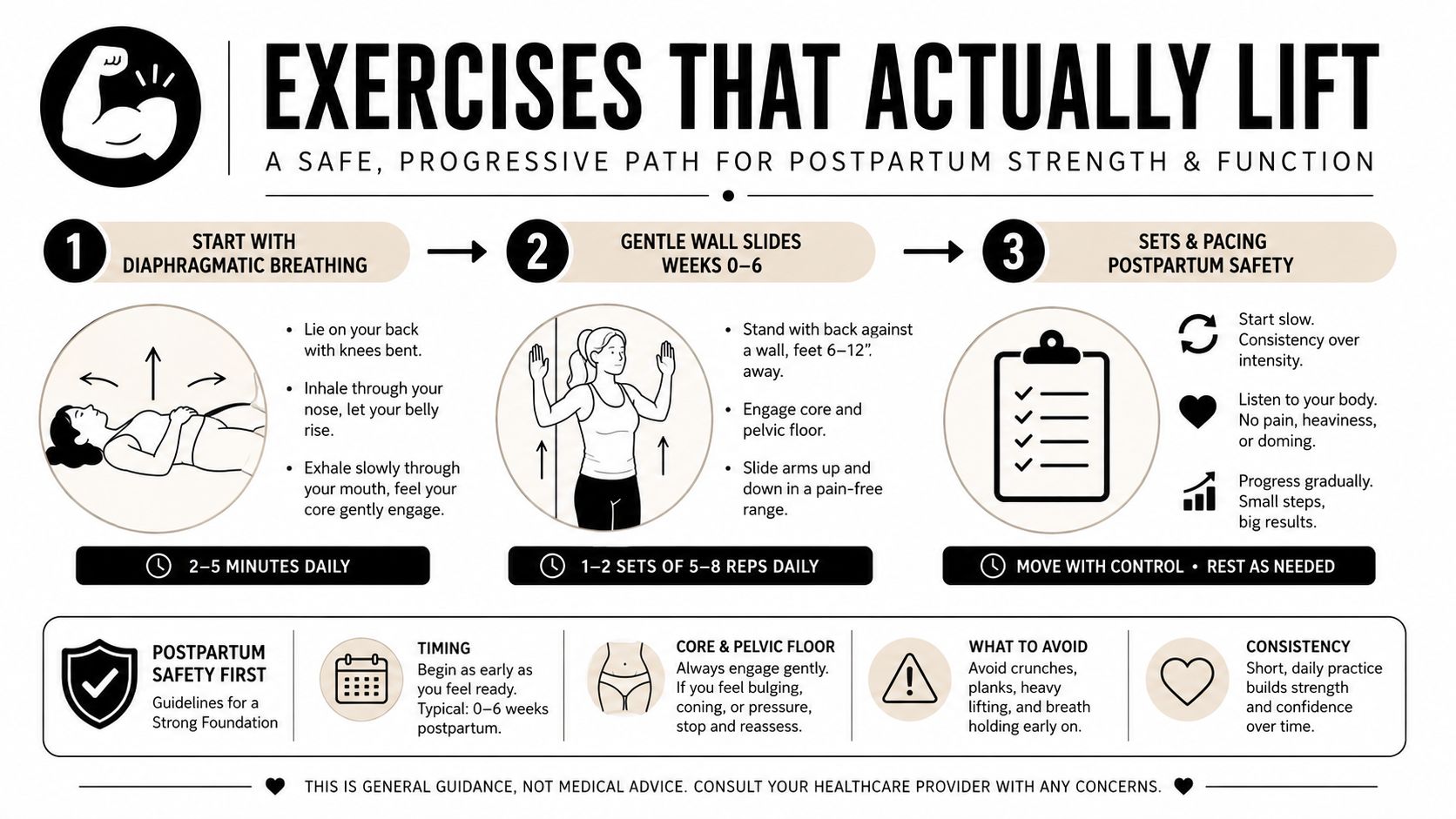
Use 2 to 3 sets of 10 to 15 repetitions, up to three sessions weekly, once you're ready for resistance work. Before each set, gently engage the deep core and pelvic floor, stack the ribs over the pelvis, and keep the shoulder blades moving down and back without clenching the neck.
A practical progression looks like this:
- Early recovery: Diaphragmatic breathing, wall slides, and short walks.
- Rebuilding phase: Banded rows, incline push-ups, and Y-T-W raises.
- Strength phase: Incline presses, single-arm rows, and controlled Romanian pulls.
Avoid loaded overhead pressing until abdominal separation has closed and you've been cleared for that demand. Stop traditional push-ups if you see coning along the midline. If jumping causes leaking, heaviness, pressure, or pain, see a women's-health physiotherapist before adding impact.
The postpartum back-pain relief guide is useful if feeding posture and carrying have left you stiff or rounded.
The exercise demonstration below can help you visualize controlled upper-body movement, but it doesn't replace a postpartum assessment.
Skin, Weight, and Lifestyle Habits That Protect Elasticity
The strongest practical message from the available evidence is straightforward: weight stability and smoking avoidance matter more than creams, cold showers, or massage claims. The 2007 study identified age, BMI, number of pregnancies, larger pre-pregnancy bra size, and smoking as significant predictors, while the 2017 cohort also identified BMI and post-menopausal status as risk factors.
Don't crash-diet after weaning. Rapid loss can make the breasts look suddenly emptier because breast volume changes along with overall body composition. Choose a steady eating pattern, allow recovery, and let weight settle gradually rather than repeatedly cycling between restriction and overeating.
Smoking deserves special attention because it affects skin quality and elasticity. If you smoke, getting help to stop is a more meaningful breast-health step than buying a firming product. Your primary-care clinician, pharmacist, or smoking-cessation service can help you choose an approach compatible with breastfeeding if you're still nursing.
Rank the habits honestly
| Factor | Evidence Strength | Actionable Threshold | What To Do |
|---|---|---|---|
| Weight stability | Supported by the available medical discussion | Avoid large, rapid swings | Eat regularly, avoid crash diets, and pursue gradual change |
| Smoking | Supported as a significant predictor in the 2007 study | No safe cosmetic level | Stop smoking and seek structured support |
| Number of pregnancies and age | Important but not modifiable | Not applicable | Focus attention on the habits you can change |
| Breast size and genetics | Relevant background factors | Not applicable | Use stronger support during movement and accept individual variation |
| Posture and upper-body conditioning | Practical support strategy | Progress gradually | Train the upper back, chest, and shoulders |
| Skin products and hydration | Limited evidence for changing ptosis | No proven cosmetic threshold | Moisturize for comfort, but don't expect a cream to lift tissue |
Sun protection is sensible for exposed chest skin because ultraviolet exposure contributes to skin aging, but sunscreen won't reverse existing ptosis. Hydration supports general wellbeing and skin comfort, while protein and vitamin-rich food support recovery overall. Don't turn those basics into promises of restored breast structure.
High-impact movement without support is another avoidable stressor. Wear a bra that contains the breasts during running or bouncing, and choose lower-impact exercise while your body is still recovering.
Weaning, Massage, and a Postpartum Skin Routine
Abrupt weaning is uncomfortable for many women because breast volume can change quickly. A paced approach gives your breasts time to adjust and makes engorgement less likely. The clinical review on breastfeeding support and duration also supports the value of practical breastfeeding support, although it doesn't prove that gradual weaning prevents sagging.
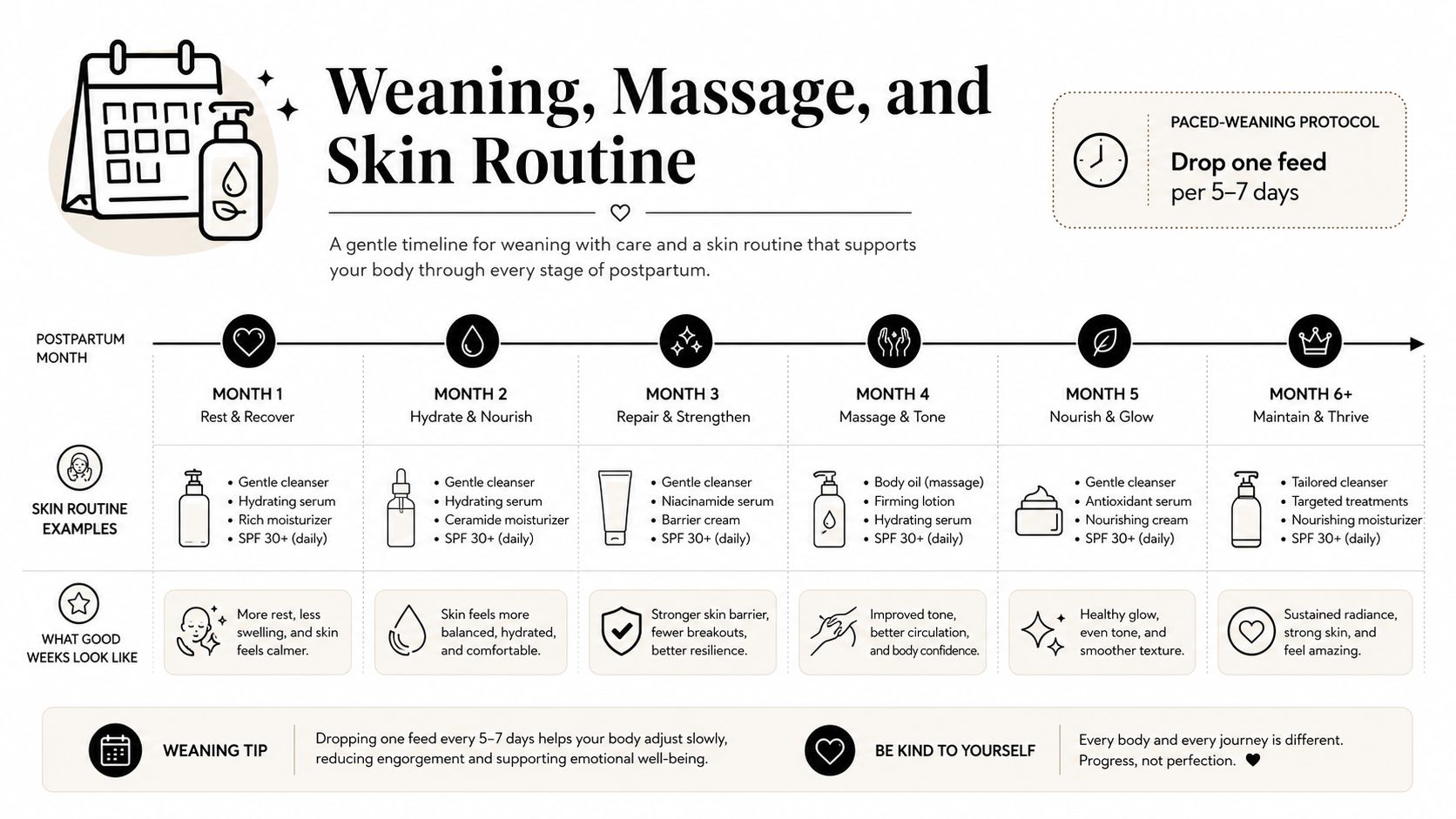
A simple approach is to drop one feed every 5 to 7 days, starting with a midday feed that your baby is most willing to replace. Keep the remaining feeds consistent until your body feels settled, then remove the next feed. If your breasts become painfully full, slow down and express only enough for comfort.
Sample paced-weaning patterns
For someone starting with four feeds, the progression might look like this:
- Weeks 1 and 2: Remove the midday feed and keep three feeds.
- Weeks 3 and 4: Remove the least preferred remaining feed and keep two.
- Weeks 5 and 6: Remove another feed and keep one.
- Weeks 7 and 8: Remove the final feed when both parent and child are ready.
For someone starting with six feeds, the same principle can be extended:
- Weeks 1 and 2: Remove one daytime feed.
- Weeks 3 and 4: Remove another daytime feed.
- Weeks 5 and 6: Remove a third feed.
- Weeks 7 and 8: Continue only with the feeds that remain comfortable, then taper those one at a time.
These are examples, not rules. Night feeds, medical needs, infant age, supply concerns, and your emotional readiness all matter.
Keep skincare simple
From postpartum months 0 to 3, use a gentle cleanser and a plain moisturizer on the chest. If you massage, use light circular strokes from the chest wall outward for a few minutes, and never knead tender or inflamed tissue. Massage may feel soothing, but there's no strong evidence that it can lift stretched breast tissue.
From months 3 to 6, you can discuss a peptide or niacinamide product with a dermatologist. Don't apply active products to the nipple or areola during lactation unless a qualified clinician says they're appropriate. After weaning, introduce any retinoid gradually if a dermatologist considers it suitable, and continue daily sun protection.
Seek same-day clinical advice for sudden firmness, one-sided swelling, or peau d'orange skin. Those signs need medical evaluation, not more massage, waiting, or an aesthetic routine.
Your Prevention Plan and When to See a Specialist
Use this 30-day plan as a practical starting point. It's intentionally unglamorous because the habits that help most are consistent.
Daily
- Feed comfortably: Check latch quality and avoid waiting for painful overfullness.
- Support movement: Wear a fitted bra for activity and replace it if the band shifts or cups spill.
- Protect skin: Apply chest-area sun protection when exposed.
- Reset posture: Stack your ribs over your pelvis while feeding, carrying, and working.
Weekly
- Train progressively: Complete two upper-body sessions if your clinician has cleared resistance work.
- Review symptoms: Note pain, pelvic-floor pressure, coning, persistent fullness, or new asymmetry.
- Adjust weaning slowly: Remove only one feed at a time and pause if engorgement becomes difficult.
Monthly
- Check fit: Reassess your bra as your body changes. A refit around 6 to 8 weeks postpartum and again at weaning can be useful.
- Review weight habits: Look for steadiness rather than aggressive restriction.
- Book support when needed: A lactation consultant can address latch, milk transfer, and engorgement. A women's-health physiotherapist can assess posture, abdominal recovery, pelvic-floor symptoms, and safe loading. A dermatologist can advise on skin concerns. A board-certified plastic surgeon can discuss structural correction if sagging continues to affect your quality of life after your body has stabilized.
Don't wait for a cosmetic appointment if you notice sudden asymmetry, a palpable lump, persistent pain, nipple inversion, skin dimpling, or rapid volume loss after weaning. These symptoms deserve clinical assessment. Cosmetic consultation makes more sense after weaning is complete, weight has been stable, and your exercise routine has reached a settled pattern, rather than during an active period of rapid change.
Some ptosis will reflect genetics, age, breast size, and the number of pregnancies you've had. Prevention can reduce avoidable mechanical stress, but it can't promise a perfect or unchanged shape.
Milk&Lace offers later-postpartum nursing lingerie that combines soft lace, flexible or structured support, and discreet breastfeeding access for women who want more than a purely utilitarian bra. Visit Milk&Lace to explore supportive options that help you feel comfortable and connected to your style as your body continues to change.