

You're halfway through a coffee, your baby is turning red with frustration, and the café has no quiet corner. You scan the room, consider walking to the car, and wonder whether feeding now will draw attention. That moment is common, but it doesn't mean you've failed to plan. It means you're caring for a hungry baby in a space that wasn't designed around nursing.
Learning how to breastfeed discreetly isn't about making yourself invisible. It's about preserving dignity, comfort, and participation in ordinary life, whether you're at a café, on a park bench, in a waiting room, or sitting in a parked car. The practical details matter, but so does the message behind them: you don't have to choose between feeding your baby and remaining part of the world.
A Calmer Way to Think About Feeding in Public
In the United Kingdom, the Equality Act 2010 guidance on breastfeeding protects breastfeeding in public. You don't need to cover your baby or use a designated room to make feeding legitimate. Still, legal protection and personal comfort aren't the same thing. Many mothers want discretion because they prefer less exposure, fewer interruptions, or a calmer experience, not because they owe anyone concealment.
That distinction changes the practical question. Instead of asking, “How do I hide?” ask, “What setup lets me feed comfortably while staying present?” A top that opens with one hand, a supportive bra, a seat with a backrest, and a baby who isn't already frantic can reduce more stress than an elaborate cover.
Your baby also responds to your tension. A settled caregiver can usually arrange clothing and positioning more smoothly, while a rushed, uncomfortable setup can make latch and feeding harder. The aim isn't perfect performance. It's a repeatable routine you can use when the environment is busy or imperfect.
Practical rule: Choose the method that keeps you calm enough to watch your baby's latch and breathing.
Global breastfeeding data show why this support belongs in everyday design. UNICEF reported that the global exclusive breastfeeding rate reached 48% in 2023, rising by 10 percentage points over the previous decade, as documented in the UNICEF Global Breastfeeding Scorecard 2023. WHO later noted that in 2024 nearly half of infants under six months were exclusively breastfed, while 46% of newborns were put to the breast within one hour of birth. Feeding often begins immediately and continues in places that don't offer ideal privacy.
This guide focuses on the parts that reduce friction: clothing and bra access, public-friendly latch adjustments, optional covering, expressed milk as a backup, feeding when no lounge exists, and signs that it's time to contact an IBCLC. You're allowed to want privacy, and you're also allowed to feed without creating a hidden enclosure around yourself.
Preparing Your Outfit and Nursing Setup Before You Leave Home
Clothing determines how many hands you'll need at the exact moment your baby latches. Government guidance recommends tops that pull up or button down, and that advice works because it keeps the process simple. A shirt that lifts from the waist can leave fabric across your upper chest and back, while a button-down lets you open only the area your baby needs.
A two-layer outfit adds flexibility. Wear a stretchy tank under a loose shirt, cardigan, or lightweight kimono. You can lift the outer layer and lower the tank only as far as necessary, keeping your stomach and back covered without depending on a separate nursing cover.
Choose access you can operate one-handed
Button-down shirts, wrap tops, and stretchy V-necks can all work, but test the closure before you leave. Stiff buttons, narrow openings, and tight necklines often become difficult when one arm is supporting a wiggling infant. Pull-up nursing tops and side-opening garments usually reduce the amount of rearranging around the baby's face.
A nursing bra should release with one hand and stay stable when unclipped. A stretched-out sports bra may force you to pull the whole front down, while a fitted nursing bra keeps the cup and straps in a predictable position. Practice the release while holding a weighted stuffed animal or folded blanket, then repeat it while seated in the chair you're likely to use outside.
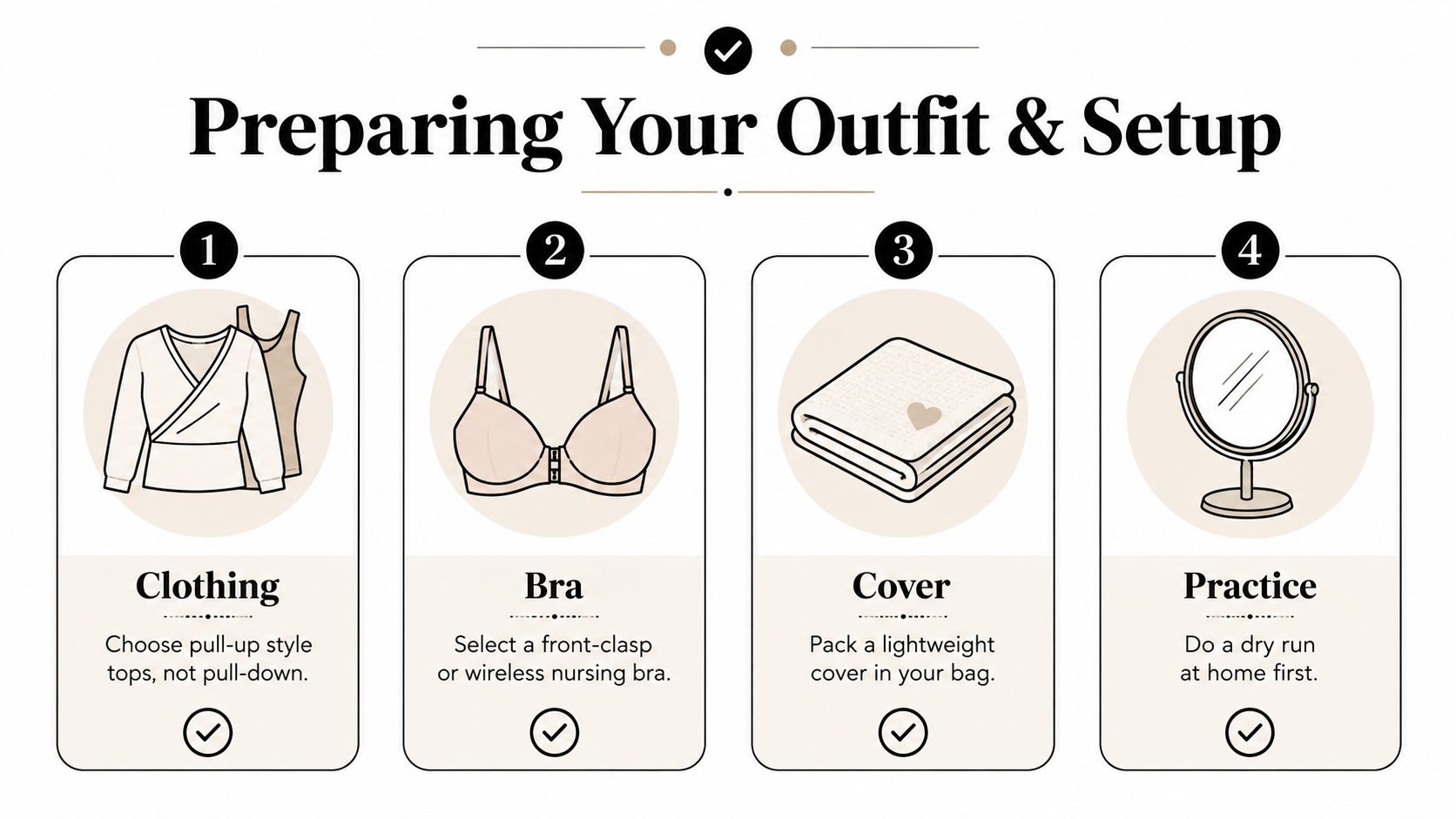
If you're looking for more wardrobe ideas, the best clothes for breastfeeding are the ones that open quickly without making you expose more of your body than you want. The GAIA nursing bra is described as a soft nursing bra with stretch lace, flexible support, and breastfeeding access.
Pack a small kit, then rehearse it
Keep your bag focused on problems you can solve quickly:
- Burp cloth: Place it where you can reach it without searching.
- Nipple balm: Useful if friction or dryness makes public feeding uncomfortable.
- Spare breast pad: A simple backup after a let-down or a longer outing.
- Water: Keep hydration within reach before you sit down.
- Muslin: Use it as an optional shoulder layer or for cleanup, not as a requirement.
At home, sit in front of a mirror on a café-style chair. Put the baby in position, release the bra, adjust the top, and replace everything after the feed. Government guidance also recommends practicing the entire setup at home with a cover or sling if you plan to use one. A dry run exposes awkward closures before you're balancing a hungry baby and a takeaway cup.
Positioning and Latch Techniques That Stay Discreet
Public feeding works best when you adapt a familiar hold rather than learn a completely new one under pressure. The cross-cradle hold is often practical because your opposite arm supports the baby while your free hand manages the breast and clothing. Keep your supporting hand around the baby's neck and shoulders rather than pressing the back of the head, so your baby can tilt back slightly and come toward the breast.

Position your baby's body close before opening your clothing. Their torso should face yours, with the ear, shoulder, and hip broadly aligned. That preparation keeps the baby from twisting toward the breast and helps your clothing fall around the latch instead of being pulled aside.
Make the latch do the covering
An asymmetric latch can reduce visible breast tissue. Bring the baby's lower lip to the lower edge of the areola first, then allow the mouth to open wide before drawing the baby in. A deeper latch generally leaves less areola visible because the baby's mouth covers more of the breast, and it also gives you a more secure feed than a shallow attachment.
The football hold can help when you need the baby tucked alongside your body, especially if you're seated beside an armrest or supporting a larger baby. It may also suit a parent using a sling or wrap for closeness, provided the carrier is handled safely and never blocks the baby's airway.
For more foundational latch guidance, these breastfeeding tips for first-time mothers can support practice before you add public distractions.
A hungry baby may fuss before latching. Try holding your baby skin to skin for a short period before opening your top, then move to a quieter position within the same venue if needed. You often don't need a different room. A seat with less foot traffic, a wall behind you, or a companion who can occupy an older child may solve the underlying issue.
Covering Options That Actually Work in Real Settings
A cover is a comfort tool, not a condition of breastfeeding. Some parents like the visual boundary, while some babies pull at fabric, become warm, or need an unobstructed view of the breast to latch. The right choice depends on your baby, the weather, your seating, and whether you need to monitor the feed closely.
A structured nursing cover can stay in place and create a clear opening for looking down, but it may feel bulky in a crowded café. A scarf is easier to carry and can provide partial coverage, though it can slide during repositioning. A poncho offers broad concealment but may trap warmth and make it harder to see a young baby's face.
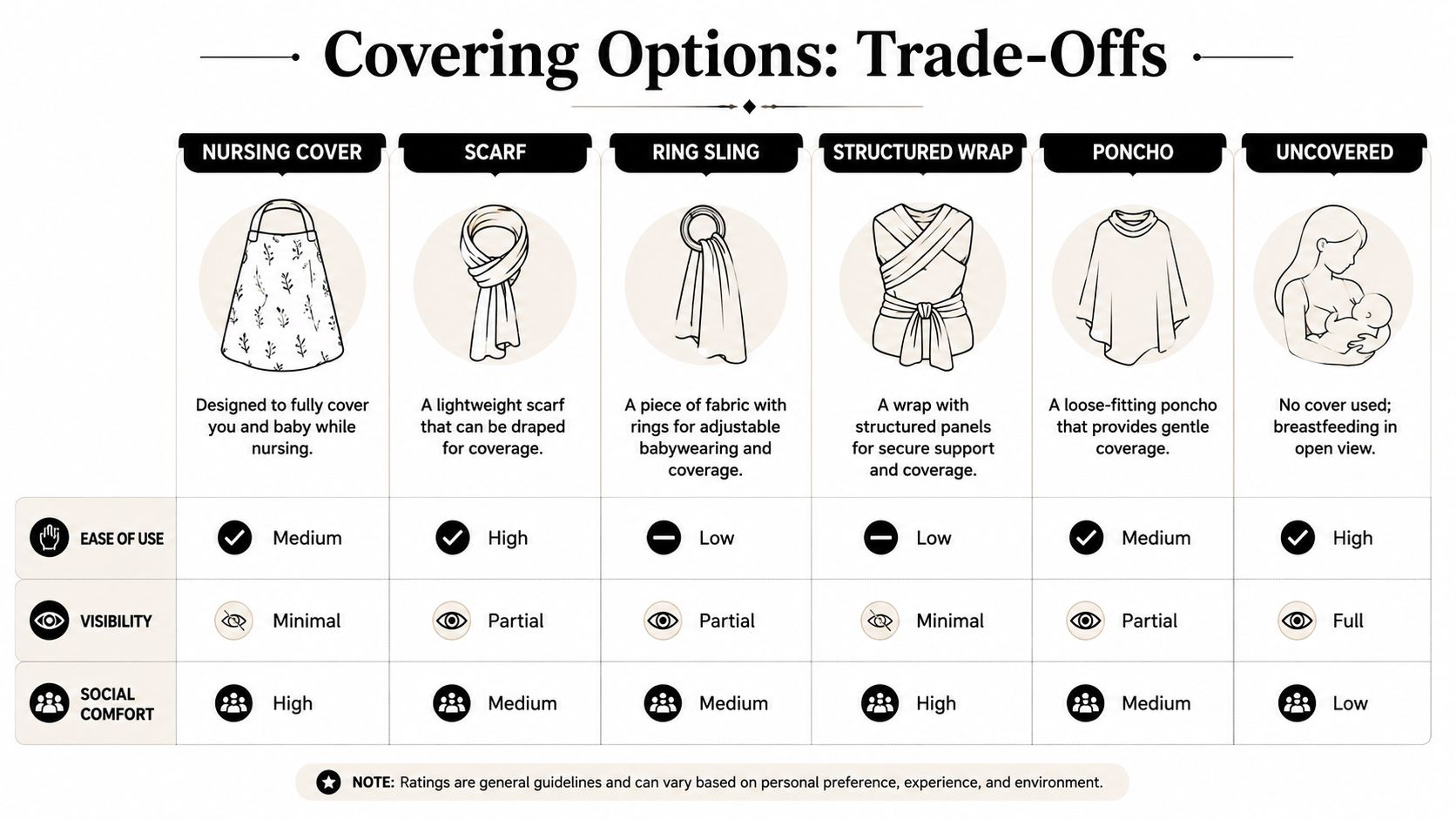
Compare the trade-offs
| Option | One-handed use | Coverage during latch | Main trade-off |
|---|---|---|---|
| Nursing cover | Usually straightforward once positioned | Broad, depending on design | Can limit visibility and warmth control |
| Scarf | Flexible and easy to carry | Partial and changeable | May slip or be pulled |
| Ring sling | Can support closeness | Variable | Requires careful airway awareness |
| Structured wrap | Secure when correctly fitted | Broad around the body | More setup and less visibility |
| Poncho | Simple once worn | Broad | Can feel warm or restrictive |
| No cover | Fastest access | Depends on clothing and baby position | Requires personal comfort with open feeding |
Government guidance says you can use a blanket around your shoulders if you want extra coverage. It also warns that slings and carriers must be used carefully because they can create a suffocation risk for infants. Keep your baby's face visible, airway clear, and chin away from the chest. Never let fabric cover the nose or mouth while feeding.
Match the option to the setting
In a busy venue, a lightweight cover may help with visual privacy and distractions. Outdoors in warm weather, a breathable layer or no cover may be more comfortable. With a young baby who needs frequent latch checks, choose visibility over maximum concealment. With an older, curious baby who grabs fabric, a cardigan or strategically chosen seat may work better than a loose scarf.
Qualitative research found recurring pressure for mothers to be “discrete and covered-up” and to use private or designated spaces. The same literature reported privacy concerns among 25% of mothers and feelings of vulnerability or unsafety among 5%, as described in this qualitative review of breastfeeding in public. Those concerns deserve respect, but they shouldn't turn an optional cover into an obligation.
Using Pumped Milk When You Need a Backup Plan
Expressed milk can make an outing easier when direct feeding would be difficult, but it works best as a planned alternative rather than a source of pressure. It may suit a long appointment, a travel day, a place with no comfortable seating, or the early stages of returning to work. Direct breastfeeding remains the simplest option when you and your baby are comfortable, while pumped milk gives you another way to respond when the setting creates obstacles.
Carry expressed milk in a properly insulated cool bag with ice packs. Follow the storage guidance provided by your midwife, lactation professional, or local health service, because safe handling depends on temperature, timing, and whether milk is fresh, chilled, or frozen. If you need to warm it, use a container of warm water or ask a venue for hot water. Don't rely on a microwave, which can heat unevenly.
Make bottle feeding slower and responsive
A caregiver can use paced bottle feeding to keep the experience closer to breastfeeding:
- Hold the baby upright: Keep the bottle more horizontal rather than pouring milk quickly into the mouth.
- Use a slow-flow nipple: This gives the baby more control over the pace.
- Pause regularly: Let the baby rest and notice signs of fullness instead of encouraging the bottle to empty.
- Watch the baby, not the volume: Relaxed hands, turning away, or slowing down may signal that a break is needed.
Pumping on the go may involve hand expression in a parked car, a manual pump, or a wearable pump. A hands-free setup can reduce the need to hold pump parts continuously, but you'll still need a clean way to store equipment and milk. Guidance on hands-free pumping can help you think through clothing and access before leaving home.
Workplace pumping protections vary by location, so check the rules that apply to you. Where accommodations exist, they may address break time and a space that isn't a bathroom. Pumping supports your feeding plan, but it doesn't have to replace direct nursing whenever direct feeding is comfortable and practical for you.
When There Is No Good Place to Sit
Many mothers aren't searching for a better cover. They're searching for somewhere dignified to feed. A 2026 survey from Mamava's State of Breastfeeding Survey reported that 77% of parents had nursed or pumped in a car, 36% in a public bathroom, and 14% in a storage closet. Those locations point to an infrastructure problem, not a failure of maternal modesty.
A bathroom may offer a lock, but it isn't automatically clean, comfortable, or appropriate for feeding. A parked car can provide privacy and control over interruptions, although heat, cold, awkward seating, and safety still matter. A dressing room may work briefly, but it can be inconvenient if you need space for a stroller or another child.
| Location used | Approximate share of mothers |
|---|---|
| Car | 77% |
| Public bathroom | 36% |
| Storage closet | 14% |
The figures come from the Mamava survey cited above. They shouldn't be read as a checklist of acceptable places. They show what parents do when public spaces fail to provide a usable alternative.
Make an imperfect location safer
Look for a bench with a backrest, a quiet wall-side chair, or a shaded outdoor seat rather than automatically retreating to a bathroom. In a car, park in a legal, well-lit place, keep the baby out of unsafe positions, and take the time to establish a stable hold before opening your clothing. If you use an app or venue directory that identifies feeding spaces, treat it as a convenience rather than a guarantee. Check cleanliness, access, opening hours, and whether the room is available.
When you want a private room, use direct language:
“I'm breastfeeding my baby and need a clean, private place to sit for a feed. Is there a room available that isn't a bathroom?”
Ask a restaurant manager, shop supervisor, clinic receptionist, or venue host. You're not asking permission to feed. You're requesting practical accommodation, and many staff members can help when the request is specific.
Building Confidence and Knowing When to Ask for Help
Confidence usually grows through repetition, not through waiting until you feel completely ready. The first outing may involve too much fabric, a slow latch, or a seat that seemed ideal until your baby started wriggling. The next attempt gives you information. Soon you know which bra clip releases cleanly, which shoulder needs support, and how early your baby shows hunger cues.
Keep your social response simple. If someone looks over, continue feeding unless you need a pause. A companion can redirect a curious child or answer an intrusive question. If a stranger comments, you can say, “We're comfortable here, thank you,” and return your attention to your baby. You don't need to debate your feeding choice while you're trying to latch.
Separate learning discomfort from warning signs
Public awkwardness is common. Persistent physical problems deserve attention. Contact an IBCLC, midwife, doctor, or pediatric professional if you notice:
- Pain that continues beyond the first two weeks: Ongoing pain can signal a latch or positioning issue.
- Weight concerns: Seek guidance if your baby hasn't regained birth weight by 10 to 14 days, as recommended in the care plan you've been given.
- Fewer than six wet diapers daily: This is a reason to ask promptly about intake and feeding effectiveness.
- Bleeding, cracked nipples: Damage that bleeds shouldn't be dismissed as something you must tolerate.
These warning signs need a qualified assessment rather than a clothing adjustment. A lactation visit may include observing a feed, checking positioning and latch, discussing milk transfer, reviewing your feeding pattern, and making a practical plan for home and public settings.
Local support can come from WIC peer counselors, La Leche League groups, hospital outpatient lactation clinics, or an independent IBCLC. Your care team can also help you understand whether insurance covers a visit and what the appointment includes.
Discreet breastfeeding becomes easier when three pieces work together: a prepared outfit, a practiced technique, and a support contact you can reach. You don't need to rehearse every outing forever. You need a setup that respects your body, your baby's cues, and the demands of public spaces.
Milk&Lace offers nursing lingerie designed to combine elegant lace, flexible support, and accessible breastfeeding features for mothers returning to everyday routines. Explore the Milk&Lace collection to find a nursing bra that helps make public feeding feel more comfortable and aligned with your personal style.