

The baby's finally asleep, the laundry's waiting, and you're standing in front of the mirror in the bra you've worn all week. It does the job, mostly. But you miss the small pleasure of choosing something because you like how it looks, not just because it's easy to pull aside.
Wanting a pretty bra isn't a silly distraction from motherhood. It can be a way of recognizing yourself in a season when feeding, recovery, and everybody else's needs take up so much room. The trick is to match the bra to the stage you're in, rather than expecting one style to work for every postpartum day.
The Moment You Want to Feel Like Yourself Again
Maybe you're a few weeks into nursing, or maybe feeding has become familiar enough that you're starting to think about your own clothes again. You catch your reflection while changing, notice the soft bra under your shirt, and think: I'd like to feel a little more like me today. That thought doesn't mean you're ungrateful, vain, or ready to stop prioritizing comfort.
The early stretch can call for bras that are gentle, flexible, and easy to move around. If your breasts are changing quickly or feel tender, a soft wireless bra may be exactly right. Keep it in the drawer. A structured lace style doesn't have to replace the bra that got you through the unpredictable days.
Breastfeeding is also a widespread part of early parenthood, not a brief or unusual detour. WHO and UNICEF reported that 48% of infants younger than six months were exclusively breastfed worldwide in 2023, a 10-percentage-point increase over the preceding decade, bringing the rate close to the World Health Assembly's 50% target for 2025 (WHO and UNICEF's global breastfeeding scorecard). For a nursing bra, that broad use case makes discreet access, adaptable fit, and everyday wearability meaningful design concerns, not minor extras.
Here's my opinion after breastfeeding through the beautiful, exhausting stretch of it: you don't have to choose between comfort and feeling attractive. You need a drawer with options. Soft early-stage bras and a more structured lace bra can serve different days, different bodies, and different moods.
What Actually Makes a Nursing Bra Look Cute
“Cute” is personal, but it isn't impossible to assess. Look at the whole design, not just the lace trim. A bra can have pretty fabric and still feel dull under clothes if the cup shape, seams, or straps make it look more like a sports bra than lingerie.
Start with the details you can see
Fabric matters. Stretch lace can give a bra a lingerie feel while allowing some flexibility, but its softness and recovery matter too. If you want a closer look at how different materials affect the feel and finish of a bra, explore this guide to bra fabrics.
Cup shape changes the mood. A balconette-inspired neckline can look lighter and more delicate; a fuller cup can feel more covered and secure. Neither shape is automatically prettier. The right one is the one that works with your neckline and gives you a silhouette you enjoy seeing in your clothes.
Then check the hardware and seams. A discreet clip that blends into the design feels more considered than a bulky-looking fastening, while seams that follow the cup can make a bra look polished rather than athletic. Strap width also matters visually, but don't dismiss a wider strap just because it feels less delicate. Support shouldn't be sacrificed for a thin line under a camisole.
Use a quick shopping checklist
Before you buy, ask yourself:
- Lace pattern: Does it look soft and intentional, or busy and stiff?
- Cup shape: Does the neckline suit what you wear?
- Straps and hardware: Do they feel integrated into the design?
- Color: Would you reach for this shade under the clothes you own?
The best cute nursing bras don't need to shout “special occasion.” They should make an ordinary outfit feel a little more like yours.
The Engineering Hiding Behind the Pretty
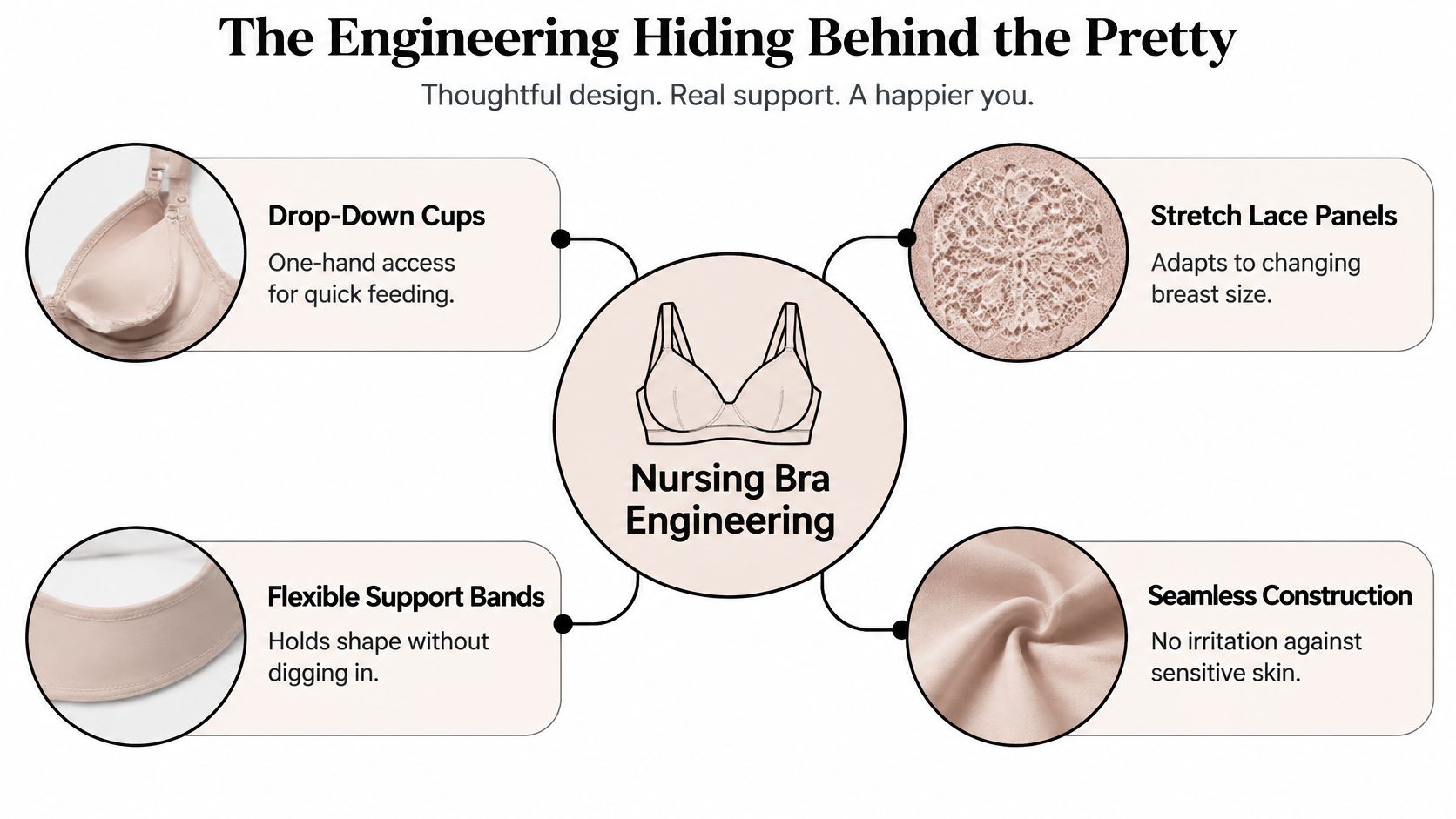
Lace gets your attention. The construction determines whether you still like the bra after a long day of feeding. Nursing access, adaptive fit, and fabric recovery aren't separate from style. They're what let the bra keep its shape, feel comfortable, and work with your routine.
Nursing-bra design has developed through repeated attempts to solve access and convenience problems. U.S. patent records document a nursing brassiere dating to 1960–1963, followed by later designs for closures, a double-closure clasp, hands-free pumping, and removable or replaceable cups. A 2009 publication describes a nursing bra as one designed to allow breastfeeding or pumping without removing the garment, using openings in the cup or central section (nursing-bra patent history). That history doesn't tell us which design is best, but it makes one point clear: easy access is an engineering challenge, not an afterthought.
Fit has to make room for change
Breast volume can shift substantially around birth, and the amount varies from person to person. In a longitudinal lactation study, breast volume increased by approximately 60–480 mL between late pregnancy and seven days postpartum in 10 of 11 participants (longitudinal study of breast volume during lactation). That's a good reason not to demand a fixed, sculpted fit from a body that's still changing.
Adjustable closures and controlled stretch help a bra accommodate shifts in fullness. Drop-down cups or other accessible openings should release smoothly, without forcing you to wrestle with the bra one-handed. And fabric recovery matters: material that stretches but doesn't recover can lose its shape and leave the support feeling inconsistent.
A structured bra can become a confidence tool later on. If the band, cups, and straps distribute support comfortably, and the access mechanism works without disrupting the silhouette, the bra can feel both practical and polished. The engineering is part of the look. A good-looking bra that pinches or fights you during a feed isn't doing its job; a functional one that also feels beautiful doesn't ask you to choose.
The Underwire Question Most Guides Get Wrong
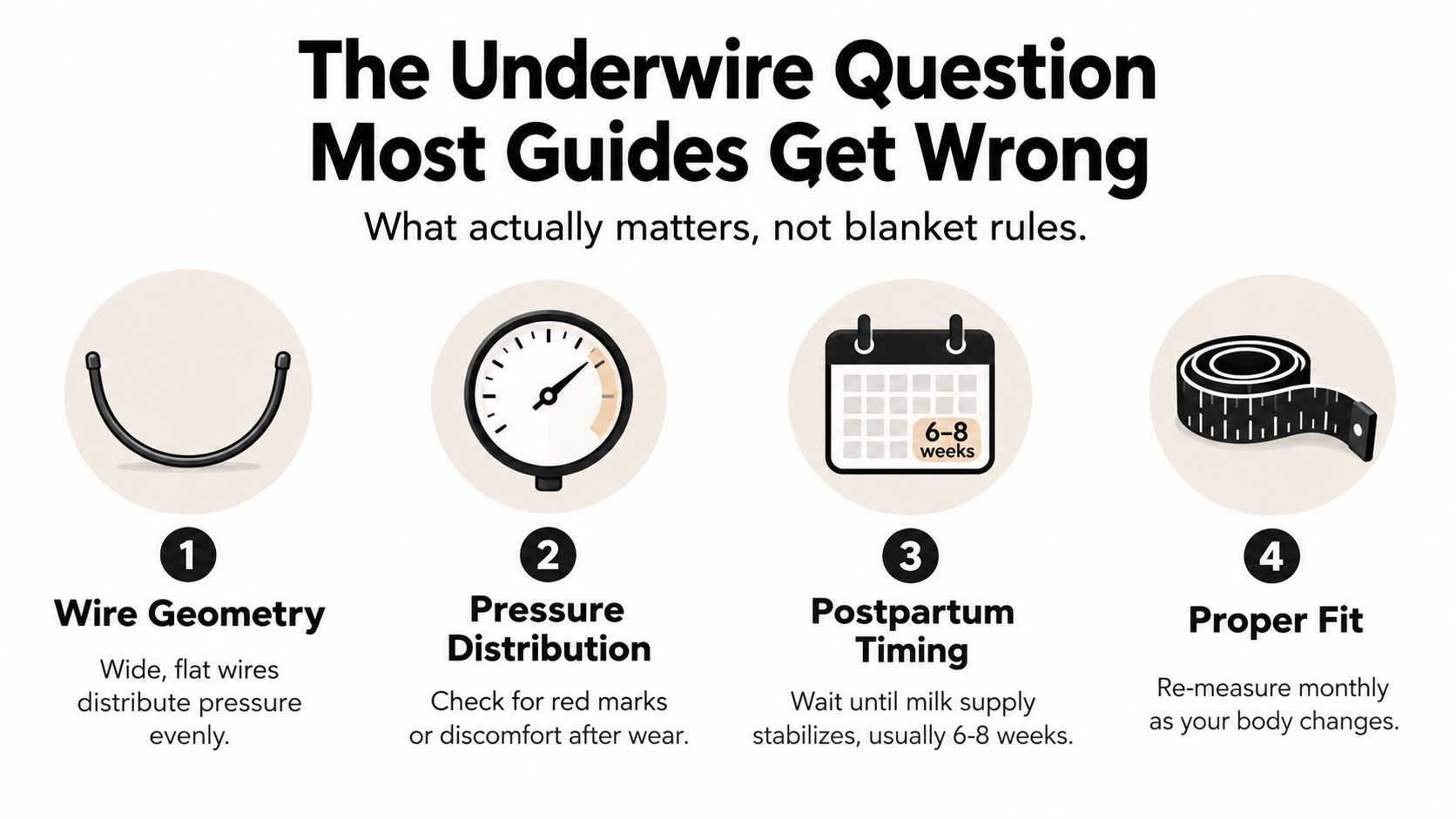
The blanket rule that every nursing bra with underwire is unsafe is too simple. The questions are whether the wire fits your breast root, whether it presses on breast tissue, and whether your body is at a stage where the fit can stay comfortable as fullness changes.
A well-fitted underwire should lie flat against the body and encircle the breast without gaping or digging. The UK's National Childbirth Trust advises avoiding pressure on breast tissue, since a poorly positioned wire may contribute to discomfort and mastitis (NCT guidance on maternity and nursing bras). The issue is pressure and fit, not the mere presence of a wire.
Choose by stage, then check the fit
In the early weeks, when breast size may shift rapidly, a soft wireless bra is often the easier choice. Later, once your size feels more settled, a structured style may work if it fits without creating pressure. That's a stage-specific choice, not a rule that every nursing parent should follow.
Breastfeeding Support notes that the Academy of Breastfeeding Medicine recommends a well-fitted supportive bra, while acknowledging that the recommendation is based on consensus rather than high-quality clinical evidence (guidance on nursing bras and fit). I'd treat that as a reason to focus on fit checks, not to fear every structured bra.
Check the band by sliding two fingers beneath it. Move your arms and confirm the wire stays outside the breast root, rather than shifting onto breast tissue. Then assess the fit after a feed, when fullness may be lower.
Red flags: Localized pressure, persistent marks, pain, swelling, or a feeling that milk flow is restricted are reasons to take the bra off and reassess the fit. Don't try to “break in” a bra that's hurting you.
A good decision rule is simple: wear structured support only when it stays comfortable through movement and changing fullness. For more on the fit considerations behind this choice, see this guide to nursing bras with underwire.
GAIA and PETRA Compared for Real Postpartum Life
Week three and month five are different wardrobes. Early on, I wanted a bra that asked nothing of me. Later, I wanted one that gave something back: a defined line under a fitted top, the quiet satisfaction of lace that exists for me and not only for the baby. GAIA and PETRA sit at those two ends of the timeline.
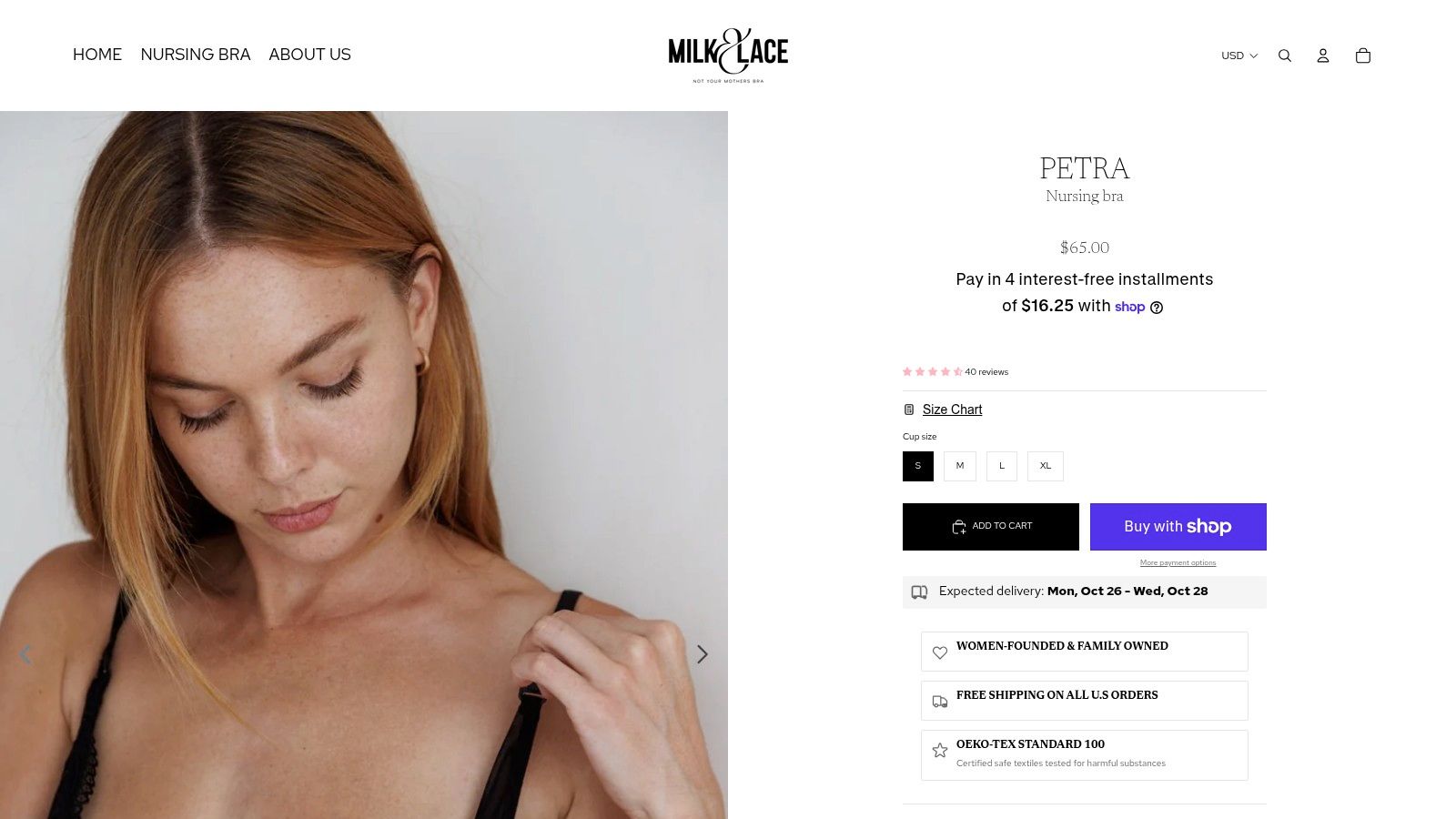
GAIA is described as a soft nursing bra with stretch lace, flexible support, and breastfeeding access. PETRA is described as an ultra-soft stretch-lace nursing bra with gentle underwire and one-hand access. In plain terms, GAIA bends with your body while PETRA gives your body a little architecture.
GAIA vs PETRA at a Glance
| Dimension | GAIA | PETRA |
|---|---|---|
| Overall feel | Soft and flexible | Soft lace with a more structured feel |
| Support approach | Flexible support | Gentle underwire |
| Nursing access | Effortless breastfeeding access | One-hand nursing access |
| Best suited to | Relaxed everyday wear | Days when you want more shaping |
Reach for GAIA on the tender days. Cluster feeding afternoons, nights that blur into mornings, the stretch of weeks when your cup size still seems to have a mind of its own. A bra that flexes with you earns its keep fast.
PETRA belongs to the later chapter. Once feeding settles into a rhythm and your size stops surprising you, a structured lace bra does something a soft one cannot. It gives back a silhouette. Putting it on for lunch with a friend or your first proper evening out is a small act of reclaiming yourself, and that matters more than it sounds.
My honest test: Choose the one you'd happily pull on when you're already short on time and patience. If it feels like one more task on the list, it is the wrong bra for that day.
Outfits That Earn Their Place in Your Week
A pretty nursing bra earns its drawer space when it works with clothes you already wear. You don't need to build a new wardrobe around it. Think of it as one useful layer that can make familiar outfits feel more intentional.

For the lounge-to-school-run shuffle, pull on an oversized knit, relaxed trousers, and trainers. A stretch-lace bra can peek out at the neckline without making the outfit feel fussy. Keep a soft cardigan by the door for the walk, and you're dressed without changing your whole mood.
For a work-from-home call, pair a structured top or a draped blouse with a smooth, well-fitting bra beneath it. You want the clothes to sit comfortably through the call and stay easy to manage when it's time to feed. Keep the top simple; the confidence comes from knowing what's underneath works for you.
Here's a little style inspiration for the everyday closeness and movement that make up family life.
For dinner with friends, wear a wrap top or a soft blouse with trousers or a skirt you can sit in comfortably. Choose a neckline that makes nursing access manageable, so you're not planning the whole evening around a difficult outfit change.
For an evening at home with your partner, let the lace be the detail. Add a robe or an open shirt if that feels like you, or leave the bra under your usual clothes and enjoy the private pleasure of wearing something you chose for yourself. It doesn't need to be an occasion to count.
Fit, Exchanges, and What Happens After You Click Buy
Buying a nursing bra isn't just a matter of selecting a label size and hoping for the best. During lactation, cup and band needs can change independently. A bra that was comfortable recently may start to ride up, shift, or press in the wrong place.
After you try it on, check whether the band sits level and feels secure without digging. Notice if one cup overflows while the other fits, if the wire has moved onto breast tissue, or if the bra leaves persistent marks. A small difference in fullness from side to side can happen; discomfort is still a reason to reassess the fit rather than blaming your body.
Timing matters. If your size is in the middle of a noticeable swing, a structured bra may be a frustrating purchase. Wait until your fit has felt relatively steady for a while, then try it on and move around before deciding it works for your day.
Before ordering, review Milk&Lace's size, returns, and policy information so you know what the exchange, return, refund, and shipping guidelines say. The brand describes its size-exchange policy as flexible, but check the current terms for the details that apply to your order.
Also look over the checkout choices before you commit. Milk&Lace lists Apple Pay, Google Pay, PayPal, Shop Pay, Venmo, and major credit cards as payment options. Knowing how fit concerns and ordering logistics will be handled makes it easier to choose thoughtfully, rather than buying in a rush and hoping the bra magically suits every stage.
Wearing Your Identity, Not Just Your Bra
Remember that mirror moment? The one where you wanted a little more than a garment that stayed in place? A nursing bra can't return you to some earlier version of yourself, and it doesn't need to. You're still you, even if your days now have more feeding, less sleep, and a drawer full of bras chosen for convenience.
The useful shift is to stop asking one bra to do everything. Let soft, flexible styles carry you through the days when comfort is the priority. When your fit feels steadier and you want more shape, consider a structured lace option that feels right on your body. Check the fit carefully, dress around the bra you enjoy wearing, and let practicality and beauty share the same drawer.
This week, take a look at what you reach for most. Notice what stage your body is in, then choose one gap to fill, whether that's a softer everyday bra or a more structured piece for the days you want to feel dressed. You don't have to make a grand statement. You can just choose something that feels like you.
Milk&Lace offers nursing lingerie designed to pair lace, breastfeeding access, and support for later postpartum wear. Visit Milk&Lace to explore the collection and choose a style that fits the stage you're in now.