

You're in the third trimester, standing in front of an open drawer, trying to decide what you'll want to wear at 2 a.m. The hospital gown looks unavoidable, your maternity pyjamas feel too warm, and every waistband suddenly seems personally offensive. After birth, that problem gets sharper. You're sweating, leaking, feeding, bleeding, and protecting skin that may be sore from a C-section incision, stitches, cracked nipples, or simple hormonal sensitivity.
A cotton nursing nightgown solves more of that daily friction than a beautiful but impractical hospital-bag outfit. The right one gives you airflow, fast nursing access, gentle coverage, and enough room to move without exposing your entire body every time you stand up. It also needs to survive repeated washing, because postpartum sleepwear becomes workwear when you wear it night after night.
Why a Cotton Nursing Nightgown Earns Its Place in Your Hospital Bag
Pack the nightgown for the moment you stop caring about looking prepared and start caring about getting comfortable. A loose cotton silhouette won't press against a tender abdomen, catch on healing skin, or force you to pull trousers over a swollen belly. It also makes skin-to-skin simpler. You can open the chest area, settle the baby against you, and cover both of you without wrestling with a stiff button-down top.
Cotton nightwear has a long practical history. Museum and fashion references show white cotton nightgowns in use by the 1860s, while histories of the garment trace its modern form to earlier nightshirts and women's night-chemises nightgown history. That matters because the nursing version isn't a novelty. It inherits a sleepwear shape built around coverage, breathability, and straightforward laundering.
Pack for the problems you can't schedule
Your first weeks may include:
- Night sweats: Temperature can shift quickly after birth, so a breathable, loose layer feels less clammy than tight synthetic sleepwear.
- Tender skin: A gown avoids waistbands and seams sitting directly across a C-section incision or healing perineal area.
- Frequent feeding: Pull-aside, button, or discreetly layered access lets you nurse without stripping down.
- Leaks: Cotton is forgiving around breast milk, sweat, and postpartum bleeding, provided you wash it promptly.
- Bathroom trips: A practical length gives coverage without turning every trip into a hem-management exercise.
Practical rule: If you wouldn't want to sleep, feed, and walk to the bathroom in it while exhausted, don't pack it just because it photographs well.
Use a maternity hospital bag packing guide to build the rest of your bag around recovery rather than appearance. The nightgown should be the garment you reach for after the first shower, then keep wearing at home when disposable hospital clothing and overly precious maternity pyjamas have lost their appeal.
Choose fabric weight, nursing access, and sizing as if you'll wear the gown for months, not one night. A good buy still needs to feel comfortable when your body is changing, your laundry basket is never empty, and you want something more flattering than a basic hospital gown.
What Cotton Actually Does for a Postpartum Body
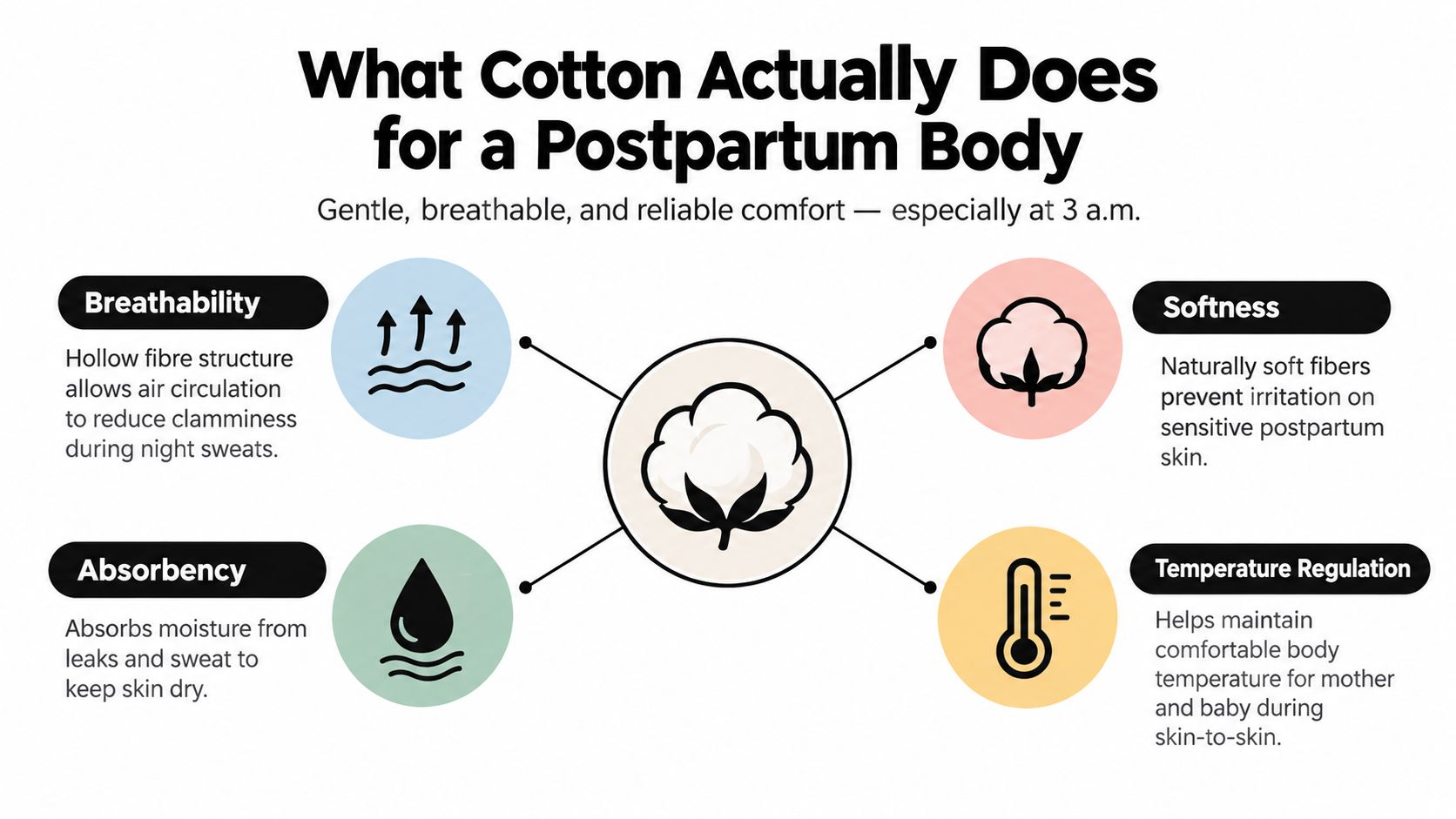
Cotton earns its place at 3 a.m. because it manages the space between your skin and the fabric without making a production of it. A systematic review recorded a 100% cotton sleepwear sample with a fabric weight of about 153.8 g/m², thickness of 0.51 mm, vapour resistance of 3.532 m²·Pa·W⁻¹, and air permeability of 181.7 L·m⁻²·s⁻¹ sleepwear fabric research. You don't need to memorise those measurements. You do need to understand what they mean when you're hot, damp, and trying to settle a baby.
The comfort benefits are real, but fabric choice still matters
Cotton can absorb up to roughly 27% of its own weight in water before it feels damp cotton nursing nightgown fabric reference. That absorbency helps with sweat and small leaks because moisture moves into the fibre instead of sitting immediately on the skin. Cotton absorbs rather than rapidly wicking, so it can feel comfortable during a hot flush, but a soaked gown becomes heavy and clingy.
Air permeability is the more important buying detail. Look for a loose knit, lightweight jersey, or cotton voile rather than a dense, tightly packed fabric. Openness gives humid air somewhere to go. A thick, close-fitting cotton gown defeats much of the benefit, especially if you sleep warm.
Cotton also behaves differently when wet. The review notes that its thermal properties can change significantly after the fibre absorbs moisture. Dry cotton may feel pleasantly comfortable, while damp cotton loses some of its insulating performance and dries more slowly than many synthetics. Keep a spare gown in rotation, and don't expect one garment to carry the whole week.
A soft cotton layer can also reduce irritation compared with non-breathable synthetic fabric, but “cotton” alone doesn't guarantee a pleasant finish. Rough fibres, heavy seams, surface pilling, and excess dye can all bother sensitive skin. Check the inside of the garment, not just the fabric label. Smooth covered seams and a soft, stable knit matter more than a marketing phrase.
For the bra underneath, GAIA is described as a soft nursing bra with stretch lace, flexible support, and breastfeeding access. It makes sense when you want light structure beneath an open nightgown, rather than relying on the gown to support your breasts.
See how cotton layers behave in everyday postpartum dressing with this visual guide.
Your cotton maternity underwear should follow the same logic. Keep the fabric breathable, the fit non-binding, and the care routine realistic.
Features That Make a Nightgown Actually Nursing-Friendly
A basic maternity nightie may be soft, but softness isn't enough. At night, you need to open the chest with one hand, keep the fabric from falling into the baby's face, and regain coverage without turning on a bright light. Construction determines whether the gown helps or irritates you.
Start at the bust
Pull-aside cups with hidden side openings work well for feeding in bed because you can move the breast into position while the gown stays on your shoulders. A full vertical zip is faster for some parents, but it can gape when you sit up and may expose more of your chest than you wanted. Buttons offer familiar control, although tiny buttons are a poor choice when you're feeding half-asleep.
Wide, adjustable straps distribute the weight of engorged breasts better than narrow spaghetti straps. They're also easier to reposition after washing and less likely to twist or cut into your shoulders. Check whether the strap hardware feels secure and whether the adjustment sits away from your neck.
Inspect the inside, not just the front
Seams across the chest should be flat or covered. A raised centre-front seam can press into a breast during side-lying feeds, while bulky elastic can irritate skin that is already tender. A modesty lining over the nipple area is useful for skin-to-skin, visitors, and the inevitable toddler wandering into the room when you thought you had privacy.
Choose a hem around mid-calf if you want coverage and easy movement. An overly long gown can tangle around your feet during a night bathroom trip. A very short one rides up when you lean over the cot.
| Feature | Best For | Watch Out For |
|---|---|---|
| Pull-aside cups | Side-lying and cross-cradle feeds | Openings that are difficult to find by touch |
| Full vertical zip | Fast access during urgent night feeds | Gaping when sitting or bending |
| Wide adjustable straps | Heavy breasts and changing fit | Hardware that twists or digs in |
| Flat chest seams | Sensitive breasts and frequent wear | Raised seams over the nipple area |
| Double-layer bust | Skin-to-skin and modest coverage | Extra thickness that traps heat |
| Mid-calf hem | Bathroom trips and bedside movement | Excess fabric around the ankles |
Use the best clothes for breastfeeding as a broader wardrobe reference, but judge a nightgown by the moment you need it. If you have to use both hands, stand up, or remove half the garment to feed, the design has failed.
Cotton Compared to Modal, Bamboo, and Microfiber
Fabric choice comes down to what you need most at night. Cotton is the dependable primary layer. Modal and bamboo-derived rayon feel more fluid. Polyester microfiber dries quickly. None of them wins every category, and the softest fabric in the shop isn't automatically the one you'll still want after months of feeding and laundry.
Choose for the way you actually wear it
Cotton absorbs sweat and small leaks, feels familiar against sensitive skin, and suits a loose nursing silhouette. Its weakness is drying time. It can also shrink or lose shape if the construction is poor and the care is careless.
Modal has a smooth hand and elegant drape. It feels lovely for lounging when you want a gown that falls close to the body, but thin modal can lose structure and pill under constant washing. Treat it as a comfort piece for lighter rotation, not automatically as your only gown.
Bamboo-derived rayon often feels cool and silky, with a fluid fall that looks less utilitarian than ordinary jersey. Its long-term performance depends heavily on the fibre blend and finishing. Judge the actual garment, including seams and elastic, instead of assuming the fibre name guarantees durability.
Polyester microfiber dries quickly and resists wrinkles, which helps when you need a gown back in service fast. It can hold odour and create static, and it isn't my first choice for a hot sleeper or anyone whose skin reacts to less breathable fabric.
| Fabric | Night-Sweat Comfort | Wash Durability (12+ months) | Drape | Avg. Price-Per-Wear |
|---|---|---|---|---|
| Cotton | Breathable and absorbent, slower to dry | Strong when well constructed and cared for properly | Structured to softly relaxed | Usually favourable for frequent wear |
| Modal | Smooth and cool, can feel clingy when damp | More vulnerable to pilling and thinning | Fluid and close | Better for occasional rotation |
| Bamboo-derived rayon | Silky and comfortable in a light layer | Depends strongly on construction and blend | Fluid and soft | Variable |
| Microfiber | Fast drying, but may trap odour and static | Often resists wrinkles and quick laundering | Smooth and light | Useful when drying speed matters most |
The practical rule is simple: cotton for the gown you wear most nights, modal or bamboo for occasional luxury, microfiber only when fast drying outweighs everything else. Don't buy a fabric based solely on touch in the fitting room. Ask whether the placket, straps, and side seams can handle your real laundry routine.
Sizing and Fit From Day One to Month Nine
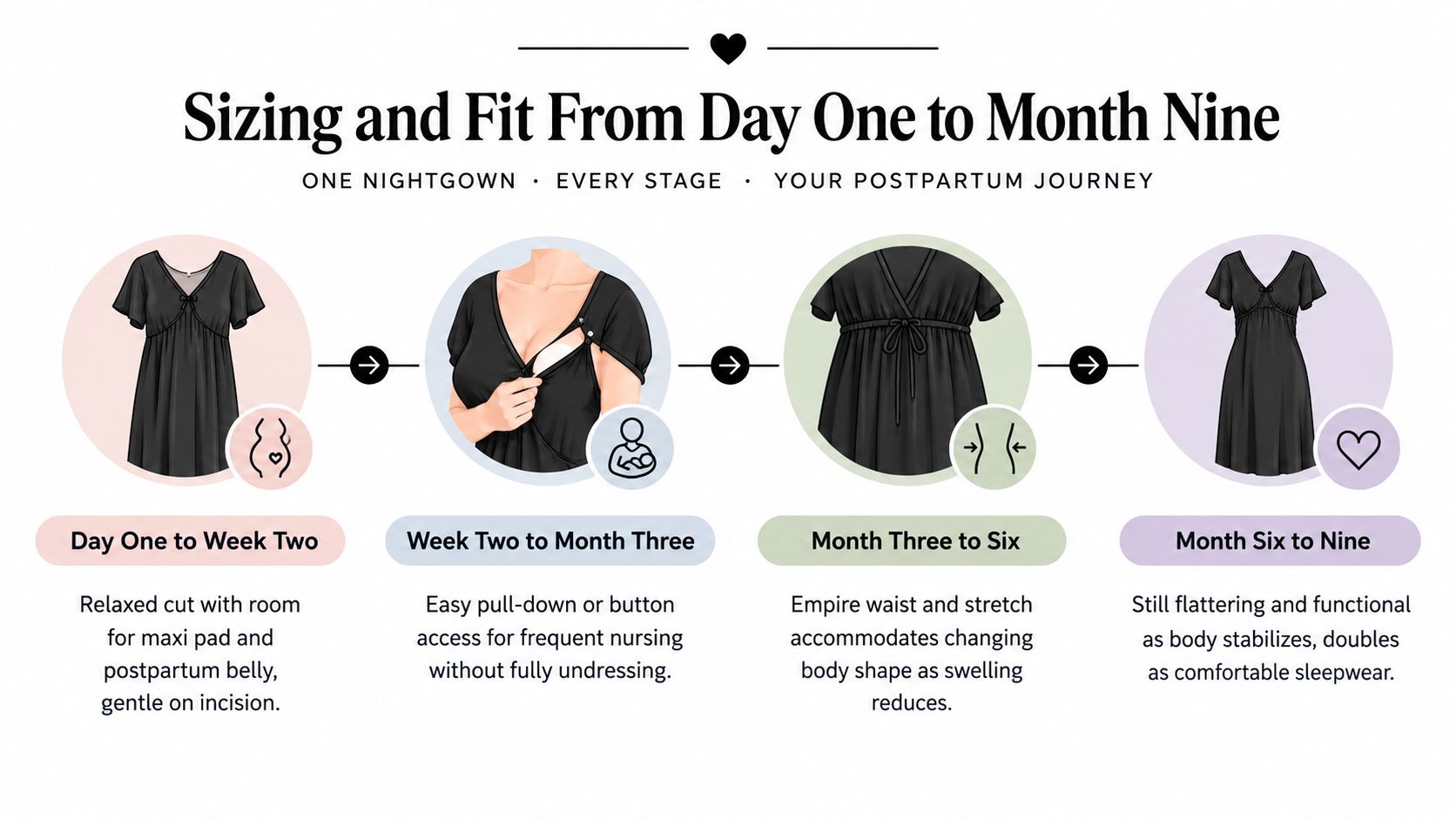
Your body doesn't finish changing when the baby arrives. A nightgown that fits beautifully at the end of pregnancy can feel restrictive once your milk comes in, then look oversized after swelling reduces. Buy for movement through the transition, not for a single flattering mirror check.
Day one through the early weeks
For the first two weeks, choose a relaxed empire or A-line cut. It should skim your abdomen and leave room for a maxi pad, postpartum underwear, and a tender C-section incision without pulling across the front. Avoid a fitted waist seam that lands exactly where your body is sore.
A generous bust is essential, but don't solve every fit concern by buying a huge gown. Excess fabric can fall into the baby's face during feeding and twist around your legs. Look for controlled volume through the middle, adjustable straps, and a chest opening that stays where you place it.
As feeding settles
Between the early weeks and the following months, the bust can remain changeable even as the abdomen feels less swollen. An adjustable strap, flexible underbust area, or drawstring empire band gives you more control than a fixed, narrow seam.
For structured cotton poplin, start with your pre-pregnancy size if the brand's measurements support it. For stretchy jersey, consider one size up when the bust or hips sit between sizes. These are starting points, not substitutes for the garment's actual measurement chart.
Later postpartum fit
By the later months, your shape may redistribute and the gown may begin to feel too loose through the upper body but still tight across the hips. A mid-thigh or mid-calf hem with a slightly generous hip cut prevents riding up during side-lying feeds and keeps the garment useful beyond the first recovery stage.
Fit test: Sit, lean forward, lift one arm, and simulate pulling the nursing opening aside. If the neckline shifts, the hem climbs, or the bust pulls, choose a different cut before you wash it.
Measure your fullest bust, especially if you're wearing a nursing bra while checking fit. Don't trust S, M, or L labels across brands. A nightgown that accommodates your current body while offering controlled adjustment will serve you far better than an oversized shape that only works during the first exhausted weeks.
Care Routine That Keeps It Soft Through Year One
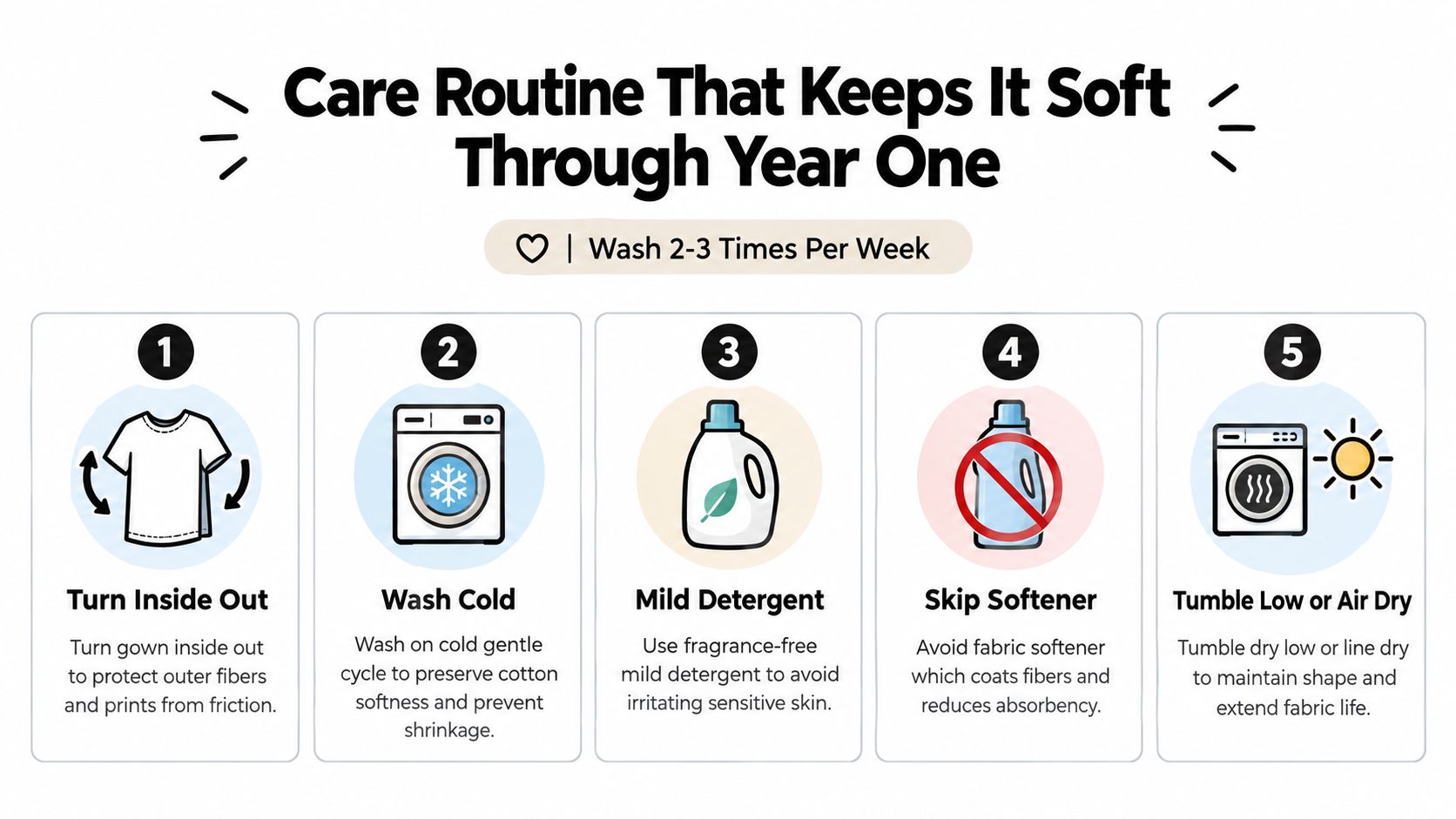
A cotton nursing nightgown needs a care routine designed for repetition. Postpartum sleepwear may enter the wash several times a week, especially during the stage of night sweats, milk leaks, and unpredictable spills. The goal isn't to preserve a showroom finish. It's to prevent shrinkage, placket distortion, roughness, and permanent stains while keeping the fabric comfortable.
Five decisions that protect the garment
- Turn it inside out. This reduces friction on the outer surface and protects prints, snaps, and decorative details. Fasten buttons or snaps first if they're loose enough to catch on other garments.
- Use a cool gentle cycle. Hot water can encourage shrinkage, particularly around an empire seam or nursing opening. Choose a mild detergent without optical brighteners, especially for white cotton that can yellow or lose its clean appearance over time.
- Skip fabric softener. Softener leaves a coating on cotton fibres and reduces absorbency. That makes little sense for a garment chosen to manage sweat and leaks.
- Treat milk stains before washing. Rinse the area in cold water first. Apply an oxygen-based stain treatment, then wash normally. Don't set a protein stain with hot water before treatment.
- Dry with restraint. Tumble dry on low when necessary, or hang the gown flat to reduce shrinkage and protect the shape. Don't hang damp cotton from a narrow hanger, because the weight can stretch the neckline.
Fold the gown once it's fully dry. Storing it folded keeps the shoulders and neckline from carrying the weight of the fabric between wears. If you own two gowns, alternate them rather than washing one repeatedly while the other sits untouched.
The fabric itself matters as much as the label. A dense, low-quality knit may pill quickly and feel abrasive. A lightweight, well-finished fabric may need gentler drying but will remain more comfortable against postpartum skin.
When a Nightgown Is Enough and When You Want More
A cotton nursing nightgown is not only for the hospital bag. It earns its space during overnight feeds when nobody is visiting, lazy morning cluster feeds while your partner handles older children, and home days when your only planned outing is the paediatrician. The right silhouette can also make you feel less like you're wearing recovery clothing and more like yourself.
Keep it within reach for the hours when comfort and speed matter more than a defined outfit. A nightgown lets you sit cross-legged on the sofa, feed without a waistband, and move from bed to kitchen without assembling a complete look. Add a robe or cardigan when someone arrives, and you have a functional home uniform without pretending you're dressed for an office.
Know when the gown has reached its limit
The garment isn't designed to provide serious bust support, create a polished neckline, or anchor an outfit under a fitted cardigan. Back-to-office days, family photographs, and daytime plans may require a nursing bra and top combination that gives your shape more definition.
That doesn't mean replacing the gown. It means assigning it the job it does well. A structured nursing bra can support the bust under a shirt, dress, or knit layer, while the nightgown remains your sleep and unstructured home piece.
Wardrobe rule: Keep the nightgown for sleep and relaxed home hours. Build a small group of supportive, shape-giving pieces for everything that needs more polish.
Buy the cotton nursing nightgown with the full postpartum arc in mind. You want soft access in the first week, reliable comfort when feeding becomes routine, and enough construction quality that the garment still deserves a place in your drawer months later. That is a practical wardrobe decision, not a hospital-bag indulgence.
Milk&Lace offers nursing lingerie designed to add support, breastfeeding access, and a more considered silhouette as your postpartum wardrobe develops. Start with a durable cotton nursing nightgown for sleep, then visit Milk&Lace when you're ready to build the structured layers that make daytime nursing outfits feel like yours again.