

You're three days into breastfeeding, standing in front of an open lingerie drawer with one hand supporting your tender breast and the other searching for something that won't pinch, rub, or make feeding harder. Your old bras feel too rigid, too small, or unrelated to the body you're living in now. Milk leaks, breasts change volume, and even the idea of getting dressed can feel like work.
But comfort isn't the only thing you're allowed to want. A cotton nursing bra can give sensitive skin a gentler foundation while thoughtful lace, flattering lines, and discreet access help you feel connected to yourself again. The right choice supports feeding, sleep, movement, and the gradual return of personal style without asking you to ignore what your postpartum body needs.
The Postpartum Shift and Your Lingerie Drawer
Your pre-pregnancy bra was designed for a relatively predictable body. Breastfeeding introduces a different rhythm. Your breasts may feel fuller before a feed, softer afterward, and uncomfortable if a band or cup presses in the wrong place. Your ribcage and posture may also feel unfamiliar after pregnancy, while leaking and sweating make fabric contact more noticeable than it used to be.
That's why a nursing bra should be treated as responsive clothing, not a bra with clips. It needs to move with changing volume, avoid unnecessary pressure, and make feeding possible without a complicated undressing routine. A rigid cup that looked beautiful before pregnancy may now create pressure at exactly the point where your body needs room.
Your body hasn't become difficult to dress. Your old lingerie simply wasn't designed for this season.
Many women begin with soft, wireless bras because they're easy to wear around the clock. That makes sense during the tender early days, especially when rest, skin comfort, and quick access matter more than polished styling. Yet survival lingerie doesn't have to become your permanent identity. As your routine settles, you may want more shape, support, and beauty without giving up nursing functionality.
A cotton nursing bra can act as the bridge. Cotton gives you a familiar, gentle base, while stretch fibers, lace, adjustable straps, and well-planned openings create a garment that works with your changing body. The broader principles of choosing supportive postpartum undergarments still apply: prioritize comfort first, then refine the details that help you feel like yourself.
The emotional side matters. Motherhood has expanded your responsibilities, but it hasn't erased your taste, sensuality, or need to feel attractive. Your nursing lingerie can acknowledge the practical reality of breastfeeding while still reflecting the woman behind the routine.
Why Cotton Remains the Gold Standard for Sensitive Skin
Cotton remains a strong starting point because it addresses the first problem many breastfeeding women notice, skin comfort. A nursing bra sits against the nipple and areola area for long periods, often while the skin is already tender from feeding, pumping, leakage, and repeated cleansing. Fabric softness and low friction aren't decorative details. They shape whether you can wear the bra comfortably through the day.
A 2024 design study on nursing bras found that practical testing consistently favored cotton and cotton-bamboo blends for softness, breathability, moisture management, durability, and shape retention after repeated washing. The same study treated easy fastening as a central performance feature, which reinforces an important point: cotton works best when the garment around it is designed intelligently.
What hydrophilic cotton does well
Cotton is hydrophilic, meaning it absorbs moisture readily. Sweat and small amounts of milk can be taken up by the fiber rather than sitting immediately against the skin. That can make cotton feel calmer and less abrasive during everyday wear, especially for someone whose priority is reducing irritation rather than drying fabric as quickly as possible.
The tradeoff is moisture retention. Independent textile literature comparing cotton and synthetic fibers reports that cotton absorbs more moisture but dries more slowly, while polyester absorbs less and dries more quickly with stronger wicking performance in textile comparisons. If you experience frequent leakage or heavy night sweating, you'll need to change the bra or nursing pads when damp rather than assuming cotton will keep the area dry indefinitely.
Clinical guidance also supports avoiding excessive compression. A breastfeeding bra modeling study noted that tight bras can obstruct lactiferous ducts and emphasized soft, non-abrasive fabric with good absorption of milk fluids. That doesn't mean every nursing bra must be loose or shapeless. It means the band and cups should support you without creating concentrated pressure.
Cotton needs good construction
A cotton-rich bra with rough seams can still irritate. Look for a smooth inner surface, minimal seam bulk, and a cup opening that doesn't scrape across the breast when lowered. Stretch fiber can help the bra accommodate normal changes in fullness while recovering its shape after wear.
For a softer, more elegant interpretation of nursing lingerie, GAIA combines stretch lace, flexible support, and breastfeeding access in a design centered on comfort and confidence. The fabric choice matters, but the way the bra distributes pressure determines whether that softness remains useful for all-day wear.
Comparing Cotton to Modal, Microfiber, and Blends
Pure cotton isn't automatically the right choice for every breastfeeding routine. It excels when tenderness and breathability lead your priorities, but another fabric may suit you better if rapid drying, a sleek silhouette, or stronger recovery matters more. The smartest purchase matches the textile to your body and your day.
Nursing Bra Fabric Comparison Matrix
| Fabric Type | Best For | Moisture Management | Stretch & Recovery |
|---|---|---|---|
| Cotton | Sensitive skin, lounging, everyday comfort | Absorbs moisture readily, but dries slowly | Usually comfortable, with recovery depending on the blend |
| Modal | A smooth, soft second-skin feel | Generally comfortable against the skin, but performance varies by construction | Flexible, with recovery depending on added fibers |
| Microfiber | Sleek layering, quick-drying needs, streamlined clothing | Dries faster and can move moisture efficiently, depending on the fiber and knit | Often strong when paired with elastane |
| Cotton-Lycra blend | Comfort with adaptable fit | Keeps cotton's absorbency while adding quicker recovery | Better stretch and shape retention than plain cotton |
Choose by the problem you're solving
If your main concern is soreness, itching, or friction, start with cotton or a cotton-rich construction. Cotton's softness and moisture absorption can make it more comfortable against sensitive tissue, particularly for sleep and low-impact daily wear. You'll still need breathable nursing pads and regular changes if leakage leaves the fabric wet.
If your biggest issue is sweating, frequent let-down, or needing a bra to dry quickly between washes, microfiber may be more practical. Synthetic fibers generally absorb less water and dry faster than cotton, so they can feel more convenient during demanding days. That convenience can come with a less natural hand feel, and some sensitive skin reacts more favorably to cotton than to synthetic surfaces.
Modal appeals to women who want a smooth, fluid texture that feels closer to a lightweight second skin. It can be lovely under fitted clothes, but don't judge the entire bra by the fiber name. Cup lining, elastic, thread, dye, and finishing treatments all affect the experience.
Cotton-Lycra blends are often the most balanced option for fluctuating breasts. Cotton provides the familiar softness and breathability, while Lycra or another stretch fiber helps the cups expand and return to shape. The earlier fabric guidance for nursing bras is useful here because it frames material as part of a larger system, not a standalone promise.
If sensitivity leads, choose cotton. If drying speed leads, consider microfiber. If fit fluctuation leads, choose a carefully made blend.
Don't confuse a high synthetic content with superior support, or a natural fiber label with complete textile safety. The composition is a starting point. The finished bra must also fit correctly, stay comfortable when wet, and let you feed without pulling the cup aggressively against the breast.
Design Features That Elevate a Basic Nursing Bra
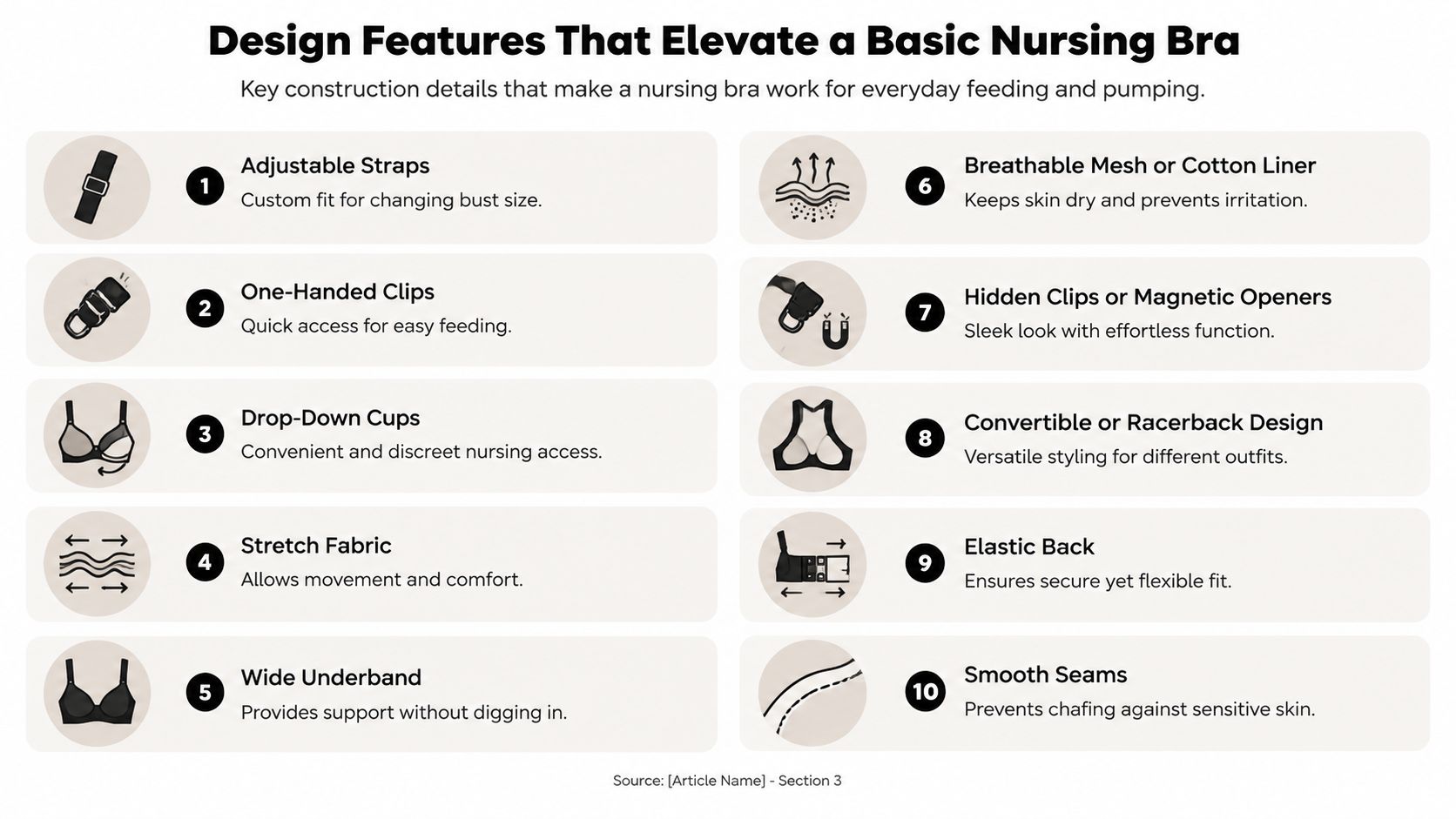
A beautiful fabric can't rescue poor construction. Your nursing bra should make feeding simpler, distribute weight across your torso, and keep pressure away from delicate areas. Judge the garment from the inside out, especially if you'll wear it for long stretches.
Start with access and pressure
One-handed clips are valuable when you're holding a baby. Drop-down cups provide a clear opening, while pull-aside styles can feel more flexible for lounging and sleep. Hidden clips or magnetic openers create a cleaner appearance, but they still need to open smoothly and close securely.
The underband should sit level around your body without rolling or cutting into your ribs. A wide band usually spreads pressure more comfortably than a narrow elastic edge. Adjustable straps let you fine-tune support as breast volume changes, and a racerback option can help certain tops sit more naturally.
Check the skin-facing details
Seam placement deserves as much attention as the outer appearance. Smooth seams reduce rubbing, while a cotton liner or breathable inner layer can make the bra feel less clammy. If you have sensitive skin, inspect the thread, elastic, labels, and trims rather than focusing only on the fiber printed on the product page.
Chemical safety also deserves a direct conversation. Independent testing found indications of PFAS in 53% of 15 nursing bras tested, according to Mamavation's nursing-bra testing report. That finding doesn't mean every cotton nursing bra carries the same concern, but it does show why “cotton” alone isn't a complete safety assessment.
Look for transparent material information and certifications such as OEKO-TEX or GOTS when they're available. Organic cotton can be helpful, but elastic, synthetic thread, dyes, and finishing treatments may still touch your skin. Ask what the whole garment contains.
The bra should also work with nursing pads, wearable pumps if relevant, and the clothing you wear. A garment that looks refined but shifts during feeding isn't functional. A plain bra that supports you without digging may be your essential base, while a lace option can give you the confidence lift you want for dressing up.
Use this short shopping check:
- Access: Can you open it with one hand while holding your baby?
- Support: Does the band carry most of the weight without digging?
- Surface: Are the seams, labels, and elastics comfortable against your skin?
- Safety information: Does the brand clearly identify fiber content and available certifications?
- Adaptability: Can the bra accommodate nursing pads, changing fullness, and your usual wardrobe?
A quick demonstration can reveal more than a product description. Watch the video below for a visual reference on nursing-bra function and access.
Finding the Right Fit for Your Evolving Postpartum Body
Your postpartum body doesn't hold one stable measurement. A bra that feels perfect during early engorgement may become loose once feeding patterns settle, while a bra bought later may feel too restrictive on a fuller day. Choose adjustability over precision and reassess whenever the bra starts behaving differently.
Measure for a forgiving baseline
Begin with a soft tape measure and wear a lightly supportive, unpadded bra if possible. Measure your ribcage directly beneath the bust without pulling the tape tight enough to compress. Then measure around the fullest part of the bust, keeping the tape level and relaxed.
Use the brand's own size chart rather than translating automatically from your old size. Nursing bra sizing varies, particularly between soft-cup, structured, wireless, and underwire designs. If you're between sizes, prioritize a cup that contains the breast without compression and a band that sits securely on the loosest adjustment.
A step-by-step nursing bra measuring guide can help you take consistent measurements before ordering. Measure at a calm point in the day, then remember that your breasts may still feel fuller before feeding.
Fit-test the bra in motion
Try the bra while standing, sitting, reaching, and simulating a nursing position. The cup should hold your breast without spilling at the top or sides. The center and underband should lie comfortably, and the straps should support without leaving deep grooves in your shoulders.
Check the nursing opening with one hand. If the clip releases only when you twist your wrist or use both hands, it may frustrate you during real feeds. The cup should fold down or move aside without pulling sharply across the nipple or pressing the remaining fabric into the breast.
A nursing bra should give you room to change, not room to collapse.
Watch for warning signs. A band that rides up may be too loose or too stretched out. A tight edge, visible indentation, persistent soreness, or a breast that feels compressed in one area suggests the fit needs attention. Since tight bras can obstruct lactiferous ducts, treat concentrated pressure as a functional problem, not a minor annoyance.
Flexible underbands and stretch lace can accommodate variation more gracefully than rigid molded cups. Multi-hook closures also let you adjust the band as your ribcage and comfort change. Underwire requires particular care. If you choose it, look for a flexible, well-positioned wire that sits around the breast rather than on breast tissue, and stop wearing it if it creates pressure or discomfort.
Plan for more than one fit. Your early postpartum bra may be soft and forgiving, while a later option can provide more structure and a closer connection to your personal style. Neither choice has to define the entire breastfeeding journey.
Caring for Your Cotton Nursing Lingerie to Make It Last
Nursing bras face a demanding laundry cycle. Milk, sweat, nursing-pad residue, body oils, and frequent washing can wear down cotton, lace, elastic, and fasteners long before the bra looks visibly damaged. A simple routine protects the softness you bought the bra for.
Wash with less stress
Read the care label first, especially if the bra includes lace, molded cups, underwire, or specialized closures. In general, use a cool or lukewarm gentle cycle, place the bra in a mesh lingerie bag, and close the hooks before washing. The bag reduces snagging and keeps clips from catching on other garments.
Choose a mild detergent and avoid chlorine bleach. Fabric softener can coat fibers and interfere with absorbency, while harsh products may weaken elastic and aggravate sensitive skin. If you're dealing with milk residue, rinse promptly rather than scrubbing the fabric aggressively.
Hand washing is useful for delicate lace or a bra with fragile hardware, but don't twist the cups. Press out excess water with a clean towel. Twisting can distort the shape and strain the nursing mechanism.
Dry for shape retention
Air-dry the bra away from intense heat. High dryer temperatures can shrink cotton, fatigue stretch fibers, and shorten the useful life of elastic. Don't hang a wet bra by one strap, because the weight can stretch it unevenly. Lay it flat or hang it from the center of the band.
Rotate between bras instead of washing and wearing the same piece continuously. A small rotation gives elastic time to recover and makes it easier to keep one clean and dry during unpredictable leakage. Remove nursing pads before washing when the care instructions call for it, and inspect clips and seams after each cycle.
Cotton's slower drying behavior makes planning important. Keep a clean spare in your changing area, overnight bag, or pumping station so you're not tempted to wear a damp bra longer than feels comfortable.
Reclaiming Your Confidence Beyond the Early Months
The first postpartum weeks ask you to value ease above almost everything. That priority is valid, but it doesn't have to last forever. As feeding becomes more familiar and you return to work, social plans, or dressing for yourself, lingerie can become part of your identity again rather than another piece of recovery equipment.
A cotton-rich or cotton-blend nursing bra gives you a practical foundation. From there, elegance comes through construction: stretch lace that moves with you, support that doesn't punish your ribs, and nursing access that stays discreet beneath clothing. You can choose softness for sleep, structure for the day, and a more refined silhouette when you want to feel polished.
That desire isn't frivolous. Clothing affects how you inhabit your body, especially after pregnancy has changed its shape and your attention has shifted toward someone else's needs. A well-fitting bra can remind you that care includes you.
For women ready for a more lingerie-led approach, PETRA features ultra-soft stretch lace, gentle underwire, and one-hand nursing access, combining a feminine appearance with practical breastfeeding function. It belongs in the later-stage conversation, when you want support and beauty to share the same garment.
Motherhood hasn't replaced who you were. It has added depth, responsibility, tenderness, and strength to your identity. Your nursing lingerie can reflect that fuller version of you, with comfort close to the skin and confidence visible in the way you get dressed.
Milk&Lace offers nursing lingerie that pairs breathable comfort and practical breastfeeding access with elegant lace, including the GAIA and PETRA designs. Visit Milk&Lace to explore nursing bras that support your evolving postpartum body while helping you feel like yourself again.