

Yes, you can wear nursing bras while pregnant when they remain comfortable and don't compress breast tissue. Fit and construction matter more than the drop-down cups, which can stay closed until you need them.
The useful question isn't whether you're pregnant enough for nursing clips. It's whether the garment supports the body you have today without squeezing it. That distinction makes shopping less stressful, especially when a bra that felt lovely recently starts pinching by evening.
Yes With a Different Bra at Each Stage
Most breast-size changes have usually occurred by around 16 weeks, according to the Australian Breastfeeding Association's maternity-bra guidance. That's a useful point for reassessment or a professional fitting, not a deadline before which you should tolerate uncomfortable underwear.
A nursing bra can serve as pregnancy support because its feeding clips don't need to be used yet. However, the word nursing doesn't guarantee stretch, generous cups, or a comfortable band. Some nursing styles are flexible enough for changing proportions; others have a more fixed shape that you may outgrow.
Think of buying for pregnancy as choosing support for a stage, rather than predicting your final size. Your breasts and rib cage don't necessarily change together, and tenderness can alter what feels wearable even when your measurements seem similar.
Nursing bra choice by pregnancy stage
| Stage | What usually changes | Bra move | Recheck when |
|---|---|---|---|
| Early pregnancy, before that reassessment point | Growth is underway and breasts may be tender | Choose a soft, adjustable nursing or maternity bra rather than a rigid fixed size | The band digs, cups compress, or marks appear |
| Around the reassessment point | Much of the early breast-size change may have happened | Reassess your fit or book a professional fitting | The early bra feels tight or tissue spills |
| Later pregnancy shopping | A bra bought now may carry into feeding, but there's no guarantee | Look for adjustable hooks, stretch, and sufficient cup coverage | During a regular wardrobe check, and whenever the rib cage feels tighter |
| Late pregnancy | Fullness can continue increasing toward the due date | Keep the bra only while support remains comfortable | You notice new digging, gaping, or shoulder strain |
| First postpartum months | Some people need a larger cup as milk volume changes | Reassess rather than assuming the pregnancy bra still fits | Engorgement, spilling, or a band that won't sit level |
A reassuring early fit isn't a promise about delivery day. Equally, needing another size doesn't mean you made a poor purchase. A bra that supported you comfortably during a changing stage has done a useful job, even if it doesn't become your everyday feeding bra.
Buy for the body you can fit
Say your current cups feel shallow, but the band remains comfortable. Buying a much larger band to create extra room can leave you with less support while the cups still don't suit your breast shape. The more useful move is to identify which part no longer fits, then choose a garment that solves that problem.
Leave room for adjustment, but don't buy a bra so loose that you're waiting to grow into it. Future flexibility should come from the design, not from wearing an unsupported size today.
A nursing bra is an option during pregnancy, not a commitment to wearing the same garment through every stage.
If you're wondering, “Can you wear nursing bras while pregnant?” the permission is straightforward. Keep wearing the one that feels right, and stop treating its size label as permanent.
What Changing Breasts Ask of a Bra
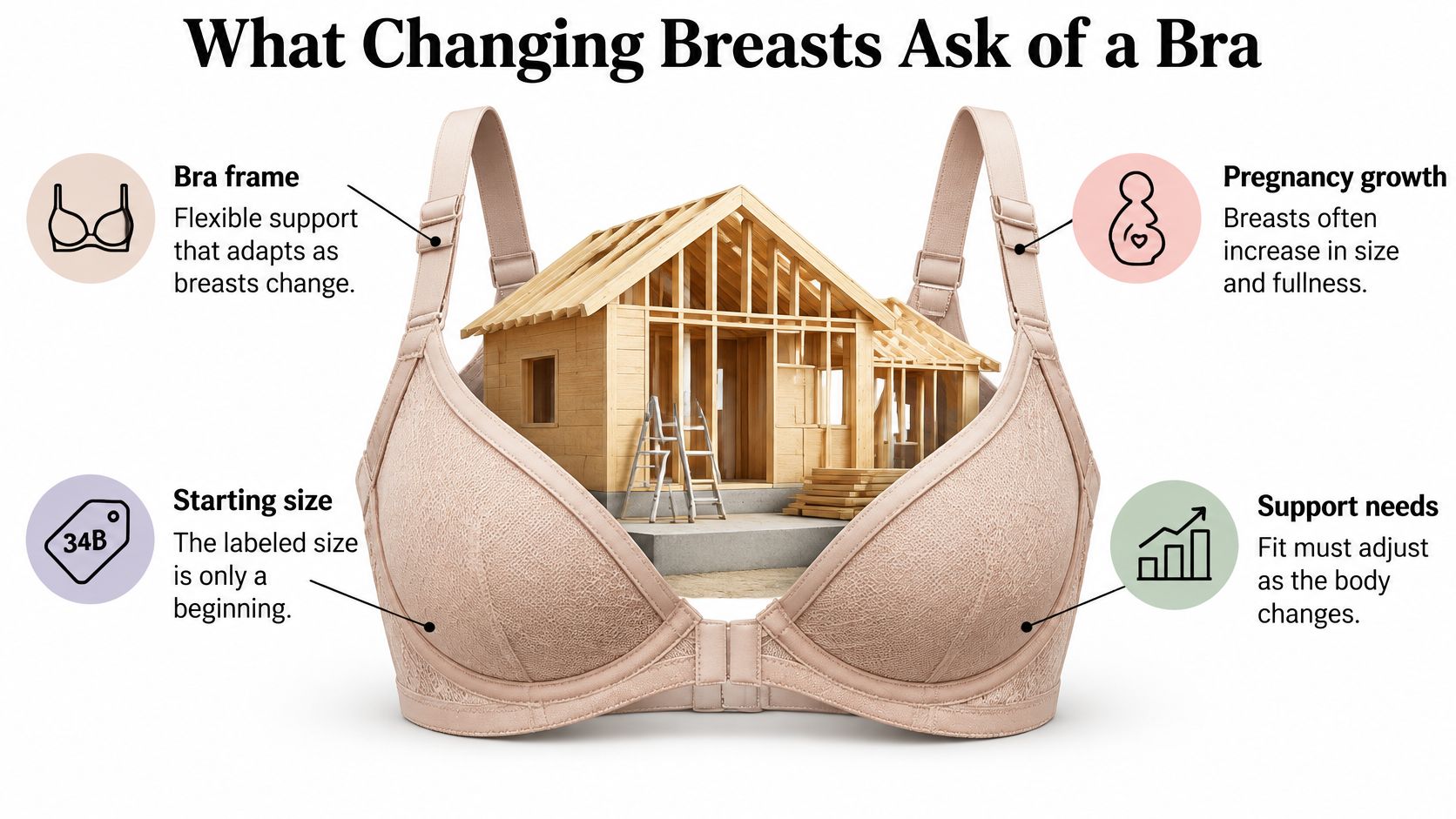
A pregnancy bra is like a flexible frame around a house still being built. The frame needs to accommodate changes without pressing against what's inside, so the labeled size is only a starting point.
Say you try on a nursing bra that looks smooth beneath a shirt. Before deciding it fits, take the shirt off and check the garment itself. A neat outline can hide breast tissue pressed flat at the sides or a band pulled upward at the back.
Use this illustration as a reminder to assess the whole garment, not just its label.
Check the band before the straps
Pregnancy can bring increasing breast fullness and changing proportions, as described by the Office on Women's Health. Assess the band first, then the cups, before using strap adjustments to fine-tune support.
- Look from the side. The band should sit level from front to back rather than climbing toward your shoulder blades.
- Gently pull the band away. You should feel some give without needing to tug hard. A rigid band that restricts breathing isn't a supportive fit.
- Try the loosest hooks. For a new bra, this leaves tighter settings available if your rib-cage measurement later decreases. It doesn't create more expansion room during pregnancy, so additional growth may require an extender or another size.
- Check the entire cup edge. Breast tissue should sit inside the cup without bulging at the neckline, sides, or underarm.
Now move normally. Sit down, reach forward, and raise your arms. The bra shouldn't need constant repositioning or rely on tightly shortened straps to stay in place.
Change the part that isn't working
An extender can help when the band alone is restrictive and the cups still contain your breasts comfortably. It won't deepen a shallow cup, move a wire away from breast tissue, or correct straps attached in an uncomfortable position.
If the cups spill while the band stays level, try more cup capacity. If the straps dig, loosen them and reassess whether the band and cups are doing enough work instead of asking your shoulders to carry everything.
For a fresh starting measurement, use our guide to measuring for a nursing bra. Then let the mirror and your comfort confirm the choice, rather than assuming your pre-pregnancy size still applies.
Fabric and Seam Checks
Tender breasts can make an ordinary seam feel surprisingly noticeable. The fabric against your skin matters as much as the shape you see from the outside, so inspect the inside of a bra before buying it.
Start by turning a cup inside out. Run your fingertips along the nipple area, neckline, underarm edge, and the point where the straps join. If something feels scratchy against your fingers, don't assume you'll stop noticing it after a long day.
A hands-on comfort checklist
- Choose a breathable base. Cotton or a soft cotton blend with stretch is a practical daytime option. Check that the lining feels comfortable too, rather than judging only the outer fabric.
- Press the cup gently. Soft or lightly lined cups can be easier to tolerate than stiff padding during tenderness. Padding isn't automatically a problem, but it shouldn't force your breast into a shape that feels compressed.
- Inspect seam thickness. Flat, soft seams are preferable wherever an edge touches sensitive skin. Watch for bulky stitching near the underarm.
- Stretch the underband. The elastic should extend evenly, without a narrow section that feels much firmer than the rest.
- Test hardware placement. A clip shouldn't rub your arm, and an adjustment slider shouldn't sit against a sore spot.
Our bra fabric and material guide can help you compare materials, but touching the lining and trying the garment remain useful checks.
Keep sleep and care uncomplicated
If you prefer support overnight, choose a soft, nonwired style without firm edges. You don't have to sleep in a bra if going without feels better.
Comfort check: A rough seam calls for a smoother finish. A deep indentation calls for a fit check, not merely softer fabric.
For washable pieces, gentle cool washing and air drying are sensible starting points, provided the care label permits them. Avoid wringing cups or stretching wet elastic, and rotate garments so you can notice thinning fabric, uneven stretch, or roughened seams before they become uncomfortable.
Pressure and Underwire Rules
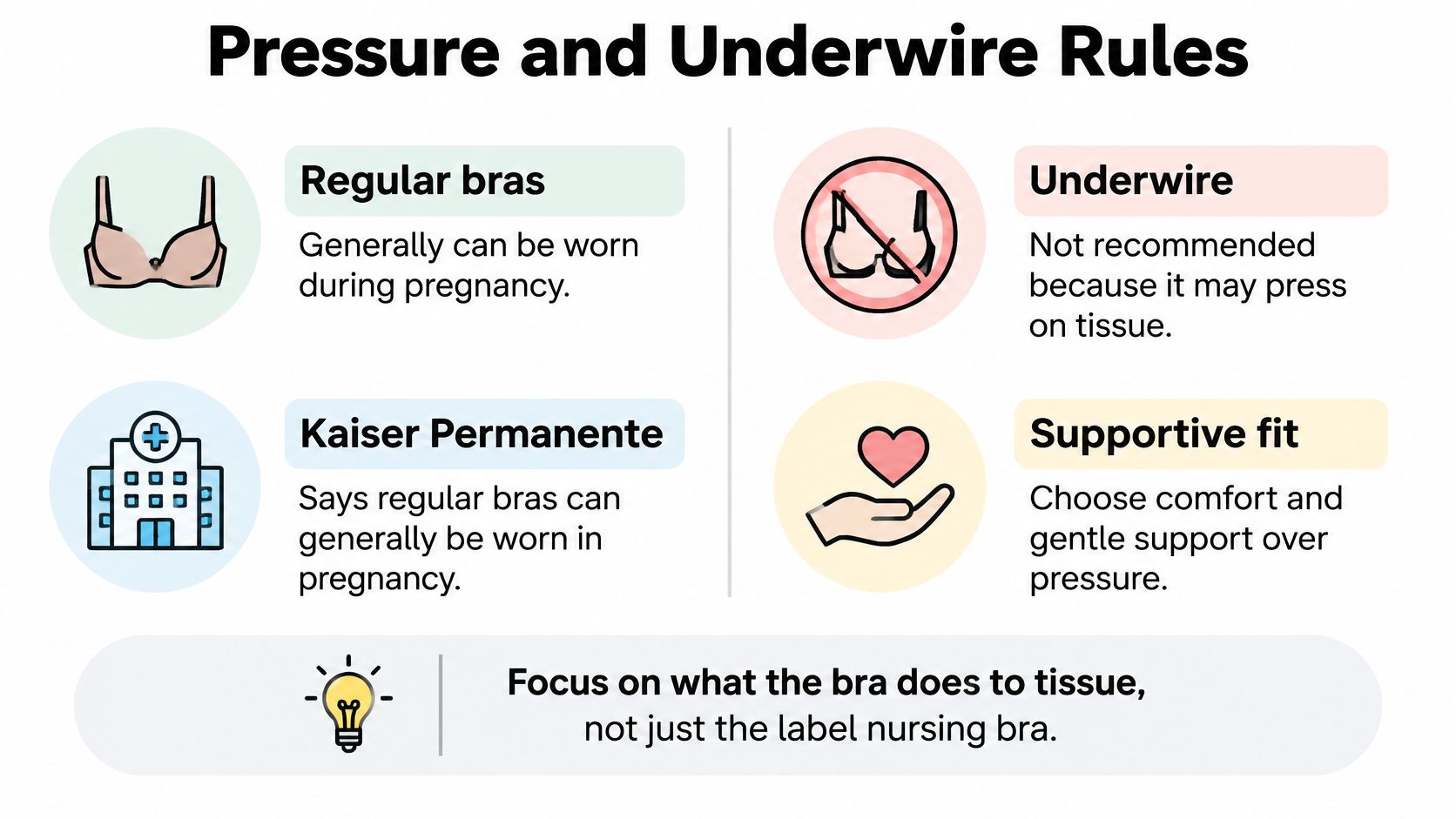
The nursing clip isn't the safety question. Pressure is. A clip provides access; the band, cup edges, wires, and other firm parts determine where the garment presses.
Kaiser Permanente's prenatal breast-care guidance says regular bras can generally be worn during pregnancy, doesn't recommend underwire bras, and notes that supportive cotton bras may feel more comfortable as breasts enlarge. That gives you a straightforward starting option when tenderness makes structured underwear difficult.
The practical distinction is easier to see when you compare gentle support with pressure against tissue.
Why underwire advice can sound contradictory
An NHS-affiliated maternity-bra leaflet states that there's no evidence that properly fitted underwire bras block milk ducts and allows them when the wire lies flat without digging. That isn't the same as saying every underwired bra remains appropriate throughout pregnancy and feeding.
The National Childbirth Trust's maternity and nursing bra guidance makes correct positioning central to fit: a wire should surround the breast rather than sit on breast tissue, without digging or uncomfortable pressure. A structured bra can therefore be reasonable for some pregnant wearers while being less forgiving when size or tenderness changes.
You don't need to settle this as an all-or-nothing argument. If you prefer underwire, assess its position carefully and remove it when it causes discomfort. If checking or tolerating it becomes difficult, a soft cup is a simpler choice.
Check where the wire actually sits
Look beneath the breast and toward the underarm. The wire should follow the breast's perimeter, lying against the torso rather than cutting across the fuller outer part of the breast.
Pay attention to what happens when you sit. A wire that clears tissue while you're standing may push upward when your posture changes, and a firm side panel can pinch even if the wire itself appears well positioned.
- Keep the breast inside the wire. Tissue shouldn't be caught beneath or outside it.
- Avoid focal pressure. A sharp spot or concentrated ache isn't something to break in.
- Check the rib cage too. A correctly shaped cup doesn't excuse a constricting band.
Our guide to nursing bras with underwire offers further help with this choice. The immediate decision, though, comes from how the garment sits on your body.
Separate a fit problem from a health concern
Bra signals and what to do next
| What you notice | Likely meaning | Next step |
|---|---|---|
| Band digs or leaves deep marks | The band is too tight for today's size | Loosen, size up, or stop wearing that bra |
| Cup flattens or spills at the edge | Tissue is compressed or the cup is small | Choose more coverage and a larger cup |
| Wire or firm edge sits on breast tissue | Focal pressure on a changing breast | Switch to a soft cup or a wire that clears the breast |
| Soreness that eases when the bra comes off | Fit or wear time may be contributing | Choose a less restrictive bra and reassess |
| Persistent red area, hard lump, fever, flu-like symptoms, skin or nipple changes, or abnormal discharge | A possible health concern, not only a fit issue | Seek medical advice rather than only changing bras |
Relief after removing a bra is useful information, but it isn't a diagnosis. Persistent or localized pain deserves attention even if you've also found a tight edge.
The rules shift when milk arrives
During pregnancy, the immediate concern is often tenderness and localized compression. Once feeding begins, changing fullness introduces another reason not to rely on a rigid shape that only fits at one moment.
A pregnancy favorite may become unsuitable when breasts are fuller between feeds or during engorgement. Don't assume yesterday's comfortable wire still clears today's breast tissue. Choose an accommodating option and seek care for concerning symptoms instead of trying to solve everything through underwear.
What You Gain Before Birth and What You Trade
There's a practical appeal to learning a garment before you need to feed in it. You can find the clips, practise opening and closing them, and discover whether the cup folds out of the way without struggling.
That familiarity is useful, but it isn't a reason to buy an entire feeding wardrobe early. A nursing bra earns its place before birth by being comfortable now, not by promising to become useful eventually.
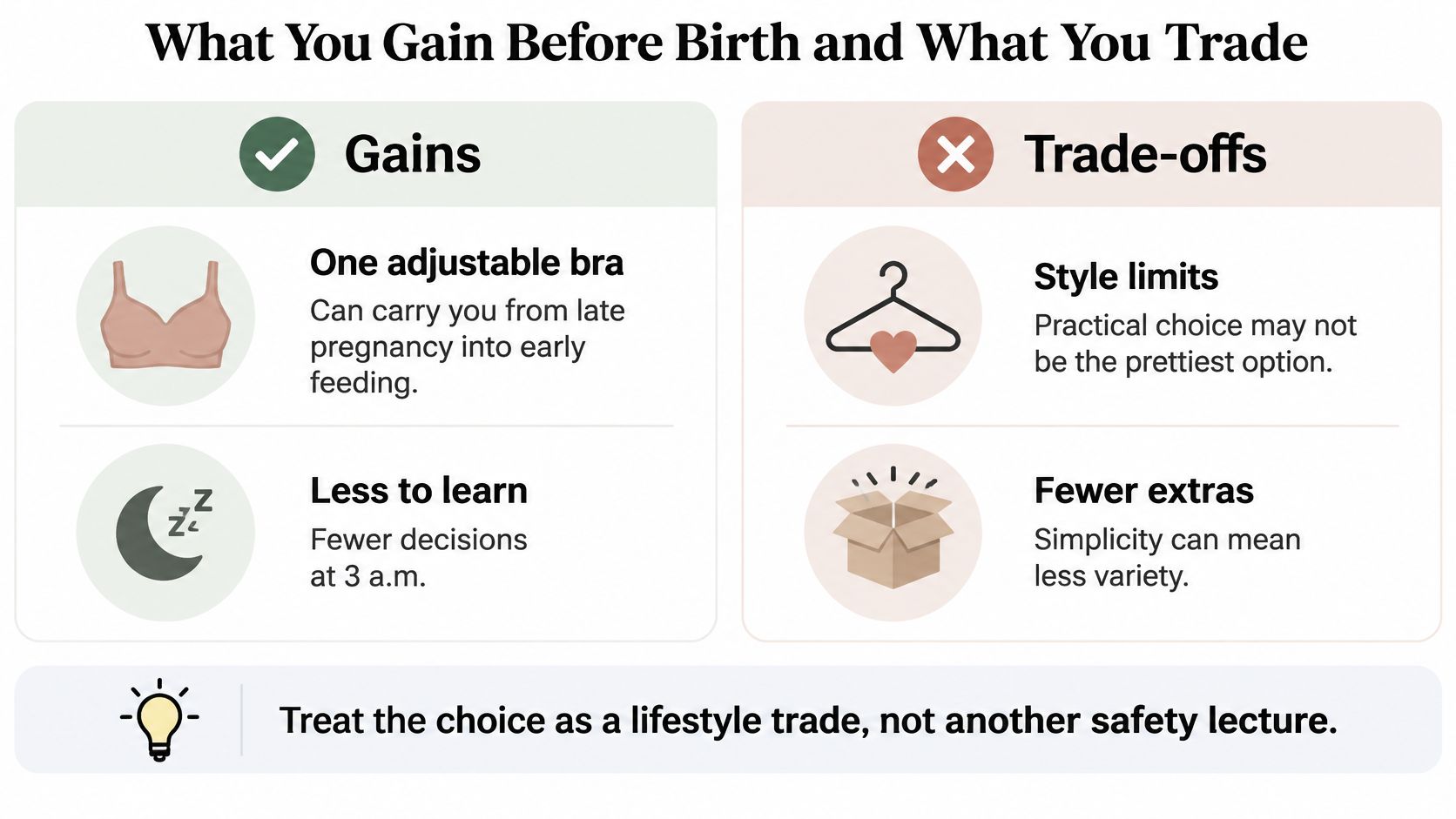
The trade-offs are ordinary wardrobe decisions, not a test of how prepared you are.
The useful gains
An adjustable nursing bra can reduce the number of garment types you need to learn. If it continues to fit, you can move into feeding with familiar straps, fastenings, and access rather than changing everything at once.
A supportive cup may also make a larger, unfamiliar bust feel more manageable during ordinary activities. You can choose that benefit without needing the nursing function yet.
- Familiar access. Practise with the clips while you're getting dressed, without making it another task to master perfectly.
- Potential continuity. A pregnancy purchase may remain useful after birth, provided its fit still works.
- More choice today. You're free to choose a nursing style because you like wearing it, not because you've reached a particular milestone.
The honest costs
Hardware and deeper bands can feel bulky beneath lightweight clothes. Some structured styles also take up more space in a drawer or feel warmer than a simple soft bra.
Buying ahead carries a sizing risk. If you outgrow the garment before feeding begins, the money bought pregnancy comfort rather than a long-term nursing staple. That can still be worthwhile, but it helps to make the decision consciously.
You don't have to find a single bra that handles tenderness, work clothes, sleep, and feeding equally well.
Keep separate roles in mind: something gentle for rest, and something supportive for time upright. You may already own a garment that fills one role, so this isn't automatically a shopping list.
Changing bras during the day is a sensible response to different needs. It's not evidence that you failed to find the perfect product.
Pick Today's Support and Act Tonight
Choose the job before the style. If you're resting at home with tender breasts, your priorities are different from those of someone dressing for a workday or preparing a hospital bag.
Set aside the idea that your underwear must mark a particular stage of motherhood. Start with what you need to feel comfortable this evening.

Choose for the next ordinary day
If your usual bra becomes sharp or irritating by evening, pick a soft, nonwired alternative for rest. Nursing access is optional at this point; the useful feature is a construction you can tolerate comfortably.
For work or a long walk, try the bra under the clothes you plan to wear. Reach for a bag, sit at a table, and bend to put on your shoes. You're checking whether it stays supportive during your routine, not whether it looks right while you stand still.
Use these decisions to narrow the choice:
- For tenderness and rest. Choose softness and an absence of firm pressure points.
- For time upright. Look for secure support that doesn't depend on overtightened straps.
- For birth preparation. Have an accommodating feeding option ready, without expecting it to predict every postpartum change.
- For early feeding. Prioritize flexibility when fullness fluctuates rather than forcing a structured pregnancy favorite to work.
A fitting video can be a useful companion while you assess a garment in front of the mirror.
Leave later-postpartum choices open
Late-pregnancy shopping is preparation, not permission to start wearing a nursing bra. You don't need to wait for a shopping window if your current underwear is uncomfortable, and you don't need to buy your later-postpartum wardrobe before you know what you enjoy wearing.
Once feeding is established and your fit feels more predictable, you may want a lightly structured lace option. Milk&Lace's GAIA combines stretch lace, flexible support, and breastfeeding access for that later-postpartum choice. It isn't a substitute for an accommodating early-feeding bra when tenderness or engorgement makes structure unsuitable.
Personal style can wait until you want to think about it. It can also matter a great deal when you're ready; neither choice makes you more or less practical.
Tonight, put on your current bra and assess it without your top covering it. Gently lift the band away, check the cup edges, then sit and reach forward. Keep it in rotation only if it supports you without compression, and set aside anything you're wearing merely because it used to fit.
Milk&Lace offers maternity and nursing lingerie, including lace nursing styles for the later-postpartum stage when you're ready for more structure and personal style. Visit Milk&Lace to explore those options when the time feels right, choosing for your current fit rather than a size you hope will last.