

You wake up, reach for the bra in the top drawer, and feel that familiar little jolt of frustration. Yesterday it seemed fine. Today the band rides up, the cup wrinkles at the top, and your body feels like it changed again overnight. That's the moment a breast type chart becomes a practical tool, especially in postpartum life, when shape, placement, and tissue can feel less predictable than your calendar.
A good chart does not ask you to freeze yourself into one identity. It helps you notice what is happening now, so you can choose a bra that supports your chest, opens easily for feeding, and stays comfortable as your body keeps shifting. For nursing and later postpartum months, that matters because fit depends on more than cup size. Breast geometry can change with pregnancy, breastfeeding, hormones, aging, and weight shifts, which makes one-time self-labels unreliable for many women.
Why a Breast Type Chart Matters After Baby
The first few weeks after birth can make a bra feel like a stranger. A cup that used to lie smooth may start to gap at the neckline. A soft style that worked during early nursing may collapse once tissue settles, or feel too shallow when fullness changes through the day. A breast type chart helps here because it gives you a way to describe those fit changes instead of leaving you to guess.
A moving map beats a fixed label
Breast-shape charts do not follow one universal medical standard. They usually come from fit research, shape segmentation, and garment design logic, which is exactly why they are useful in postpartum life and also why they cannot promise a one-size-fits-all answer. One study of American females aged 26 to 35 found four shape clusters, droopy breasts (31%), small/flat breasts (19%), upward breasts (24%), and large/inward breasts (26%), plus three placement clusters, high placement (36%), medium placement (44%), and low/open placement (20%).
Those numbers do not define you forever. They show why a chart works best as a moving map of shape plus placement, a guide that can change as your body changes. For a nursing bra, that difference matters because the same body can need different support depending on whether fullness sits high or low, wide or narrow, centered or set apart.
Practical rule: if your bra feels different from week to week, assume your fit needs changed before you assume your body did something wrong.
That mindset can make the whole process easier. Instead of asking, “What's wrong with my breasts?” you can ask, “What is this bra asking of my shape right now?” The second question points you toward better fabric choices, better cup construction, and less self-blame.
The Two Axes That Define Every Breast Shape
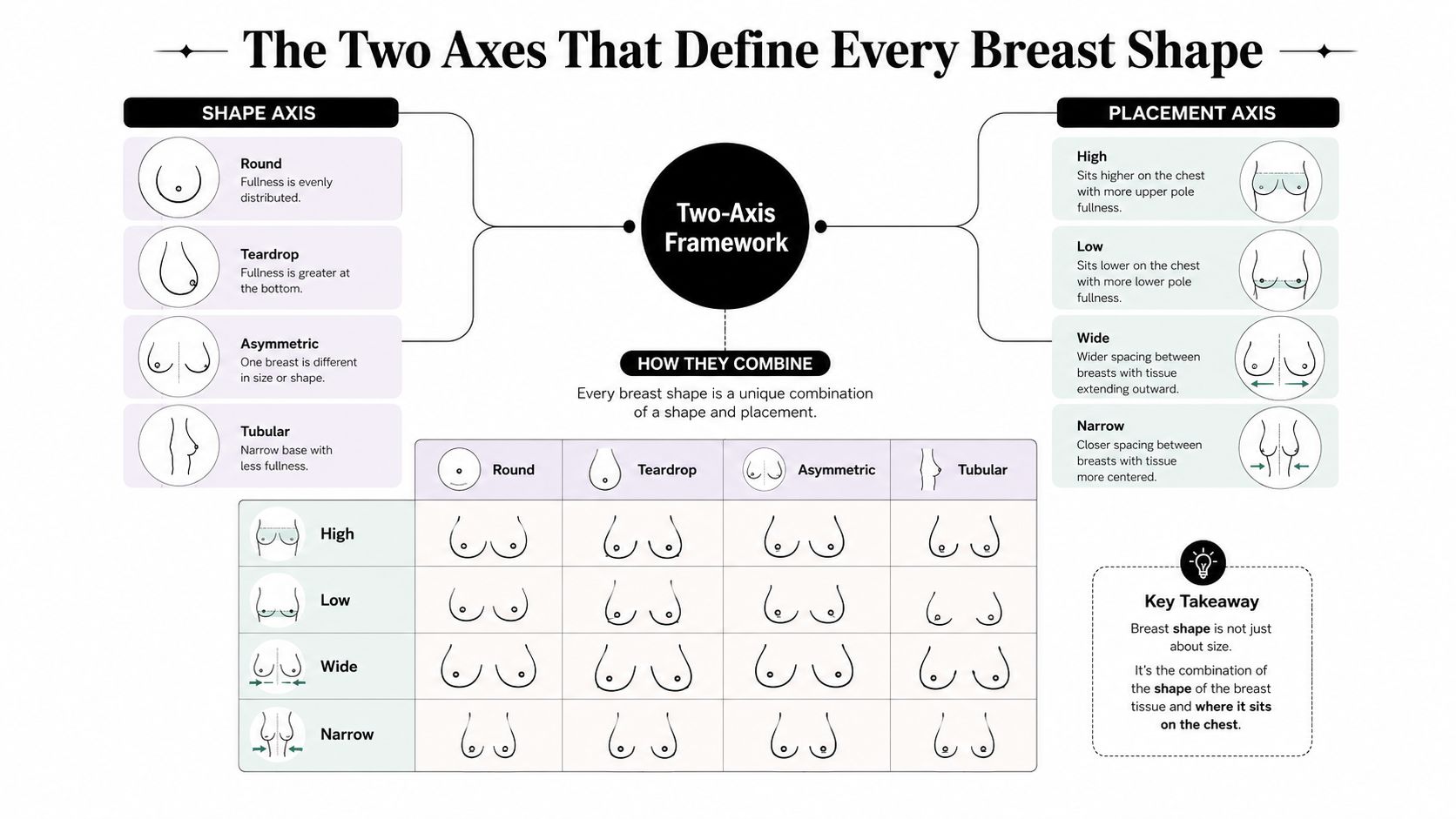
A breast type chart is easiest to read when you separate it into two parts. One axis describes shape, the overall contour of the breast. The other describes placement, where the breast sits on the chest wall. That separation matters after baby because your body may keep the same broad outline while the tissue shifts higher, lower, wider, or more centered, which changes how a nursing bra behaves on you.
Shape tells you the contour
Shape is the outline you see in the mirror. It gives clues about where fullness gathers, how much projection you have, and whether the upper or lower part of the cup tends to empty or overflow. Research behind many chart systems shows that breast patterns cluster into different shape and placement groupings rather than one neat category, which helps explain why bra guidance varies across brands and life stages (NC State citation).
Shape works like a floor plan. It shows the basic form of the space, while placement tells you where that space sits on the chest. A room can be roomy in the back and still need a different doorway than another room with the same square footage. In bra terms, two people can both say “I'm a D cup” and still need different neckline behavior, different wire shape, and different cup depth.
Placement tells you where support has to land
Placement is where the breast begins on the chest, not how large it looks from the front. High placement often needs different neckline behavior than low placement. Wide placement often needs a different cup frame than narrow placement. A quick mirror check can help here. Ask whether your tissue starts close to the collarbone, sits farther down, spreads toward the underarm, or collects more centrally.
The goal is not to pin yourself to a label. The goal is to predict how a bra will fit before you buy it.
A chart based only on cup letter misses a common fit problem. Support sits at the meeting point of shape and placement, and postpartum fit gets easier once you read both at the same time.
Eight Shape and Placement Combinations Explained
The combinations below aren't rigid identities. They're practical fit patterns, and that's what makes them useful after baby. Once you can see the tension in the cup, you can choose a bra that resolves it instead of fighting it all day.
| Breast Shape and Placement Combinations | Identifying Trait | Typical Fit Challenge | Recommended Feature |
|---|---|---|---|
| Round and high | Fullness is even and sits higher on the chest | Gaping at the top neckline | Higher neckline, stable upper cup |
| Round and low | Even fullness, but tissue sits lower | Slipping out of softer cups | Firm lower support, lifted cup frame |
| Teardrop and high | Fuller below, but still sits high | Empty space near the upper cup | Molded upper section, gentle stretch lace |
| Teardrop and low | Lower fullness with a longer vertical footprint | Bottom spill or cup collapse | Deeper cup, stronger underwire projection |
| Asymmetric and high | One side sits slightly higher or fuller | One cup fits, the other gaps | Flexible cup fabric, graduated stretch |
| Asymmetric and low | Uneven fullness with lower placement | Shift during feeding and movement | Adjustable straps, stable band anchor |
| Tubular and wide | Tissue spreads outward with less center projection | Underwire mismatch, side spill | Side support, wider cup base |
| Tubular and narrow | Fuller center line, tighter footprint | Gore pressure or cup compression | Center support, softer bridge, deeper apex |
Where the fit pain usually shows up
High-placed shapes often struggle with neckline gaping because the top of the cup is working harder than the lower half. Low-placed shapes more often need projection so the cup can sit under the breast instead of flattening it. Wide shapes usually need more room through the side panel, while narrow shapes need a cup that doesn't overwhelm the center.
A postpartum chest can also be more responsive to touch, feeding schedules, and the day's milk volume. That makes a rigid, one-note cup feel less forgiving than a design that flexes where the body needs it. If you're comparing options, GAIA is one example of a soft nursing bra with stretch lace, flexible support, and easy breastfeeding access, which can suit women who want a lighter feel without losing structure.
What each combination asks for
A round and high breast usually wants a cleaner upper edge. A teardrop and low breast usually wants a deeper cup and more lift from below. An asymmetric pattern needs some give, because both sides won't behave identically through the day. A tubular and wide pattern often benefits from side containment, since tissue can drift outward if the cup frame is too narrow.
If a bra feels fine while standing still but fails the moment you feed, bend, or pick up your baby, the cup is probably solving the wrong problem.
That's the whole point of the chart. It helps you shop for the tension your body creates.
Measuring Yourself Beyond the Cup Letter
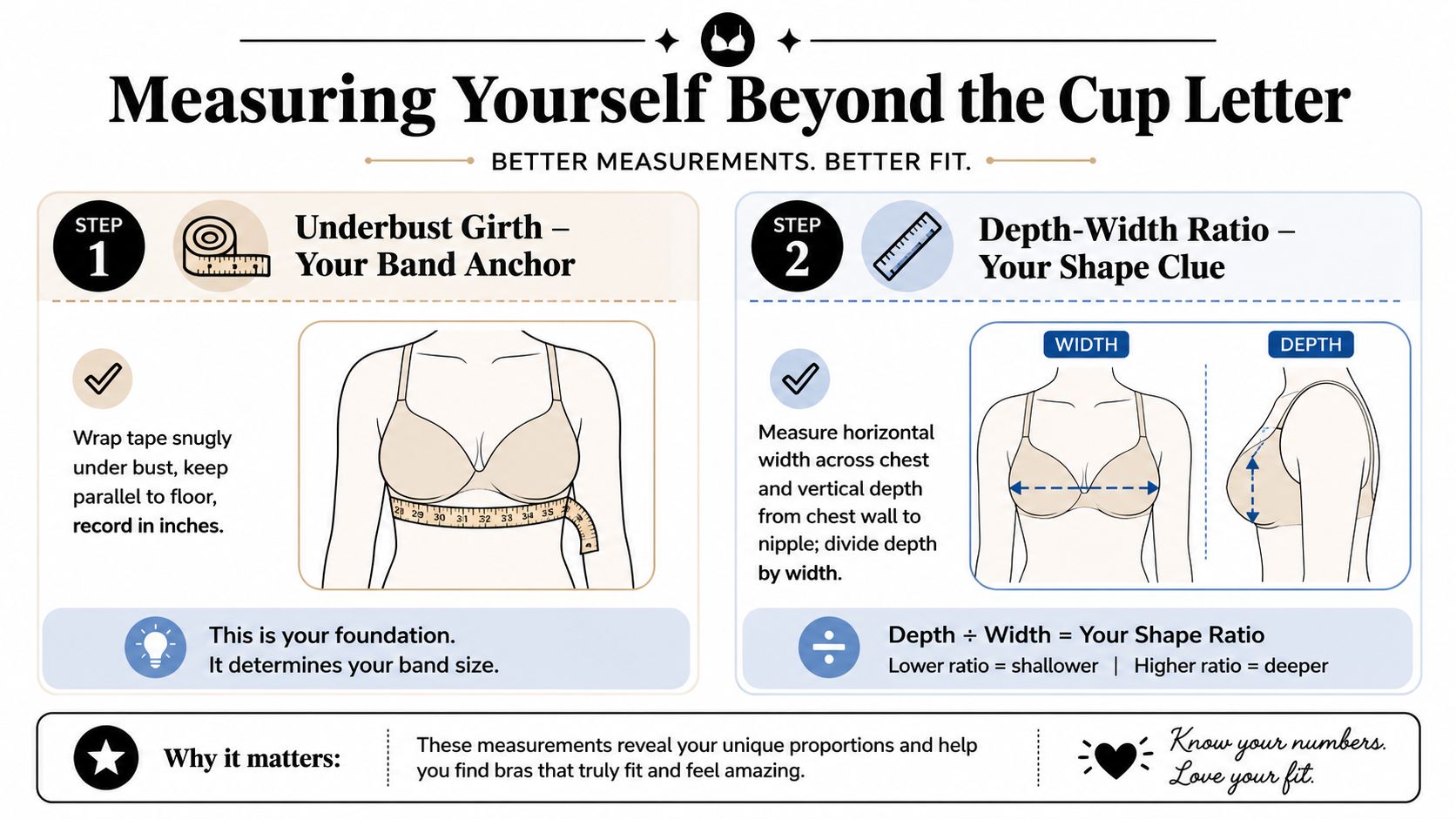
A cup letter gives only a partial answer. After baby, a better starting point is the body's actual shape and support needs, because a postpartum breast can change from day to day, much like a tide line that shifts with feeding, rest, and fullness. Measuring underbust girth and breast depth-width ratio gives you a clearer read on the band anchor and forward projection that shape fit, rather than relying on a label alone (Zheng study).
Start with the band anchor
Wrap a soft tape snugly around your ribcage just under the breast. Keep it level and close to the body, but not painfully tight. That number shows where the bra's band should sit, and the band is the anchor that keeps the cup from riding up or twisting during wear.
Then read projection against width
The second measurement helps you see how the breast sits in space. Measure the breast's width across the chest and the depth from the chest wall toward the nipple, then compare the two. In the sizing study, underbust girth and breast depth-width ratio were the two most important variables for a new sizing system, which is why two people with the same cup letter can still need very different bras (Zheng study).
Measure at the same time of day when you can, because postpartum fullness can change the reading you get.
A few common mistakes cause frustration. Pulling the tape too hard can shrink your band number. Measuring at a very full feeding moment can make projection look bigger than it usually is. Skipping notes from week to week makes it harder to tell whether your fit changed because your body changed or because the bra did.
For a simple walkthrough you can save, use this nursing-bra measuring guide. The point isn't perfect arithmetic. The point is giving yourself a repeatable method that is more reliable than a bra tag.
Matching Bra Features to Your Shape
Shape knowledge only matters when it changes what you buy. A postpartum breast type chart becomes practical at this point, because it connects shape, placement, and movement to the parts of a bra that do the work. Projection, apex position, cup depth, and coverage distribution all affect how the bra sits through a feeding day. Anthropometric work has shown that breast shape can be described through measurable geometry such as neck-to-nipple distance, nipple-to-nipple breadth, under-bust diameter, and breast depth and length variables, so the right bra features can be chosen from landmarks instead of guesswork (Korean anthropometric study).
Underwire, stretch, and access each solve a different job
Structured underwire helps when breast tissue needs a clear base and lift from below. Soft stretch lace helps when fullness shifts and the cup needs to move with you instead of holding you rigidly in one shape. Discreet nursing access matters because even a lovely fit becomes frustrating if feeding takes too much effort in the middle of the day.
The goal is choosing the right balance for your stage. Earlier postpartum, softer construction may feel easier while your body is still changing. Later on, many women want shape, smooth lines, and a silhouette that feels closer to their pre-baby self. Milk&Lace's bra style guide is useful for seeing how those trade-offs show up in real bra details, from structured underwire to softer lace and nursing access designed for regular wear.
Ask for the features that match your profile
If your chest is high and full on top, ask for a cup with a stable upper edge that holds its line without cutting in. If your tissue sits lower and deeper, look for projection through the lower cup and enough room at the apex so the breast can sit forward without being forced flat. If you're asymmetric, choose forgiving fabrics and adjustable details so one side is not punished for being different.
A flattering bra supports the breast without flattening its natural geometry.
That matters especially in postpartum months, when tenderness, supply changes, and practical feeding access all matter at once.
A Day in the Life of a Nursing Bra Rotation
At 8 a.m., Maya reaches for the bra that gives her the cleanest shape under a work top. Her fullness is a little higher in the morning, so she chooses the firmer option with more structure through the cup. By lunchtime, she wants something softer, because she's home with the baby and needs easy skin-to-skin contact, not a tight frame.
Her afternoon bra choice is different again. She knows she'll be moving around, lifting, and feeding on a longer stretch, so she picks the bra that opens quickly and stays stable at the band. That rotation doesn't mean she's indecisive. It means she's reading her body accurately.
Rotation beats forcing one bra to do everything
The chart matters here because it turns daily changes into a simple decision tree. If her shape feels fuller and more projected after a feed, she reaches for the bra that handles depth better. If she's flatter and softer later in the day, she moves to the one with more forgiveness in the upper cup. That rhythm keeps her from over-wearing one bra until the fabric loses its shape.
For women who pump as part of the day, this nursing bra guide for pumping can help narrow the choices that work across work, home, and evening life. The biggest win is not owning one perfect bra. It's owning a small rotation that matches real postpartum behavior.
You don't need your bra to solve every moment. You need a few bras that each solve one moment well.
That shift is freeing. It makes getting dressed less about compromise and more about choosing the right tool for the hour.
When Shape Changes Deserve a Doctor, Not a New Bra
A bra fit issue can change the way your breasts sit in clothing, but some changes belong in a different category entirely. Postpartum life is busy, sleep is short, and it is easy to assume every shift is a sizing problem. A good chart helps you tell the difference.
Red flags need medical attention
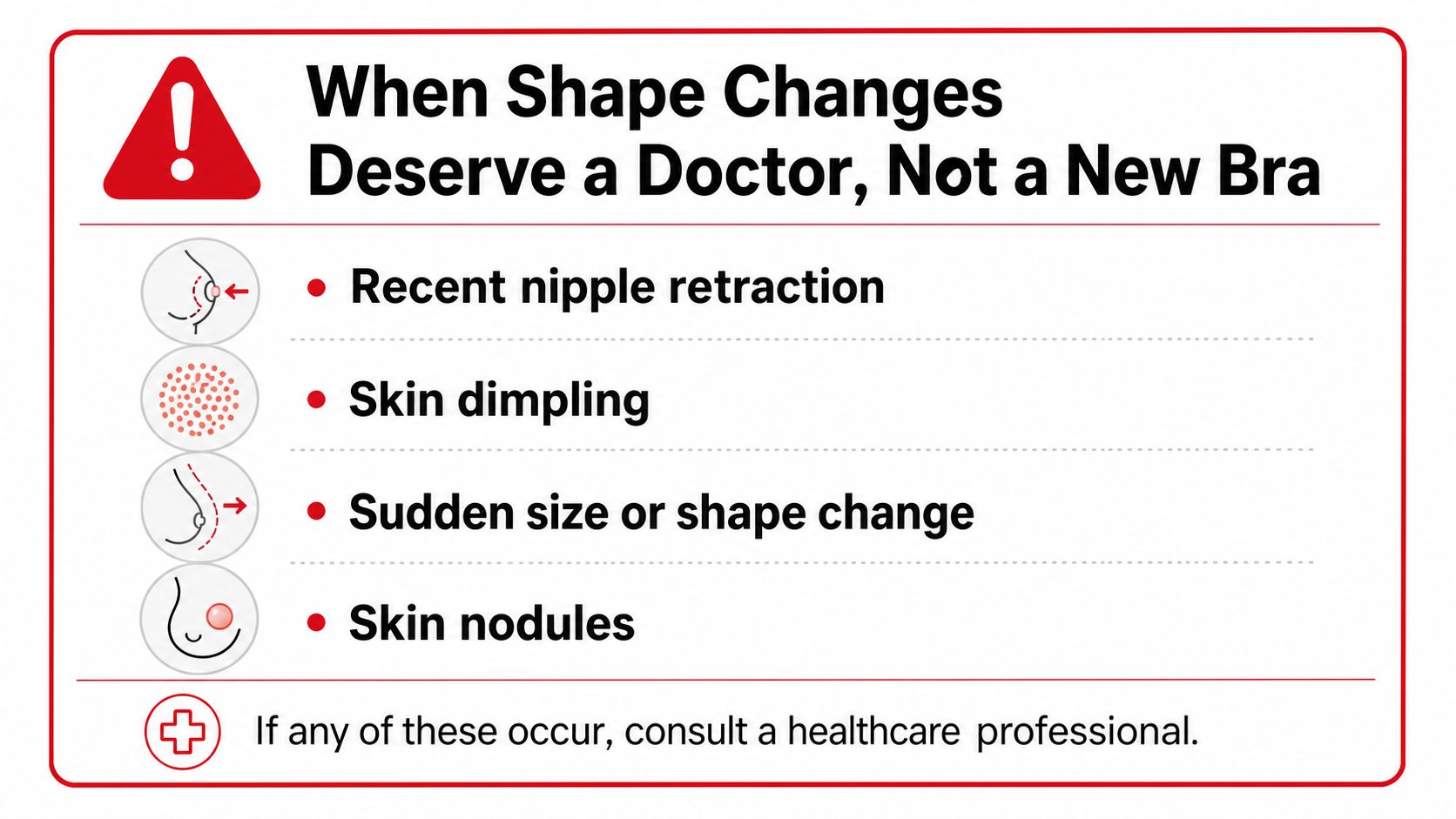
Clinical guidance flags recent nipple retraction, skin dimpling, a change in size or shape, a skin nodule, ulceration, eczema of the nipple, bloody discharge, and armpit swelling as reasons for urgent referral (Healthline). If one of those shows up, the next step is a clinician, not a different bra.
Unevenness alone is not the warning sign. Many women have some asymmetry, and postpartum breasts often look and feel uneven for ordinary reasons such as feeding patterns, fullness, or natural differences between sides. Density and tissue texture also vary, so a chart should help you sort everyday fit changes from changes that deserve a medical review.
Why density and pregnancy changes complicate the picture
Breast shape can shift with pregnancy, hormonal changes, aging, and weight changes, which makes one-time self-identification unstable for nursing women (Healthline). Dense tissue can also change how breasts look and how they screen, so a visual chart is only one piece of the picture. That is why a useful chart includes health awareness, not just style guidance.
Some changes feel familiar, like the body settling into a new pattern after feeding. Others feel abrupt, new, or unlike the changes you have already been tracking. When that happens, treat it as a health question first.
The clearest charts do not only help with shopping. They also help you know when to pause, stop sizing, and get checked.
Your Postpartum Reassessment Ritual
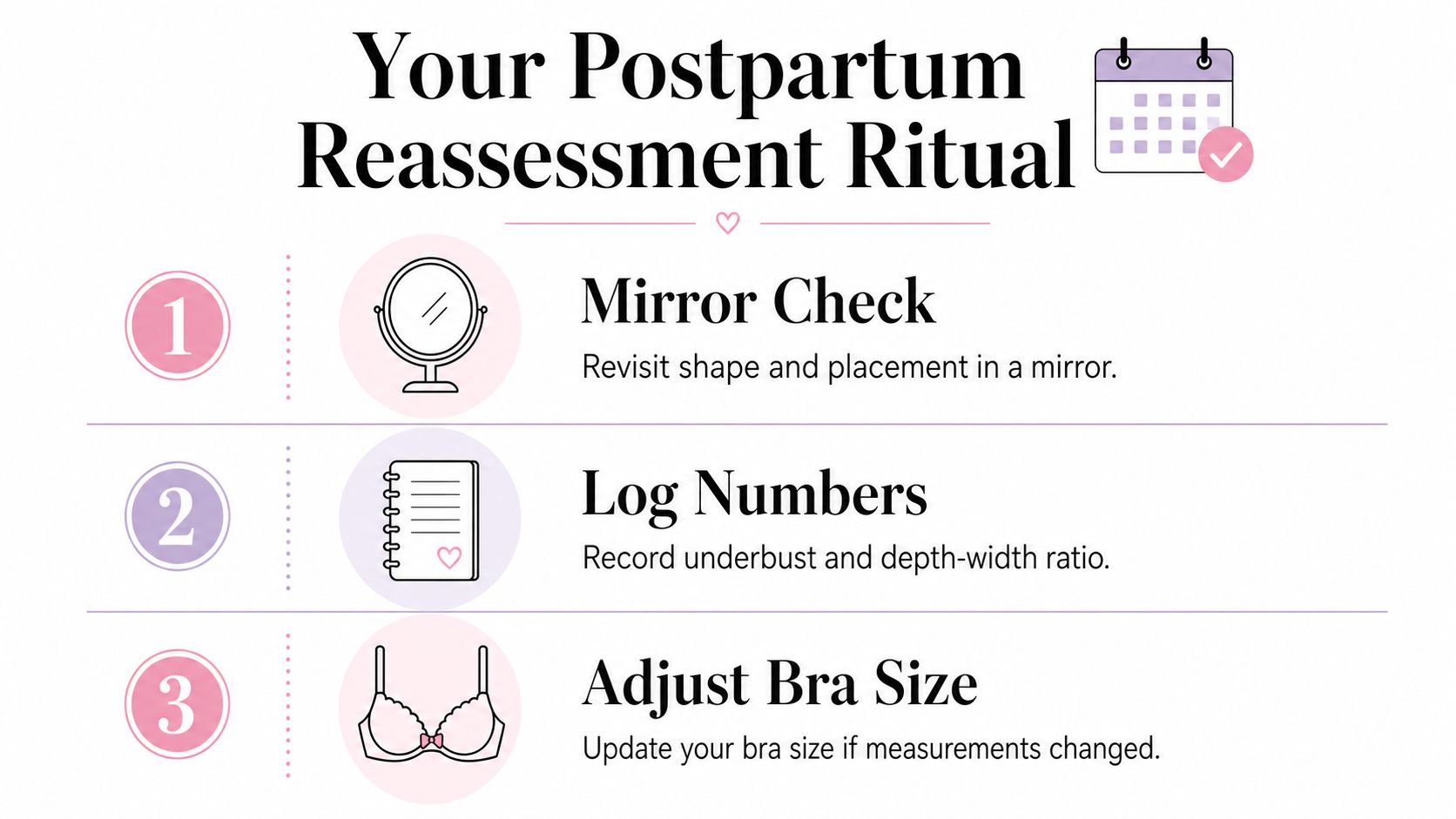
Set aside a quiet minute and run through three checks. First, look in the mirror and note shape and placement. Second, record your underbust and depth-width numbers. Third, pay attention to whether your current bra still fits the way you sit, feed, and move through the day.
That small routine keeps you from relying on memory alone. It also helps you spot changes that deserve a closer look, separate a simple size change from a different bra construction, and notice when a medical visit is the better next step. A chart works best when it stays updated, because postpartum bodies keep changing as feeding patterns and tissue settle.
Milk&Lace makes nursing lingerie for that in-between stage, when comfort still matters and confidence starts to matter more too. If you want to look for a bra that supports feeding, shape, and the way you want to feel in your clothes, visit Milk&Lace and choose the fit that meets you where you are now.