

You've weaned, packed away the nursing tanks, and decided you're ready for a bra that feels like you again. Then your old favorite goes on, the band presses into your ribs, the top edge gapes, one strap slides toward your elbow, and the underwire lands on tissue that still feels tender. The mirror shows a familiar garment on a body that has moved on.
That doesn't mean your body is doing anything wrong. Bras after breastfeeding are part of a transition, not a single sizing event. You'll move through the soft nursing-bra stretch, the frustrating middle window when nursing styles feel too loose but structured bras feel premature, and the later phase when your shape and volume are stable enough for more defined silhouettes. Most advice skips that middle phase, even though it's where many women feel stranded.
The recommendations below focus on fit mechanics, changing tissue, and real-life wear. You'll learn when to measure, how to test support, what underwire can and can't do, and how to build a rotation instead of forcing one bra to solve every postpartum problem.
The Post-Weaning Closet Moment Most Women Recognize
Mara pulls a pre-pregnancy bra from the back of her drawer six weeks after weaning. It's the one she wore under work shirts, the one that used to create a clean line beneath a silk blouse. She fastens it on the loosest hook and looks at herself in the mirror.
The band digs into her ribs. The cups wrinkle at the upper edge, yet the tissue near her underarms spills beyond the side seam. One strap keeps slipping, so she tightens it until it cuts into her shoulder. The wire sits partly on the breast crease and partly on tender tissue. When she raises her arms, the back band rides up.
This is the moment many women interpret as failure. It isn't. The bra is trying to serve a body it no longer matches.
The three phases your wardrobe needs
Phase one is the soft nursing-bra stretch. Immediately after weaning, flexible cups and forgiving bands can handle lingering fullness, sensitivity, and day-to-day variation. They may not give you the separation or lifted shape you want, but they're often the least irritating option while your body is still changing.
Phase two is the middle window. This is the awkward period, roughly six to twenty-four weeks after weaning, when the old nursing bra feels shapeless and your pre-pregnancy bras feel unpredictable. A wireless shaping bra, flexible lace style, or carefully fitted light-structure bra usually works better than jumping straight into rigid molded cups.
Phase three is the structured return. Once your measurements and comfort are more consistent, you can add underwire, contour cups, balconettes, and polished T-shirt bras. “Structured” doesn't mean “tight.” It means the band, cup, wire, and straps are sharing the work instead of asking your shoulders to create lift.
The practical mindset: Don't shop for the body you remember. Shop for the body that needs support this week.
A 2004 Italian study of 496 first-time mothers found that 73% reported their breasts looked different from before pregnancy around 18 months after birth, with enlargement and reduced firmness among the most common changes (the PubMed study on breast appearance after pregnancy). The same study found similar reported changes among women who breastfed and those who didn't. That matters because your fit problem may reflect pregnancy and postpartum remodeling, not breastfeeding-specific “damage.”
The right roadmap isn't “wait until everything settles.” It's knowing which bra can carry you through the current phase without making you feel hidden, compressed, or dressed for a life you've already left.
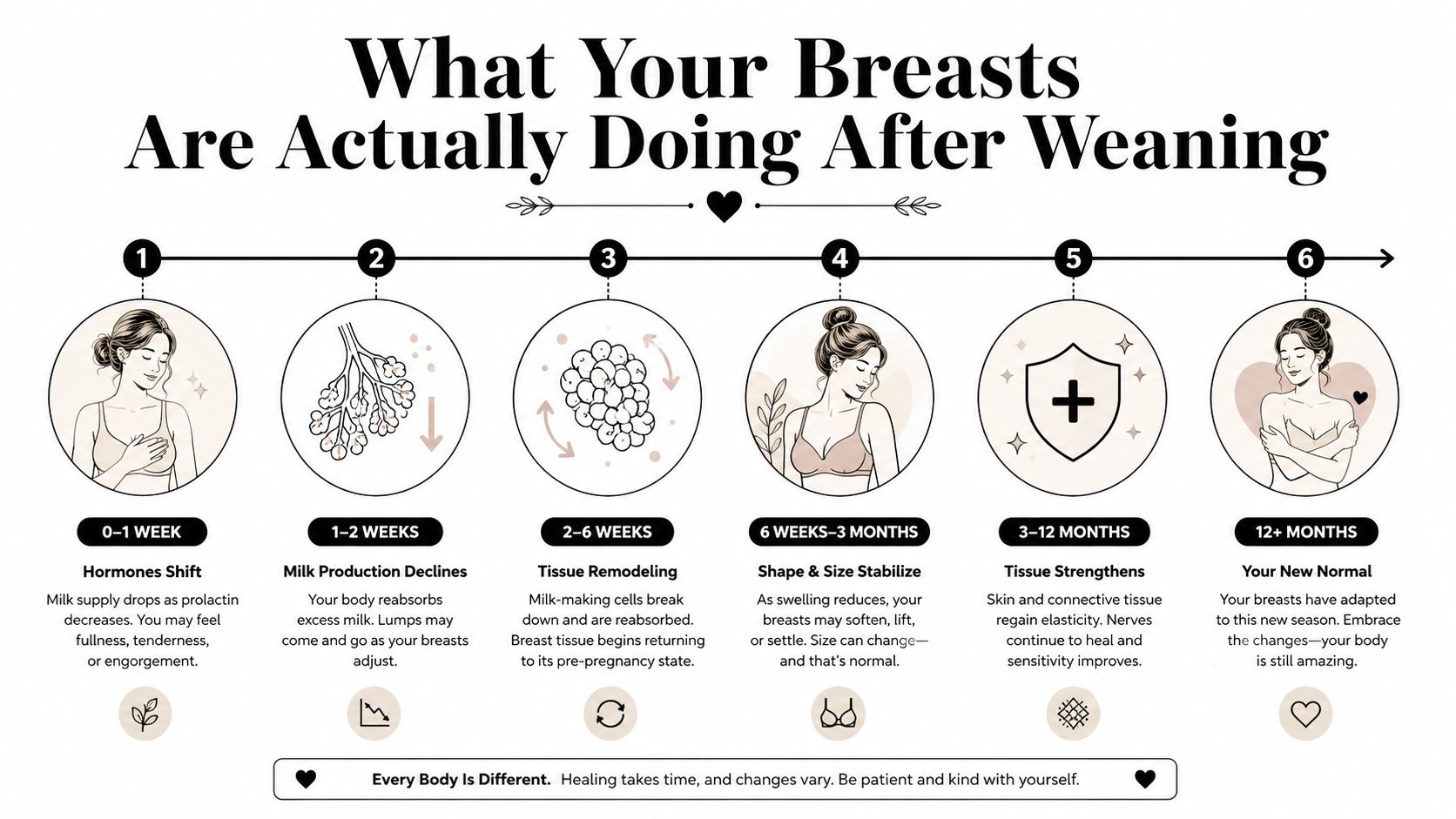
What Your Breasts Are Actually Doing After Weaning
After weaning, involution begins. That's the biological process in which milk-producing tissue reduces as the breast moves away from its lactating state. The process doesn't happen on a single morning, so a bra that feels secure shortly after weaning can become loose or oddly shaped later.
A cohort study of 559 women who had given birth found that 21.8% reported a decrease in breast size after pregnancy, while 35.1% reported an increase. It also found that 66.4% reported reduced breast stiffness, while only 5% reported increased stiffness (the University of Manchester summary of post-breastfeeding tissue remodeling). Those findings support a simple fitting rule: softness and altered volume are common, but the direction of size change isn't universal.
The transition happens in layers
In the initial phase, fullness and sensitivity can still fluctuate. Flexible cups are useful because they accommodate movement without pressing a firm edge into tissue. A soft style such as GAIA, described as a stretch-lace nursing bra with flexible support and easy breastfeeding access, can remain practical if you're still occasionally nursing or need gentle coverage.
In the advanced phase, the breast often feels softer and less uniformly full. The upper cup may empty while the lower or outer tissue still needs containment. That's when a tall cup, side support, or a flexible molded shape can outperform a stretchy triangle bralette.
In the remodeling phase, the shape becomes easier to read, but it may continue evolving for months. One expert guide notes that breasts can move toward a similar preconception size over approximately three months after breastfeeding fully stops, with reduced cup volume and a softer shape often standing out (Medela's guide to breast changes from pregnancy through weaning). Treat that as a fitting window, not a promise that your old size will return.
What each change feels like in a bra
The bust measurement can shift as volume redistributes, while the ribcage may also change after pregnancy and weaning. A bra-fitting guide notes that the band can become smaller even when cup size changes independently, which is why a former nursing bra may feel loose around the body and oversized in the cup (the post-breastfeeding bra fitting guide from Brava Lingerie).
Skin and supporting ligaments may also have stretched during pregnancy and lactation. A bra can reposition tissue and create a smoother outline, but it can't permanently restore skin elasticity or reverse structural change. Hormonal shifts can affect tenderness and density, so a wire that feels fine one day may feel intrusive during a fuller or more sensitive day.
Use the band to anchor the bra, and use the cups to accommodate the breast. If the band is stable but the bust measurement keeps moving, choose cups with enough flexibility to avoid gaping and enough containment to prevent spillage.
How to Measure Yourself When Nothing Feels Right
Measure under calm, repeatable conditions. Wear a non-padded bra, keep your arms relaxed, use a soft measuring tape, and measure at roughly the same time of day when you're tracking change. Don't pull the tape tight enough to indent your skin.
Start with the band
Wrap the tape around your ribcage directly beneath the breasts. Take one snug under-bust measurement, firm enough to stay in place but not restrictive. Then take a second, gentler measurement with the tape looser. The snug number helps you understand the band's anchoring needs, while the looser number shows how much ease you may need for breathing and movement.
Keep the tape parallel to the floor. If it slopes upward at the back, the reading is less useful and the finished bra may ride up in the same way. A good band should feel secure on the loosest hook when new, leaving room to tighten as the elastic relaxes.
Record the full shape
Measure around the fullest part of the bust, usually across the nipple line, without compressing the tissue. Then lean forward from the waist and repeat the measurement. The standing measurement captures how your breast sits upright; the leaning measurement reveals projection and can expose why a cup looks shallow even when the labeled size seems close.
Write down three numbers before you look at a size chart:
- Snug under-bust: your primary band reference.
- Full-bust measurement: your standing volume reference.
- Leaning bust measurement: your projection and shape reference.
Use sister sizing as a troubleshooting tool
Sister sizes keep a similar cup volume while changing the band. If the band is too tight but the cup fits, try a larger band with a smaller cup letter. If the band rides up but the cups feel right, try a smaller band with a larger cup letter. Don't move between sister sizes automatically. Use them to diagnose whether the problem sits around your ribs or in the cup.
A fit card may show a numerical size that looks identical to one you wore before pregnancy, but brands draft cups, wires, straps, and bands differently. Compare the garment's band measurement, cup width, and cup depth, not the tag alone. You can find more practical guidance in Milk&Lace's bra-fitting guide.
For timing, track your body rather than chasing a universal deadline. Expert fitting guidance cited in independent research recommends measuring around three to four months postpartum and again after weaning, while the same research notes that postpartum and breastfeeding participants can report meaningfully different bra sizes from non-breastfeeding postpartum participants (the NTU research on bra fit after pregnancy and breastfeeding). If you're newly weaned, check weekly during the first month, monthly through the following months, and less often once your measurements become consistent.
Comparing Bra Types for the Post-Breastfeeding Window
No single bra wins this stage. Your best choice depends on whether your breasts are sensitive, your fullness changes during the day, and whether you need separation, movement control, softness, or a polished outline.
| Bra Type | Best Timing After Weaning | Support Source | Comfort Ceiling | Best For |
|---|---|---|---|---|
| Nursing bra | Early transition or occasional ongoing feeds | Flexible band, stretch cups, access panels | Gentle to moderate for long wear | Sensitivity and fluctuating fullness |
| Supportive underwire | Once tissue feels calm and the wire can sit in the crease | Band, wire, shaped cups | High when correctly fitted, low when compressive | Separation and defined lift |
| Wire-free bralette | Early to middle transition | Fabric tension and broad band | Moderate, but shape may soften over time | Softness and light daily support |
| Sports bra | Any phase for exercise, with the right level of control | Encapsulation, compression, band, straps | Activity-specific, not always ideal for all-day wear | Walking, workouts, and movement |
| Everyday T-shirt bra | Middle to later transition when volume is easier to predict | Firm band and molded cups | High under clothing, variable with asymmetry | Smooth lines and consistent shape |
Nursing bras
Flexible nursing bras are useful when nipples remain sensitive or fullness changes between morning and evening. Their stretch accommodates variation, but that same flexibility can stop providing enough separation once you want clothes to hang cleanly. A bra that felt supportive during active lactation may feel inert after weaning because the cups no longer need to make room for milk fullness, they need to contain softer tissue.
Wire-free shaping bras and bralettes
A wire-free shaping style is often the strongest middle-phase compromise. Look for a stable lower band, broad side coverage, and cups that create some lift without squeezing the breasts together. A simple lace bralette feels wonderful for lounging, but it may not manage a high-step-count workday or a fitted blouse.
Sports bras
Choose sports bras according to movement, not postpartum identity. A compression style presses the breasts together, while an encapsulation style supports them separately. If asymmetry or tenderness is lingering, separate cup support may feel more controlled. Don't wear a high-compression sports bra for hours after exercise if it leaves pressure marks or numbness.
Underwire and T-shirt bras
A supportive underwire can bring back separation and lift once the breast root is comfortable with the wire. A molded T-shirt bra smooths the outline, but its fixed cup shape can reveal gaping when volume is still shifting. For detailed style guidance, use Milk&Lace's bra style guide.
Decision shortcut: Rank your current priorities. If softness comes first, choose wire-free. If movement control comes first, choose a sports bra. If separation comes first, try a correctly fitted underwire. If shape under clothing comes first, test a flexible T-shirt bra and check it at the end of the day.
The Real Story on Underwire After Breastfeeding
The blanket rule that underwire is always wrong after breastfeeding is too crude. The issue is pressure on breast tissue while milk production, engorgement, or blocked ducts are still active. A wire should trace the inframammary fold beneath the breast and curve around the breast root. If it sits on the breast itself, the garment is compressive in the wrong place.
During active lactation, that pressure can be especially uncomfortable because the breasts may become fuller and more sensitive. After weaning, the concern usually shifts from protecting milk flow to managing tenderness and fit. Research on post-breastfeeding needs also points to a gap between basic nursing support and the structured, confidence-focused bras many women want for everyday life (the NTU research on post-pregnancy bra design and fit).
Use this underwire readiness check
Before buying a wired bra, assess your current body rather than the calendar.
- Sensitivity: Can you tolerate firm contact beneath and at the sides of the breasts without discomfort?
- Lumps or blocked areas: If you still have lingering lumps, engorgement, or unexplained pain, postpone rigid pressure and seek medical advice for persistent symptoms.
- Fullness patterns: Notice whether your breasts still change substantially through the day.
- Band behavior: The band should anchor without digging, rolling, or forcing the wire upward.
- Wire width: The wire should surround the breast root, not cut across it or stop short of the outer tissue.
A correct wire feels like a frame. It holds the cup away from the chest wall and gives the breast a defined boundary. An incorrect wire feels like a clamp.
Walk away from a style if red marks remain for more than thirty minutes, the center front pinches, or the wire rides up the chest wall. Also reject a bra that only feels supportive when you tighten the straps aggressively. The band and cup should provide the structure. Your shoulders shouldn't be doing the lifting.
A Smart Shopping Checklist for Bras After Breastfeeding
Measure before each purchase, even if you measured recently. Post-weaning fit can change, and a pre-pregnancy label is a memory, not a measurement.
Test the garment before you trust it
Start with the band. Fasten a new bra on the loosest hook, stand naturally, and slide two fingers beneath the band. It should sit parallel to the floor and remain level when you lift your arms, twist, and bend.
Next, scoop and settle your tissue into the cups. Check the top edge, center front, side seam, and lower cup. You want containment without cutting in, but you also don't want a floating cup that wrinkles because the shape is too deep or too rigid.
Use the straps as a final adjustment, not the main support system. Loosen them, put the bra on correctly, then tighten only enough to remove slack. If the straps bear the weight of the breasts, the band or cup is wrong.
Finally, inspect the wire or seam. It should sit in the breast crease, not on breast tissue. Walk around for a few minutes, sit down, reach overhead, and wear the bra long enough to notice pressure that doesn't appear during a quick mirror check.
Read the fabric like a fitter
Look for elastic with recovery, meaning it stretches and returns rather than staying slack. Breathable, moisture-handling fabric helps during active days, while smooth seams reduce friction. Check seam placement around the nipple line, especially if sensitivity remains.
A flexible cup can accommodate shifting volume, but excessive stretch won't create reliable lift. A firm cup can produce a beautiful outline, but it may gap when your shape changes. Choose the least rigid construction that still meets your actual support needs.
Buy with an exit plan
Shop when your breasts are usually fullest, often later in the day, so the fit doesn't become restrictive at your most swollen point. Confirm the retailer's return and size-exchange terms before removing tags. A generous policy matters more than a beautiful product page when your body is still moving through transition.
Reject these red flags regardless of the price:
- Straps that dig: If tightening them is the only way to create lift, the bra isn't distributing support correctly.
- Persistent gaping: If the cup gaps after you've adjusted the tissue and straps, the shape may be too deep or too structured.
- Rolling bands: A band that rolls or flips during ordinary wear won't become more comfortable with time.
- Early fabric failure: Pilling, stretched lace, or lost recovery signals poor durability for a garment you need to rely on.
Reclaiming Comfort and Confidence on Your Own Terms
The most useful shift is to stop treating bra shopping as a return ticket to your old body. Your breasts may continue changing after weaning, but your wardrobe doesn't need to wait for a final answer before it starts serving you.
Fit the body you have today. Don't squeeze into a remembered pre-pregnancy silhouette, and don't buy a size based on the body you hope to have later. Measure, test, and choose the construction that makes your current clothes sit better.
Function creates the conditions for confidence. A band that stays level, cups that contain without cutting, and straps that don't slip can change how you stand and move through the day. That matters when you're carrying a child, commuting, exercising, working at a desk, or leaning forward repeatedly.
You also don't need one permanent category. Rotate a soft wireless bra for sensitive days, a structured everyday style for work, a sports bra for movement, and a more defined silhouette when you want your clothes to look polished. That isn't indecision. It's intelligent dressing for a body and schedule that aren't identical every day.
The Milk&Lace guide to feeling like yourself again captures the larger point: postpartum lingerie can support identity as well as comfort. The right bra after breastfeeding matches the season you're living, the demands of your week, and the way you want to dress now. You're not trying to get back to someone else. You're choosing what helps you recognize yourself today.
Milk&Lace offers nursing lingerie that combines soft lace, flexible or gentle structured support, and discreet breastfeeding access for women moving through changing postpartum needs. Visit Milk&Lace to explore styles that can help you build a comfortable rotation while your fit continues to evolve.